The week@work – leadership, lawyers, student loans & the economy

What makes a great leader or a great lawyer? What’s the best strategy to retire student debt? This week@work surveys articles that provide some answers, and as the economy continues to strengthen, offers some practical advice on career advancement.

Joshua Rothman wrote ‘Shut Up and Sit Down: Why the leadership industry rules’ for The New Yorker. He gives us a quick tutorial on the history of leadership, why we value the concept, but are so often disappointed in the people. He alludes to the current presidential contest, and then focuses on change in both our expectations of leaders, and the roles they play in contemporary organizations.Print
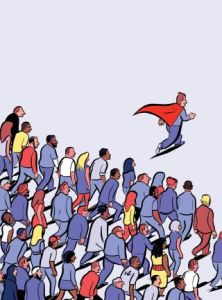
“In recent years, technological and economic changes like social media and globalization have made leaders less powerful.

Leaders used to be titanic and individual; now they’re faceless guiders of processes. Once, only the people in charge could lead; now anyone can lead “emergently.” The focus has shifted from the small number of people who have been designated as leaders to the background systems that produce and select leaders in the first place.

Leaders, moreover, used to command; now they suggest. Conceptually, at least, leadership and power have been decoupled.

To some extent, leaders are storytellers; really, though, they are characters in stories. They play leading roles, but in dramas they can’t predict and don’t always understand. Because the serialized drama of history is bigger than any one character’s arc, leaders can’t guarantee our ultimate narrative satisfaction. Because events, on the whole, are more protean than people, leaders grow less satisfying with time, as the stories they’re ready to tell diverge from the stories we want to hear. And, because our desire for a coherent vision of the world is bottomless, our hunger for leadership is insatiable, too. Leaders make the world more sensible, but never sensible enough.”

The New York Times profiled two women who chose law as their profession and took divergent, pioneering paths to achieve success. What makes a good lawyer? Meet Kimberley Chongyong Motley and Damaris Hernandez.

David Jolly profiled Ms. Motley, who has been practicing her profession in Afghanistan for close to eight years and was recently the subject of an award winning documentary, ‘Motley’s Law’.

image.adapt.990.high.kimberley_motley_05feb2016_portrait.1454770287607“Ms. Motley, 40, a Marquette University Law School graduate, had never before traveled overseas when she enrolled in a Justice Department program to train Afghan lawyers and flew to one of the world’s more dangerous places.

After her nine-month assignment, she did not return home to Milwaukee, instead hanging out her own shingle in Kabul. She studied Shariah, the Islamic code that lies beneath the fragile new Afghan Constitution, and she established herself as the only foreign litigator in one of the world’s most conservative and male-dominated cultures.

Ms. Motley says she makes a point of closely studying the cultures of both Afghanistan and the courtroom. “I’m a sort of legal archaeologist,” she said. “I try to uncover laws that have not been used, and then use them for the benefit of my clients.”

Damaris Hernandez was recently promoted to partner at the firm Cravath, Swaine & Moore, becoming the first Latina to reach that position. Elizabeth Olson tells her story as a first generation college student, who advanced in her career with the support of a unique scholarship at NYU.

Hernandez web.jpg

That achievement is an acknowledgment of her talent and hard work. But the story of her route to the top also reveals how much more complex the journey is for minorities and women than for the white men who overwhelmingly dominate the firms. Skill is only one of the keys. Being able to navigate unspoken rules is at least as important.

“When I was the only one of color or the only woman in the room, I had the confidence to believe in my ability,” said Ms. Hernández, 36, describing the advantages of the program to her. “When you are the first, you need someone to have your back.”

Over the last decade and a half, she and 100 others who attended the New York University School of Law received that support from a scholarship program that paid their full tuition and also gave them access to a network of luminaries including federal judges, law firm partners and even Supreme Court justices.”

If you are seeking ways to reduce your student loan obligation, NPR’s Yuki Noguchi offers ‘Strategies For When You’re Starting Out Saddled With Student Debt’. It’s not just about individual liability, but also the long term impact on career choice and economic growth.

“Experts say studies show rising student debt is limiting peoples’ career options. They decide against graduate school. Or feel they can’t afford lower-paying public service jobs or the risk of starting a new business. That’s a problem, because new companies create new jobs.”
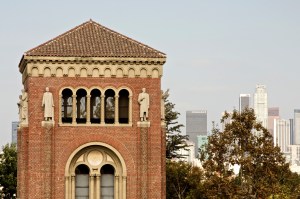
University Park campus of the University of Southern California

This past week the University of  Southern California announced a tuition increase that will bring the annual bill to over $51,000. Financing college involves loans as part of the  package. Having a repayment strategy is critical to long term career success.

“Chris Costello, CEO of Blooom, a personal finance advice firm targeting lower-net-worth people, advises his firm’s clients to tackle student debt with this strategy.

First, if your employer matches contributions to a retirement plan, such as a 401(k) or 403(b), max out on the matching contributions.

After maxing out on the matching contributions, pay off the debt with the lowest balance.

Check to see if you can qualify for loan forgiveness, refinancing or debt consolidation.

Do not incur new debts: in other words, live below your means.”

Chico Harlan of The Washington Post reported on the latest figures released by the U.S. Labor Department on Friday.

“U.S. employers continued their rapid hiring in February, new government data showed Friday, a sign of the nation’s economic durability during a tumultuous global slowdown.

The U.S. added 242,000 jobs as the unemployment rate held at 4.9 percent, the lowest mark during the seven-year recovery from the Great Recession.

That pace, consistent with gains over the last year, indicates Americans are returning rapidly to the labor force, helped by steady consumer spending that is bolstering demand and prompting employers to expand their workforces. In data released Friday by the Department of Labor, sluggish wages provided the only disappointing note — a signal that labor market still has room to improve.”

Two other articles of interest this week:

’15 things successful 20-somethings do in their spare time’ by Jacquelyn Smith and Rachel Gillett for Business Insider

‘How to Advance In Your Career Without Becoming A Workaholic’ by Lisa Evans for Fast Company
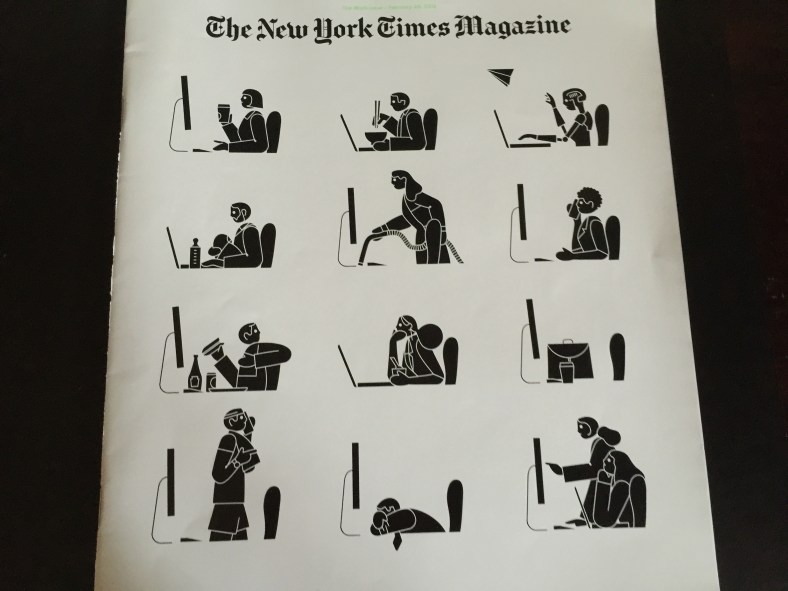


The Saturday Read ‘Worklife: Rethinking the office for an always-on economy’

The Saturday Read this week is a compilation of articles that appeared in the February 28, 2016 ‘work issue’ of The New York Times Magazine.

A group of journalists and writers contributed coverage on a variety of work/life topics, adding new perspectives from groundbreaking research, demonstrating that, regardless of profession, it’s all about the culture. And the culture is in need of change.

Organization culture determines who succeeds, fails, and communicates ‘hints’ through recruiting practices, and the daily process of getting things done; meetings, teamwork and office space.

“We do often work at home. But we also work at work, before going home to work more. The office has persisted, becoming even bigger, weirder, stranger: a symbol of its outsize presence in our lives.”

The ‘work issue’ is an interesting survey of some of the most pressing issues @work today. The sampling of the content below is meant to serve as an introduction, with a recommendation to take the time to read the edition in its entirety.

NYT staff writer, Susan Dominus challenges us to think about balance beyond policies by ‘Rethinking the Work-Life Equation’, reporting on the research of Phyllis Moen of the University of Minnesota and Erin Kelly of M.I.T.

“Workers in the experimental group were told they could work wherever, and whenever, they chose so long as projects were completed on time and goals were met; the new emphasis would be on results rather than on the number of hours spent in the office. Managers were trained to be supportive of their employees’ personal issues and were formally encouraged to open up about their own priorities outside work — an ill parent, or a child wanting her mom to watch her soccer games. Managers were given iPods that buzzed twice a day to remind them to think about the various ways they could support their employees as they managed their jobs and home lives.

The research found that employees in the experimental group met their goals as reliably as those in the control group, and they were, in short, much happier: They were sleeping better, were healthier and experienced less stress. Other studies examining the same workplace found that the effects even cascaded down to employees’ children, who reported less volatility around their own daily stresses; adolescents saw the quality of their sleep improve. A year out, and then three years out, employees in the experimental group reported less interest in leaving the organization than those in the control group.

…sometimes there is little more than tradition holding organizations back from making meaningful changes that bring tremendous peace of mind to their employees.”

Five years ago, Google decided to determine what makes a ‘perfect team’. Pulitzer prize winning New York Times reporter Charles Duhigg reports on the results in an excerpt from his new book, ‘Smarter Faster Better: The Secrets of Being Productive in Life and Business’.

“For Project Aristotle, research on psychological safety pointed to particular norms that are vital to success. There were other behaviors that seemed important as well — like making sure teams had clear goals and creating a culture of dependability. But Google’s data indicated that psychological safety, more than anything else, was critical to making a team work.

However, establishing psychological safety is, by its very nature, somewhat messy and difficult to implement. You can tell people to take turns during a conversation and to listen to one another more. You can instruct employees to be sensitive to how their colleagues feel and to notice when someone seems upset. But the kinds of people who work at Google are often the ones who became software engineers because they wanted to avoid talking about feelings in the first place.

What Project Aristotle has taught people within Google is that no one wants to put on a ‘‘work face’’ when they get to the office. No one wants to leave part of their personality and inner life at home. But to be fully present at work, to feel ‘‘psychologically safe,’’ we must know that we can be free enough, sometimes, to share the things that scare us without fear of recriminations. We must be able to talk about what is messy or sad, to have hard conversations with colleagues who are driving us crazy. We can’t be focused just on efficiency. Rather, when we start the morning by collaborating with a team of engineers and then send emails to our marketing colleagues and then jump on a conference call, we want to know that those people really hear us. We want to know that work is more than just labor.”

Nikil Saval, who wrote about the evolution of the office in ‘Cubed: The Secret History of the Workplace’, writes about new experiments with office space, ‘Labor/atories’

“The sudden efflorescence of the tech industry in the late ’90s took us from the desert of cubicles to the milk-and-honey offices of today. Many of the dot-commers had graduated from (or, very often, dropped out of) cozy university campuses to toil in big corporations. Starting their own companies, they recreated the effortless drift between work and play that characterized their college lives. The cubicle walls came down, and in the wide, open warehouse and loft spaces they occupied, exceptionally long workdays would be punctuated by frenzied Mario Kart races or fierce Ping-Pong battles. Creating a playful office became one of the standard ways of attracting skilled employees in a competitive environment: The hope was that a talented engineer wouldn’t leave a tech behemoth for the dinky start-up next door that didn’t have a gym and a resistance pool. Thus has the ‘‘fun office’’ spread throughout the world.”

Each of the articles provides a ‘take away’ to apply @work. If you’re a leader, you’ll rethink your approach as you begin to understand what your competitors are doing to recruit and retain employees. As a manager, you’ll learn ways to improve the daily routine of meetings, but more important, reinforce behavior that will encourage employees to be productive. For the rest of us, a window has been opened to view alternative approaches to work and workplace. What will you do on Monday to turn policy into practice?


The week@work – innovative organizations, AT&T’s new culture, Shonda Rhimes @TED, the online platform economy and pausing to enjoy the view

The week@work was dominated by the story of Apple’s opposition to the court order to unlock the San Bernardino gunman’s IPhone. Simultaneously, news was being made as Fast Company released its annual list of the ‘Most Innovative Companies’, AT&T’s leadership challenged workers to reinvent themselves,  Shonda Rhimes shared her ‘year of yes’ @TED, and the JP Morgan Chase Institute released a study examining the online platform economy, and its impact on one million of its customers.

And for balance, in this centennial year of the National Park Service, enjoy the view of Horsetail Fall in Yosemite National Park as sunset transforms the waterfall into an apparent stream of hot lava. Sangeeta Day captured the photo above for National Geographic.

On Monday, Fast Company released their list of The Most Innovative Companies of 2016. The top five are BuzzFeed, Facebook, CVS Health, Uber and Netflix.

3055973-poster-c-1-TOC-march-2016.jpg

BuzzFeed CEO, Jonah Peretti’s vision drew on his fascination with Paramount Pictures, CNN and JayZ. “BuzzFeed has built its success, like Paramount a century ago, by owning all the elements of a modern media business: a global news team, its own video pro­duction studio, a sophisticated data operation, and an in-house creative ad agency.” 

“The “bored-at-work network,” as Peretti himself once called it, was merely a single U.S. website. In late 2014, he foresaw that people wouldn’t want to leave their social apps, so Peretti drastically shifted his company’s strategy: Instead of trying to lure eyeballs to its own website, the way most publishers do, BuzzFeed would publish original text, images, and video directly to where its audience already spent its time, some 30 different global platforms, from Facebook to the Russian social networks VK and Telegram. Rather than write one definitive article and publish it on every platform (the de facto standard in the media business), BuzzFeed would tailor content specifically for the network and audience where it’s being viewed.

How’d that turn out? Across all the platforms where it now publishes content, the company generates 5 billion monthly views—half from video, a business that effectively did not exist two years ago. Traffic to the website has remained steady—80 million people in the U.S. every month, putting it ahead of The New York Times—even though as much as 75% of BuzzFeed’s content is now published somewhere else.”

at-and-t-squarelogo.png


One company that has lost its standing in the top 50 innovators is legacy telecom AT&T. As the competitors have changed with the shift from traditional phone and cellular carriers to Internet and cloud computing, the company’s leadership team is making new demands on its workforce, resetting the culture, again.

“AT&T’s competitors are not just Verizon and Sprint, but also tech giants like Amazon and Google. For the company to survive in this environment, Mr. Stephenson needs to retrain its 280,000 employees so they can improve their coding skills, or learn them, and make quick business decisions based on a fire hose of data coming into the company.

In an ambitious corporate education program that started about two years ago, he is offering to pay for classes (at least some of them) to help employees modernize their skills. But there’s a catch: They have to take these classes on their own time and sometimes pay for them with their own money.

To Mr. Stephenson, it should be an easy choice for most workers: Learn new skills or find your career choices are very limited.”

Adapting to change, learning new skills, saying yes, and taking time to play were all part of television producer Shonda Rhimes’ TED Talk in Vancouver.

d80be53df8b115a4e19b5182ccfd653380dee585_254x191.jpg

“You can do it too, say yes every time your child asks you to play. Are you thinking that maybe I’m an idiot in diamond shoes? You’re right, but you can still do this. You have time. You know why? Because you’re not Rihanna and you’re not a Muppet. Your child does not think you’re that interesting.

I said yes to less work and more play, and somehow I still run my world. My brain is still global. My campfires still burn. The more I play, the happier I am, and the happier my kids are. The more I play, the more I feel like a good mother. The more I play, the freer my mind becomes. The more I play, the better I work. The more I play, the more I feel the hum, the nation I’m building, the marathon I’m running, the troops, the canvas, the high note, the hum, the hum, the other hum, the real hum, life’s hum. The more I feel that hum, the more this strange, quivering, uncocooned, awkward, brand new, alive non-titan feels like me. The more I feel that hum, the more I know who I am. I’m a writer, I make stuff up, I imagine. That part of the job, that’s living the dream. That’s the dream of the job. Because a dream job should be a little bit dreamy.”

de3d8aa4bfe6c55dba2d3a5e60101d6f9ffde7cb_800x600.jpg

In other news @TED, the annual $1 million TED Prize was awarded to Sarah H. Parcak, a space archaeologist who uses satellite imagery to discover ancient sites, and map looting.

“I wish for us to discover the millions of unknown archaeological sites across the globe. By building an online citizen science platform and training a 21st century army of global explorers, we’ll find and protect the world’s hidden heritage, which contains clues to humankind’s collective resilience and creativity.”

Unknown.jpegEric Morath reported the findings of a JP Morgan Institute Study of market volatility and the emergence of  “a new marketplace for work by unbundling a job into discrete tasks and directly connecting individual sellers with consumers.” 

Call it ‘gig’ or ‘sharing’, the economy is being supported by folks who are supplementing their income with ‘app jobs’.

“The share of Americans earning income from digital platforms such as Uber and Airbnb is growing rapidly, but those gigs typically supplement incomes rather than replace full-time work.

Nearly 1% of U.S. adults earned income in September 2015 via one of the growing number of firms that are part of the sharing or gig economy, according to a study of bank transactions by the JPMorgan Chase Institute, released Thursday. Participation has exploded since October 2012, when just 0.1% of adults were paid by such platforms.

At 2.5 million, the sharing labor force is roughly equivalent to the number of teachers and others that work for public schools in the U.S., though the study finds that people driving for Lyft or selling crafts on eBay typically have other sources of income.

The average monthly income for someone who provided labor via one of the platforms was $533, representing a third of total income. The share of active participants earning 50% or more of their monthly income has fallen since the summer of 2014, as the total number making some money increased.”

In other stories of interest this week@work:

‘Channing Dungey to Succeed Paul Lee as Chief of ABC Entertainment’ by Brooks Barnes and John Koblin   “Channing Dungey, previously ABC’s drama chief, will take over as the head of ABC entertainment, making her the first black network president.

Ms. Dungey’s elevation is a breakthrough for an industry that has often struggled with diversity, especially among the senior executive ranks.”

‘Fashion Week’s Shift Toward Diversity’ by Ruth La Ferla  “Well before the Oscars stirred a diversity debate, Seventh Avenue had been the target of stinging criticism for the sin of omission, routinely parading mostly white models on its runways.

In this latest round of shows, which ended on Thursday, many designers appeared to have taken a hard look at the highly charged issue of casting, stepping up their efforts to hire racial and ethnic minorities and sounding a chord for inclusiveness.”

And because it’s the beginning of Oscar Week:

b67e67830551ea34f84eb0edf7900236553b83045ca648f52711fe9838b7a681‘Films once were an escape from work. Now, they celebrate it. What gives?’ by Charles McNulty  “There was a time when Americans went to the movies to escape the workplace. These days, in keeping with the way our offices have taken over our lives, filmmakers have turned the big screen into one long career day.
Audiences have been invited to experience first-hand the everyday grind of being a journalist (“Spotlight”), an astronaut (“The Martian”), a screenwriter (“Trumbo”), a fur trapper (“The Revenant”) and even an inventor of kitchen mops (“Joy”).”

Pleasant dreams of gold for all, this week@work.


“If you just focus on the work…” A leadership lesson from Taylor Swift

While the annual TED conference is taking place 1,300 miles north, the event at the Staples Center in Los Angeles last night provided a valuable soundbite of career advice from an industry leader. Perhaps the folks at TED might think about an invite for 2017.

You had to wait for it. After two hours and 20 minutes, the woman who opened the 58th Grammy Award telecast returned to the stage to accept the iconic statuette for Album of the Year. Taylor Swift took her moment of recognition to encourage those in dysfunctional workplaces keep going and avoid the distractions of toxic coworkers.

“I want to say to all the young women out there – they’re going to be people along the way who will try to undercut your success, or take credit for your accomplishments or your fame. But if you just focus on the work and you don’t let those people sidetrack you, someday, when you get where you’re going, you’ll look around and you will know that it was you and the people who love you who put you there, and that will be the greatest feeling in the world.”

la-et-ms-taylor-swift-shames-kanye-west-empowering-grammys-acceptance-speech-20160215.jpeg

You may read in the tabloids that the speech was all about an on-going feud with a member of the Kardashian family, but that would trivialize the weight of the words, and devalue the message.

Ms. Swift is a hero to many young women and last night she became the first woman to receive the Album of the Year Award twice. She is an industry leader who has kept her focus on the work and become a major influence on how music is produced and distributed, and artists compensated. Don’t let the fashion distract, it’s a strategic piece of product packaging.

Still skeptical that a 26 year old performer should be taken seriously as a leader?

Last year, writer and magazine contributor Chuck Klosterman profiled Ms. Swift for GQ. Here she describes a key to her success that comes right out of all the research on emotional intelligence.

“I used to watch Behind the Music every day,” she says. (Her favorite episode was the one about the Bangles.) “When other kids were watching normal shows, I’d watch Behind the Music. And I would see these bands that were doing so well, and I’d wonder what went wrong. I thought about this a lot. And what I established in my brain was that a lack of self-awareness was always the downfall. That was always the catalyst for the loss of relevance and the loss of ambition and the loss of great art. So self-awareness has been such a huge part of what I try to achieve on a daily basis. It’s less about reputation management and strategy and vanity than it is about trying to desperately preserve self-awareness, since that seems to be the first thing to go out the door when people find success.”

Last night Taylor Swift spoke from her workplace experience, and shared an essential leadership lesson for us all…”just focus on the work”.

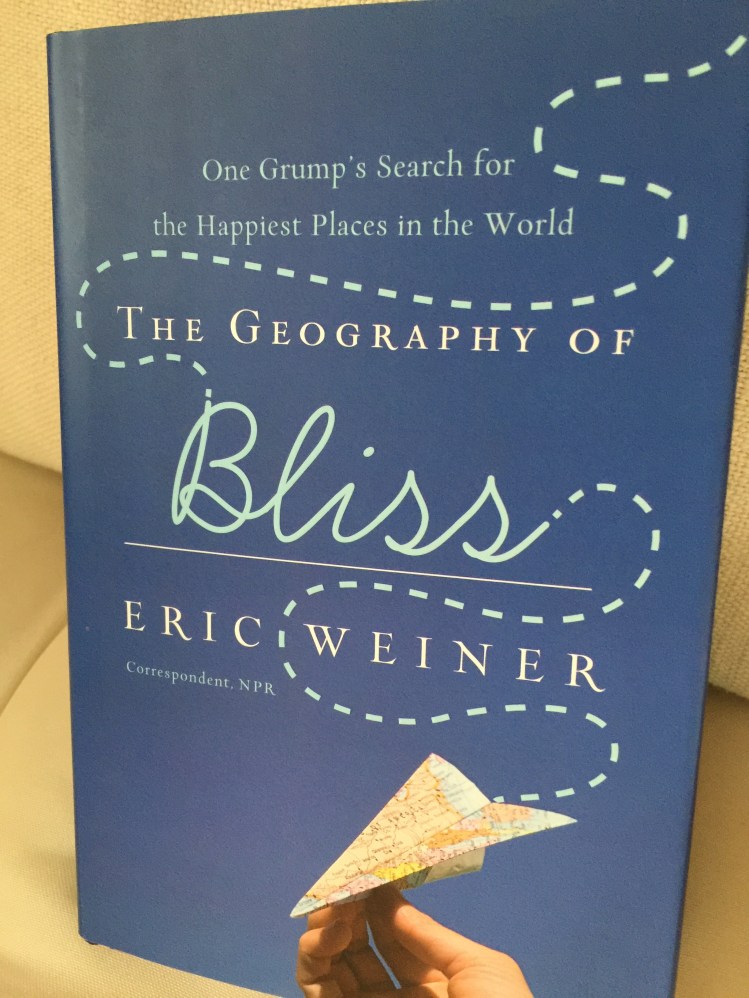
The Saturday Read ‘The Geography of Bliss’ by Eric Weiner

The Saturday Read this week is ‘The Geography of Bliss: One Grump’s Search for the Happiest Places in the World’, by former NPR correspondent and self-described philosophical traveler, Eric Weiner. It’s a travelogue of personal discovery with a universal  message, “where we are is vital to who we are”.

Early in his career decision process, Weiner decided travel was a necessary component to success – free travel. He started out as a foreign correspondent, going to some of the most unhappy global places. After a number of years covering conflicts in Iraq, Afghanistan and Indonesia he decided it was time to consider the alternative, the happy places.

“What if, I wondered, I spent a year traveling the globe, seeking out not the world’s well-trodden trouble spots but, rather, its unheralded happy places? Places that possess, in spades, one or more of the ingredients that we consider essential to the hearty stew of happiness: money, pleasure, spirituality, family and chocolate, among others.”

And we’re off. First to the Netherlands and the World Database of Happiness to meet Ruut Veenhoven, Professor of Happiness Studies.

Veenhoven was a graduate student in sociology when he found his calling in a new discipline, happiness studies. In a career story that may resonate with others in academia, he describes a meeting with his advisor. He was interested in the study of healthy minds and happy places. “His advisor, a sober man with solid academic credentials, told him, in no uncertain terms, to shut up and never mention that word again. Happiness was not a serious subject…Today, Veenhoven is at the forefront of a field that churns out hundreds of research papers each year.”

By simply asking folks if they are happy, researchers have found:

“Extroverts are happier than introverts; optimists are happier than pessimists; married people are happier than singles, though people with children are no happier than childless couples; Republicans are happier than Democrats; people who attend religious services are happier than those who do not; people with college degrees are happier than those without, though people with advanced degrees are less happy than those with just a B.A….people are least happy when commuting to work; busy people are happier than those with too little to do; wealthy people are happier than poor ones, but only slightly.”

Before returning home to the U.S., Weiner traveled to Switzerland, Bhutan, Qatar, Iceland, Moldova, Thailand, Great Britain, and India. Finding your bliss is subjective, but deeply rooted in culture.

“The glue that holds the entire enterprise together is culture.”  He embarked on an odyssey to find happiness, and discovered one of the key elements to success in life and work.

“…where we are is vital to who we are.”

“By ‘where’, I’m speaking not only of our physical environment but also of our cultural environment. Culture is the sea we swim in – so pervasive, so all-consuming, that we fail to notice its existence until we step out of it. It matters more than we think.”

Each new chapter invites the reader to experience another place, a new culture, citizens adapting to change, and challenges preconceived notions of the happiest places.

Sitting in an airport bar at the end of his journey, Weiner reflects on what he has learned. “Money matters, but less than we think and not in the way that we think. Family is important. So are friends. Envy is toxic. So is excessive thinking. Beaches are optional. Trust is not. Neither is gratitude…Happiness is not a noun or a verb. It’s a conjunction. Connective tissue.”

The shelves of bookstores are brimming with self help tomes on happiness. Eric Weiner’s global journey sets this book apart from the competition, transporting the reader on a round trip from domestic familiarity to places of contrasting mindsets, and back. It’s the perfect book for a winter read.


The week@work – Super Bowl@50, Facebook@12 and unemployment@4.9%

This week@work the center of the media universe shifted from Iowa to New Hampshire, and Silicon Valley where, separated by about 12 miles on Highway 101, Levi Stadium in Santa Clara will host the 50th Super Bowl game, and Facebook celebrated it’s twelfth birthday at corporate HQ in Menlo Park. And, in the U.S. the unemployment rate dropped to 4.9%, the lowest since 2008.

In the lead up to the big game there were hundreds of stories about those who choose football as a career, from the high school senior announcing a college choice to the veteran player rewarded with membership in the Football Hall of Fame.

The typical NFL player takes their first step in their career at the annual February ritual, ‘National Signing Day’. It’s the day high school football players sign a ‘Letter of Intent’ to accept an offer of admission and commit to play football at the collegiate level. This year, Tom Brady and Derek Jeter were on hand in Ann Arbor, Michigan to participate in ‘The Signing of the Stars’ “a flamboyant national signing day pep rally streamed live on Wednesday by The Players’ Tribune — the website founded by Jeter, a Michigan native — and intended to build the hype around this year’s class of prospective Wolverines football players.”

Time will tell if the top college recruit, Rashan Gary, from Paramus Catholic High School in New Jersey will advance beyond his playing days at Michigan.

On the other end of the football career spectrum is recognition as an inductee into the NFL Hall of Fame. The class of 2016 includes former Oakland Raiders quarterback, Ken Stabler who let his team to their first Super Bowl victory after the 1976 season.

“While generally a cause for celebration, Saturday’s announcement of the class of 2016 for the Pro Football Hall of Fame carried a somber tone as Ken Stabler, a Super Bowl-winning quarterback for the Oakland Raiders, was elected days after it was publicly revealed that he had had Stage 3 chronic traumatic encephalopathy, or C.T.E., a degenerative brain disease, before his death in July.

Stabler, known as the Snake, who won a Most Valuable Player Award for the 1974 season and led the Raiders to the team’s first Super Bowl victory after the 1976 season, was previously a finalist for election three times, but this year, as a senior candidate, he was elected alongside Dick Stanfel, a star offensive lineman in the 1950s. The modern-era electees were Brett Favre, Marvin Harrison, Kevin Greene, Orlando Pace and Tony Dungy, as well as Edward J. DeBartolo Jr., who owned the San Francisco 49ers for all five of their Super Bowl wins and was elected as a contributor.”

On Wednesday, journalist, John Branch’s profile of Stabler, and his life after football with chronic traumatic encephalopathy (C.T.E.) was published in The New York Times.

“After retiring from football, Stabler worked as a broadcast analyst for the N.F.L. and for the University of Alabama, where he had played quarterback under Coach Bear Bryant. His damaged knees became such a problem in the past 10 years that he rarely ventured out.

“His vision of what a leader is, what a strong person is, is someone who did not show signs of weakness,” said Alexa Stabler, 29, the second of Stabler’s three grown daughters. “Because it would affect the people he relied on and the people he cared about, whether that was his family or his teammates.”

When Stabler was 31, a 1977 Sports Illustrated feature story detailed his penchant for honky-tonks and marinas, usually with a drink in one hand and a pretty woman in the other…He pondered what he might do after football.

“My lifestyle is too rough — too much booze and babes and cigarettes — to be a high school coach,” Stabler said. “I’d hardly be a shining example to the young athletes of the future.”

His family hopes that the most powerful lesson he provides is the one delivered after he was gone.

In between signing day and induction into the Football Hall of Fame, if you’re impossibly lucky, is a chance to compete in the national championship of professional football, the Super Bowl.

The annual spectacle, held this year in the vortex of Silicon Valley has exposed the growing economic divide, “gentrification, sky-high housing prices and the technology industry’s influence on local government, even the nation’s biggest party has become a battleground.”

“The cost of hosting the Super Bowl — estimated at about $5 million for the city — has unleashed a storm of anger among residents already resentful of the influx of expensive restaurants, high-end stores and rich, young tech workers who have snapped up apartments in historically low-income neighborhoods. To tidy up for the tourists, the city’s large homeless population has been swept out of view, which some people here see as evidence that this city, long a seat of leftist activism, has sold itself to corporate interests.

“In San Francisco, we’re supposed to be the bastion of crazy liberals,” Ms. Leitner said. “Instead of raising wages for teachers so they can afford to live here, why are we spending money on a party for people who work for the N.F.L.?”

Fast Company writer, Michael Grothaus marked the birthday celebration on Thursday at Facebook.

“It’s a bit crazy when you think about it, but Facebook is 12 years old today. On February 4, 2004, Mark Zuckerberg launched his fledgling social media site at Harvard. And the rest, as they say, is history. Twelve years on, Facebook has become the largest social media company ever. It influences myriad aspects of our lives and recently passed a billion active users each day.

It’s also kind of doing what candy makers and online retailers have tried to do in the past by deeming February 4th as an unofficial holiday that it hopes catches on: Friend’s Day.”

A look back to the 2004 Harvard Crimson article about ‘thefacebook.com’ may be the best  argument for why venture capitalists should be reading their alma mater’s student newspaper.

“Thousands of students across the country use it. Major corporations are falling over themselves to buy it.

But nearly a semester after creating thefacebook.com, a social networking website launched on Feb. 4, Mark E. Zuckerberg ’06 doesn’t seem to have let things go to his head.

Wearing a yellow t-shirt, blue jeans, and open-toe Adidas sandals, Zuckerberg sits on a ragged couch in the middle of a messy Kirkland House common room, surrounded by strewn clothes and half-closed boxes.

Amidst this squalor, he smiles.

“I’m just like a little kid. I get bored easily and computers excite me. Those are the two driving factors here.”

Thefacebook.com allows university students to create personal profiles listing their interests, contact info, relationship status, classes and more.

It started locally at Harvard. It now has almost 160,000 members from across the country.”

Twelve years later, Thomas Friedman considers the question, ‘Social Media: Destroyer or Creator?’

“Over the last few years we’ve been treated to a number of “Facebook revolutions,” from the Arab Spring to Occupy Wall Street to the squares of Istanbul, Kiev and Hong Kong, all fueled by social media. But once the smoke cleared, most of these revolutions failed to build any sustainable new political order, in part because as so many voices got amplified, consensus-building became impossible.

Question: Does it turn out that social media is better at breaking things than at making things?

Recently, an important voice answered this question with a big “ yes.” That voice was Wael Ghonim, the Egyptian Google employee whose anonymous Facebook page helped to launch the Tahrir Square revolution in early 2011 that toppled President Hosni Mubarak — but then failed to give birth to a true democratic alternative.

“Five years ago,” concluded Ghonim, “I said, ‘If you want to liberate society, all you need is the Internet.’ Today I believe if we want to liberate society, we first need to liberate the Internet.”

Beyond the Super Bowl and Facebook, the economy continues to improve. The jobless rate is under 5% and wages are rising.

“It’s not that the new data blew the lid off expectations or pointed to some radical acceleration in job growth in the opening weeks of 2016. Quite the contrary. The nation added 151,000 jobs in January, which was below analysts’ expectations and well below the revised 262,000 jobs added in December. That looks an awful lot like “reversion to the mean,” and it wouldn’t be surprising if final revisions show a slower pace of job growth across the two months.

But while economists and financial markets have traditionally placed the greatest weight on that payroll number as the key indicator of whether economic growth is speeding up or slowing down, we’re entering a phase where some other components of the jobs report are more important.”

Two additional articles of interest this week profile the executive who created the culture at Netflix and a BBC photo essay on the career dreams of the children who have fled Syria.

‘The Woman Who Created Netflix’s Enviable Company Culture’  Vivian Giang for Fast Company – “The woman behind “Netflix Culture: Freedom & Responsibility” was the company’s chief talent officer at the time, Patty McCord…Instead of listing the company’s core values like every other company was doing, McCord decide to write down the things the company valued, what mattered to them, what they expected in their people.”

‘When I grow up I want to be…’ (BBC) “Despite their current predicament, children who have fled the conflict in Syria and are now living in neighbouring countries dream of what the future holds for them, and the International Rescue Committee (IRC) sent photographer Meredith Hutchison to find out.”

To end this week@work, let me introduce you to Rama, age 13, and her dream of becoming a doctor, as a reminder to honor your dreams.

_88034777_a80f7902-6be1-4991-913e-aed456838390.jpg“Walking down the street as a young girl in Syria or Jordan, I encountered many people suffering – sick or injured – and I always wanted to have the power and skills to help them.
“Now, as a great physician in my community, I have that ability. Easing someone’s pain in the most rewarding aspect of my job. To be able to give them relief is the most rewarding aspect of my job. To be able to give them relief and make them smile – this is what I love most.”


workthoughts@one

Happy Groundhog Day! A day immortalized in the 1993 Bill Murray movie, as our national holiday of second chances.

I launched ‘workthoughts’ a year ago, on Groundhog Day, because I believed a blog about work should consider career evolution, lifelong learning and several second chances. It was never meant to be a place to find a job, rather a place to consider choices, share ideas and reconnect with dreams.

‘Workthoughts’ had its origin in a Tuesday afternoon course I taught for college students who were employed as interns for the semester. Most arrived thinking it was a waste of time, an added commitment to an already crowded schedule of classes, commuting and work.

As the semester progressed we dealt with the situations that develop in any workplace: disconnect in expectations, dysfunctional communications, poor leadership, lack of meaningful assignments, and recognition. We also talked about the bigger picture: global trends, leadership, teamwork, generations in the workplace, diversity and gender issues, work/life balance. It was about the humanities and social sciences, and building relationships with mentors, colleagues and clients.

“What would you do if you were stuck in one place and everything was exactly the same and nothing that you did mattered?” (Bill Murray, Groundhog Day)

Success@work begins with a clear understanding of self and a broad knowledge of the world@work. How can you connect the dots if you’re stuck in one place, everything is exactly the same and nothing you do matters?

‘Workthoughts’ provides weekly supplements in the humanities with the ‘Friday Poem’, sampling a variety of lyrical interpretations of work, and ‘The Saturday Read’, a book or long form article recommendation to illuminate the work experience and offer alternate views to problem solving. The ‘week@work’ summarizes selected stories from a variety of journalists and experts. And in-between are the conversations about fun, joy, success, and failure @work.

Work is about relationships. We build them, not on the technical aspects of the work to be accomplished, but on the human connections that grow beyond, in shared interests and experience.

Thank you to all who have connected and shared your ‘workthoughts’ this year. And thank you to all the alumni of MDA 250 – who stay connected, continue to inspire, and know the value of second chances.


After a 50 year absence, the humanities return to medicine

Medicine remains one of the fields that is defined by a hierarchy that would rival the world of Downton Abbey at its pinnacle. Over fifty years ago medical training lost track of the humanities and with it the ability to effectively connect with colleagues and patients as fellow humans.

The intensity of preparation for acceptance to a top medical school only deepens with competition for internships and residencies. Doctors in training represent the best and the brightest, but often not the top of the class when it comes to emotional intelligence.

At a time when college is increasingly defined as vocational prep, with students choosing majors based on perceived guarantees of post-grad employment, medicine is stepping back from its singular focus on the sciences and reintroducing the humanities to remove barriers created by hospital hierarchy, promote teamwork and improve patient communication.

Dr. Tara Narula, a medical contributor for CBS This Morning, reported Thursday on a program in Boston that “teaches physicians in training to use their eyes and ears to connect with patients and enhance the practice of medicine.”

“At the Brigham and Women’s Hospital, doctors, nurses and Harvard medical students are helping reshape medical education. By day, members of the integrated teaching unit, or ITU, focus on treating patients. But at night, they fix their sights on works of art.

At the Museum of Fine Arts in Boston, art becomes a catalyst to strengthen clinical and interpersonal skills, softening the hard science of medicine with creative expression.

Dr. Joel Katz designed the art curriculum at Brigham and Women’s, which has become a model for other hospitals.

Katz chose the art museum because it “allows everybody to focus on an external object in a way that I would say takes the personal aspects out and lets them solve problems together.”

Activities are carefully designed to enhance team-building, and to break down the hospital hierarchy, junior staff members are paired with more senior colleagues. Observing and describing art is used to promote problem solving, communication, thinking outside the box and appreciating other perspectives.”

Increasingly, schools of medicine are recognizing the need to ‘humanize’ medical practitioners, including Columbia University’s program in Narrative Medicine and Stanford University’s Medicine and the Muse program. And a quick review of the best seller lists over the past decade, will reveal an impressive list of physicians who have exercised their talents in the humanities: Adam Verghese, Atul Gawande, Oliver Sachs, Siddhartha Mukherjee, and this month, Paul Kalanithi.

“With this program, Dr. Joel Katz hopes to find some of the human interaction that has been lost in medicine.

In fact, as recently as 50 years ago, humanities were at the core of medical practice. While research into this program’s effects is still ongoing, there is strong anecdotal evidence that both patients and practitioners benefit.”


The week@work – agents of change, NY values and imagining a windfall

The week@work was dominated by stories of the small group of workers in entertainment, sports and politics. It was also the week that everyone had the opportunity to imagine entry into the world of celebrity via the purchase of a single $2 lottery ticket.

On Sunday evening the Hollywood Foreign Press Association handed out their annual Golden Globes, with the surprise winner being Mexican actor, Gael Garcia Bernal for his role as conductor of the fictional ‘New York Symphony’ in Amazon’s Golden Globe winning ‘Mozart in the Jungle’. “I want to dedicate this to music, to all the people that find the music and common ground for communication, for justice for happiness.”

As Huell Howser might say, “This is amazing!”, that a series about classical musicians led by a talented Mexican actor, wins an award in a year of political polarization and classical music’s declining prominence in our culture.

On Thursday, the actor who played Severus Snape in the Harry Potter series, Alan Rickman died. “With the last film it was very cathartic because you were finally able to see who he was,” Mr. Rickman said “It was strange, in a way, to play stuff that was so emotional. A lot of the time you’re working in two dimensions, not three.”

CYs2JjqWkAAWSqZ

Agents of change in theater, music, and the workplace challenge our thinking. On Monday we learned of the death of another transformational icon, David Bowie.

“In his dazzling artistry, daring style, unabashed intelligence, intensity of emotion, cultivation of magic, mystery and imagination, Bowie was a figure who bridged high and low culture, reverberating on so many different levels.”

On Monday morning, NPR replayed his 2002 interview with ‘Fresh Air’ host Terry Gross.

“I’m not actually a very keen performer. I like putting shows together. I like putting events together. In fact, everything I do is about the conceptualizing and realization of a piece of work, whether it’s the recording or the performance side. And kind of when I put the thing together, I don’t mind doing it for a few weeks, but then, quite frankly, I get incredibly, incredibly bored because I don’t see myself so much as a – I mean, I don’t live for the stage. I don’t live for an audience.”

David Bowie event planner? When we think of careers, we make assumptions about success, only to realize that each of us holds a unique definition which sculpts our approach to a calling.

“People often forgot, but up until his death, on Sunday at age 69, Mr. Bowie was a New Yorker

And though Mr. Bowie was enormously wealthy, he wasn’t one of those rich guys who kept an apartment in the city, along with a portfolio of global real estate holdings, and flew in. Aside from a mountain retreat in Ulster County, N.Y., his Manhattan apartment was his only home.

You may not have considered all this because Mr. Bowie was an apparition in the city, rarely glimpsed. You heard it mentioned that he lived here. Somewhere downtown, someone thought. But seeing him out? Good luck.”

Which brings us to the political discourse on ‘New York values’ and its relevance to job search. Relocation is a major consideration for many seeking career advancement. Understanding the character of the community you join outside of your workplace is equally, if not more important to understanding the values of your workplace community.

How many folks have decided to take a job in New York or LA only to later realize a major disconnect? This is not a value judgement, just a realization that we all need to find a place where we can be successful. Unfortunately, the job perks sometimes outweigh the geographical/cultural component in the decision making mix and it’s only when we are fully committed to our workplace that we begin to realize our success is being eroded by deficiencies in our neighborhood.

On to the world of sports. On Monday evening, two college football teams competed in the College Football National Championship game in Arizona. The University of Alabama’s team won by a score of 45-40 over Clemson. A few days later at the NCAA’s annual meeting, “NCAA president Mark Emmert praised student-athlete activism during his annual speech Thursday at the NCAA convention.”

During his 20-minute address at the NCAA’s opening business session, Emmert urged schools to continue to emphasize academics, fairness and the health and well-being of student-athletes.”

And yet, actions speak louder than words. Inside Higher Education reported“While the time demands on college athletes ­became the central focus of the National Collegiate Athletic Association’s annual meeting here this week, several proposals to deal with the issue were seemingly tabled the day before the NCAA’s five wealthiest conferences were scheduled to vote on them.”

Here’s the thing. With the exception of college coaches, everyone is in agreement that the ‘student’ in the ‘student-athlete’ equation takes priority. ‘Official’ time demands don’t begin to reflect the ‘unofficial’ time requirements of competing in Division I sports. And with only a select few moving on to compete in their sport as professionals, these students need the flexibility to explore career opportunities and participate in internships.

“Roderick McDavis, president of Ohio University, said it would be a mistake for colleges to wait for NCAA policy changes to prompt that shift. “Policies don’t change behavior,” he said. “People change behavior. We can hope that the NCAA catches up with us all one day, but what I know I can control is I can go home tomorrow and make a difference on my campus.”

And then there were the omnipresent billboards advertising the Powerball Jackpot at $999 million. Except the amount had grown to over $1.5 billion, which gave us all an opportunity to contemplate what we would do with that amount of money.

On a CNN broadcast the night before the drawing, international anchor Richard Quest asked anchor Anderson Cooper what he would do with the winnings if he had the lucky set of numbers. (You may know that Mr. Cooper is a Vanderbilt by ancestry.) His response, “I would buy a watch.” And he would be back at work the next day.

Here are a few additional articles that you may have missed from the past week.

‘Why I Always Wanted to Be a Secretary’ by Bryn Greenwood – Does your work define you? What if your dream job is central to an organization, but society’s definition is demeaning?

‘At Work And Feeling All Alone’ by Phyllis Korkki – In the world of telecommuting, new research indicates those left behind in the office have ended up feeling lonely and disconnected.

‘60% of Women in Silicon Valley Have Been Sexually Harassed’ by Lydia Dishman – Results of a survey of 200 women demonstrates a serious level of dysfunction in the tech giants’ workplace.

‘Yahoo’s Brain Drain Shows a Loss of Faith Inside the Company’ by Vindu Goel – “More than a third of the company’s work force has left in the last year, say people familiar with the data. Worried about the brain drain, Ms. Mayer has been approving hefty retention packages — in some cases, millions of dollars — to persuade people to reject job offers from other companies. But those bonuses have had the side effect of creating resentment among other Yahoo employees who have stayed loyal and not sought jobs elsewhere.”


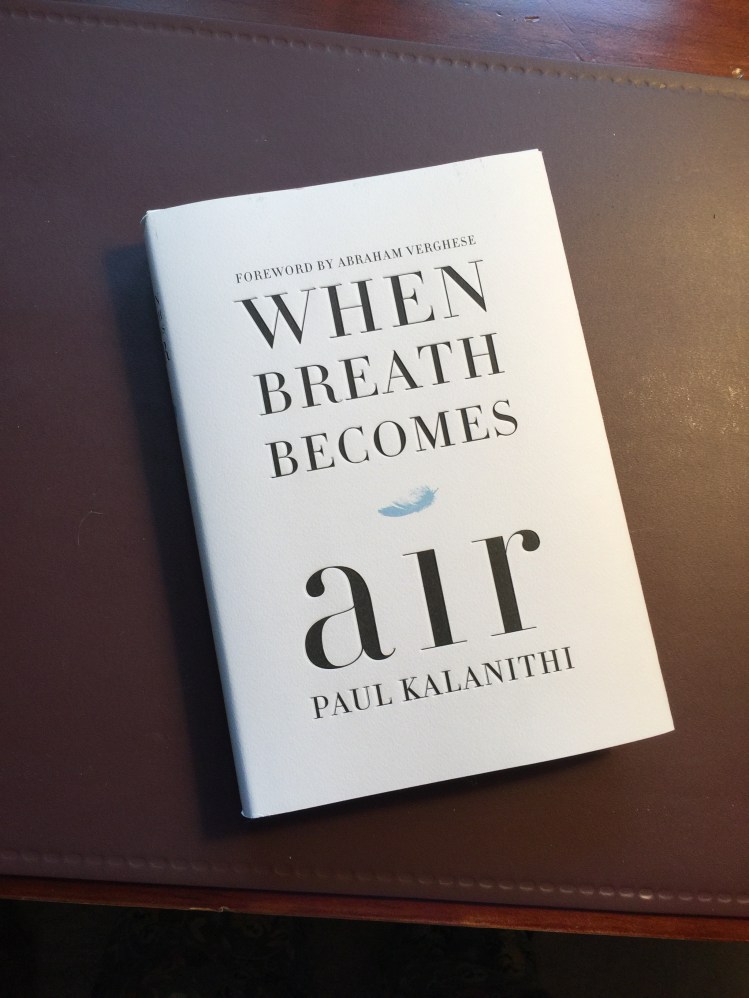
The Saturday Read – ‘When Breath Becomes Air’ by Paul Kalanithi

“I knew with certainty that I would never be a doctor.”  How many of us eliminated career options with such conviction in our final year of high school?

The Saturday Read is ‘When Breath Becomes Air’ by Paul Kalanithi. Although not intended as a ‘career’ book, the beautiful prose and compelling story will leave you reflecting on choices, time and values.

The book is a narrative revealed in two parts.

The first begins with the story of a college student making the most of his experience at Stanford, initially studying English literature, “…seeking a deeper understanding of a life of the mind” until his ultimate realization that “I was merely confirming what I already knew: I wanted that direct experience. It was only in practicing medicine that I could pursue a serious biological philosophy. Moral speculation was puny compared to moral action…I was going to Yale for medical school.”

The unintended value of the book’s Part I is a tutorial on the process of career decision making: exploration, reflection, discovery, reality testing, trade-offs and identity.

“In the fourth year of medical school, I watched as, one by one, many of my classmates elected to specialize in less demanding areas…and applied for their residencies. Puzzled by this, I gathered data from several elite medical schools and saw the trends were the same: by the end of medical school, most students tend to focus on “lifestyle” specialties – those with humane hours, higher salaries, and lower pressures – the idealism of their med school application essays tempered or lost…Indeed, this is how 99 percent of people select their jobs: pay, work environment, hours. But that’s the point. Putting lifestyle first is how you find a job – not a calling.”

Part II, “Cease Not till Death” addresses an essential question of life and career, What happens when your sense of identity is shaken?

“Lying next to Lucy in the hospital bed, both of us crying, the CT scan images still glowing on the computer screen, that identity as a physician – my identity – no longer mattered.

Instead of being the pastoral figure aiding a life transition, I found myself the sheep, lost and confused.”

Before the book was published, Dr. Kalanithi wrote two articles a year apart. Elements of both appear throughout the narrative. The first, ‘How Long Have I Got Left?’ for The New York Times in January 2014 described his role reversal as he “traversed the line from doctor to patient” and reflected on his own mortality.

“I began to realize that coming face to face with my own mortality, in a sense, had changed both nothing and everything. Before my cancer was diagnosed, I knew that someday I would die, but I didn’t know when. After the diagnosis, I knew that someday I would die, but I didn’t know when. But now I knew it acutely. The problem wasn’t really a scientific one. The fact of death is unsettling. Yet there is no other way to live.

Faced with mortality, scientific knowledge can provide only an ounce of certainty: Yes, you will die. But one wants a full pound of certainty, and that is not on offer.”

The second article, ‘Before I Go’ was published in the Spring 2015 issue of Stanford Medicine. Here he writes about time and career as the future “flattens out into a perpetual present”. 

“Time for me is double-edged: Every day brings me further from the low of my last cancer relapse, but every day also brings me closer to the next cancer recurrence — and eventually, death. Perhaps later than I think, but certainly sooner than I desire.

Everyone succumbs to finitude. I suspect I am not the only one who reaches this pluperfect state. Most ambitions are either achieved or abandoned; either way, they belong to the past. The future, instead of the ladder toward the goals of life, flattens out into a perpetual present. Money, status, all the vanities the preacher of Ecclesiastes described, hold so little interest: a chasing after wind, indeed.”

In the end, his illness brought him back to his love of literature and writing. His remarkable life informs this brilliant memoir. It’s a book for the new year, when resolutions are carelessly disregarded. The words, and Dr. Kalanithi’s legacy, reconnect us with the fundamentals of humanism.