The week@work – The ‘Fallows question’, flexibility@work and the long term impact of student debt

On Saturday Night Live actor Cecily Strong delivered a line that summed up what many of us are feeling this week@work, “I want one day without a CNN alert that scares the hell out of me.” 

It got me thinking about the question Facebook COO, Sheryl Sandberg posed to the Barnard Class of 2011, “What would you do if you weren’t afraid?”

This week@work The New York Times Op-Ed Columnist David Brooks posed ‘the Fallows question’“If you could move to the place on earth where history is most importantly being made right now, where would you go?”

“James and Deborah Fallows have always moved to where history is being made…James and Deb have an excellent sense of where world-shaping events are taking place at any moment — and a fervent commitment to be there to see it happen.

If you want to “observe” history, the Fallows say, go to Washington. If you want to “participate,” go elsewhere.”

If you weren’t afraid, and could pick up and move to where the action is, where would you go? Brooks offered a few destinations to start, but just maybe, this week@work you might spend some time considering a temporary relocation “in search of history”.

IMG_7024.jpg

Folks@work are moving forward, finding ways to succeed independent of national politics. Some voice concern about the potential impact of new policies on their workplace, while others seek ways to express a response in their work. For many, the challenges of the gender gap and student debt remain a constant, often extending into retirement.

Claire Cain Miller examined the tension in employer expectations between flexibility and presence@work in ‘How to Close a Gender Gap: Let Employees Control Their Schedules’.

“The main reason for the gender gaps at work — why women are paid less, why they’re less likely to reach the top levels of companies, and why they’re more likely to stop working after having children — is employers’ expectation that people spend long hours at their desks, research has shown.

Flexibility regarding the time and place that work gets done would go a long way toward closing the gaps, economists say.

A new job search company, Werk, is trying to address the problem by negotiating for flexibility with employers before posting jobs, so employees don’t have to.”

And then there are the financial pressures; spanning generations from twenty-somethings being subsidized by parents, as their grandparents face social security payment garnishment to repay outstanding student loan debt.

IMG_8146.jpg

Quoctrung Bui reported on ‘A Secret of Many Urban 20-Somethings: Their Parents Help With the Rent’.

“According to surveys that track young people through their first decade of adulthood, about 40 percent of 22-, 23- and 24-year-olds receive some financial assistance from their parents for living expenses. Among those who get help, the average amount is about $3,000 a year.

It’s a stark reminder that social and economic mobility continues past grade school, high school and even college. Economic advantages continue well into the opening chapters of adulthood, a time when young people are making big personal investments that typically lead to higher incomes but can be hard to pay for.”

On the other side of the generation spectrum, The Editorial Board of The New York Times identified an emerging trend threatening older Americans, ‘Haunted by Student Debt Past Age 50’.

“The experience of being crushed by student debt is no longer limited to the young. New federal data shows millions of Americans who are retired or nearing retirement face this burden, as well as the possibility of having their Social Security benefits garnished to make payments.

Americans age 60 and older are the fastest-growing age group of student loan debtors. Older debtors, many of whom live hand-to-mouth on fixed incomes, are more likely to default. When that occurs with federal loans, as happens with nearly 40 percent of such borrowers who are 65 and over, the government can seize a portion of their Social Security payments — even if it pushes them into poverty. About 20,000 Americans over the age of 50 in 2015 had their Social Security checks cut below the poverty line because of student loans, with poverty-level benefits falling even further for 50,000 others, according to a recent report by the Government Accountability Office.”
IMG_7827.jpg

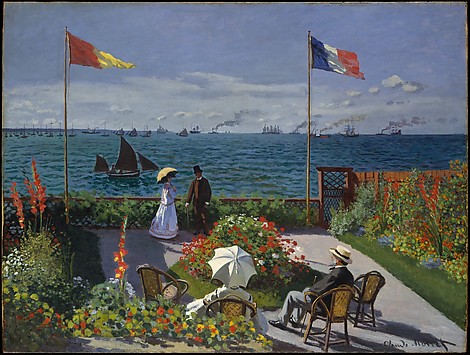
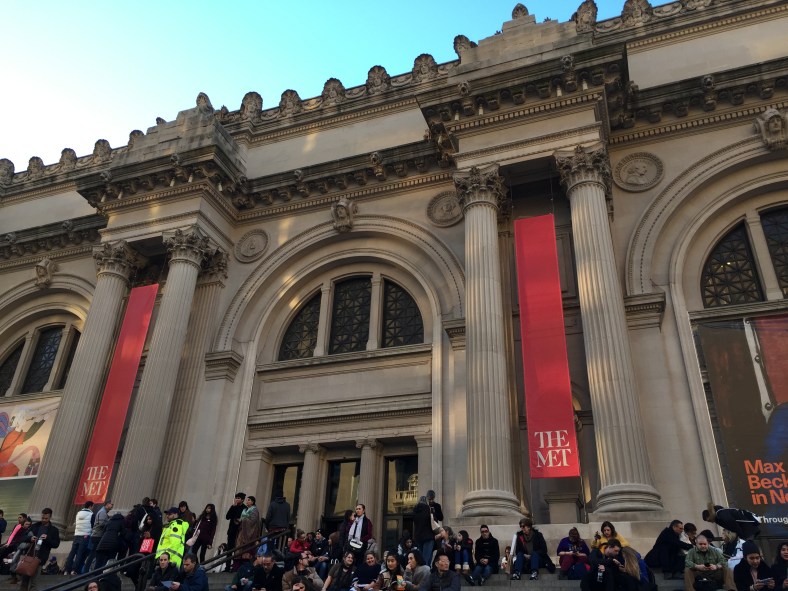
The last story this week@work, highlights the importance of art@work and in our lives. The Metropolitan Museum of Art announced the next step in their digital evolution – open access to over 375,000 archive images. (Monet’s ‘Garden at Sainte-Adresse’, 1867 above)

Pictures from the revolution – 1/21/17

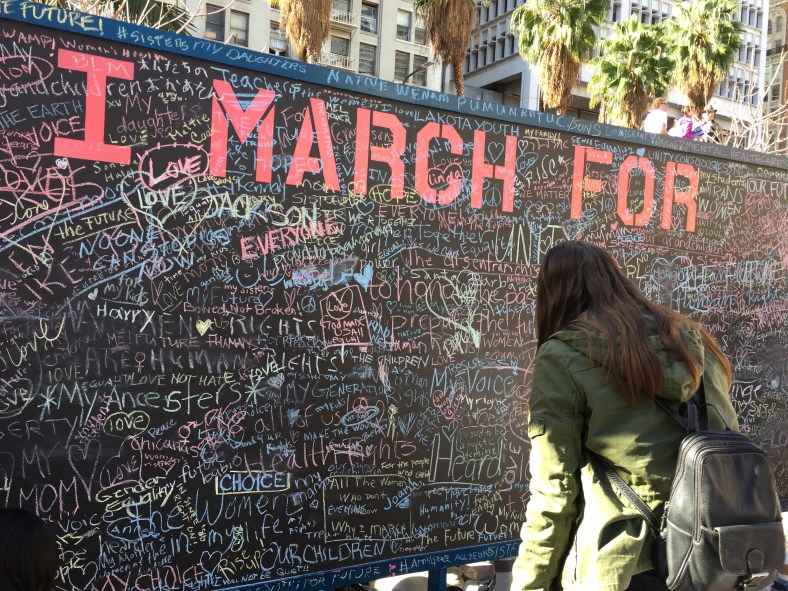
I got as far as Pershing Square in Downtown LA. There were too many people to ‘march’ to City Hall. The real estate in-between was occupied by a sea of veteran and newly-minted activists.

Eventually, we headed in the opposite direction along 6th and up Grand to the Disney Concert Hall. The thousands in the ‘tangent march’ I joined never heard the political speeches of the day, but were overjoyed in the surprise of the turnout.

We were a rainbow representation of the California we call home. We were messengers from divergent origin, chanting with one voice. “This is what democracy looks like”.

IMG_8183.jpgThis is what I want you to understand. The result of the U.S. election may have been the catalyst, but this is about families, values and redefining a new American dream. It’s not about following a 70 year old white man into the past, but creating a solid bridge to a viable global future for our children and grandchildren. It’s about legacy, not name calling.
IMG_8149.jpgIf we can harness the energy and creativity that knitted pink pussy hats, and illustrated catchy posters, we can change the world. The present day reality holds enough shock value without piling on with unproductive language that creates a diversion from authentic action.

 We are the parents who are the everyday role models for our children. It’s our lot in life to “go high, when others go low”. We are the adults in the room.

Many doubt our unity. They minimize our resolve. They write we cannot sustain the momentum initiated on 1/21/17.

img_8191How often, as women@work, have we heard those whispered doubts of our ability to get the job done – to compete? Enough.

I have great respect for those who have blazed trails so others might succeed, but it’s time to hand over the power to the next generation of dreamers – to trust their ability to employ genuine entrepreneurial skill to reimagine the future.

They were there on Saturday; on every street, in every city around the world.

IMG_8180.jpgWhere do we begin? Start local. Be a mentor, donate to organizations that support K-12 leadership initiatives. Invest in people.

Take any opportunity to start a conversation, and listen.

Read the constitution. Fill in the gaps in your knowledge of American history. Learn the words to ‘We Shall Overcome’.

Visit the library or local bookstore and read at least one book by an author from another culture.

Go to your state capitol, find your representative, and ask, what they are doing to encourage a new cohort of leaders? Offer to help.

If you have massive amounts of cash, avoid the temptation to create a private label on a building, and put your money toward those who will cement a more permanent legacy through public service.

If you can’t find an organization with a ‘mission match’ to your values, create one. It was one woman’s Facebook post that grew into the Women’s March.

IMG_8187.JPG

And so it begins…

Photo credit- Downtown LA – LA Mayor’s website 


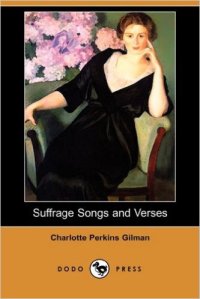
The Friday Poem ‘To The Indifferent Women’ by Charlotte Anna Perkins Gilman

On the eve of the ‘Women’s March’, the Friday Poem reprises ‘To The Indifferent Women’ by Charlotte Anna Perkins Gilman. I originally posted the poem in July after the first woman in U.S. history accepted her party’s nomination for president.

Sometimes things don’t work out as planned.

Tomorrow, in Washington D.C. and cities around the country, women will join together in a nation that could not ratify an equal rights amendment, or elect the first woman president, and remind those elected that women’s rights are human rights.

“In the spirit of democracy and honoring the champions of human rights, dignity, and justice who have come before us, we join in diversity to show our presence in numbers too great to ignore. The Women’s March on Washington will send a bold message to our new government on their first day in office, and to the world that women’s rights are human rights. We stand together, recognizing that defending the most marginalized among us is defending all of us.”

There is something going on here, as there was in 1911 when Ms. Perkins was writing for the cause of women’s rights.

One of the more stunning stories, in advance of the D.C. march, appears in today’s NY Times and profiles an unlikely activist contingent – ‘From Wall Street to National Mall: Women Overcome Fears to Attend March’.

“They are professionals in trading, public relations, marketing, deal-making, investing and the law. They keep punishing schedules, fear losing business by offending their clients and often feel that in an industry still overwhelmingly populated by men, the less attention drawn to their sex, the better.

But the inauguration of Mr. Trump has prompted a striking number of Wall Street women to overcome their worries about demonstrating in public.”

For those who will march and be questioned why, and for those still without weekend plans – a beautiful question from 1911.

“Do you believe the sorrow of the world
Does not concern you in your little homes?”

To The Indifferent Women

A Sestina

You who are happy in a thousand homes,
Or overworked therein, to a dumb peace;
Whose souls are wholly centered in the life
Of that small group you personally love;
Who told you that you need not know or care
About the sin and sorrow of the world?

Do you believe the sorrow of the world
Does not concern you in your little homes? —
That you are licensed to avoid the care
And toil for human progress, human peace,
And the enlargement of our power of love
Until it covers every field of life?

The one first duty of all human life
Is to promote the progress of the world
In righteousness, in wisdom, truth and love;
And you ignore it, hidden in your homes,
Content to keep them in uncertain peace,
Content to leave all else without your care.

Yet you are mothers! And a mother’s care
Is the first step toward friendly human life.
Life where all nations in untroubled peace
Unite to raise the standard of the world
And make the happiness we seek in homes
Spread everywhere in strong and fruitful love.

You are content to keep that mighty love
In its first steps forever; the crude care
Of animals for mate and young and homes,
Instead of pouring it abroad in life,
Its mighty current feeding all the world
Till every human child can grow in peace.

You cannot keep your small domestic peace
Your little pool of undeveloped love,
While the neglected, starved, unmothered world
Struggles and fights for lack of mother’s care,
And its tempestuous, bitter, broken life
Beats in upon you in your selfish homes.

We all may have our homes in joy and peace
When woman’s life, in its rich power of love
Is joined with man’s to care for all the world.

Charlotte Anna Perkins Gilman ‘Suffrage Songs and Voices’ 1911

41py0cnjwl-_sx331_bo1204203200_

Photo credit: Screen shot from Women’s March LA website


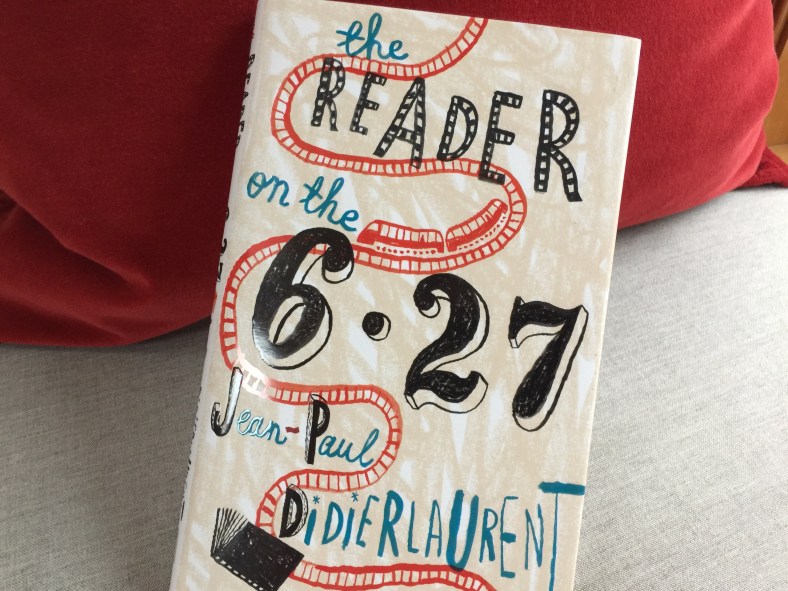
The Saturday Read ‘The Reader on the 6.27’ by Jean-Paul Didierlaurent (translated by Ros Schwartz)

Does our work define us? Many would argue it doesn’t and yet, we carry the bias of standard stereotypes throughout our work day toward those we encounter along the way.

This question of work identity and expectations forms the center of the story of ‘The Reader on the 6.27’ by French writer Jean-Paul Didierlaurent.

In this novel, I wanted to highlight the invisible, the battered lives, the ordinary people who often go unnoticed; and I wanted to show that each of them could have their own unexpected story. In a society where looks have become a religion and where we judge more on appearance, I wanted to highlight our prejudices and show that the clothes do not always make the man. But this book is also a declaration of love for words and for reading. All the characters have a close relationship with words – the words they read, the words they speak and finally the words of love. These words are the real cement of the novel.”

The novel’s hero is Guylain Vignolles whose workplace is dominated by an overbearing caricature of the worst boss ever, and ‘The Thing’.

“The Thing sat there, huge and menacing, right in the centre of the plant. In the fifteen years he had worked there, Guylain had never been able to call it by its real name, as if the simple act of naming it might be to acknowledge it, to demonstrate a sort of tacit acceptance, which he did not want at any cost. Refusing to name it was the last bastion he had managed to erect between it and himself, to avoid selling his soul for good.”

What if your job was to destroy the thing you loved most? That’s Guylain’s dilemma. ‘The Thing’ – the Zerstor 500 – is a hungry metal behemoth that turns books into sludge. (You will have a different view of recycling after reading the description.)

Guylain finds meaning in rescuing sheets of paper from the jaws of the “eleven-tonne monstrosity” and reading these disjointed narratives to his fellow commuters each morning on the 6.27.

Then, one day he finds a memory stick “through pure chance” as “it jumped out of the folding seat as he lowered it. A little plastic thing barely the size of a domino which bounced across the floor of the compartment and came to a halt between his feet..”

The contents of the USB are revealed as Guylain, the ‘reader on the 6.27’, replaces his daily narration from the remainders of ‘the thing’ with the story of a mysterious stranger.

“Once a year, at the spring equinox, I do a recount. Just to see, to make sure that nothing ever changes. At this very special time of year, when day and night share time equally, I do a recount with, lodged in the back of my mind, the ludicrous idea that perhaps, yes, perhaps one day, even something as unchanging as the number of tiles covering my domain from floor to ceiling might change.  It’s as hopeless and stupid as believing in the existence of Prince Charming, but deep down inside me is that little girl who refuses to die and who, once a year wants to believe in miracles.”

Julie’s domain is in the basement of a mall. And it’s her story that should forever challenge the reader’s preconceptions of society’s work identity assignments.

“When you’re a public lavatory attendant, wherever that may be, you’re not expected to keep a diary and sit there tapping away on the keyboard of your laptop. You’re only good for wiping from morning to evening, shining the chrome, scrubbing, polishing, rinsing, refurbishing the cubicles with toilet paper, and that’s it. A loo attendant is meant to clean, not to write…It’s as if there has been a misunderstanding, a miscasting. In the nether world, even a miserable twelve-inch laptop next to the tips saucer will always be a blot on the landscape…”

“I quickly had to come to terms with the fact that people generally expect only one thing of you: that you reflect back the image of what they want you to be.”

“Fit docilely into the mould, slip into this lavatory attendant’s costume – which is what I am paid to do – and play the part, sticking closely to the script.”

Mr. Didierlaurent has filled the gap in workplace literature with a beautifully told story of memorable characters who reside in the periphery of vision, but will long linger in the reader’s memory. Here is a novelist providing the lesson that not all workplace advice is to be found in the business section of the bookstore.

After reading the novel, and becoming acquainted with a cast of characters who bring it to life, perhaps we can reorient our expectations, and look beyond the surface for the complementing prism of talent that defines us all.

Resist “sticking closely to the script”, and follow Julie’s advice.

“I advance in small steps. Not a single day goes by without my writing. Not to do so would be as if I had restricted myself to the role of loo-poo-puke cleaner that they want me to play, a poor creature whose only raison d’être is the lowly occupation for which she is paid.”


The Friday Poem “Hope” is the thing with feathers by Emily Dickinson

What do we have if we don’t have hope?

In December, U.S. First Lady Michelle Obama was interviewed by Oprah Winfrey. One of the most stunning, yet relatable, quotes concerned ‘hope’- the promise of her husband’s presidential campaign eight years ago.

“I think that we feel the difference now. See, now we’re feeling what not having hope feels like. 

“Hope is necessary. It’s a necessary concept, and Barack didn’t just talk about hope because he thought it was just a nice slogan to get votes.”

“What else do you have, if you don’t have hope? What do you give your kids if you can’t give them hope?”

The Friday poem this week is from the nineteenth century American poet, Emily Dickinson – because we all could use a little hope “perched in our soul” in this new year.

“Hope” is the thing with feathers

“Hope” is the thing with feathers –
That perches in the soul –
And sings the tune without the words –
And never stops – at all –

And sweetest – in the Gale – is heard –
And sore must be the storm –
That could abash the little Bird
That kept so many warm –

I’ve heard it in the chillest land –
And on the strangest Sea –
Yet – never – in Extremity,
It asked a crumb – of me.

Emily Dickinson ‘The Poems of Emily Dickinson’ edited by R.W. Franklin

9780674018242.jpg


The Holiday Read ‘Bobby Kennedy: The Making of a Liberal Icon’ by Larry Tye

Biographies are the stories of career transition. When we make a selection from a bookstore, library or electronic shelf we may not be seeking the secret to success. We may not even be thinking about work and career. A life story well told is one that surprises the reader with the unexpected; previously unknown challenges faced, and career crises resolved.

The ‘holiday read’ recommendation this season is the new biography of Bobby Kennedy by Larry Tye. It’s a life story well told, of someone we thought we knew.

If the current political landscape seems bleak, this trip back to 1950’s-1960’s America will frame the present within the historical context of our not too distant past. And perhaps offer a bit of hope.

Bobby Kennedy’s story is a career story that begins, as many do, following the expectations of others. At age 38 the carefully constructed career scaffolding collapsed and he faced a decision, what should I do with my life?

“He had spent the first twenty-five years with the world seeing him as Joe Kennedy’s boy, and the next dozen as John Kennedy’s brother. Now he would be his own man, one who was both more tempered and fiercer.”

The narrative reflects these two career/life phases. The first six chapters explore the less familiar territory of Bobby Kennedy, “…nurtured on the rightist orthodoxies of his dynasty-building father and started his public life as counsel to the left-baiting, table-thumping senator Joseph McCarthy. That younger RFK was a bare-knuckled political operative who masterminded his brother’s whatever-it-takes bids for senator and president.”

The remaining chapters relate the story of a man plotting a career path apart from the influence of his father and older brother.

The trauma of assassination “had loosed Bobby’s moorings, quelled his passions, and made him question even his faith…The values and qualities that would define him were present from the beginning, but they fully bloomed only after his father’s disability and his brother’s death…Now this man so shaped by others was reshaping himself, the way the existentialists said he could. He could finally ask what he wanted and needed. His public persona began to reflect the gentleness that family and friends say they had always known.”

In 1964 Bobby Kennedy was at that point we may recognize from personal experience. “The breadth of the choices he was weighing reflected the reality that for the first time, he didn’t know what he should do…He was also self-aware enough to realize the implausibility of his impasse: “It’s a hell of a thing, isn’t it? Thirty-eight years old and no place to go.””

Public service had driven his decisions in the past and on August 25, 1964 he embarked on the next stage of his career, announcing a run for senate from the State of New York.

Trailing in the polls, accused of being a ‘carpetbagger’, on October 5, he addressed “more than two thousand people at Columbia University’s Wollman Auditorium…Standing onstage alone in the glaring TV lights, a microphone in his hand, he looked younger and smaller than the student interrogators who threw him one hardball question after another for eighty-five minutes… His audience was filled with students from the most politically active generation ever in America, who four years later would help ignite the nation in protest over everything from the war in Vietnam to crumbling U.S. ghettos. For now, these fans of Bob Dylan and the Rolling Stones sensed that Bobby was as authentic as a politician got.”

On November 3, Kennedy won the election, making history. “The Kennedys were the first family ever to send three brothers to the U.S. Senate, and the second to have brothers serving simultaneously…”

His senate career represented a historical catalog of the social issues facing the country: civil rights, anti-poverty programs, and eventual opposition to the Vietnam war.

“The senator from New York’s involvement with the Republic of South Africa was different. Unlike Vietnam, it didn’t matter to the White House or to most Americans. And in South Africa, it wasn’t Bobby but millions of oppressed blacks and thousands of their white allies who were desperate to speak our but had gagged themselves for fear of the consequences. Traveling there in 1966, Bobby gave them a voice in a way that nobody else had. The trip also freed him from the politics that clouded everything he did in America and brought him back to first principles.”

Once again, it was a crowd of university students at the University of Cape Town on June 6, 1966 that provided him a platform to deliver one of his most memorable speeches, ‘The Ripple of Hope’.

“It is from numberless diverse acts of courage and belief that human history is shaped each time a man stands up for an ideal or acts to improve the lot of others or strikes out against injustice. He sends forth a tiny ripple of hope, and crossing each other from a million different centers of energy and daring, those ripples build a current that can sweep down the mightiest wall of oppression and resistance.”

Larry Tye’s biography doesn’t dwell on the familiar in Bobby Kennedy’s history. He doesn’t rehash the work of previous biographers. What he delivers to readers is a life story, illuminated by contemporary journalists’ coverage, informed by historical fact, and imbued with Kennedy’s ceaseless career passion as an advocate for those with no representation.

“Bobby was a shaker-upper dedicated to the art of the possible. That he could change so substantially and convincingly over the course of his brief public life helped restore a changing America’s faith in redemption. In the end he could become this nation’s high priest of reconciliation precisely because he had once been the keeper of our darkest seekers.”

Spend your holiday with ‘Bobby Kennedy: The Making of a Liberal Icon’ and restore your belief in “the art of the possible”.


The Friday Poem ‘Introduction to Poetry’ by Billy Collins

When I first started ‘workthoughts’ almost two years ago, I wanted to include a weekly poem or lyric. A colleague had once shared her secret of success@work, “I start my day reading a poem”.

I believe we all become a bit more creative when we discover the world through a poet’s eyes. Why don’t more of us include poetry in our work lives?

Former U.S. Poet Laureate Billy Collins shared his opinion in an interview to Ben Yakas of gothamist.com.

“…the teaching of poetry is often brutally centered on interpretation. This gives teachers power because they kind of “know the answer.” And I think there’s a streak of sadism in it as well as they watch students get the wrong answer by guessing.”

In October, Mr. Collins published his 12th book of poetry, ‘The Rain in Portugal’. The Friday Poem this week is from his first collection, ‘The Apple That Astonished Paris’, and is for all of you whose early love of poetry was extinguished by an overzealous pursuit of analysis.

Introduction to Poetry 

I ask them to take a poem
and hold it up to the light
like a color slide

or press an ear against its hive.

I say drop a mouse into a poem
and watch him probe his way out,

or walk inside the poem’s room
and feel the walls for a light switch.

I want them to waterski
across the surface of a poem
waving at the author’s name on the shore.

But all they want to do
is tie the poem to a chair with rope
and torture a confession out of it.

They begin beating it with a hose
to find out what it really means.

Billy Collins from ‘The Apple That Astonished Paris’ 1988

collins.png

The week@work – U.S. unemployment at nine year low, Rosberg and Schultz exit roles on top, and “mother nature needs her daughters”

If you weren’t paying attention, you would have thought the major story this week@work was about the 800 folks who will retain positions at Carrier, a division of United Technologies. You might have missed the news that U.S. unemployment reached a nine year low @4.6%, adding 178,000 jobs in November.

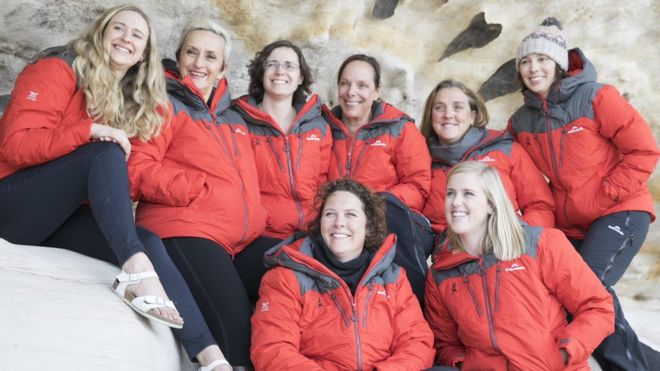
In ‘departures’, newly crowned Formula One champion, Nico Rosberg announced his retirement and Starbuck chief, Howard Schultz, will be stepping down from his position next year.  Seventy-six women scientists have embarked on an expedition to Antarctica to focus on climate change and women who work in the sciences.

Ana Swanson reported on the U.S. unemployment news for The Washington Post, Wonkblog.

“Data released on Friday showed a sharp drop in the unemployment rate from 4.9 percent the previous month, driven partly by the creation of new jobs and partly by people retiring and otherwise leaving the labor force.

A broader measure of unemployment, the U-6 rate, which includes those who have given up looking for work and part-time workers who would like to have full-time jobs, fell to 9.3 percent, the lowest reading since April 2008. The figure still remains elevated from average levels in the 2000s.”

Paul Weaver covered the announcement of F1 champion, Nico Rosberg’s decision to retire from racing five days after capturing the title for The Guardian.

551069_10152244647569874_65635453_n.png

“Nico Rosberg has stunned Formula One by announcing his retirement, just five days after the 31-year-old became the sport’s world champion…

He said he had “climbed my mountain”. Now he is going out at the peak.

Rosberg said he first started thinking about retiring when he won the Japanese Grand Prix in early October and realised the title was within his grasp. “From the moment when the destiny of the title was in my own hands, the big pressure started and I began to think about ending my racing career if I became world champion,” he wrote in a post on his Facebook page announcing his departure.”

At the other end of the career spectrum, the visionary leader of Starbucks, Howard Schultz announced he will be stepping away from his leadership position at the company he joined in 1982. Andrew Ross Sorkin reported on the change at the top for The New York Times.

“I wanted to build the company my father never got to work for,” he said.

Howard_Schultz_and_Kevin_Johnson.JPG

At an all-hands employee meeting at the company’s headquarters on Thursday, Mr. Schultz was greeted with tears and a standing ovation. “For me, perhaps there are other things that are part of my destiny,” he told them.”

Mr. Schultz said he intends for Starbucks to “maintain our moral courage.” And he defended efforts like the company’s “Race Together” campaign to spur a conversation about race relations, saying that it “was not a failure. I’d do it again.” He said such campaigns are deeply embedded in the company’s brand of “challenging the status quo about the role of a public company.” He is excited by the question, “Since we have stores in every community in America, how can we use our scale for good?”

How do folks successfully transition from one phase of their work life to the next?

Adam Bryant‘s ‘Corner Office’ interview with Nyansa chief executive, Abe Ankumah provides a hint.

“Be a lifelong student. That doesn’t mean go enroll in a bunch of classes all the time. It’s a mind-set. It means continuing to push yourself to learn rather than saying, “I’ve got this degree in this, and that’s what I’m going to do.”

The other thing is not to become too comfortable in a role. Chances are that if you’re comfortable, you’re not learning, you’re not pushing the envelope and you’re probably going to get stagnated.”

The last story this week@work is an example of pushing the envelope, for the greater good.

On Thursday I received a tweet from BBC Australia about an expedition of women scientists traveling to Antarctica. The tag line of their sponsor, ‘Homeward Bound’, is “mother nature needs her daughters”.

img_2600-1-1080x675

From the BBC  Australia story – “They call Ushuaia, a cold and windy port city in Argentina, the end of the world.

It’s from here that the largest ever all-female expedition to Antarctica will depart, with more than 70 women with backgrounds in science set to spend 20 days at sea.

The voyage is part of the Homeward Bound initiative, an Australian programme aimed at increasing the representation of women in top science jobs across the globe.

“We’re missing half the voice at the leadership table,” says Dr Jessica Melbourne-Thomas, who along with entrepreneur and management expert Fabian Dattner, came up with the idea.

The pair met during a leadership development course run by Dattner, and their frustration at the challenges faced by women in science quickly became a bold idea.

Two years later, the first of what is hoped to be several voyages is about to depart.”

We talk a lot about ‘dream jobs’ and whether ‘finding your passion’ is attainable. For those of you skeptics out there, I close with the closing paragraphs of Fabian Dattner‘s blog post, co-founder of Homeward Bound, who as I write is on her journey south.

“So, right now as I work with a group of leaders in my day job, my mind wanders effortlessly to what lies ahead – now only a few sleeps away – and I am finally lost for words, carried forward – as with all the people involved – on a deeply felt sense of rightness: right purpose, right time, right people, right outcome.

I know what ‘flow’ means now; I know what purpose, autonomy and freedom mean. I know what it means to lead and be led. And I know in my bones what is possible for humans, when leaders act on behalf of the greater good.

Stay with us on this journey. It’s for all of us.”  @HomewardBound16


Photo credits: Antarctica expedition – Homeward Bound, Kevin Johnson/Howard Schultz -Starbucks Newsroom

The week@work – good lives without good jobs?, good vs. great leaders, Yahoo hacked, and are university rankings hurting higher ed?

The workplace is changing, and politicians are beginning to recognize the impact of the shift on long term policy planning. This week@work a ‘think tank’ fellow considered the possibility of good lives without good jobs, a professor found leadership is not a continuum, Yahoo announced 500 million users accounts were hacked, and Irish universities missed the top tier of international schools for the first time, generating a debate on the value of global rankings.

New America Fellow, Michael Lind suggested “Politicians should tell working Americans what they need to hear, not what they want to hear. And what they need to hear is that it is possible for all Americans to have good lives, even if they can’t all have good jobs.”

Writing in The New York Times Sunday Review he asked, ‘Can You Have a Good Life if You Don’t Have a Good Job?’

“…the political problem remains. Even if center-left and center-right policy wonks agree that the goal should be good lives for all workers, even those with bad jobs, many Americans do not agree, to judge from the rhetoric of politicians, who know their audiences well. The replacement of a world in which one or a few lifetime jobs in a paternalistic company that provided benefits during your working life and a pension after your retirement by a future in which individuals struggle to survive by piecing together “gigs” and “tasks” with a bewildering variety of federal, state and local social programs may strike many workers as a dystopian nightmare. The price of increased flexibility may be increased stress.

The unelected policy experts who envision a future of multiple job types and a greater, if hidden, role for government in maintaining minimum incomes and providing health and retirement benefits are essentially right. The elements of a “good job” — adequate income, health insurance and retirement benefits — that were once combined in the package that a Detroit automobile manufacturer provided to a unionized male steelworker in 1950 are likely to be provided, for most American workers now, by some combination of employer and government.

Until most American workers are persuaded that they will not be worse off in a system characterized by flexible work arrangements and partly socialized benefits, they may continue to make unrealistic demands that 21st century politicians restore something like the occupational structure of the 20th century.”

Which of the folks vying for U.S. President will have the courage to deliver this message? It may depend on their leadership style. Professor James R. Bailey of George Washington University’s School of Business examined ‘The Difference Between Good Leaders and Great Ones’ for HBR digital.

W160913_BAILEY_LEADERSHIPISNOT.png

“That anyone can develop as a leader is not in question. What I dispute is the stubborn resolve that great and good are points along the same stream. That just isn’t so. Great leadership and good leadership have distinctly different characteristics and paths. Leadership is not one-dimensional. It can be great and good, or one but not the other, or neither.

The tug between great and good leadership is one of perpetual and dynamic coexistence. There is great — a force that is often inexplicable, occasionally irrational, and, importantly, intermittently ungovernable. Then there is good — a direction that is north-star true, providing the point of values of mutual benefit.

It’s natural to think of leadership as running from one end to the other. To do so, though, is to mistake what great and good leadership are. They’re fundamentally different. Separating them, thus upending the ever-convenient continuum, seems counterintuitive. But it’s absolutely necessary for understanding the very elements that explain leadership’s operation and impact. Great can be vital but destructive; good can be compassionate but impotent. The coexistence of the two is the best hope for leadership — without good we should fear.”

Switching gears, to privacy – it came as no surprise when Yahoo announced a massive data breach. Kara Swisher reported for recode in advance of the public disclosure.

yahoo-535059009-1024x683.jpg

“Earlier this summer, Yahoo said it was investigating a data breach in which hackers claimed to have access to 200 million user accounts and one was selling them online. “It’s as bad as that,” said one source. “Worse, really.” 

…this hack, said sources, which became known in August when an infamous cybercriminal named “Peace” claimed on a website that he was selling credentials of 200 million Yahoo users from 2012 on the dark web for just over $1,800. The data allegedly included user names, easily decrypted passwords and personal information like birth dates and other email addresses.

At the time, Yahoo said it was “aware of the claim,” but the company declined to say if it was legitimate and said that it was investigating the information. But it did not issue a call for a password reset to users. Now, said sources, Yahoo might have to, although it will be a case of too little, too late.”

Over 500 million accounts have been reported hacked…about that earlier article on good/great leadership and “another blemish on the record of CEO Marissa Mayer”.

On campus, this week@work, university presidents and deans awaited the verdict of the annual ‘World University Rankings’.

oxford.jpg

Grainne Loughran reported on the implications of the new rankings for The Irish Times.

“Another week, another set of university rankings as the Times Higher Education releases it league table. It follows others recently published by Quacquarelli Symonds (QS) and the Academic Ranking of World Universities (Shanghai).

The organisations may differ, but the pattern is broadly the same: Ireland’s best higher education institutions are in free-fall.

The decline in rankings has been alarming university presidents for the past six years. But while rankings are of significant reputational importance worldwide, they only take into account a tiny proportion of the picture of how universities stand.

Lack of understanding of what they actually measure has resulted in the rankings gaining an unwarranted notoriety and position to influence policy, with the potential to harm higher education institutions in Ireland and worldwide.

There are about 20 global rankings of higher education. All have varying methodologies and in some cases give vastly different weightings to the factors they have in common.”

This week@work also marked the anniversary of ‘The Death of the Phone Call’. Timothy Noah looked back on a moment in history.

“The phone call died, according to Nielsen, in the autumn of 2007. During the final three months of that year the average monthly number of texts sent on mobile phones (218) exceeded, for the first time in recorded history, the average monthly number of phone calls (213). A frontier had been crossed. The primary purpose of most people’s primary telephones was no longer to engage in audible speech.”

Also this week@work – two stories from Silicon Valley:

‘Zuckerberg, Chan Start $3 Billion Initiative to Cure Disease’ Sarah Frier for bloomberg.com “Mark Zuckerberg and his wife, Priscilla Chan, are pledging to spend more than $3 billion over the next decade to work on curing diseases.

“Can we work together to cure, prevent or manage all disease within our children’s lifetime?” Chan said Wednesday onstage at an event in San Francisco for the Chan Zuckerberg Initiative. “Mark and I believe that this is possible.”

‘How Tech Companies Disrupted Silicon Valley’s Restaurant Scene’ Nicole Perlroth for The New York Times “All told, more than 70,000 square feet of Palo Alto retail and restaurant space were lost to office space from 2008 to 2015, as the tech bubble drove demand for commercial space downtown.

It is a story playing out across Silicon Valley, where restaurateurs say that staying afloat is a daily battle with rising rents, high local fees and acute labor shortages. And tech behemoths like Apple, Facebook and Google are hiring away their best line cooks, dishwashers and servers with wages, benefits and perks that restaurant owners simply cannot match.

Silicon Valley technologists love to explain how they have disrupted the minutiae of daily life, from our commutes to the ways we share family photos. But along the way, they have also managed to disrupt their local restaurant industry.”

Finally, from The New York Times Magazine survey (September 18): “In an eight-hour workday, how much time do you spend actually working? 44% 4-6 hours, 43% 7-8 hours, 7% 1-3 hours, and 6% less than an hour.”


Photo credits: Yahoo, Lisa Werner/Getty for Wired

The Saturday Read – The National Book Award ‘Long List’

This past week The National Book Foundation announced the ‘long list’ of nominees for The National Book Award to be announced on November 16. The books nominated fall into four categories: Fiction, Non-Fiction, Poetry, and Young People’s Literature.

A quick review of the titles provides a cultural snapshot of the issues we face as individuals and society as a whole. ‘The Saturday Read’ this week offers a list those nominated in the  fiction and non-fiction categories.

The fiction nominees includes an Oprah Book Club pick, my favorite of the past year, and an anticipated new novel to be released in October.

In non-fiction, racism is a common topic; echoing the theme of last year’s ‘required reading’, 2016 award winner, Ta-Nehisi Coates’ ‘Between the World and Me’. The nominees in this category remind us why we read non-fiction: to listen, to understand the world in all its complexity, and to make thoughtful decisions about our future.

Fiction

Chris Bachelder, The Throwback Special (W. W. Norton & Company)

Garth Greenwell, What Belongs to You (Farrar, Straus and Giroux/Macmillan)

Adam Haslett, Imagine Me Gone (Little, Brown and Company/Hachette Book Group)

Paulette Jiles, News of the World (William Morrow/HarperCollinsPublishers)

Karan Mahajan, The Association of Small Bombs (Viking Books/Penguin Random House)

Elizabeth McKenzie, The Portable Veblen (Penguin Press/Penguin Random House)

Lydia Millet, Sweet Lamb of Heaven (W. W. Norton & Company)

Brad Watson, Miss Jane (W. W. Norton & Company)

Colson Whitehead, The Underground Railroad (Doubleday/Penguin Random House)

Jacqueline Woodson, Another Brooklyn (Amistad/HarperCollinsPublishers)

Non-Fiction

Andrew J. Bacevich, America’s War for the Greater Middle East: A Military History
(Random House/Penguin Random House)

Patricia Bell-Scott, The Firebrand and the First Lady: Portrait of a Friendship: Pauli Murray, Eleanor Roosevelt, and the Struggle for Social Justice (Alfred A. Knopf /Penguin Random House)

Adam Cohen, Imbeciles: The Supreme Court, American Eugenics, and the Sterilization of Carrie Buck (Penguin Press/Penguin Random House)

Arlie Russell Hochschild, Strangers in Their Own Land: Anger and Mourning on the American Right (The New Press)

Ibram X. Kendi, Stamped from the Beginning: The Definitive History of Racist Ideas in America (Nation Books)

Viet Thanh Nguyen, Nothing Ever Dies: Vietnam and the Memory of War
(Harvard University Press)

Cathy O’Neil, Weapons of Math Destruction: How Big Data Increases Inequality and Threatens Democracy (Crown Publishing Group/Penguin Random House)

Andrés Reséndez, The Other Slavery: The Uncovered Story of Indian Enslavement in America (Houghton Mifflin Harcourt)

Manisha Sinha, The Slave’s Cause: A History of Abolition (Yale University Press)

Heather Ann Thompson, Blood in the Water: The Attica Prison Uprising of 1971 and Its Legacy (Pantheon Books/Penguin Random House)