The week@work – An astronaut in Greenland, a McDonald’s worker in Edinburgh, Facebook’s identity crisis, and how to design a happier life

This week@work, a former astronaut and climate scientist, and a McDonald’s employee in Edinburgh challenged expectations and stereotypes, journalists questioned Facebook’s content algorithm, and a leading happiness scholar shared his formula.

In January, Piers J. Sellers, Deputy Director of the Sciences and Exploration Directorate and Acting Director of the Earth Sciences Division at NASA/GSFC wrote an opinion for The New York Times Sunday Review, ‘Cancer and Climate Change’.

“I’m a climate scientist who has just been told I have Stage 4 pancreatic cancer.

This diagnosis puts me in an interesting position. I’ve spent much of my professional life thinking about the science of climate change, which is best viewed through a multidecadal lens. At some level I was sure that, even at my present age of 60, I would live to see the most critical part of the problem, and its possible solutions, play out in my lifetime. Now that my personal horizon has been steeply foreshortened, I was forced to decide how to spend my remaining time. Was continuing to think about climate change worth the bother?

1024px-Piers_Sellers_spacewalk.jpg

Journalist and author, Jon Gertner continued the story this week with ‘An Astronaut Finds Himself in Greenland’ for The New Yorker.

“Piers Sellers landed in Greenland on a frigid Monday morning in April, and as he stepped off the plane at Thule Air Base he regarded the surrounding snow-covered hills with delight…Sellers was visiting the country for the first time. “I didn’t even see this from space, since the farthest north the shuttle goes is fifty-one degrees latitude,” he said. “We’re at seventy-six degrees now, right? Fantastic.” Sellers’s plan was to rendezvous with NASA researchers at Thule (pronounced “TOO-lee”) and accompany them on Operation IceBridge, an annual mission to collect data on the diminishing ice in the Arctic Ocean and on the Greenland ice sheet. “These guys at IceBridge are always saying, ‘Oh, you should come along, see where the rubber meets the road,’ and I say that I’m too busy, with too much piled on my desk,” Sellers explained. “But, given my current situation, of all the things that we’re doing in the field, this one is probably the most critical right now.”

After the diagnosis, he briefly considered living his final year or so—assuming his doctors’ expectations prove correct—as a rich man might, in a tropical, hedonistic splurge. “I thought of myself sitting for weeks on a beach,” he said. “What would I do? I’d be thinking about climate.”

So Sellers went back to his desk job at Goddard, where he oversees the work of about sixteen hundred people, and considered how he could fit a few modest adventures between his office duties and chemotherapy sessions. Soon it occurred to him to go to the Arctic, which is warming faster than any other part of the world.

The second story this week comes via Mashable and writer Davina Merchant‘s coverage of the Facebook post of McDonald’s employee, Mike Waite. Bravo for debunking stereotypes!

Unknown.png

“Today I have had enough of the judgemental criticism. Let me be clear. YES I work at Mcdonalds and do it nearly 50 hours a week. Why? Not because I have no aspiration, motivation or intelligence…but for the opposite…because in a few months time like a great number of people I work with I will be going back into higher education. McDonalds has this reputation which is quite unfounded in the recent age, every person I work with has a story and every person is working their ass off in what can be a very tough job for their own reasons…be it they are in school, uni, have family, have kids, saving…etc. The one thing McDonalds is is a job which is extremely (extremely) flexible, has opportunities for growth and can allow you to do what you want to do. There are people becoming pilots, lawyers, designers, architects, and people who are at a point in their life that they will do whatever it takes to look after their family. I work with people I would aspire to be like, who have strengths in areas I wish I had, who have overcome situations I never could and who have the determination to not fade away on handouts but rather step up and work for their living unlike a huge number of people in this country. In the past I have known and worked with very rich folks in very high end jobs, and a few of them could never match the resilience and work ethic of some of the current lads/lassies. After the ending of a big part of my life McD’s is not only letting me save up for University, but setting me up with flexible work I can continue over the next years to come. Not only that but I intend on eventually progressing into the management side of things, something which ties in directly to my degree and will enhance my future job prospects.”

Beyond brilliant posts to its site, Facebook was in the news this week when Gizmodo reported that content on the platform was being ‘subjectively’ curated.

14LfacebookWeb-mediumThreeByTwo210.jpg

David Uberti reported ‘Facebook wants you to think it’s just a platform. It’s not.’ for the Columbia Journalism Review.

“As prominently argued by Emily Bell, director of Columbia’s Tow Center for Digital Journalism, Facebook is increasingly shaping the contours of the public square, and citizens and news organizations have little choice but to go along for the ride. The power shift raises the all-important question of how information travels in free societies—and what we know about it.

“This is an unregulated field. There is no transparency into the internal working of these systems,” Bell said in a University of Cambridge speech earlier this year. “We are handing the controls of important parts of our public and private lives to a very small number of people, who are unelected and unaccountable.”

News organizations once had a more central role in setting the terms of public debate, balancing money-making aspects of publishing with more civically minded accountability journalism. They also generally followed widely accepted journalistic standards. Social networks have assumed much of the same power, Bell and others have argued, though they typically use more opaque processes and have a greater focus on those profitable slices of publishing. That’s not to say this new construct is necessarily worse, but it is foreign. And Facebook has little incentive to open up about its methodology.”

Fast Company’s Elizabeth Segran introduced us to London School of Economics professor and happiness scholar, Paul Dolan in ‘How To Intentionally Design A Happier Life’.

37398b0

“After decades of studying happiness, Dolan has developed a happiness formula. He says that happy people pay attention to the everyday experiences that give them pleasure and purpose, then organize their lives so that they are doing more of those things. It sounds obvious, right? Sure, but the problem is that we spend so much of our lives on autopilot instead of consciously focusing on doing things that make us happy. “We are creatures of habit and we automate processes very quickly,” Dolan says. “We do a lot of what we do because we’ve always done it, not because it is good for us or because we enjoy it.” The good news, however, is that Dolan offers two tangible ways for us create more happy moments in our lives. The first is creating a mental habit of paying attention to what makes us happy and the second is designing our lives so it is easier to do those things.”

Two additional stories of interest this week@work:

‘It’s a Tough Job Market for the Young Without College Degrees’  by Patricia Cohen for The New York Times

“Only 10 percent of 17- to 24-year-olds have a college or advanced degree, according to a new study by the Economic Policy Institute, although many more of them will eventually graduate.

And for young high school graduates, the unemployment rate is disturbingly high: 17.8 percent. Add in those who are underemployed, either because they would like a full-time job but can only find part-time work, or they are so discouraged that they’ve given up actively searching, and the share jumps to more than 33 percent.”

‘The Miserable French Workplace’ by Pamela Druckerman opinion for The New York Times

“While many other European countries have revamped their workplace rules, France has barely budged. The new labor bill — weakened after long negotiations — wouldn’t alter the bifurcated system, in which workers either get a permanent contract called a “contrat à durée indéterminée,” known as a C.D.I., or a short-term contract that can be renewed only once or twice. Almost all new jobs have the latter.

(French workers) believe that a job is a basic right — guaranteed in the preamble to their Constitution — and that making it easier to fire people is an affront to that. Without a C.D.I., you’re considered naked before the indifferent forces of capitalism.

No matter what the government does, the workplace is becoming less secure.”

To close this week@work, let’s return to Piers Sellers’ January 2016 NYT opinion piece.

“As for me, I’ve no complaints. I’m very grateful for the experiences I’ve had on this planet. As an astronaut I spacewalked 220 miles above the Earth. Floating alongside the International Space Station, I watched hurricanes cartwheel across oceans, the Amazon snake its way to the sea through a brilliant green carpet of forest, and gigantic nighttime thunderstorms flash and flare for hundreds of miles along the Equator. From this God’s-eye-view, I saw how fragile and infinitely precious the Earth is. I’m hopeful for its future.

And so, I’m going to work tomorrow.”

The week@work – leadership lessons from Leicester City, #TonysSoDiverse, exit strategies & the April jobs report

This week@work we visit Leicester, England (think Wichita,KS) to uncover a story of unlikely success, celebrate the diversity of the Tony Award nominees, grasp the value of a positive employee exit process, and review the April jobs report.

At the beginning of the English Premier League season, Ladbrokes, the world leader in gaming and betting set 5000/1 odds that Leicester City would win the title. On Monday, the team beat the odds to hoist the trophy and celebrate their marvelous win.

569698369-125280-3103660_150x113.JPG

There were hundreds of news articles published over the past week, covering the story from every possible angle. Here are a few, examining the business applications and social impact.

‘What do the foxes say?’, The Economist’s take on the champions suggests a future in business school and corporate conference engagements for club manager, Claudio Ranieri.

“In footballing terms, Claudio Ranieri, an affable Italian, has found a way to turn water into wine. Mr Ranieri manages a club in England, Leicester City, which historically has not been very good. On May 2nd his team were crowned champions of the English Premier League, a competition more watched than any other on the planet, and reliably won—including in every one of the preceding 20 years—by one of four much bigger clubs.

…Leicester’s triumph will also spark inordinate interest in the world of business, which has long looked to sport for lessons on management and leadership.

The BBC’s Robert Plummer shared six of ‘Leicester City’s business secrets’. “You don’t need to throw money at the problem. Get the right people around you. Create the right culture. Do the maths. Create the right incentives. Don’t forget your mum’s birthday!”

For a literary, fan perspective, Booker winning author, Julian Barnes wrote ‘My Stupid Leicester City Love’.

“I haven’t always been a Leicester City supporter: there was a time before I could read, or knew how to tune the Bakelite wireless to the voice of Raymond Glendenning on Sports Report. But from the moment I became sportingly sentient – say, the age of five or six – I have been (as they didn’t much say then) a Fox. So, six and a half decades and counting.

To be a lifelong supporter of Leicester is to have spent decades poised between mild hopefulness and draining disappointment. You learn to cultivate a shrugging ruefulness, to become familiar with the patronising nods of London cabbies, and to cling to an assortment of memories, of pluses and minuses, some comic, some less so. Yes, we have won promotion to the top division every so often; but the fact of promotion logically implies an earlier relegation. Yes, we did win the League Cup; but what burns the soul are the four times we reached the FA Cup final and the four times we lost.”

images-1.jpeg

ESPN’s Wright Thompson introduced readers to the diverse “salad bowl” that is Leicester, England, in ‘We’ve come to win the league’.

“This is the first city in the United Kingdom with less than 50 percent of the population identifying as “white British,” which some people see as the inevitable destiny of an island nation that tried to conquer the world, while others see it as a sign of the apocalypse. People here of different faiths and races seem to get along; Narborough Road, one of the main avenues into the city, was named the most diverse street in Britain by researchers. Shopkeepers and small business owners from 23 nations work there.

John Williams lives on a park near the local university where he teaches…He studies the sociology of football and has written many books on the subject. Whenever someone wants to understand the subtext of life on the pitches and terraces of Leicester, he’s often the first call.

“It was a very white space,” Williams said. “It had a sense of foreboding and exclusion about it. The new stadium has none of those memories. Everyone starts with a clean state at the new stadium because you have to make the history. This is a new history being written.”

Janan Ganesh shared ‘Lessons for everyone from the rise of Leicester City’.  “There is more of the Enlightenment than of romance about this story.

Foreign owners, a foreign coach, a polyglot squad, a laboratory of a training ground: far from mounting a stand against the modern world, Leicester is the modern world. Do not hold out against change, this season teaches us, absorb and master it. The lesson is not just for other clubs but also for modest cities adapting to globalisation and for individuals navigating an insecure world.”

And while we are on the topic of diversity, the Tony Awards were announced last week, recognizing the best of the American theater over the past year. Katherine Brooks sent a message to the left coast, ‘Dear Hollywood, Let Broadway Show You What Diversity Looks Like’.

13131599_1373658495994357_4299389596848712065_o.jpg

“The nominations for “Hamilton,” along with other plays and musicals like “The Color Purple,” “Eclipsed,” “On Your Feet!,” and “Shuffle Along,” reveal a picture of Broadway far more diverse than seasons before it. These shows feature actors of color in lead roles, highlight the experiences of women and minorities in the U.S. and beyond, and empower writers and directors breaking barriers in their categories. They prove, along with a litany of shows that weren’t nominated, that this year was a different kind of year for the Great White Way.

…critics across the Internet are using a different kind of hashtag ahead of the theater world’s version of the Academy Awards: #TonysSoDiverse.”

images

Heather Huhman addressed the importance of ‘last impressions’ in an article for Entrepreneur. Building and maintaining a positive reputation is key to recruiting talent. How an employer treats people throughout their ‘on the job life cycle’ is often chronicled in social media. Thinking strategically about the exit process can reap long term benefits.

“…the process for offboarding employees should be just as important as the onboarding one, and that companies neglecting the former, integral process may experience negative impacts. Here are a few things to consider, to ensure your formal offboarding program is successful: make saying goodbye positive, go beyond the exit interview, turn exiting employees into brand ambassadors and use past employees in your referral program.

Go beyond the exit interview to establish and continually improve the offboarding process to include exit surveys, strong communication throughout an organization and a plan to stay connected to departing employees.”

united-states-unemployment-rate@2x.png

Eric Morath analyzed the recent jobs report for the Wall Street Journal.

“U.S. companies slowed the pace of hiring in April while paying workers only slightly more, signaling a softening of the labor market…

…an increase in wage growth and a pickup in the number of hours worked across the economy could signal solid underlying income growth for workers that would support stronger consumer spending in coming months.

…the easing of job gains could also suggest the economy reached a level where firms will provide workers better pay increases and more hours, rather than hiring new employees.”

The week@work – A ‘fumbled’ transition @ABC, a second chance for Cho, the Class of 2016 & the ‘Secret Shame of the American Middle-Class”

When is the right time to share news of a career transition with a colleague? This week@work, the communication of Michael Strahan’s move to ‘Good Morning America’ provided a lesson in what not to do. In other stories: Jerry Seinfeld stepped in to mentor fellow comedian Margaret Cho, the Class of 2016 enters the job market, and the middle class continues to live paycheck to paycheck.

‘Kelly Ripa’s Absence From ‘Live’ Points to Rancor at ABC’ was the #1 most read New York Times business article this past week. #8 on the list was ‘Michael Strahan, Switching Shows, Is Headed to ‘Good Morning America’. Leadership lesson: the reaction shouldn’t be bigger news than the announcement.

Unknown.png

Why did this story resonate with readers?  Because it’s a story about fairness @work, professional respect among colleagues, and being left out of the loop. We have all been Kelly and many of us have been Michael.

Both GMA and Live fall within the Disney brand portfolio. It might be time to send the management team to the Disney Institute for a ‘values’ refresh. Jeff James, president and general manager of the Institute, often writes for INC. Here is a sample from April, 2014.

“Walt Disney said, “You can design and create, and build the most wonderful place in the world. But it takes people to make the dream a reality.”

To achieve success, leaders should consider these three concepts to motivate and inspire their team:

  1. Vision and Values. At Disney Institute, we believe every leader is telling a story about what he or she values. These values must be aligned with the vision for an organization or team… 
  2. Behaviors over Intentions. Individuals within an organization will look to a leader as a model to develop their own behaviors and decisions… As a leader, it is essential that your behaviors reflect your values and your vision… 
  3. Purpose before Task. When assigning new projects to a team, it is important to discuss the purpose behind the task… if a team understands the common purpose behind individual responsibilities, they will be more inspired to own the tasks as well as the goal.

Tomorrow morning Kelly Ripa will return to the ‘Live’ studio to resume her hosting assignment. In anticipation, Ned Ehrbar of CBS News asks “Is 9 a.m. too early for popcorn? Because this should be good.” Stay tuned.

There was a small story last week about second chances.

“Last month, the stand-up comedian Margaret Cho had a bad set at the Stress Factory in New Jersey. It happens. O.K., it was worse than usual since a clip of Ms. Cho being booed by the crowd showed up on TMZ. But for a comic, bombing is part of the job. What’s less common is getting a second chance with the same audience.”

images.jpeg

We’ve all been there. We prepare a presentation complete with all possible tech bedazzling, and imagine kudos from a receptive audience. However, the execution doesn’t quite match the expectation and we experience an epic fail.

Recovery for the average worker is a combination of coaching, training and perhaps client feedback. It’s extremely rare for an entertainer to revisit the scene of a bad set. Enter Jerry Seinfeld.

“In an invitation sent to all the ticketbuyers from her late-night show in New Brunswick on March 26, Mr. Seinfeld wrote: “At most workplaces, if there’s a problem on the job, there’s a conversation and usually some sort of outcome. But when a stand-up show doesn’t go well, the audience and the comedian both go home unhappy, sometimes not really sure what went wrong.”

Then Mr. Seinfeld made a proposal: “So as I was talking with Margaret about this show last week during the taping in L.A., we started wondering, wouldn’t it be something if we could go back to New Jersey, back to that club with the same audience and try to make things right? Have a discussion where both sides — comedian and audience — could talk about what happened? And then both of us could do a show — a sort of redo for the audience?”

When the jacaranda trees begin to bloom in Southern California, you know it’s time for commencement, and the string of news stories on the job prospects for the Class of 2016.

la-me-jacaranda-mk-la0009868688-20130604.jpeg

Lydia Dishman reported on the Economic Policy Institute’s analysis of work prospects for this year’s grads.

“Members of the class of 2016 are about to take their first steps on career paths. While no one can predict how they will do once they become part of the workforce, the Economic Policy Institute analyzed employment, enrollment, and wage trends to determine their economic prospects.

A paper, titled “Class of 2016,” found that this cohort has better job prospects than members of last year’s graduating class. Thanks to the steady economic recovery, these young people are expected to do better than any other class since 2009.”

The Economic Policy Institute’s paper is not an optimistic read, but a well researched study on the impact of nonexistent wage growth and a volatile economic future.

“Graduating in a weak economy has long-lasting economic consequences. For the next 10 to 15 years, those in the Class of 2016 will likely earn less, and have more spells of unemployment, than if they had graduated when job opportunities were plentiful.”

Saving the best for last, Neal Gabler‘s courageous, must read article in The Atlantic Magazine, ‘The Secret Shame of Middle-Class Americans’.

“Since 2013, the federal reserve board has conducted a survey to “monitor the financial and economic status of American consumers.” Most of the data in the latest survey, frankly, are less than earth-shattering: 49 percent of part-time workers would prefer to work more hours at their current wage; 29 percent of Americans expect to earn a higher income in the coming year; 43 percent of homeowners who have owned their home for at least a year believe its value has increased. But the answer to one question was astonishing. The Fed asked respondents how they would pay for a $400 emergency. The answer: 47 percent of respondents said that either they would cover the expense by borrowing or selling something, or they would not be able to come up with the $400 at all. Four hundred dollars! Who knew?

Well, I knew. I knew because I am in that 47 percent.”

In an interview with NPR last week, Gabler spoke of “the shame of financial impotence”.

“That shame weighed on me — and I am not overstating the case — on not only a daily basis, but an hourly basis. It keeps you up at night. It is ruinous for relationships, the shame is so great. The ongoing sense of shame, that in a country where we are told anyone can be successful, and where, as Donald Trump has told us endlessly, if you don’t make it you’re a “loser.”

So, yes, did I feel like a loser? You bet I did. But what can you do with that sense of shame? You can’t share it with anybody, because to expose it is, like sexual impotence, something you just don’t want to talk about.”


The week@work – wage gaps, low expectations, false assumptions,’Confirmation’, and reflections on a 50 year career

After reviewing the stories selected for this week@work, I realized there was a common theme in all except one: women who are pursuing their dream jobs in male dominated fields. The last story, and exception to the theme, is Alberto Tomasi’s, a cabdriver for the past 50 years in Rome.

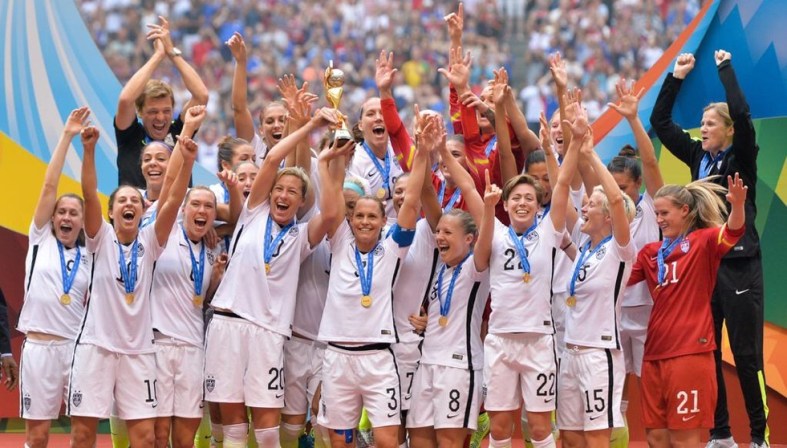
There have been many conversations recently about the wage gap between men and women@work. One of the most egregious discrepancies occurs on the global stage of world cup soccer. Earlier this month, five members of the U.S. Women’s National Team filed a wage discrimination action against the U.S. Soccer Federation. Carli Lloyd, co-captain of the team outlined her position in an essay, ‘Why I’m Fighting for Equal Pay’.

“I’ve worn a U.S. Soccer uniform for 12 years and have done so proudly. I’ve had some of the greatest moments of my life — winning two Olympic gold medals and the 2015 Women’s World Cup — wearing that uniform. So when I joined four teammates in filing a wage-discrimination complaint against U.S. Soccer late last month, it had nothing to do with how much I love to play for my country.

IMG_2458.jpg

When we talk about the wage gap in today’s workplace, experts estimate women earn 79% of a man’s salary for the same job. For U.S. women’s soccer, it’s 17% for the top players and 21% for the rest. There is no overtime pay in a career that requires a player to be on the road for 260 days a year.

In a sport where the women’s team revenue will exceed $5million vs. a $1million deficit for the men’s team, the top five women’s annual salaries are $72K vs the men’s at $406K. Members of the women’s world cup team earn $15K to the men’s $69K. When the women won the world cup last year they earned a $75K bonus. If the men were to win, they would bring home $390K.

The fact that women are being mistreated financially is, sadly, not a breaking news story. It goes on in every field. We can’t right all the world’s wrongs, but we’re totally determined to right the unfairness in our field, not just for ourselves but for the young players coming up behind us and for our soccer sisters around the world.”

In a related story, New York Magazine writer, Dayna Evans reports on the ‘expectation gap’ in salary negotiations uncovered by job marketplace, Hired – ‘Study Finds That Women in Tech Ask for Lower Salaries Than Men Do’.

womenwhocode1

“After analyzing 100,000 interview requests and job offers over the last year, tech job marketplace Hired found that, on average, tech companies offer women 3% less than men for the same roles. Among the most interesting—and troubling—pieces of data is that men receive higher salaries 69% of the time than women for the same job titles at the same companies.

Some of that disparity could be attributable to women not setting their demands high enough. Because Hired’s marketplace lets job seekers specify the salaries they’re seeking, the report provides a glimpse into both expectations and final offers. In roles that are more male dominated, women often set their salary expectations lower than their male counterparts.

Overall, Hired’s data shows that the average woman on our platform sets her expected salary at $14k less per year than the average man on our platform. When we break the expectation gap down by role — comparing women and men in the same job category — we found as the ratio of men to women in the role increases, so does the gap.”

The death of Pritzker Prize winning architect, Zaha Hadid on March 31 prompted The New York Times to send an “informal online questionnaire” asking “female architects among its readers to talk candidly about their experiences in the profession: the progress they’ve made and the obstacles they still face on construction sites and in client meetings.”

“For a woman to go out alone in architecture is still very, very hard,” the architect Zaha Hadid said. “It’s still a man’s world.” Ms. Hadid often stated that she did not want to serve as a symbol of progress for women in her profession. But, inevitably, she did. A study on diversity in the profession released this year by the American Institute of Architects found that “women strongly believe that there is not gender equity in the industry”; that women and minorities say they are less likely to be promoted to more senior positions; and that gender and race are obstacles to equal pay for comparable positions. Since Ms. Hadid won the Pritzker Prize in 2004, the percentage of female architects in the United States has barely grown, increasing to 25.7 percent from 24 percent, according the Bureau of Labor Statistics.”

The article is a series of snapshots of successful architects@work, encountering obstacles in a still white-male dominated field. One example from Yen Ha, Principal of Front Studio Architects in New York.

13archwomen-span-master675

“We absolutely face obstacles. Every single day. It’s still largely a white, male-dominated field, and seeing a woman at the job site or in a big meeting with developers is not that common. Every single day I have to remind someone that I am, in fact, an architect. And sometimes not just an architect, but the architect. I’m not white, wearing black, funky glasses, tall or male. I’m none of the preconceptions of what an architect might be, and that means that every time I introduce myself as an architect, I have to push through the initial assumptions. Every new job site means a contractor who will assume I am the assistant, decorator or intern. It usually isn’t until the third meeting that the project team looks to me for the answers to the architectural problems.”

In 1991 there was a vacancy on the U.S. Supreme Court. Then President George H.W. Bush nominated U.S. Circuit Court of Appeals Justice Clarence Thomas to fill the vacancy. This past weekend, HBO aired ‘Confirmation’, the story of former colleague Anita Hill testifying before the Senate Judiciary Committee that Thomas had sexually harassed her.

Unknown.jpeg

‘The Real Story Behind HBO’s ‘Confirmation’ From The NPR Reporter Who Broke The Story’ provides a Q & A with NPR correspondent, Nina Totenberg.

“I’d been hearing all summer long that there were women who said they were harassed by Clarence Thomas when he was at the EEOC and when he was at the Education Department,” Totenberg said. “But I could never really prove it. And then I heard about this woman, Anita Hill.”

That’s when everything changed.

You don’t recognize this now, but sexual harassment was a dirty little secret that most women had but they didn’t talk about. They were embarrassed by it; it was a hindrance and not a help in any way. Now suddenly, it gets popped into the open. … But all of those silent, female experiences materialized in the … phones exploding on Capitol Hill.”

Thomas was confirmed by a vote of 52-48. The legacy of Hill’s action was a dramatic increase in the number of sexual harassment claims filed with the EEOC.

“NPR received the prestigious George Foster Peabody Award for its gavel-to-gavel coverage — anchored by Totenberg — of both the original hearings and the inquiry into Anita Hill’s allegations, and for Totenberg’s reports and exclusive interview with Hill.”

Totenberg received individual accolades as well, but there was a downside.

“I was pilloried during this. I had one of the great stories of any reporter’s life. I had worked very hard to get it. And the cost was enormous in terms of negative publicity and people trashing me a lot and senators yelling at me. At one point I had a driver at Nightline who went around the corner [and] stopped and he said to me … “Lady, you better get a gun.”

The final story this week is ’50 Years in a Cab: A Long, Winding Trip for One Driver, and His City’, from Elisabetta Povoledo.

Rome_airal_picture.jpg

“From his front-seat perch, Alberto Tomassi, a Roman cabdriver for 50 years, has been both eavesdropper and confessor. He has played impromptu tour guide, thwarted muggings and rushed countless clients to the emergency room.

Expertly navigating Rome’s narrow, potholed streets — many conceived centuries before the internal combustion engine — he has developed the unflappable calm of a Zen monk.

“If you can get through the first 15 years without getting really angry, you can do it forever,” Mr. Tomassi said. “I just take things as they come.”

“You don’t get rich doing this job, but it’s honest work,” he said. “You can raise a family, put your kids through school.”

His only disappointment this year was in not being recognized for his service.

“…no party, no gold watch, no tribute — so he decided to place a round silver sticker emblazoned with “50 years of taxi” on the rear window of his cab.”


The week@work: Inequality on stage, Apple@40, ‘job crafting’ & odd interview questions

As the economy continues to improve, and include workers who had given up, playwrights are staging works that reflect the continued struggle and inequity in the workplace. This week@work we celebrate Apple@40, take a look at ‘job crafting’ as a way to reimagine work and pose a few interview questions.

Nelson D. Schwartz and Neil Irwin reported ‘Jobs and Wages Notching Gains Long In Coming’ for the New York Times.

“Companies have been hiring in recent months at a pace not seen before in this century. Wages are rising faster than inflation. Joblessness is hovering near the low levels last reached in 2007 before the economy’s downturn.

And perhaps most significantly, the army of unemployed people who gave up and dropped out of the job market is not only looking for work, but actually finding it.

“Wages and participation are where the rubber meets the road,” said Michael Gapen, chief United States economist at Barclays. “We will take our cue about the overall strength of the economy based on that.”

At the same time, the chasm widens between the average worker, still trying to recover with modest wage gains, and the quantum leaps in compensation for the wealthy.

It’s this divergence that is reflected in several theater productions, under the heading ‘Haves and have-nots: Putting America’s financial inequality on the stage’. The Economist article reviews ‘The Humans’, ‘Hungry’, ‘Hold On To Me Darling’, ‘The Way West’, ‘Dry Powder’, and ‘Red Speedo’ to illustrate how the economy and work are inspiring a generation of playwrights.

“There is something familiar about the Blakes, the American family at the centre of “The Humans”, a new play by Stephen Karam that is now on Broadway. Anyone who has navigated the emotional minefield of a family meal will recognise the affectionate way they bicker, their barbs softened with tenderness. But something else about this family will also resonate with a growing group of Americans: each member is struggling financially.

This conversation resembles countless others across the country, as Americans try to make sense of an economy in which working hard is no longer enough to afford a comfortable life. Parents who assumed that their children would surpass their own accomplishments are now startled to find so many of them sweating over rent and saddled with college debt. What does it take to get ahead? Why does the system create so few haves and so many have- nots?”

This past week marked the 40th anniversary of Apple. In his commencement speech to the Stanford class of 2005, co-founder Steve Jobs recalled the journey from start-up to his firing by the Board of Directors.

920x1240.jpg

“I was lucky — I found what I loved to do early in life. Woz and I started Apple in my parents’ garage when I was 20. We worked hard, and in 10 years Apple had grown from just the two of us in a garage into a $2 billion company with over 4,000 employees. We had just released our finest creation — the Macintosh — a year earlier, and I had just turned 30. And then I got fired. How can you get fired from a company you started? Well, as Apple grew we hired someone who I thought was very talented to run the company with me, and for the first year or so things went well. But then our visions of the future began to diverge and eventually we had a falling out. When we did, our Board of Directors sided with him. So at 30 I was out. And very publicly out. What had been the focus of my entire adult life was gone, and it was devastating.

We know the rest of the story. Jobs returned to Apple in 1997. David Pierce and Michael Calore identify ‘Fifteen Products That Defined Apple’s First 40 Years’.

iPhone-SE-gaming.jpg

#1 the iPhone

“If you want to understand the iPhone’s importance to Apple, just look at its earnings. But it’s not just that: Without it, our phones might still look like BlackBerries. We might never have learned to pinch to zoom. We might all carry point-and-shoots. It’s almost impossible to overstate the revolution the iPhone started in 2007, which has touched and connected billions of people around the world.”

hiddenbrain_deepbluereverse2_sq-d4dc2bc0fb94c4fa0074fb7ab2e1b681e6245d7a-s400-c85

If you prefer to digest ideas via podcast, add NPR’s Hidden Brain to your subscription list. Last week’s installment featured host Shankar Vedanta in conversation with Yale’s Amy Wrzesniewski on finding meaning in our work.

“Why do you work? Are you just in it for the money or do you do it for a greater purpose? Popular wisdom says your answer depends on what your job is. But psychologist Amy Wrzesniewski at Yale University finds it may have more to do with how we think about our work. Across groups such as secretaries and custodians and computer programmers, Wrzesniewski finds people about equally split in whether they say they have a “job,” a “career” or a “calling.” 

According to Wrzesniewski’s research “people who see work as a calling are more satisfied, engaged, and better performers”. These are folks who “go beyond notice” to craft the boundaries of their job to make work more meaningful.

The last story from this week@work is about interview questions. File it under the query, ‘What was the oddest question you were asked in an interview?’, from recruiting site, glassdoor.com.

Here’s a sample:

“What would the name of your debut album be?” (Urban Outfitters)

“What would you do if you found a penguin in your freezer?” (Trader Joe’s)

And here’s one that we should all be prepared to answer.

“If you were a brand, what would be your motto?” (BCG)

Think about it, and have a great week@work.


The week@work: terror on the way to work, a factory fire anniversary, values-based leadership@Starbucks, a millennial workplace, & a new job benefit


How do you share work thoughts when so many were killed and injured on their way to work on Tuesday morning? Apparently, we go on. I have to agree with the sentiment expressed by writer Pamela Druckerman in today’s New York Times ‘Je Suis Sick of This’.

“To Europeans, Brussels was supposed to be a dull place that you didn’t have to think much about until you had to change planes there. There’s a parlor game in which you stump people by asking them to name 10 famous Belgians. “Brussels, the anti-fanatic attacked by the fanatics,” French journalist Laurent Joffrin wrote in Wednesday’s Libération. “Brussels, a cousin whom one is content to know is there.”

Right after an attack it’s easy to say that everything feels different. People are horrified. Parents keep their kids home from school. Newspapers run headlines like “Europe at War.” There is the sad, familiar search for a slogan: This time, I prefer the Belgian frites arranged to make a rude gesture resembling a finger, and the banner reading, “Je suis sick of this” followed by an expletive.”

We don’t stop working. Maybe we are a bit more vigilant, the slogan ‘If you see something, say something’, temporarily gets more attention.

Journalist Druckerman continued, “Despite the inevitable false positives, it’s hard not to be on guard. I’m constantly making a series of mundane existential calculations: Is it worth it to risk going to a movie? Should I let my kids ride the metro to soccer practice? Daily life has a chiaroscuro quality: One minute you’re riding a bus and enjoying a view of the river; the next you’re wondering about the fellow with an unusually large backpack.”

There were other stories this week@work.

Friday was the 105th anniversary of the Triangle Shirtwaist Factory fire. It resonates with workers today because it was a story of immigrant workers, and led to changes in U.S. factory regulations and safety.

triangle fire.jpeg

Joseph Berger summarized the events in a 2011 article.

“A block east of Washington Square, not far from the neighborhood’s boutiques and chic restaurants, was the site of one of the nation’s worst industrial disasters. Many New Yorkers might be unaware of this.

Some labor advocates are trying hard to change that. They have organized an effort to build a memorial to the infamous Triangle Shirtwaist Factory fire of 1911, in which 146 workers died. Most of them were young immigrant women from Eastern Europe and Italy, and more than 50 jumped to their deaths from the factory’s ninth floor.

Two years ago, Tom Marshall posed the question, “Can disasters make life better for future generations?”  He went on to draw a parallel between the Triangle Shirtwaist factory fire and the 2013 garment factory collapse in Dhaka, Bangladesh.

“In both cases, inspectors visited and filed critical safety reports, but scores of people still died while making clothes for others. The American disaster is now hailed as a turning point that led to safer workplaces and broad support for a minimum standard of workers’ rights, while the Bangladeshi disaster’s impact is less certain.”

This week@work Starbucks chairman and CEO, Howard Schultz spoke at the annual shareholders meeting, and expanded on a conversation begun two years ago on the role and responsibility of a for-profit corporation. “What is the role and responsibility of all of us, as citizens?”

K9sMR38U-1650-1650

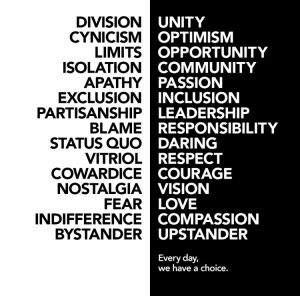
“Viewing the American Dream as a “reservoir” that is replenished with the values, work ethic and integrity of the American people, Schultz said, “Sadly, our reservoir is running dry, depleted by cynicism, despair, division, exclusion, fear and indifference.”

He suggested citizens fill the reservoir of the American Dream back up, “not with cynicism, but with optimism. Not with despair, but with possibility. Not with division, but with unity. Not with exclusion, but with inclusion. Not with fear, but with compassion. Not with indifference, but with love.”

“It’s not about the choice we make every four years,” Schultz said. “This is about the choices we make every day.”

One of the ‘most read’ articles last week, ‘What Happens When Millennials Run the Workplace?’, provided one more illustration that work issues are people issues, and it really doesn’t matter how you generationally identify.

“Joel Pavelski, 27, isn’t the first person who has lied to his boss to scam some time off work.

But inventing a friend’s funeral, when in fact he was building a treehouse — then blogging and tweeting about it to be sure everyone at the office noticed? That feels new.

Such was a recent management challenge at Mic, a five-year-old website in New York that is vying to become a leading news source created by and for millennials.”

The workplace is changing and the 80 million millennials @work will make a significant impact on work/life and the global economy. As a group, the 40 million with college degrees enter the workforce taxed with student loans that are the equivalent of a mortgage. Fidelity Investments announced a new employee benefit last week to address student loan repayment.  Tara Siegel Bernard provided the details.

“Fidelity will apply up to $2,000 annually to the principal of its employees’ student debts.

Fidelity is one of the more prominent employers to announce the student loan repayment benefit in recent months, a policy that seems likely to gain traction. The benefit helps address what some employers describe as a challenge attracting and retaining younger workers, many of whom can’t see beyond the burden of their student debt. Most employers that are offering the new perk also cap their costs at, say, $10,000 total per employee.”

At the end of a difficult week, spring wishes and Happy Easter!

IMG_4148


The week@work: team spirit, setting boundaries@work, getting fired, & the first day of spring

This week@work we review articles on the effectiveness of teams, the risk of not setting boundaries @work, why getting fired isn’t always a bad thing, and a sign of spring.

Organizations are employing cross functional teams to solve a variety of business problems. The Economist explored new research on the effectiveness of teams.

20160319_wbd000

“Leigh Thompson of Kellogg School of Management in Illinois warns that, “Teams are not always the answer—teams may provide insight, creativity and knowledge in a way that a person working independently cannot; but teamwork may also lead to confusion, delay and poor decision-making.”

Profound changes in the workforce are making teams trickier to manage. Teams work best if their members have a strong common culture.

…the most successful teams have leaders who set an overall direction and clamp down on dithering and waffle. They need to keep teams small and focused: giving in to pressure to be more “inclusive” is a guarantee of dysfunction. Jeff Bezos, Amazon’s boss, says that “If I see more than two pizzas for lunch, the team is too big.”

…organisations need to learn something bigger than how to manage teams better: they need to be in the habit of asking themselves whether teams are the best tools for the job…Even in the age of open-plan offices and social networks some work is best left to the individual.”

Travis Bradberry lists ‘6 Things You Don’t Owe Your Boss’. Research at Northern Illinois University found that ‘telepressure’, the stress resulting from constant connection to work, negatively impacts health and cognitive performance.


“We need to establish boundaries between our personal and professional lives. When we don’t, our work, our health, and our personal lives suffer.

You need to make the critical distinction between what belongs to your employer and what belongs to you and you only. The items that follow are yours (health, family, sanity, identity, contacts & integrity). If you don’t set boundaries around them and learn to say no to your boss, you’re giving away something with immeasurable value.”

What if we replaced ‘getting fired’ with ‘moving on’ to describe separating from work? That’s just one of the strategies surveyed by Vivian Giang in ‘Why We Need To Stop Thinking Of Getting Fired As A Bad Thing’.

Unknown.jpeg

“…if we want to change the way we think about someone leaving a company, we need to change the way we think about work. In the book, The Alliance: Managing Talent in the Networked Age, LinkedIn cofounder Reid Hoffman, along with coauthors Chris Yeh and Ben Casnocha, say relationships between employers and employees should be viewed as an alliance where employers are upfront and honest with new hires about their “tour of duty,” and how long each mission will take. That way, it takes away the unrealistic expectation that either, or both, parties can have about the relationship being lifelong, where nothing ever changes.

…the alliance says there are two independent parties that are coming together around certain mutual goals,” says Yeh. “They are going to be very specific about how they work together, really spelling this out and managing expectations, so they’re able to be more honest with each other and build a greater sense of trust.”

That way, employers and employees have a clear sense of what they’re trying to get out of the other party from the beginning. Employees know their mission, and how it will benefit the company and their own career. Employers are able to admit—and be okay with—the knowledge that their employees won’t be there forever.”

The world of work is changing. We talk about the ‘gig economy’ as something new, when the idea of contract employment has been the norm in many industries. Consider a theater or film project. Each professional brings a specific expertise to create magic. Each individual an entrepreneur, each worker an owner; managing the totality of their career, with a mosaic of assignments.

It’s the first day of spring. If you are traveling to Washington D.C. this week, you will arrive in time for the peak bloom of the cherry blossoms. Cherry-Blossoms-Washington-DC-March-18-2016-07-678x453.jpg

“Each year, the National Cherry Blossom Festival commemorates the 1912 gift of 3,000 cherry trees from Mayor Yukio Ozaki of Tokyo to the city of Washington, DC. The gift and annual celebration honor the lasting friendship between the United States and Japan and the continued close relationship between the two countries.”

The week@work: ‘idea debt’, interview questions & women@work: #pledgeforparity & the downside of being a trailblazer

‘Idea debt’, emotional intelligence, International Women’s Day, and lessons from the ‘girl next door who loved sports’, headline our survey of stories this week@work .

Are you a ‘wantrapreneur’? Journalist Oliver Burkeman debunks the belief that thinking about doing something is doing it.

1156.jpg

“I hadn’t seen the problem clearly until the other day, when I encountered the illustrator Kazu Kibuishi’s term for it: “idea debt”. You run up an idea debt, Kibuishi’s fellow artist Jessica Abel explained, when you spend “too much time picturing what a project is going to be like, too much time thinking about how awesome it will be… and too little time actually making the thing”.

Just as the accruing interest on a credit card makes it harder and harder to get back on your feet financially, idea debt impedes action. The more glorious and detailed the pictures in your mind, the more daunting it feels to start making them real.

As Gregg Krech writes in his book The Art Of Taking Action, external reality remains exactly the same after your decision to ask someone out, to write a book, or leave your job. What matters is “creating ripples”, as he puts it – actions, however tiny, that alter things in the world outside your head.”

What are the questions employers ask to determine if a job candidate possesses a solid set of ‘people skills’?  With her article, ‘7 Interview Questions That Determine Emotional Intelligence’, Carolyn Sun not only provides tips for interviewers, but explains the rationale behind the questions for potential hires.

images.jpeg

Here’s one example:

“Can you teach me something, as if I’ve never heard of it before? (It can be anything: A skill, a lesson or a puzzle.)
A job candidate’s answer to this question can reveal several qualities:

Whether the person is willing to take the time to think before speaking.

If the candidate has the technical ability to explain something to a person who is less knowledgeable in the subject.

Whether the candidate asks empathetic questions to the person being taught, such as, “Is this making sense?”

On March 8, International Women’s Day, the Economist “created a glass-ceiling index”, to show where women have the best chances of equal treatment at work. It combines data on higher education, labour-force participation, pay, child-care costs, maternity rights, business-school applications and representation in senior jobs. Each country’s score is a weighted average of its performance on nine indicators.

purple-woman.jpgTo no one’s surprise, Nordic countries come out well on educational attainment and labour-force participation. Women are also relatively well represented in their parliaments; Finland and Sweden were among the first countries to allow women to vote and stand for election. Yet even there women are paid less than men for similar work. In Finland and Sweden the gap is close to the OECD average of 15%, though in Norway it has fallen to 8%.

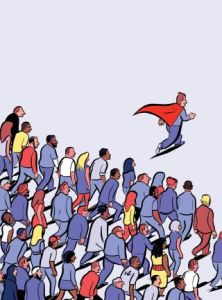
At the bottom of our index are Japan and South Korea. Too few women there have jobs, few senior managers or board members are women and pay gaps are large—in South Korea, at 37%, the largest in the OECD. If, in the UN’s words, “equality for women is progress for all”, both countries have a long way to go.”

If you are interested additional reporting on #pledgeforparity and IWD,  Washington Post journalist Danielle Paquette wrote two stories this week for Wonkblog:

‘It’s 2016, and women still make less for doing the same work as men’

‘Pay doesn’t look the same for men and women at top newspapers’

The next story falls into the category of ‘you should be safe when you pursue your dream job.’

When sports journalist Erin Andrews graduated from the University of Florida in 2000, she began a career that eventually brought her to sidelines of college football at both ESPN and Fox Sports, and the dance floor; first as a finalist and now as the co-host of ‘Dancing With The Stars’.

Sarah Kaplan, reporting for The Washington Post summarized what happened next.

“In 2008, Michael David Barrett, who served 2 1/2 years in federal prison after pleading guilty to interstate stalking — said he chose to target her because she was popular and trending on Yahoo.”

“Erin Andrews wanted to be “the girl next door who loved sports,” she said.

“And now I’m the girl with a hotel scandal,” the Fox sportscaster tearfully told a Tennessee courtroom Monday.”

The trial and jury verdict in her favor last week is just one story of ‘The Dangers of Being a Female Sportscaster’ described by Richard Sandomir and John Branch for The New York Times.

Unknown.jpeg

“Female sportscasters have unparalleled reach in an age of round-the-clock sports broadcasting and the widespread dissemination of their work across social media. There are more of them now than ever, across multiple channels and websites.

The stories Sandomir and Branch recount serve as a guide for all women@work, not just those with a high profile in social media.

“I’ll try to avoid ever being in the hall of a hotel by myself,” said Kim Jones, a reporter for NFL Network. “And I’ll allow whoever is behind me to pass me before I put my card or key in the door. You have to be so aware because unfortunately that one time out of 10,000, something can happen.”

Alyssa Roenigk, a reporter for ESPN the Magazine who also appears on the air, primarily covering action sports like the X Games, said she had rarely given her security much thought. For years, she usually walked from venues to her hotel, even late at night. But as she began to do more television and was recognized more often, she was told by her bosses to start taking the courtesy car provided by the network.

“At first I thought I was getting special treatment, and I don’t want special treatment,” Ms. Roenigk said. “It’s not special treatment. It’s being safe.”

Stay safe this week@work, create some ripples and start reducing that ‘idea debt’.


The week@work – leadership, lawyers, student loans & the economy

What makes a great leader or a great lawyer? What’s the best strategy to retire student debt? This week@work surveys articles that provide some answers, and as the economy continues to strengthen, offers some practical advice on career advancement.

Joshua Rothman wrote ‘Shut Up and Sit Down: Why the leadership industry rules’ for The New Yorker. He gives us a quick tutorial on the history of leadership, why we value the concept, but are so often disappointed in the people. He alludes to the current presidential contest, and then focuses on change in both our expectations of leaders, and the roles they play in contemporary organizations.Print

“In recent years, technological and economic changes like social media and globalization have made leaders less powerful.

Leaders used to be titanic and individual; now they’re faceless guiders of processes. Once, only the people in charge could lead; now anyone can lead “emergently.” The focus has shifted from the small number of people who have been designated as leaders to the background systems that produce and select leaders in the first place.

Leaders, moreover, used to command; now they suggest. Conceptually, at least, leadership and power have been decoupled.

To some extent, leaders are storytellers; really, though, they are characters in stories. They play leading roles, but in dramas they can’t predict and don’t always understand. Because the serialized drama of history is bigger than any one character’s arc, leaders can’t guarantee our ultimate narrative satisfaction. Because events, on the whole, are more protean than people, leaders grow less satisfying with time, as the stories they’re ready to tell diverge from the stories we want to hear. And, because our desire for a coherent vision of the world is bottomless, our hunger for leadership is insatiable, too. Leaders make the world more sensible, but never sensible enough.”

The New York Times profiled two women who chose law as their profession and took divergent, pioneering paths to achieve success. What makes a good lawyer? Meet Kimberley Chongyong Motley and Damaris Hernandez.

David Jolly profiled Ms. Motley, who has been practicing her profession in Afghanistan for close to eight years and was recently the subject of an award winning documentary, ‘Motley’s Law’.

image.adapt.990.high.kimberley_motley_05feb2016_portrait.1454770287607“Ms. Motley, 40, a Marquette University Law School graduate, had never before traveled overseas when she enrolled in a Justice Department program to train Afghan lawyers and flew to one of the world’s more dangerous places.


After her nine-month assignment, she did not return home to Milwaukee, instead hanging out her own shingle in Kabul. She studied Shariah, the Islamic code that lies beneath the fragile new Afghan Constitution, and she established herself as the only foreign litigator in one of the world’s most conservative and male-dominated cultures.

Ms. Motley says she makes a point of closely studying the cultures of both Afghanistan and the courtroom. “I’m a sort of legal archaeologist,” she said. “I try to uncover laws that have not been used, and then use them for the benefit of my clients.”

Damaris Hernandez was recently promoted to partner at the firm Cravath, Swaine & Moore, becoming the first Latina to reach that position. Elizabeth Olson tells her story as a first generation college student, who advanced in her career with the support of a unique scholarship at NYU.

Hernandez web.jpg

That achievement is an acknowledgment of her talent and hard work. But the story of her route to the top also reveals how much more complex the journey is for minorities and women than for the white men who overwhelmingly dominate the firms. Skill is only one of the keys. Being able to navigate unspoken rules is at least as important.

“When I was the only one of color or the only woman in the room, I had the confidence to believe in my ability,” said Ms. Hernández, 36, describing the advantages of the program to her. “When you are the first, you need someone to have your back.”

Over the last decade and a half, she and 100 others who attended the New York University School of Law received that support from a scholarship program that paid their full tuition and also gave them access to a network of luminaries including federal judges, law firm partners and even Supreme Court justices.”

If you are seeking ways to reduce your student loan obligation, NPR’s Yuki Noguchi offers ‘Strategies For When You’re Starting Out Saddled With Student Debt’. It’s not just about individual liability, but also the long term impact on career choice and economic growth.

“Experts say studies show rising student debt is limiting peoples’ career options. They decide against graduate school. Or feel they can’t afford lower-paying public service jobs or the risk of starting a new business. That’s a problem, because new companies create new jobs.”

University Park campus of the University of Southern California

This past week the University of  Southern California announced a tuition increase that will bring the annual bill to over $51,000. Financing college involves loans as part of the  package. Having a repayment strategy is critical to long term career success.

“Chris Costello, CEO of Blooom, a personal finance advice firm targeting lower-net-worth people, advises his firm’s clients to tackle student debt with this strategy.

First, if your employer matches contributions to a retirement plan, such as a 401(k) or 403(b), max out on the matching contributions.

After maxing out on the matching contributions, pay off the debt with the lowest balance.

Check to see if you can qualify for loan forgiveness, refinancing or debt consolidation.

Do not incur new debts: in other words, live below your means.”

Chico Harlan of The Washington Post reported on the latest figures released by the U.S. Labor Department on Friday.

“U.S. employers continued their rapid hiring in February, new government data showed Friday, a sign of the nation’s economic durability during a tumultuous global slowdown.

The U.S. added 242,000 jobs as the unemployment rate held at 4.9 percent, the lowest mark during the seven-year recovery from the Great Recession.

That pace, consistent with gains over the last year, indicates Americans are returning rapidly to the labor force, helped by steady consumer spending that is bolstering demand and prompting employers to expand their workforces. In data released Friday by the Department of Labor, sluggish wages provided the only disappointing note — a signal that labor market still has room to improve.”

Two other articles of interest this week:

’15 things successful 20-somethings do in their spare time’ by Jacquelyn Smith and Rachel Gillett for Business Insider

‘How to Advance In Your Career Without Becoming A Workaholic’ by Lisa Evans for Fast Company


The week@work – It’s in the stars: Hollywood stories, #YearInSpace & 18,300 applications

The stories behind the headlines this week@work originate in Hollywood, Geneva, Washington D.C., and on the International Space Station.

The careers of a U.S. deputy trade ambassador and an executive editor for the Washington Post converge in Hollywood, astronaut Scott Kelly captures the final week of his #YearInSpace in photos, and 18,300 applicants aspire to take his place.

Unknown

Would you get up at 4:30 AM every day to pursue your dream? Alexandra Alter reported on a ‘behind the scenes’ Hollywood story about working beyond your ‘day job’.

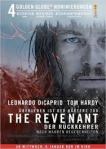
One of the most successful global trade negotiators added a few hours to his work day 17 years ago to write a novel about fur trader Hugh Glass. His book, ‘The Revenant’ was published in 2002 and sold 15,000 copies. Last year publisher Picador reissued the novel, selling over half a million copies.

images

Michael Punke, the deputy United States Trade Representative and the United States ambassador to the World Trade Organization and author, has become a rock star among colleagues in global trade.

“We all think it’s quite cool,” said Keith Rockwell, a spokesman for the W.T.O., who added that colleagues occasionally tease Mr. Punke by asking him how his buddy Leo is doing. “The W.T.O. isn’t normally known for having a Hollywood connection.”

Some of his colleagues marvel that he has such a successful side career, while steering the country’s international trade policy from his post in Geneva.

“The guy is so talented, you read his bio, and it’s like he has two lives,” said Christopher Wenk, the executive director for international policy at the U.S. Chamber of Commerce.”

Joining Ambassador Punke at the Dolby Theater on Oscar night is current Washington Post executive editor and former Boston Globe editor Martin Baron.

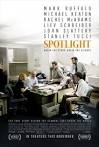
In November, Esquire Magazine ran a career profile asking ‘Is Martin Baron the Best News Editor of All Time?’. In the Oscar nominated film, ‘Spotlight’, actor Liev Schreiber’s performance channels the editor who led the Pulitzer Prize winning team investigating the child abuse scandal in the Catholic Church.

Unknown-1.jpeg

This week, Mr. Baron used his time in the Oscar ‘spotlight’ to reflect on the long term rewards of the film and journalism today, ‘I’m in ‘Spotlight’, but it’s not really about me. It’s about the power of journalism.’

“Aside from the acclaim of critics, “Spotlight” already has delivered one gratifying result. In emails, tweets and Facebook posts, journalists have declared themselves inspired, buoyed and affirmed. That is no small matter in this badly bruised profession. We have felt the traumatizing financial effect of the Internet and been berated by just about everyone, especially politicians in a campaign season that has seen us cynically labeled “scum.”

One journalist wrote me that “the story that inspired the movie serves as a wonderful, wonderful reminder why so many of us got into this business in the first place and why so many stayed despite all the gloom and doom and all the left hooks that landed squarely on our chins along the way.”

The article is required reading for all who earn a living pursuing a journalism career. It should be framed on the walls of journalism schools and be the first google search result on the world ‘journalism’.

Two additional stories about work in Hollywood this week addressed the ongoing conversation on inclusion:

‘From C-Suite to Characters on Screen: How inclusive is the entertainment industry?’ USC Annenberg professor Stacy L. Smith authored the MDSC Initiative’s first report on diversity in the entertainment industry.

Melena Ryzik profiled 27 industry professionals in ‘What It’s Really Like to Work in Hollywood*  (*If you’re not a straight white man.)’

Before leaving the week@work, let’s travel to the International Space Station where astronaut Scott Kelly is completing his 240 day mission in space.

CTeSzSOWIAApQID

“10,944 sunrises and sunsets

“The International Space Station zips around Earth at more than 17,000 miles per hour, or once every 90 minutes. That means over the course of Mr. Kelly’s stay, the space station will have made 5,440 orbits, and the sun will have gone up and down 10,944 times from the perspective of the astronauts aboard. Of course, Mr. Kelly did not see all of them. He is not continuously looking out the window, and he sleeps, too.”

(Scott Kelly tweeted the photo above of sunrise on February 27 and ice earlier today)CcT9mfcW4AAZFvx.jpg

NASA announced this week that it had received 18,300 applications for 14 open spots in the new astronaut class. The recruiting effort which began in the fall demonstrates a rekindled interest in exploration and discovery.

“Now that NASA’s Feb. 18 deadline for applicants has passed, the agency’s 18-month winnowing process has begun.

NASA staff will look at 400 to 600 applicants who survive the initial purge and identify those who pass reference and background checks. Then 120 will be invited to the Johnson Space Center for interviews.

The final 14 will be announced in July 2017 and begin two years of extensive training on spacecraft systems, spacewalking skills, team building and Russian language. Those who complete the program will be assigned to NASA’s Orion deep space exploration ship, the International Space Station or one of two commercial vehicles in development.”

As @StationCDRKelley vacates his spot on the ISS, it’s good to know there are thousands who hope to fill his seat.

This week@work – it’s in the stars, and the dreams of those who aspire to be actors, film makers, journalists, writers, astronauts, and international trade negotiators.