The week@work – Stock market volatility, workplace violence, effective hiring tactics and the best jobs require you to be a ‘people person’

This was probably not the best week@work with stock market volatility and one of the most horrific incidents of workplace violence broadcast live on the morning news.

The first shock of the week came in the global stock market and created an opportunity for one corporate leader to step out from the cable news apocalyptic babble.

In response to the crisis in world financial markets, Starbucks CEO, Howard Schultz sent a email to his employees both to ease worries about the impact on Starbucks’ business and encourage them to understand the mood of their customers. The email was met with mixed reviews outside the Starbucks organization, but was consistent with the Shultz’s style and the culture of ‘servant leadership’.

“Our customers are likely to experience an increased level of anxiety and concern. Please recognize this and–as you always have–remember that our success is not an entitlement, but something we need to earn, every day. Let’s be very sensitive to the pressures our customers may be feeling, and do everything we can to individually and collectively exceed their expectations.”

The second shock of the week arrived with breakfast, in Roanoke, Virginia. Two journalists, Alison Parker and Adam Ward were murdered @work early Wednesday morning, doing what they loved. Their deaths will be added to the global total of 42 journalism deaths since the beginning of the year.

CNN political commentator, Errol Louis responded with a thoughtful opinion piece, ‘The real issue behind on-air killings of journalists’.

“According to the National Institute for Occupational Safety and Health, a federal agency, while workplace violence has dropped in recent years, it is still startlingly frequent. Nearly a decade ago, according to the agency, 20 workers were murdered every week. A more recent report shows the tide of violence declining, but as of 2009, 521 people were killed on the job and 572,000 non-fatal violent crimes took place, including rape, robbery and assault.”

“…we have to stop treating workplace killings as sporadic, one-time bursts of irrational behavior.”

Workplace safety has to be a priority for CEOs. It effects all aspects of organization culture, beginning with the ability to attract and retain talent.

Two additional stories from the week@work focus on talent@work: finding it and nurturing it.

How do you find people who will be successful in your organization? CEO Richard Sheridan of  software design firm, Menlo Innovations, shared his company’s approach.

“Menlo hires people in mass auditions conducted several times a year. The process is designed to mimic the company’s operations. Our staff spends their days working in pairs, with each pair collaborating on a distinct task, sharing a single computer. So when applicants show up for our auditions, we pair them up and give each pair a single sheet of paper and a pencil. Then we set them to work on a task, Menlo style.”

“Candidates who make the first cut return for a test of skills that–like the mass audition–is an immersion in our process and culture. The candidate comes in for a full paid day working on real projects. She pairs with one Menlonian in the morning and a different Menlonian after lunch. If both give her a thumbs-up, we offer a three-week trial contract. We make special arrangements for those who can’t risk taking time away from their current situations.”

The selection and retention of candidates who become contributing members of an organization’s community is a major challenge for leadership. Each week you can find articles on creative ways to recruit. In a world of algorithmic forecasts, maybe it’s time to get back to basics and invite candidates into the reality of the workplace with the first interview.

Andrew Flowers reporting for ‘The FIveThirtyEight Economics’ finds ‘The Best Jobs Now Require You To Be A People Person’.

“To land a lucrative job today, hard skills in math and engineering, for instance, may not be enough. As technology allows us to automate more technical jobs, new research shows that people skills — communicating clearly, being a team player — matter more than ever. And women appear to be the ones capitalizing on this shift in the workplace.

“The days of only plugging away at a spreadsheet are over,” David Deming, an associate professor of economics at Harvard, told me. Deming is the author of a new working paper, “The Growing Importance of Social Skills in the Labor Market,” which shows how today’s high-skill, high-paying jobs — like consultants and managers — increasingly require interpersonal skills.”

You can’t land your first job and relax. It’s the beginning of a lifelong learning experiment interacting with customers, investors and colleagues. And you will need an array of communication skills to advance. Which brings us back to the first story of Starbucks founder Howard Schultz. It’s his emotional intelligence combined with his business savvy that has led to his success and ability to influence the national conversation on work and workers.

The week@work – The time we spend @work, unpaid interns@the UN, no union for college football and the value of one good friend

Sarah Boseley reported on Wednesday on the health risks of working long hours for The Guardian newspaper in the UK.

“The largest study conducted on the issue, carried out in three continents and led by scientists at University College London, found that those who work more than 55 hours a week have a 33% increased risk of stroke compared with those who work a 35- to 40-hour week. They also have a 13% increased risk of coronary heart disease.

The findings will confirm the assumptions of many that a long-hours culture, in which people work from early in the morning until well into the evening, with work also intruding into weekends, is potentially harmful to health.”

During a discussion of these findings on CBS This Morning, co-anchor Charlie Rose turned the conversation to a discussion of how we define work.

“For some people reading a lot is play and pleasure. For others it’s work. It’s part of what they do and how they spend their time. It’s one thing to be on an assembly line, I think, and another thing to be reading a novel in preparation to interview someone. 

Where do we draw the line? Is there a line? That is the topic of the next article this week@work.

The New Yorker writer, Tim Wu thinks ‘You Really Don’t Need To Work So Much’. He questions why we have allowed ourselves to become players in “a football game where the whistle is never blown”. His solution, work should fulfill society’s needs with minimal effort. Let the workaholics have their fun, but not at the expense of the rest of us.

“The past fifty years have seen massive gains in productivity, the invention of countless labor-saving devices, and the mass entry of women into the formal workforce. If we assume that there is, to a certain degree, a fixed amount of work necessary for society to function, how can we at once be more productive, have more workers, and yet still be working more hours? Something else must be going on.”

“…in white-collar jobs, the amount of work can expand infinitely through the generation of false necessities—that is, reasons for driving people as hard as possible that have nothing to do with real social or economic needs.”

“The antidote is simple to prescribe but hard to achieve: it is a return to the goal of efficiency in work—fulfilling whatever needs we have, as a society, with the minimal effort required, while leaving the option of more work as a hobby for those who happen to love it.”

Does society need more unpaid interns? Apparently the United Nations thinks so and has grown their ‘volunteer workforce’ from 131 in 1996 to over 4,000 worldwide this year. ‘The Economist Explains why the UN doesn’t pay it’s interns’.

“The story of an unpaid intern living in a tent in Geneva did not make the United Nations look good. David Hyde, a fresh-faced 22-year-old from New Zealand, said he set up camp on the banks of Lake Geneva because he could not afford the Swiss city’s exorbitant rents while working for free. The news stirred up public outrage as well as sympathy from Mr Hyde’s colleagues: scores of UN interns in Geneva walked off the job on August 14th to protest against his plight. That same day a cluster of “interns’ rights” groups penned an open letter to the UN’s secretary-general, Ban Ki-moon, pointing out that the practice of not paying interns sits awkwardly with Article 23 of the organisation’s own Universal Declaration of Human Rights (“Everyone who works has the right to just and favourable remuneration ensuring for himself and his family an existence worthy of human dignity”). So why doesn’t the UN pay its interns?”

“They fear that paid internships may become a back door for recruitment and increase competition for coveted low-level “professional” positions.”

Excuse me, isn’t that why you do an internship? Isn’t this the apprenticeship that may one day lead to a full time job?

And while we are on the subject, let’s turn our attention to another group of unpaid collegians in the news this week, college football players. On Monday the U.S. National Labor Relations Board dismissed a petition from Northwestern University football players to form a union.

Ben Strauss reported on the board’s rationale in The New York Times:

“The board did not rule directly on the central question in the case — whether the players, who spend long hours on football and help generate millions of dollars for Northwestern, are university employees. Instead, it found that the novelty of the petition and its potentially wide-ranging impacts on college sports would not have promoted “stability in labor relations.”

Citing competitive balance and the potential impact on N.C.A.A. rules, the board made it clear that it harbored many reservations about the ramifications of granting college athletes, much less a single team, collective bargaining rights.”

For some college football players, their teammates are their best friends. And it may explain why many are so resilient.

Melissa Dahl described recent research in the UK for New York Magazine, ‘Having Just One Good Friend Strengthens Kids’ Resilience’.

“Let’s take a moment to praise the wonders of the true-blue best friendship, an especially powerful thing during the teenage years. A new study, published earlier this summer in the British Journal of Psychology, looked at this idea specifically among kids from low-income neighborhoods, and found that kids with just one solid, supportive friendship also tended to show signs of greater resilience when facing adversity than the kids with lower-quality friendships.

In their analysis, the researchers found an association between higher-quality friendships and greater resilience, likely, they theorize, because of the emotional support and the sounding board a real best friend provides.”

Here are a few more articles from the week@work that you may have missed.

The Future of Work and Workers – The Pacific Standard began a series this week exploring “What worries you most—and/or excites you most—about the future of work and workers? Put another way: What will be the most consequential changes in the world of work and workers, and what anxieties and possibilities will they produce?”

What the First Female Rangers ProveElizabeth Samet for Bloomberg View “Access to Ranger School, and combat units, is really about access to leadership opportunities. Of the 12 four-star Army generals currently on active duty, all are men. Eleven began their careers in the infantry or armor branch. Ten wear the Ranger tab. In other words, if you want a chance of running the Army, you would do well to go to Ranger School.”

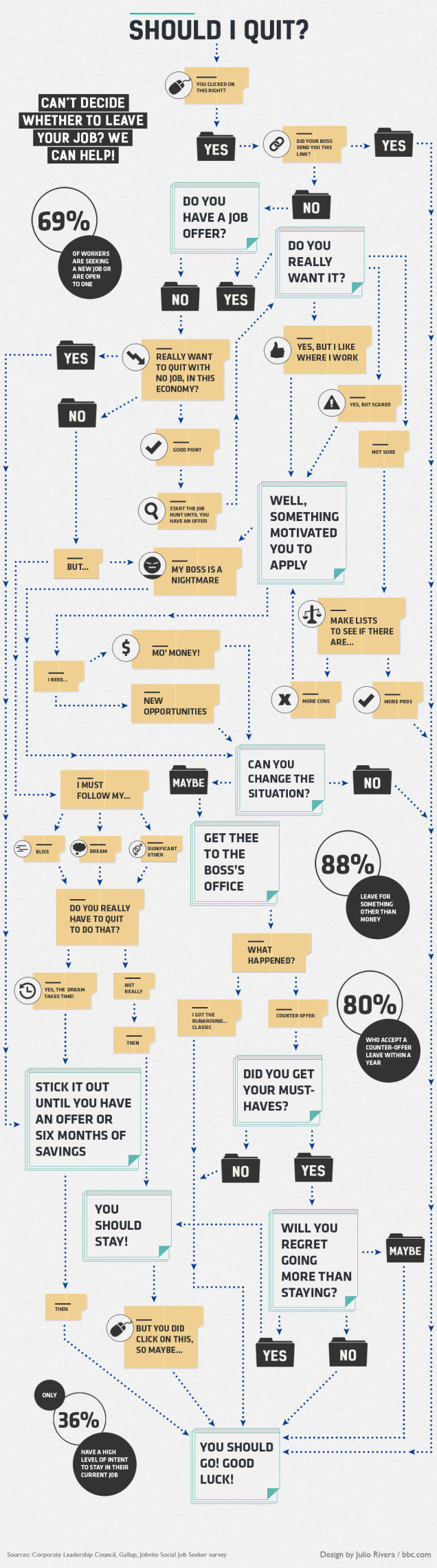
To Quit Or Not To Quit? This Flowchart Tells If It’s Time George Mortimer for Lifehack “Changing jobs or careers is something many people think about, but never seriously consider until it’s too late to change. The use of this flowchart makes it easier for you to determine if your current job satisfies your lifestyle. In basic terms, if your job isn’t making your life better you’re probably better off finding a new one.”

1372360723813364326

The week@work – The pressure to succeed @school, @work and @amazon

This week@work includes articles that echo a growing concern that we are not adequately preparing our children for the future @work, millennials expectations @work, and Amazon’s culture that just may be more in line with those expectations.

Are we teaching our children to fear failure? Contributing Atlantic writer Jessica Lahey answers the question by narrating a parent – teacher conversation. The parent is expressing a concern about a child who is achieving academically but losing the desire to learn.

“The truth—for this parent and so many others—is this: Her child has sacrificed her natural curiosity and love of learning at the altar of achievement, and it’s our fault. Marianna’s parents, her teachers, society at large—we are all implicated in this crime against learning. From her first day of school, we pointed her toward that altar and trained her to measure her progress by means of points, scores, and awards. We taught Marianna that her potential is tied to her intellect, and that her intellect is more important than her character. We taught her to come home proudly bearing As, championship trophies, and college acceptances, and we inadvertently taught her that we don’t really care how she obtains them. We taught her to protect her academic and extracurricular perfection at all costs and that it’s better to quit when things get challenging rather than risk marring that perfect record. Above all else, we taught her to fear failure. That fear is what has destroyed her love of learning.”

Innovation is the product of failure. At a time when global competition is intense, there is a shortage of the curious, the questioning.

It’s time to reevaluate our priorities and help “kids rediscover their intellectual bravery, their enthusiasm for learning, and the resilience they need in order to grow into independent, competent adults.”

What happens when these adults move into the workplace? What are their expectations?

In 2007 the Gallup Management Journal published the results of a poll of job seekers asking what was important to them in their job search.

“Nearly half of job seekers say the opportunity to learn and grow, the opportunity for advancement, and earning promotions based on merit are extremely important when looking for a job”

It follows that the quality of management and the relationship with ‘the boss’ are critical factors in recruitment and retention.

“Companies know they must offer competitive compensation packages when fighting for talented employees, and they must offer the right types of work for those seeking jobs. If they don’t revise their recruiting pitch to include concrete examples of great management, and if they don’t have great managers in the first place, then job seekers will listen to companies that do.”

Hopefully great managers will allow employees to fail. But apparently not, according to the next story about the generation we continue to label as millennials.

In a post for Inc. Chis Matyszczyk gives us four reasons these folks are leaving their jobs.

“They’ve seen what corporate life did to their parents, so they’ll take it just in small doses, thanks. They see through their bosses (and their bosses hate them for it). Millennials look at the corporate world and understand how uncertain the future is. Most of their role models got rich quick.”

If the expectation is to take corporate life in small doses, perhaps a resume should include some time at the world’s biggest retailer.

Welcome to orientation at Amazon. The ‘above the fold’ story in The New York Times today describes the corporate culture at Amazon. As all things Amazon the culture reflects the values. leadership principles and vision of Jeff Bezos.

“Amazon may be singular but perhaps not quite as peculiar as it claims. It has just been quicker in responding to changes that the rest of the work world is now experiencing: data that allows individual performance to be measured continuously, come-and-go relationships between employers and employees, and global competition in which empires rise and fall overnight. Amazon is in the vanguard of where technology wants to take the modern office: more nimble and more productive, but harsher and less forgiving.”

Key to Amazon’s success is Jeff Bezos’ realistic view of the new employer-employee contract – one based on mutual utility.

“…he was able to envision a new kind of workplace: fluid but tough, with employees staying only a short time and employers demanding the maximum.”

A few additional articles from the week@work:

‘Design As Strategy’ Adi Ignatius for The Harvard Business Review, September 2015 issue: “…illustrates some of the ways design thinking is starting to power corporate strategy.”

The Perils of Ever-Changing Work Schedules Extend to Children’s Well-Being‘ Noam Scheiber for The New York Times, 8/12: “A growing body of research suggests that children’s language and problem-solving skills may suffer as a result of their parents’ problematic schedules, and that they may be more likely than other children to smoke and drink when they are older.”

‘The Makeup Tax’ Olga Khazan  The Atlantic 8/5  “Years of research has shown that attractive people earn more. Thus, the makeup tax: Good-looking men and good-looking women both get ahead, but men aren’t expected to wear makeup in order to look good.”

The week@work – Unemployment, economic mobility, parental leave, a tribute to #55 and anticipating Rio

The week@work included the first debate of the 2016 election season, the release of economic indicators and two American corporations announcing generous parental leave policies. This week also marks one year until those who work in sports will demonstrate their skills at the Summer Olympics in Brazil. And the NFL, in its wisdom, denied a Hall of Fame inductee’s daughter the opportunity to fulfill a father’s wish.

Once again, the week@work was about values: those we hold as a society and those organizations demonstrate not just in policies, but in action.

The June jobs numbers were released by the Labor Department on Thursday. Ben Casselman reported on the numbers behind the numbers in his article for ‘FiveThirtyEight’, ‘Don’t Forget The Workers The Recovery Is Leaving Behind’.

“U.S. employers added 215,000 jobs in July, the Bureau of Labor Statistics said in its monthly jobs report on Friday. It was the third straight month of job growth above 200,000, and the 10th in the past year. Revisions to prior months’ data added another 14,000 jobs, and the unemployment rate held steady at 5.3 percent, the lowest it’s been since before the recession.

Although the progress has been impressive, it has not been absolute. The headline unemployment rate is nearing a level most economists consider healthy — policymakers at the Federal Reserve consider a rate of between 5 percent and 5.2 percent “normal” over the long term — but the government’s official definition of unemployment leaves out people who have stopped looking for work or are stuck in part-time jobs. A broader underemployment rate, which includes both groups, stood at 10.4 percent in July, still well above its prerecession level.

It’s worth paying particular attention to a handful of groups that were hard-hit by the recession and continue to struggle in the recovery: African-Americans, young people, the less-educated and the long-term unemployed. The good news: All four groups are seeing some improvement, in some cases rapid improvement. But all of them have a long way to go before their employment could be considered healthy.”

In a related opinion piece, Nicholas Kristof posed the question, ‘U.S.A., Land of Limitations?

“Researchers have repeatedly found that in the United States, there is now less economic mobility than in Canada or much of Europe. A child born in the bottom quintile of incomes in the United States has only a 4 percent chance of rising to the top quintile, according to a Pew study.

…more children in America live in poverty now (22 percent at last count) than at the start of the financial crisis in 2008 (18 percent). They grow up not in a “land of opportunity,” but in the kind of socially rigid hierarchies that our ancestors fled, the kind of society in which your outcome is largely determined by your beginning.”

The week@work story with the most press was the decision by Netflix, soon followed by an announcement from Microsoft, to offer extended parental leave.

Vauhini Vara writing in The New Yorker reports on ‘Why Parental Leave Remains a Privilege’.

“There are other reasons for policies like Netflix’s, besides the fight over talented workers. Gerry Ledford, a senior research scientist at the University of Southern California’s Center for Effective Organizations, pointed out that the companies that offer costly benefits, like long paid parental leaves, tend to be financially successful, with money available to spend on H.R. perks. Google and Facebook are highly profitable, and while Netflix is only barely profitable, investors don’t seem to mind; the company’s share price set a new record on the day that Netflix announced its updated parental-leave policy. A third factor—and perhaps the least known—has to do with Silicon Valley’s location in California, where all workers have access to some amount of paid leave for the first six weeks after the birth or adoption of a child; it’s easier for a company to justify generous parental leave when many of their employees were already taking time off anyway.”

This time next year we will all be cheering our respective nations as athletes compete at the Summer Olympics in Brazil. As NBC rolled out their initial commercials in anticipation of hours of broadcast time, two stories offered a preview of the competition.

The first was part of a series of videos produced by GoPro. Beach volleyball competitor and Olympic silver medalist April Ross narrates a four minute video describing her ‘life @work’ on the beach. For young women who aspire to elite competition, April’s perspective is a window on the dedication required to succeed. She shares her pride at winning silver but is motivated to take that “one step up on the podium” in Rio. Her best advice, “Don’t get caught up in other people’s expectations”.

And then there is the young woman who goes to work every day in the water. Katie Ledecky startled all in London in 2012, when she earned gold in the 800 meter freestyle. This week she won five gold medals at the World Championships. The New York Times reported on her achievement, becoming “the first to win the 200, 400, 800 and 1,500-meter freestyles in a major competition.”

“Ledecky capped off a history-making week on Saturday at Kazan Arena with another milestone. In the 800-meter freestyle, the event that launched Ledecky into the international spotlight at the 2012 London Olympics, she set her 10th world record of the past 24 months with a clocking of 8 minutes 7.39 seconds. The time was 3.61 seconds better than her 13-month-old mark.

Ledecky, 18, slapped the water three times — once for each individual world record she set at these world championships.”

Junior Seau was a football player. On Saturday he was inducted along with seven others into the Football Hall of Fame in Canton, Ohio. The New York Times covered the ceremony and the story behind the story.

“In his 20-year N.F.L. career, Junior Seau established himself as one of the game’s greatest linebackers. He committed suicide in 2012 at age 43 and was subsequently found to have had a degenerative brain condition linked to repeated hits to the head. Before his death, Seau told his daughter Sydney that she should speak on his behalf if he made it into the Pro Football Hall of Fame. But the Hall, citing a five-year-old policy of not letting others give full speeches for deceased inductees, did not allow Sydney to deliver her speech.”

Today, The New York Times printed Sydney’s complete remarks as the full page lead story of the sports section. Her words reflect the sincere love and respect of a daughter for a father and a desire to fulfill his wish. One wonders, one more time, about the disconnect at the NFL between stated and demonstrated values.

“The two words that exemplify my dad the most are “passion” and “love.” Everything he achieved, accomplished or set his mind to was done with both qualities. In every situation — whether it be practice, a game, a family barbecue, an impromptu ukulele song or just a run on the Oceanside Strand — he always gave you all of himself because to him, there was never any other option.”

“Being the first Polynesian and Samoan to make it into the Hall of Fame is such an accomplishment. He is proof that even a young boy from Oceanside can make his dreams a reality. All his success is a direct reflection of the Oceanside community and family that raised him and molded him into the man he became. Although he is the first Polynesian to make it into the Hall, I know he will not be the last.”

The week@work – How to live wisely, raise strong women, the value of a liberal arts education and more

It’s that time of year, ‘back to school’. It doesn’t matter if you are preschool or college, your local retail outlet is ready to meet every consumer need to outfit you or your dorm room. It’s also ‘back to work’ for those returning from vacation ( if you are one of the six in ten who took some leave this summer). There was a lot going on this week@work. Here are a few stories to get your Monday morning office conversations going.

Harvard professor Richard J. Light, the author of a 2001 book, ‘How to Make the Most of College’ asked New York Times readers to imagine they were dean for a day in a new article, ‘How to Live Wisely’. Before you skip to the next paragraph, stay with me. His questions have relevance for all leaders.

“Imagine you are Dean for a Day. What is one actionable change you would implement to enhance the college experience on campus?

I have asked students this question for years. The answers can be eye-opening. A few years ago, the responses began to move away from “tweak the history course” or “change the ways labs are structured.” A different commentary, about learning to live wisely, has emerged.

What does it mean to live a good life? What about a productive life? How about a happy life? How might I think about these ideas if the answers conflict with one another? And how do I use my time here at college to build on the answers to these tough questions?”

Once we leave college and begin to move ahead in our careers these questions become even more critical in our quest of life long learning.

Professor Light offers “five exercises that tackle the big questions”. Number three:

“I call this the Broad vs. Deep Exercise. If you could become extraordinarily good at one thing versus being pretty good at many things, which approach would you choose? We invite students to think about how to organize their college life to follow their chosen path in a purposeful way.”

Rephrase this one in respect to your career preparation. Have you organized your life around your choice to develop an expertise or be more of a generalist?

The next story may be too late for some struggling small colleges, but Forbes magazine reported ‘That ‘Useless’ Liberal Arts Degree Has Become Tech’s Hottest Ticket’. ( Full disclosure here, I have one of those ‘useless’ degrees and have found it extremely complementary to my career choices.)

“Engineers may still command the biggest salaries, but at disruptive juggernauts such as Facebook and Uber, the war for talent has moved to nontechnical jobs, particularly sales and marketing. The more that audacious coders dream of changing the world, the more they need to fill their companies with social alchemists who can connect with customers–and make progress seem pleasant.”

Liberal Arts = Social Alchemy? Has a six figure ring to it.

On the millennial front this week there were two stories in The New York Times. The first reported on a new Pew Research Study which found that millenials are less likely to leave the nest.

“In 2010, according to the study, 69 percent of 18- to 34-year-olds lived independently. During the first four months of this year, just 67 percent of that same age group was living independently. From 2010 to April 2015, the share of young adults living in their parents’ homes has increased to 26 percent from 24 percent, the study said.”

For those who have left the nest to build their own, another Times report found ‘Millennial Men Aren’t the Dads They Thought They’d Be’.

“Young men today have aspirations of being hands-on fathers as well as breadwinners — supportive husbands who also do dishes.

But as they enter that more responsibility-filled stage of life, something changes: Their roles often become much more traditional.

Millennial men — ages 18 to early 30s — have much more egalitarian attitudes about family, career and gender roles inside marriage than generations before them, according to a variety of research by social scientists. Yet they struggle to achieve their goals once they start families, researchers say. Some researchers think that’s because workplace policies have not caught up to changing expectations at home.”

This research and story is one to follow as this generation now makes up the largest % of the workforce. As they progress in their careers it will be interesting to see if attitudes begin to align with work/life policies.

Amy Joyce reporting in the Washington Post poses the question: ‘Are you holding your own daughter back? Here are 5 ways to raise girls to be leaders.’ This is another must read article with research backed practical suggestions for parents to avoid gender bias.

“Think you’re raising your daughter to be a strong leader? Look more closely: You, and the people around her, may unwittingly be doing just the opposite.

Teen boys, teen girls, and, yes, even parents have biases against girls and women as leaders, new research from the Harvard Graduate School of Education and its Making Caring Common project found.

Richard Weissbourd, a Harvard psychologist who runs the Making Caring Common project, said he was “surprised by the extent of it … how gendered both the boys’ and the girls’ responses were.”

Weissbourd decided to look at bias as part of the larger goal of helping children learn to be kind. “We were concerned that biases get in the way of people caring about and respecting other people, so our initial study was just looking at biases,” he said. “And one of the striking findings that emerged was gender bias.”

And the last story is related to the photo in the header. Erica Murphy, editorial assistant at Levo shared ‘7 Things I Learned About Life From Completely Unplugging’. (This one’s for you – the 4 in 10 who have not taken vacation this summer) My two favorites (you can read the rest) – “No one cares & a tech free world does exist”.

“When you live in a big city like New York, you forget that people out there do lead simple lives. And honestly? It’s not so bad. I don’t think I could deal with no running water all the time, but it’s nice to be out in the country sometimes and just relax. Maybe Potter County isn’t on your radar, but it’s the same idea as finding a nearby park and leaving your phone at home. Or maybe you go hiking for the day and really connect with nature. With our lives getting more hectic every day, it’s important to find that time for yourself to decompress.”

Hoping you find time to unplug this week@work.

The week@work – The odds of being poor@some point, how walking in nature changes the brain, young women envision pauses in their career and advice to working mothers

One story stood out from the rest this week@work. Washington Post journalists Emily Badger and Christopher Ingraham reported on the findings of sociologist Mark Rand at Washington University. The title alone was attention grabbing: ‘The remarkably high odds you’ll be poor at some point in your life’.

“The poor in America are not a permanent class of people. Who’s poor in any given year is different from who’s poor a few years later.

By the time they’re 60 years old, Rank has found, nearly four in five people experience some kind of economic hardship: They’ve gone through a spell of unemployment, or spent time relying on a government program for the poor like food stamps, or lived at least one year in poverty or very close to it.

By age 60, nearly 80 percent of us will have gone through a rough stretch.

“Rather than an uncommon event,” Rank says, “poverty was much more common than many people had assumed once you looked over a long period of time.”

The age of job stability is over, if anyone was still hanging on to an ideal of job security. Financial planning is a critical component of long term career planning. The reality of the research is that there will be periods of economic challenge alternating with periods of affluence. The ‘poor’ are not some abstract population. They are your neighbors, family and friends.

A story in The New York Times offered an example of how attitudes toward work and career might alter a family’s income. Journalist Claire Cain Miller writing for the Upshot found that the most recent entrants to the workplace envision planned pauses in their careers.

“The youngest generation of women in the work force — the millennials, age 18 to early 30s — is defining career success differently and less linearly than previous generations of women. A variety of survey data shows that educated, working young women are more likely than those before them to expect their career and family priorities to shift over time.

The surveys highlighted that two generations after women entered the business world in large numbers, it can still be hard for women to work. Even those with the highest career ambitions are more likely than their predecessors to plan to scale back at work at certain times or to seek out flexible jobs.

You might call them the planning generation: Their approach is less all or nothing — climb the career ladder or stay home with children — and more give and take.”

Recalling the career of journalist Marlene Sanders who died last week, Katherine Rosman shared the story of a member of the generation who achieved professional distinction while being among the first to ‘work outside the home’.

“In 2000, Cynthia McFadden, the senior legal and investigative correspondent for NBC News, attended a party given by her friend Jeffrey Toobin, a staff writer for The New Yorker and legal analyst for CNN. There, Ms. McFadden was catching up with Mr. Toobin’s mother, Marlene Sanders, the pioneering television reporter. She asked for her advice on managing motherhood and a career.

Ms. Sanders put both hands on Ms. McFadden’s shoulders and peered into her eyes. “Never apologize for working,” the older woman said. “You love what you do, and loving what you do is a great gift to give your child.”

Over the years, Ms. McFadden said, Mr. Toobin told her he loved having a mother who worked outside the home, even in an era when it was not that common. It was a sentiment he reiterated in an interview on Wednesday. “I found her career exciting,” he said. “I loved to watch her on TV. Guilt was never part of the equation. And given her temperament, if she had been home all the time, it would have been a close contest to determine whether she or I went insane first.”

The last story of the week shares research that should encourage you to take a walk in the park. Reporting on a study at Stanford University, Gretchen Reynolds found:

A walk in the park may soothe the mind and, in the process, change the workings of our brains in ways that improve our mental health, according to an interesting new study of the physical effects on the brain of visiting nature.

But just how a visit to a park or other green space might alter mood has been unclear. Does experiencing nature actually change our brains in some way that affects our emotional health?

That possibility intrigued Gregory Bratman, a graduate student at the Emmett Interdisciplinary Program in Environment and Resources at Stanford University, who has been studying the psychological effects of urban living. In an earlier study published last month, he and his colleagues found that volunteers who walked briefly through a lush, green portion of the Stanford campus were more attentive and happier afterward than volunteers who strolled for the same amount of time near heavy traffic.”

In summary this week@work – take a walk in the park and consider your career path. Lose the guilt if you are a working mother, and plan for both the expected as well as the unexpected shifts in work/life balance.

The week@work – Holacracy@Zappos, Exploring Pluto, Earthquakes in Seattle and Every Job in America on a Map

This week@work Harvard Ph.D. student Robert Manduca shared his visual representation of every job on a map of the United States. Three of the locations plotted were sites of interesting stories about work this week: Las Vegas and Zappos‘ experiment with ‘holacracy’, Laurel, Maryland home to the Pluto exploring ‘New Horizons’ team and Seattle…well more about that later.

Thanks to the research of Robert Manduca, we can now see concentrations of economic sectors across the U.S. Writing in the Washington Post, ‘Wonkblog’ author Emily Badger cited the significance of his work:

“Among all the things that distinguish American cities from one another — their architecture, their demographics, their history and their terrain — their economies vary widely, too. Washington is, of course, a city of government work. Charlotte is a banking hub, Manhattan a financial center, Boston an education mecca. Metropolitan Cleveland remains relatively industrial, while Las Vegas runs on tourism.

These differences form economic identities that shape each city as much as their culture and geography do.”

Where we choose to work, geographically, can have a significant impact on our success. Cultures of organizations fit within the larger communities where they are located. When considering career advancement it’s important to examine the size of a particular sector within the local economy. Will the geography lend itself to a variety of opportunities when you decide to move on?

Maybe even more important is your social life outside of work. The folks that make up your community will in some ways reflect the values of the places they go to work each day. If you really didn’t like your classmates in that ‘Intro to Finance’ class, you may want to think twice about living and working where these same folks are now grown-ups working in investment banking.

Las Vegas is one place you might consider if you were interested in the hospitality industry. It’s also the home to online retailer Zappos.com.

In his article, ‘At Zappos, Pushing Shoes and a Vision’ NY Times reporter David Gelles chronicles the experiment in ‘holacracy’ or self management which began in 2013. Tony Hsieh has run Zappos for 16 years. He has been viewed as a visionary by many and realized change was needed to sustain the corporate culture he built.

“The goal of Holacracy is to create a dynamic workplace where everyone has a voice and bureaucracy doesn’t stifle innovation.

At Zappos, this means traditional corporate hierarchy is gone. Managers no longer exist. The company’s 1,500 employees define their own jobs. Anyone can set the agenda for a meeting. To prevent anarchy, processes are strictly enforced.

At Zappos, Mr. Hsieh seems to regard Holacracy as a way to revive the close-knit community feeling that made the company so special 10 years ago, when it was just a few hundred people taking on the giants of e-commerce. “Once you have that level of friendship, there’s higher levels of trust,” he said. “Communication is better; you can send emails without fear of being misinterpreted; people do favors for one another.”

If only it were so simple. Holacracy has been met with everything from cautious embrace to outright revulsion at Zappos, but little unequivocal enthusiasm.”

Another point on the map is Laurel, Maryland home to the ‘New Horizons’ team that piloted a piano sized spacecraft to Pluto and beyond. The workplace story here is the dedication of a team to a long term goal, the implementation of a ‘longevity plan’ to ensure program success over nine years and the joy of scientific discovery way outside the box.

It’s that shear joy that was expressed by New Horizons scientist Carey Lysse in an NBC interview:

“I love to explore. It’s one of the reasons I’m a scientist. This is one of those red letter days that doesn’t happen every day and so I’ll remember it for the rest of my life. It’s incredible.”

And now about Seattle. If you are thinking of relocating you may want to read Kathryn Shultz’s  New Yorker Magazine article, ‘The Really Big One’.

“Most people in the United States know just one fault line by name: the San Andreas, which runs nearly the length of California and is perpetually rumored to be on the verge of unleashing “the big one.” That rumor is misleading, no matter what the San Andreas ever does. Every fault line has an upper limit to its potency, determined by its length and width, and by how far it can slip. For the San Andreas, one of the most extensively studied and best understood fault lines in the world, that upper limit is roughly an 8.2—a powerful earthquake, but, because the Richter scale is logarithmic, only six per cent as strong as the 2011 event in Japan.

Just north of the San Andreas, however, lies another fault line. Known as the Cascadia subduction zone, it runs for seven hundred miles off the coast of the Pacific Northwest, beginning near Cape Mendocino, California, continuing along Oregon and Washington, and terminating around Vancouver Island, Canada. The “Cascadia” part of its name comes from the Cascade Range, a chain of volcanic mountains that follow the same course a hundred or so miles inland. The “subduction zone” part refers to a region of the planet where one tectonic plate is sliding underneath (subducting) another. Tectonic plates are those slabs of mantle and crust that, in their epochs-long drift, rearrange the earth’s continents and oceans. Most of the time, their movement is slow, harmless, and all but undetectable. Occasionally, at the borders where they meet, it is not.”

The week@work – soccer, tennis, ballet & other places we work – & returning to work after vacation

It was a good week for women and little girls. The week@work began with the US women who go to work playing soccer and brought home the world cup trophy. And ended with the women who go to work on a tennis court, with Serena Williams winning her sixth Wimbledon championship and twenty-first major. And, while I was away, Misty Copeland was promoted to principal dancer with the American Ballet Theater.

And now for the bad news, good news – compensation. An article in the Washington Post on Thursday detailed the gap in prize money for women and men in major sport.

“The female players who were just crowned the best in the world brought home $2 million, a tiny fraction of the $35 million the German men’s team pocketed for winning the World Cup in Brazil last year. It was even significantly less than the $9 million the U.S. men’s team took home for getting knocked out in the round of 16.

And yet, some sports have reached parity. When the women take Centre Court this Saturday at Wimbledon, the winner will earn the exact same amount — about $2.9 million — as the winner of the men’s final match on Sunday. Since 2007, when Wimbledon and the French Open joined the other Grand Slam tournaments, tennis has provided equal prize money to men and women.”

The ‘places’ we work and returning to those ‘places’ after vacation were also on the week’s agenda.

Fast Company posed the question on Twitter, are you tired of your cubicle? And suggested working from the woods:

“If a quick view of nature at work—or even a lonely plant on your desk—can make you more creative and focused and less stressed, what would happen if you worked from middle of the woods?

When Amsterdam office workers get tired of sitting in a cubicle, they can head out to work from a forest instead. A new caravan of mobile micro-offices—fully equipped with Wi-Fi and solar-powered coffeemakers—is traveling across a network of national parks in the Netherlands.

“The inspiration to create this comes from a longing to be more deeply connected to nature,” says KantoorKaravaan founder Tom van de Beek. “These times of technological innovation and wireless connectivity provide us with the ultimate combination: getting back to nature and self sufficiency in terms of food and energy, and still be able to do our day to day business. In other words: we can now create the 21st-century equivalent of the Garden of Eden.”

The New York Times reported on a new development in the industrial zone of downtown Philadelphia hoping to attract companies in media, advertising and technology.

“They wanted to be able to recruit, to have millennials think that this would be a great place to work,” said Richard R. Previdi, the firm’s operating managing partner.

Mr. Previdi said the new space — named SoNo, for south of Northern Liberties — will be designed to encourage the collaboration that is highly valued by tenants like software companies. “They want everybody talking; they want everybody sharing ideas,” he said.

The redesign will minimize the amount of individual employee space while allowing more for common areas like a cafeteria, a gym and parking space for 70 bicycles. Alliance plans to begin construction by the end of this year, and to complete the project within 24 months.

Over all, the building’s location and design are intended for a “live-work-play” lifestyle in which young urban professionals live near their workplaces and the shops, restaurants and entertainment sites that spring up to meet that demand in Philadelphia and other cities, Mr. Previdi said.”

For many of us, tomorrow marks a return to our work ‘place’ after an extended Fourth of July holiday. Believe it or not, there is post vacation syndrome – PVS. Really. Glamour Magazine recommends limiting your meetings on your first day back. They also suggest you schedule lunches outdoors to maintain that level of fresh air you grew accustomed to on vacation. Great ideas if they fit into your work culture.

If you love what you do, although you miss the sand in your toes or the views from a mountaintop, you will find a way to insinuate your vacation experience into your work day.

The week@work – The Pope on climate change and more, Disney reverses a decision and the importance of staring out the window

This week@work has been spent planning a European adventure. For the next two weeks I will be taking leave of our conversation on work and career. I will continue to share thoughts and articles on Twitter. Please follow @Eileen Kohan or @workthoughts.

Before I go, let’s take a look at the week@work. This week included the major story of Pope Francis’ encyclical, Disney ABC Television reversing a decision on layoffs and the insights we gain from staring out the window.

Elizabeth Kolbert commented on the content of the encyclical in The New Yorker “A Papal Message That Spares No One”:

“…though its focus is on man’s relationship to nature, it also has much to say about man’s relationship to his fellow man and to himself—little of it laudatory. The vision that Pope Francis offers in his encyclical is of a world spiralling toward disaster, in which people are too busy shopping and checking their cell phones to do, or even care, much about it.

“The pace of consumption, waste and environmental change has so stretched the planet’s capacity that our contemporary lifestyle, unsustainable as it is, can only precipitate catastrophes,” the Pope writes. At another point, he says, “Many people will deny doing anything wrong because distractions constantly dull our consciousness of just how limited and finite our world really is.”

According to Francis, the problems of environmental degradation and global poverty are intimately related. Both can be traced to a way of thinking that regards the world as a means, rather than an end. This way of thinking rules the marketplace—“Finance overwhelms the real economy”—and dominates our data-driven culture: “Technology tends to absorb everything into its ironclad logic.”

The Guardian noted: “He says iPhones and all our other gadgets are getting in the way of our relationship with nature.”

“Real relationships with others, with all the challenges they entail, now tend to be replaced by a type of internet communication which enables us to choose or eliminate relationships at whim, thus giving rise to a new type of contrived emotion which has more to do with devices and displays than with other people and with nature.”

And finally, the pope’s tweet: “The earth, our home, is beginning to look more and more like an immense pile of filth.” Proving you can distill 180 pages into 140 characters.

Variety reported on the decision by Disney executives to keep 35 tech employees who not only been notified that their jobs were being eliminated, but they were expected to train their replacements.

“The Disney ABC Television Group has reversed course on cutting jobs for up to 35 application developers, two weeks after informing the employees that they were being laid off.

But the Disney ABC TV Media Technology and Strategy development team subsequently decided to rescind the layoffs. First reported by Computerworld, Disney ABC spokesman Kevin Brockman confirmed the plans on Wednesday.

When the layoffs were rescinded, some of the affected employees had already started training their Cognizant Technology replacements in what’s dubbed the “knowledge transfer” process.”

For more detail on this story, check the NPR interview with Computerworld senior editor,  Patrick Thibodeau.

The last story this week is from The School of Life on ‘The importance of staring out the window’.

“The point of staring out of a window is, paradoxically, not to find out what is going on outside. It is, rather, an exercise in discovering the contents of our own minds. It’s easy to imagine we know what we think, what we feel and what’s going on in our heads. But we rarely do entirely. There’s a huge amount of what makes us who we are that circulates unexplored and unused. Its potential lies untapped. It is shy and doesn’t emerge under the pressure of direct questioning. If we do it right, staring out the window offers a way for us to listen out for the quieter suggestions and perspectives of our deeper selves.”

“…some of our greatest insights come when we stop trying to be purposeful and instead respect the creative potential of reverie. Window daydreaming is a strategic rebellion against the excessive demands of immediate (but ultimately insignificant) pressures – in favour of the diffuse, but very serious, search for the wisdom of the unexplored deep self.”

The lessons of the week@work – Looking from space we share the same ‘home’ and the responsibility to care for that common home. How? Taking time off, paying attention to nature, disconnecting from technology and reclaiming our humanity.

The week@work – Apple’s diversity problem, top cities for worker satisfaction, college is not a commodity and AstroSamantha returns to earth

This week@work we welcomed astronaut, Sam Cristoforetti, back to the home planet, and female senior executives at Apple to the Worldwide Developers Conference stage. A former Ivy League president reminded us that college is not a commodity and we learned where we should be living to have the best opportunity for job satisfaction.

Sam Cristoforetti, aka AstroSamantha, returned to earth and the steppes of Kazakhstan on Thursday. Her fan base grew to  558.1K followers on Twitter during her 199 days in space. Now that she has returned, we will miss her end of day wishes: “Buona notte dallo spazio.” Welcome home, Captain Cristoforetti.

The LA Times covered the Apple Worldwide Developers Conference, taking note of the participation of senior, female executives:

“Apple Music, new operating systems and a smarter Siri were front and center at Apple Inc.’s Worldwide Developers Conference, but it wasn’t a new product that got people talking — it was women.

During Monday’s keynote presentation, Jennifer Bailey, Apple’s vice president of Internet services, and Susan Prescott, vice president of product marketing, took the stage to announce new developments with Apple Pay and a news reading app. It was the first time that Apple has had female executives on stage at any of its major events since at least the launch of the first iPhone in 2007.”

In an interview with Mashable prior to the meeting, Apple CEO, Tim Cook shared responsibility for the lack of diversity in Silicon Valley:

“Cook doesn’t subscribe to the idea that women just don’t want to be involved in tech — calling that argument a “cop-out.”

“I think it’s our fault — ‘our’ meaning the whole tech community,” he says. “I think in general we haven’t done enough to reach out and show young women that it’s cool to do it and how much fun it can be.”

If you are interested in working for Apple, the good news is San Francisco is at the top of ‘Forbes Top Cities for Employee Satisfaction’.

Topping the list is San Francisco, where a largely tech-focused workforce finds the deepest levels of satisfaction with their work. In fact, several California cities can claim deeply engaged workforces, as San Jose and San Diego round out the top three spots on this ranking.

Many smaller cities fare well for employee satisfaction as well. Salt Lake City, Austin, Raleigh-Durham, and Oklahoma City all make the cut. Major east coast mainstays Boston and Washington, D.C. have satisfied workforces as well, as does the Pacific Northwest’s tech flagship, Seattle.”

Hunter Rawlings, former president of Cornell University and current president of the Association of American Universities disputed the view that college is a commodity.

“A college education, then, if it is a commodity, is no car. The courses the student decides to take (and not take), the amount of work the student does, the intellectual curiosity the student exhibits, her participation in class, his focus and determination — all contribute far more to her educational “outcome” than the college’s overall curriculum, much less its amenities and social life. Yet most public discussion of higher ed today pretends that students simply receive their education from colleges the way a person walks out of Best Buy with a television.

Students need to apply themselves to the daunting task of using their minds, a much harder challenge than most people realize, until they actually try to do it. To write a thoughtful, persuasive argument requires hard thinking and clear, cogent rhetoric. To research any moderately complex topic requires formulating good questions, critically examining lots of evidence, analyzing one’s data, and presenting one’s findings in succinct prose or scientific formulas.”

The Atlantic’s Michael Levitin reflected on ‘The Triumph of Occupy Wall Street’.

“Nearly four years after the precipitous rise of Occupy Wall Street, the movement so many thought had disappeared has instead splintered and regrown into a variety of focused causes. Income inequality is the crisis du jour—a problem that all 2016 presidential candidates must grapple with because they can no longer afford not to. And, in fact, it’s just one of a long list of legislative and political successes for which the Occupy movement can take credit.”

And finally, for all you sports fans, the US Women’s National Team began their quest for soccer’s world cup with a win over Australia and a draw with Sweden.  Caitlyn Kelley, writing in The New Yorker, ‘The Hope Solo Fiasco’, asked the question on the minds of many loyal followers, “Am I going to have to root for Hope Solo if I want to root for Team U.S.A.?”

“This summer it will be sixteen years since the U.S. women last won the World Cup, which was hosted in the United States. The success of the tournament—not just the fact that the American women took home the trophy but that they did it in front of packed stadiums and record millions of television viewers—was an affirmation of the value of Title IX. Thanks to that piece of legislation, we want and expect women to have the same opportunities as men in sports. We should hold women athletes—and their organizations—equally accountable for mistakes, too.”