‘To Inez Milholland’ a poem by Edna St. Vincent Millay

On this last day of March, the Friday Poem is ‘To Inez Milholland’ by Edna St. Vincent Millay; reminding us to “to take up the song; forget the epitaph”.

In 1987 Congress designated March as Women’s History Month. Thirty years later, the month has not been a good one for women, with one bright exception. On March 23 the State of Nevada ratified the Equal Rights Amendment, thirty-five years after the 1982 deadline set by Congress.

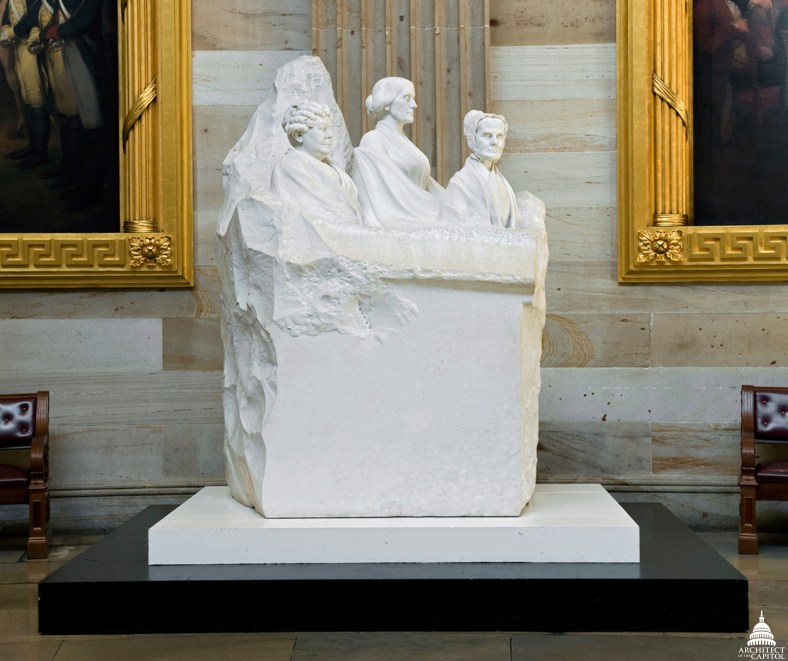
March is also the time of year that hundreds of U.S. school children visit Washington D.C. and traverse the Capitol rotunda. For many it’s their first encounter with the history of the women’s suffrage movement, as they pass the portrait monument to Lucretia Mott, Elizabeth Cady Stanton and Susan B. Anthony.

Missing from the statue is Inez Milholland Boissevain. “A rare woman, she earned a Law degree at NYU and promptly became involved with the labor strikes of the Women’s Garment Workers and the Triangle Shirtwaist factory struggle. Throughout her life, Inez worked and fought for the underrepresented and the oppressed.”

In 1916, Inez was on a cross country campaign in support of a federal suffrage amendment when she collapsed and died while delivering a speech in Los Angeles. Her last public words, “Mr. President, How Long Must Women Wait for Liberty?”

On Sunday, November 18, 1923 a ceremony was held in the Capitol to commemorate the 75th anniversary of the women’s rights movement. Poet Edna St. Vincent Millay Boissevain (yes, she married Inez’ widower) was part of the group of 200 women who participated in the event. The day before they had presented proposed new legislation, written by Alice Paul to the president – The Equal Rights Amendment.

“The “poem” that Edna read is the sonnet “The Pioneer,” which encouraged women to continue to fight for equal rights. It is unclear if Edna wrote the lines about Anthony, Stanton, and Mott (the pioneers in the marble statue) or about Inez — or about all of them. However, by 1928, Edna had retitled the sonnet “To Inez Milholland.”

To Inez Milholland

Upon this marble bust that is not I
Lay the round, formal wreath that is not fame;
But in the forum of my silenced cry
Root ye the living tree whose sap is flame.
I, that was proud and valiant, am no more; —
Save as a wind that rattles the stout door,
Troubling the ashes in the sheltered grate.
The stone will perish; I shall be twice dust.
Only my standard on a taken hill
Can cheat the mildew and the red-brown rust
And make immortal my adventurous will.
Even now the silk is tugging at the staff:
Take up the song; forget the epitaph.

Edna St. Vincent Millay 1923

Three additional links of interest @the end of Womens History Month

‘A Trove on the Women’s Suffrage Struggle, Found in an Old Box’ The New York Times, March 29, 2017

New York Historical Society Center for Women’s History

Inez Milholland ‘Forward Into the Light’

The week@work – the war for talent, following vs. leading, exhaustion, and maybe we should ask a sociologist

The last state to approve the Equal Rights Amendment to the Constitution was Indiana in 1977 – until Thursday when Nevada ratified the ERA, thirty-five years after the deadline imposed by Congress. It was a welcome antidote to the White House photo of the freedom caucus taken the same day (above). Any odds on an extension to revisit and ratify?

“Nevada has given NOW President Terry O’Neill new cause for hope. “Now it’s a two-state strategy,” she tells the Times. “It’s very exciting. Over the past five years, Illinois and Virginia have come close. I think there is clear interest in this.

In other stories this week@work, journalists and experts provided an update on the ‘war for talent’, offered an argument for balancing followers with leaders in the workplace, and expressed concern with a ‘gig economy’ advertising campaign that seemed to glorify exhaustion@work.  The last story this week@work re-examined an idea from the 60’s to establish a Council of Social Advisers to complement the Council of Economic Advisers in D.C. “It’s not just work; it’s how work offers a sense of purpose and identity.”

Dr. Tomas Chamorro-Premuzic and Adam Yearsley believe ‘The War for Talent Is Over, And Everyone Lost’. They cite workplace trends indicating more passive job seekers, the appeal of self-employment and the lure of entrepreneurship as competitive factors for employers to attract the best and the brightest, and offer a few best practices to turn things around.

IMGP1335.JPG

“In 1998, after a year-long study on the subject, McKinsey researchers declared that a “war for talent” was underway. In the years ahead, they said, organizations’ future success would depend on how well they could attract, develop, and retain talented employees–an ever more valuable asset in ever higher demand.

Instead of winning a war for talent, organizations appear to be waging a war on talent, repelling and alienating employees more successfully than harnessing their skills.

Today, in a world full of many more Chief People and Chief Happiness Officers, that war nevertheless appears to have been lost on all sides. Of course, many workers excel in their jobs and make pivotal contributions to their organizations. But for every one employee who does, there are many more who are underemployed, underperforming, and just plain miserable at work.”

One of the employer prescriptions for success is to “stop developing people’s leadership skills”.

get_more_instagram_followers-compressed.jpg

“…research suggests there’s a strong negative correlation between the amount of money spent on leadership development (which in the U.S. totals over $14 billion a year), and people’s confidence in their leaders. One of the reasons is that leaders are often deprived of negative feedback, even in training programs. We’ve gotten so used to coaching to people’s strengths that weaknesses get left unaddressed. The basics of human psychology magnify that issue; people are already prone to judging their own talents way too favorably, especially after experiencing a measure of success.”

Which links neatly into the next story of the week@work, Susan Cain‘s ‘Not Leadership Material? Good.The World Needs Followers.’

“Perhaps the biggest disservice done by the outsize glorification of “leadership skills” is to the practice of leadership itself — it hollows it out, it empties it of meaning. It attracts those who are motivated by the spotlight rather than by the ideas and people they serve. It teaches students to be a leader for the sake of being in charge, rather than in the name of a cause or idea they care about deeply. The difference between the two states of mind is profound. The latter belongs to transformative leaders like the Rev. Dr. Martin Luther King Jr. and Gandhi; the former to — well, we’ve all seen examples of this kind of leadership lately.”

Jia Tolentino used Fiverr’s new ad campaign to illustrate ‘The Gig Economy Celebrates Working Yourself To Death’.

Tolentino-TheGigEconomyCelebratesWorkingYourselftoDeath-1145.jpg

“It does require a fairly dystopian strain of doublethink for a company to celebrate how hard and how constantly its employees must work to make a living, given that these companies are themselves setting the terms. And yet this type of faux-inspirational tale has been appearing more lately, both in corporate advertising and in the news. Fiverr, an online freelance marketplace that promotes itself as being for “the lean entrepreneur”—as its name suggests, services advertised on Fiverr can be purchased for as low as five dollars—recently attracted ire for an ad campaign called “In Doers We Trust.” One ad, prominently displayed on some New York City subway cars, features a woman staring at the camera with a look of blank determination. “You eat a coffee for lunch,” the ad proclaims. “You follow through on your follow through. Sleep deprivation is your drug of choice. You might be a doer.”

A Fiverr press release about “In Doers We Trust” states, “The campaign positions Fiverr to seize today’s emerging zeitgeist of entrepreneurial flexibility, rapid experimentation, and doing more with less. It pushes against bureaucratic overthinking, analysis-paralysis, and excessive whiteboarding.” This is the jargon through which the essentially cannibalistic nature of the gig economy is dressed up as an aesthetic.”

Maybe we need a few less economists and a few more humanists to address our life@work

There was a lot of discussion in the media this weekend in the wake of the health care bill defeat. What are the lessons learned? We might ask the same question about the November election result, only this time maybe we should be consulting with sociologists vs. economists. Neil Irwin asked “What if Sociologists Had as Much Influence as Economists?”.

“For starters, while economists tend to view a job as a straightforward exchange of labor for money, a wide body of sociological research shows how tied up work is with a sense of purpose and identity.

“Wages are very important because of course they help people live and provide for their families,” said Herbert Gans, an emeritus professor of sociology at Columbia. “But what social values can do is say that unemployment isn’t just losing wages, it’s losing dignity and self-respect and a feeling of usefulness and all the things that make human beings happy and able to function.

…the economic nostalgia that fueled Donald J. Trump’s presidential campaign was not so much about the loss of income from vanishing manufacturing jobs. Rather, it may be that the industrial economy offered blue-collar men a sense of identity and purpose that the modern service economy doesn’t.”

At the beginning of this new week@work consider where work fits in your sense of identity and purpose. It’s not just work.


The week@work – “and the winner is…”, transition@the Met, stress@work, and ambition

The week@work started with ‘the mistake’ at the end of the Oscars ceremony, and continued with a visible transition at the top of the most prestigious U.S. art museum. On the job ‘burn-out’ continues to take a toll on all @work, and may explain the recent Uber executive’s meltdown. And, a leading fashion designer is launching a campaign to ’embrace ambition’.

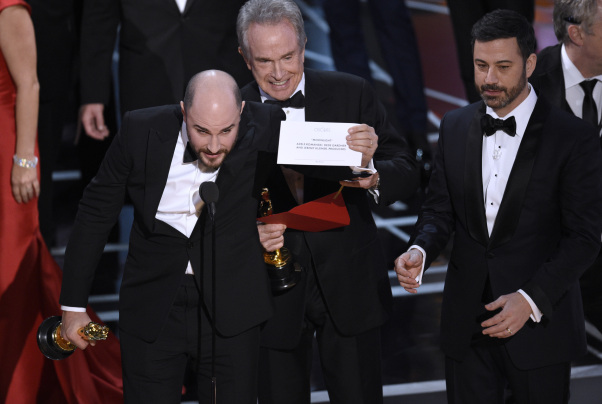
When we make a mistake @work, we typically don’t have an audience 32.9 million folks watching. But that’s what happened Sunday evening when the wrong envelope led to an ‘epic fail’ in the announcement of Best Picture winner. The New York Times film critics shared their reactions.

“…in its own way, last night’s spectacle — so relatively smooth, until all of a sudden it was anything but — represents a Hollywood watershed or, at least, like the original “Bonnie and Clyde,” the arrival of a new generation. The envelope mix-up was painful, but it brought to the stage two directors in their 30s with five features between them and reminded the audience that Damien Chazelle and Barry Jenkins are not enemies.  A.O. Scott

“Honestly, I don’t know. But something happened that seemed to simultaneously tell us who we were, are, believe ourselves to be. This is, what, the fourth time since November that the country has gathered for an evening of live television, only to be part of a rug-yanking ceremony. After Sunday night, the presidential election, the Super Bowl and, to a different but related extent, the Grammys, I’ve officially come down with outcome-oriented post-traumatic stress disorder — Ooptsd, as in upside my head.”  Wesley Morris

And from Hollywood, where the trade publication Variety’s cover seemed to mirror the events, Claudia Eller, co-editor in chief provided context for the ‘morning after’ cover.

damien-chazelle-barry-jenkins-variety-oscar-cover

“The high stakes and cutthroat tactics enlisted during Hollywood’s annual award season have long rivaled those of hard-fought political campaigns. But this year’s race showed the entertainment community at its absolute best. This was not a case of winner-take-all, but rather — as our cover story hopefully and joyfully exemplifies — proof that contenders share similar dreams, struggles, and frailties, and in fact can show respect and a generosity of spirit toward one another, whether they win or lose.”

On Wednesday morning I received this email from Thomas P. Cambell, Director and C.E.O. of the Metropolitan Museum of Art.

“I write to share the news that I have decided to step down from my role as Director and CEO of The Metropolitan Museum of Art. It is not an easy choice to step away, especially at such a transitional moment. That said, the Museum’s current vitality is what makes it the right moment to do so. For the next stage of my career I look forward to new challenges beyond The Met, always in service of art, scholarship, and understanding.”

C5yF2RLXEAEkxJ-.jpg

What now? From Margaret Lyons on Twitter, “Please, someone: Set a prestige drama among the employees of a world-class museum.”

Maybe the Met could use a ‘Mozart in the Jungle’ treatment. Are you listening Jeff Bezos?

Holland Carter offered ‘How to Fix the Met: Connect Art to Life’

“What I can talk about is art, and how a museum can make people care about it. If historical art is now a hard sell, and it is, learn to sell it hard. That means, among other things, start telling the truth about it: about who made objects, and how they work in the world, and how they got to the museum, and what they mean, what values they advertise, good and bad. Go for truth (which, like the telling of history, is always changing), and connect art to life. Mix things up: periods, functions, cultures. (You can always unmix them.) Let audiences see that old is always new, if viewed through knowledge.

To present art this way — to pitch it, advocate it, make it snap to life — is to rethink the basic dynamic of a museum, turn it from passive to active, from archival to interactive, while letting it be all of these. This is the work of curators, and the Met has some fantastic ones. But to do their job boldly and radically, they need the attentive, encouraging permission of an alert director, probably meaning one who isn’t also saddled with being the company’s chief accountant.”

Rachel Feintzeig asked ‘Feeling Burned Out at Work? Join the Club.’

“Stress and anxiety are cited in 70% of the calls placed to phone-counseling lines at Workplace Options, a provider of employee-assistance programs; in 2014, 50% of callers complained of those feelings. Total calls to those counseling lines reached 42,500 last month, an 18% increase from 2016’s average.

Gallup’s most recent large-scale survey about burnout in the U.S., conducted in 2012, found that more than 40% of workers were so stressed at work they felt burned out. A more recent survey of German workers, conducted in 2015, found that nearly a quarter felt burned out.

Workers aren’t “assertive about their boundaries because they fear for their jobs,” said Alden Cass, a Manhattan-based clinical psychologist who treats patients with high-stress jobs. Burnout begins when a worker feels overwhelmed for a sustained period of time, then apathetic and ultimately numb, he said.”

Not sure if Travis Kalanick of Uber is suffering from burn-out, but last week’s viral video arguing with one of his employees was the culmination of a series of PR nightmares for the executive. Adrienne LaFrance reported ‘As Uber Melts down, Its CEO Says He ‘Must Fundamentally Change’.

“It took eight years and at least as many back-to-back-to-back-to-back controversies to break Travis Kalanick.

After a stunning month of scandals at Uber, Kalanick, its founder and CEO, sent an emotional and uncharacteristically apologetic memo to his employees Tuesday night. “This is the first time I’ve been willing to admit that I need leadership help,” Kalanick wrote. “And I intend to get it.”

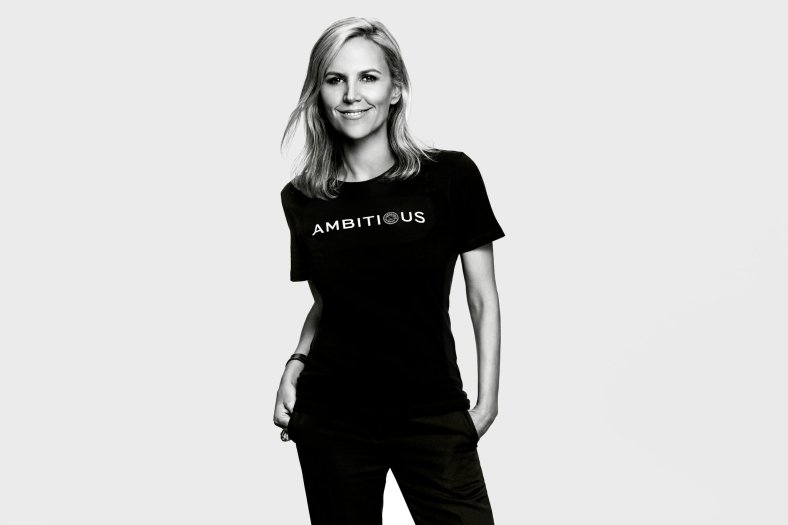
The final story this week@work comes from the fashion pages and reporter Jacob Bernstein who asks ‘When Did ‘Ambition’ Become A Dirty Word? to introduce the story of designer Tory Burch and the most recent effort of her foundation.
02TORY4-superJumbo-1.jpg

“There is nothing particularly fiery about Tory Burch…the issue of ambition, and the way it is used to defame women, is nevertheless personal to her.

In 2009, Ms. Burch started the Tory Burch Foundation and, through a partnership with Bank of America, saw it grow to an organization that ultimately gave more than $25 million to female entrepreneurs around the world.

Many of the recipients of these grants had experienced the same kind of sexism she faced. They were called too hungry, too intent on power, too ambitious — code words used in place of the more vulgar expressions that men (and sometimes women, too) used when they were out of earshot.

“There was a harmful double standard,” she said.”

The global campaign, ‘Embrace Ambition’ launches with a PSA in conjunction with International Women’s Day.

This week@work I encourage your ambition, and wish you a speedy recovery from “Ooptsd”, NYT film critic Wesley Morris’ appropriately new acronym for our times – “outcome-oriented post-traumatic stress disorder”.


The week@work – ‘Walden, a game’, Uber’s culture, pollution & the stock market, and the ‘folly’ of abolishing the N.E.A.

This week@work the designers of a new video game would like us to take a walk in the woods, a former Uber engineer authored a blog post that opened a window on corporate culture, an economics professor demonstrated the link between air pollution and stock market fluctuations, and the director of the Metropolitan Museum of Art warned against cutting funds to the National Endowment for the Arts.

When we talk about work/life balance we typically think about disconnecting from technology, not using it as a portal for relaxation. Robin Pogrebin‘s article ‘In Walden Video Game, the Object is Stillness’ offers an example of a seemingly contrarian application.

“…the new video game, based on Thoreau’s 19th-century retreat in Massachusetts, will urge players to collect arrowheads, cast their fishing poles into a tranquil pond, buy penny candies and perhaps even jot notes in a journal — all while listening to music, nature sounds and excerpts from the author’s meditations.

While the game is all about simplicity, it has actually been in development for nearly a decade. The lead designer, Tracy J. Fullerton, the director of the Game Innovation Lab at the University of Southern California School of Cinematic Arts, came up with the idea as a way to reinforce our connection to the natural world and to challenge our hurried culture.

“Games are kinds of rehearsals,” Ms. Fullerton said in an interview. “It might give you pause in your real life: Maybe instead of sitting on my cellphone, rapidly switching between screens, I should just go for a walk.”

“Maybe we don’t all have the chance to go to the woods,” Ms. Fullerton added. “But perhaps we can go to this virtual woods and think about the pace of life when we come back to our own world. Maybe it will have an influence — to have considered the pace of Walden.”

Uber has a new logo and a new ranking as #3 on Fast Company’s Most Innovative Companies. “Uber’s most valuable asset is its data, which has been an important part of Uber’s business since it first launched.” Which is why we should not be surprised if the company is having a bit of a dysfunctional workplace moment.

th.jpg

Christina Cauterucci investigated ‘The Sexism Described In Uber Employee’s Report Is Why Women Leave Tech – Or Don’t Enter At All’.

“Uber is staging a major PR defense for the second time in recent weeks after a former employee published a detailed account of persistent sexual harassment and discrimination she allegedly faced while working as an engineer at the company. Susan Fowler, who left the company in December after about a year of employment, claims in her Feb. 19 blog post that her manager sent her sexual chat messages soon after she was hired. When she reported him to human resources, she writes, she was told that it was his “first offense” and that she should switch teams if she didn’t want a negative performance review from him. Fowler later found out that other women had reported witnessing inappropriate behavior from this same man, and each were told that it was his “first offense” and not a big enough deal to require action.

In her blog post, Fowler accuses a manager of changing her performance scores after a stellar review to keep her from getting a transfer to another team, because it reflected well on the manager to prove he could retain female engineers on his team. This is a particularly outrageous deed in an account full of outrageous deeds. Instead of enforcing a zero-tolerance sexual-harassment policy or asking female employees how management could better support them, Uber has allegedly moved to improve its substandard track record on gender by narrowing opportunities for women on staff and sweeping harassment allegations under the floor mat. Fowler writes that she made repeated, documented human resources complaints about the unfair treatment she endured, but she was gaslighted by an HR representative who told her the emails she sent never happened and that men are better suited for certain jobs than women. It took a statement on a public blog to get any action from company leadership.”

The folks who work in climate science have been under fire in recent weeks. The photo below is a reminder of what the New York City skyline looked like 44 years ago, before environmental protections were enacted.

manhattan2_0.gif

For those not yet convinced of global warming, maybe a direct financial consequence would be more persuasive. Scott Berinato found ‘Air Pollution Brings Down the Stock Market’.

“When University of Ottawa economics professor Anthony Heyes and his colleagues compared daily data from the S&P 500 index with daily air-quality data from an EPA sensor close to Wall Street, they found a connection between higher pollution and lower stock performance. Their conclusion: Air pollution brings down the stock market.

The effect was strong. Every time air quality decreased by one standard deviation, we saw a 12% reduction in stock returns. Or to put it in other terms, if you ordered 100 trading days in New York from the cleanest-air day to the dirtiest-air day, the S&P 500 performance would be 15% worse on the 75th cleanest day than it was on the 25th cleanest day. We also replicated this analysis using data from the New York Stock Exchange and Nasdaq, and saw the same effect.”

img_7827

Finally, this story is not only for those who work in the arts, but for all of us whose curiosity and creativity were sparked by a play, music or a visit to a museum. The Metropolitan Museum of Art’s director, Thomas P. Campbell warns against ‘The Folly of Abolishing the N.E.A.’

“All too often, art is seen as a “soft” subject, the first thing to be cut, whether by local school boards or the federal government, when money is tight. But looked at purely in dollars, it is a false saving. The N.E.A.’s budget is comparatively minuscule — $148 million last year, or 0.004 percent of the total federal budget — while the arts sector it supports employs millions of Americans and generates billions each year in revenue and tax dollars.

The United States has no ministry of culture. In this vacuum, the N.E.A., founded in 1965, serves three critical functions: It promotes the arts; it distributes and stimulates funding; and it administers a program that minimizes the costs of insuring arts exhibitions through indemnity agreements backed by the government. This last, perhaps least-known responsibility, is crucial. This fall, the Met will host a major exhibition on Michelangelo that will bring together masterpieces from across the world. The insurance valuation is a whopping $2.4 billion — not even our museum, the largest art museum in the nation, could come close to paying the premium for such coverage without the federal indemnity the N.E.A. makes possible.

I fear that this current call to abolish the N.E.A. is the beginning of a new assault on artistic activity. Arts and cultural programming challenges, provokes and entertains; it enhances our lives. Eliminating the N.E.A. would in essence eliminate investment by the American government in the curiosity and intelligence of its citizens. As the planet becomes at once smaller and more complex, the public needs a vital arts scene, one that will inspire us to understand who we are and how we got here — and one that will help us to see other countries, like China, not as enemies in a mercenary trade war but as partners in a complicated world.”

This week@work take a break and visit your local museum. Then go home and send an email to your member of congress. Remind them of the importance of “investing in the curiosity and intelligence of its citizens”.


Photo credit: Manhattan Skyline, May 1973 – Chester Higgins NARA

The week@work – The ‘Fallows question’, flexibility@work and the long term impact of student debt

On Saturday Night Live actor Cecily Strong delivered a line that summed up what many of us are feeling this week@work, “I want one day without a CNN alert that scares the hell out of me.” 

It got me thinking about the question Facebook COO, Sheryl Sandberg posed to the Barnard Class of 2011, “What would you do if you weren’t afraid?”

This week@work The New York Times Op-Ed Columnist David Brooks posed ‘the Fallows question’“If you could move to the place on earth where history is most importantly being made right now, where would you go?”

“James and Deborah Fallows have always moved to where history is being made…James and Deb have an excellent sense of where world-shaping events are taking place at any moment — and a fervent commitment to be there to see it happen.

If you want to “observe” history, the Fallows say, go to Washington. If you want to “participate,” go elsewhere.”

If you weren’t afraid, and could pick up and move to where the action is, where would you go? Brooks offered a few destinations to start, but just maybe, this week@work you might spend some time considering a temporary relocation “in search of history”.

IMG_7024.jpg

Folks@work are moving forward, finding ways to succeed independent of national politics. Some voice concern about the potential impact of new policies on their workplace, while others seek ways to express a response in their work. For many, the challenges of the gender gap and student debt remain a constant, often extending into retirement.

Claire Cain Miller examined the tension in employer expectations between flexibility and presence@work in ‘How to Close a Gender Gap: Let Employees Control Their Schedules’.

“The main reason for the gender gaps at work — why women are paid less, why they’re less likely to reach the top levels of companies, and why they’re more likely to stop working after having children — is employers’ expectation that people spend long hours at their desks, research has shown.

Flexibility regarding the time and place that work gets done would go a long way toward closing the gaps, economists say.

A new job search company, Werk, is trying to address the problem by negotiating for flexibility with employers before posting jobs, so employees don’t have to.”

And then there are the financial pressures; spanning generations from twenty-somethings being subsidized by parents, as their grandparents face social security payment garnishment to repay outstanding student loan debt.

IMG_8146.jpg

Quoctrung Bui reported on ‘A Secret of Many Urban 20-Somethings: Their Parents Help With the Rent’.

“According to surveys that track young people through their first decade of adulthood, about 40 percent of 22-, 23- and 24-year-olds receive some financial assistance from their parents for living expenses. Among those who get help, the average amount is about $3,000 a year.

It’s a stark reminder that social and economic mobility continues past grade school, high school and even college. Economic advantages continue well into the opening chapters of adulthood, a time when young people are making big personal investments that typically lead to higher incomes but can be hard to pay for.”

On the other side of the generation spectrum, The Editorial Board of The New York Times identified an emerging trend threatening older Americans, ‘Haunted by Student Debt Past Age 50’.

“The experience of being crushed by student debt is no longer limited to the young. New federal data shows millions of Americans who are retired or nearing retirement face this burden, as well as the possibility of having their Social Security benefits garnished to make payments.

Americans age 60 and older are the fastest-growing age group of student loan debtors. Older debtors, many of whom live hand-to-mouth on fixed incomes, are more likely to default. When that occurs with federal loans, as happens with nearly 40 percent of such borrowers who are 65 and over, the government can seize a portion of their Social Security payments — even if it pushes them into poverty. About 20,000 Americans over the age of 50 in 2015 had their Social Security checks cut below the poverty line because of student loans, with poverty-level benefits falling even further for 50,000 others, according to a recent report by the Government Accountability Office.”

IMG_7827.jpg

The last story this week@work, highlights the importance of art@work and in our lives. The Metropolitan Museum of Art announced the next step in their digital evolution – open access to over 375,000 archive images. (Monet’s ‘Garden at Sainte-Adresse’, 1867 above)

The Friday Poem ‘The New Colossus’ by Emma Lazarus

Most immigrants to the U.S. arrive by plane, bypassing the Statue of Liberty standing in New York harbor. Perhaps this detour has created a bit of amnesia regarding fundamental American values.

For the Friday poem this week, we travel back in time to 1883, when Emma Lazarus was asked to write a poem as part of fundraising effort to construct the pedestal for the statue.

Washington Post journalist Katie Mettler revisited Ms. Lazarus’ story on Wednesday, citing renewed interest in the sonnet in the aftermath of the executive order banning  U.S. entry to all Syrian refugees and citizens of seven Muslim countries

“What the poet didn’t know at the time — as a woman whose work as a “poetess” had been at times the subject of condescension — was that it would be her words, lyrical and poignant, that decades later came to define the American vision of liberty.

More than a century later, in 2017, the words are rallying people against a controversial president and his policies and attitudes toward immigrants.”

It’s time for these words to be posted at every point of entry to the U.S. to remind all of our core values.

The New Colossus 

Not like the brazen giant of Greek fame,
With conquering limbs astride from land to land;
Here at our sea-washed, sunset gates shall stand
A mighty woman with a torch, whose flame
Is the imprisoned lightning, and her name
Mother of Exiles. From her beacon-hand
Glows world-wide welcome; her mild eyes command
The air-bridged harbor that twin cities frame.
“Keep, ancient lands, your storied pomp!” cries she
With silent lips. “Give me your tired, your poor,
Your huddled masses yearning to breathe free,
The wretched refuse of your teeming shore.
Send these, the homeless, tempest-tost to me,
I lift my lamp beside the golden door!”

Emma Lazarus   ‘Emma Lazarus: Selected Poems and Other Writings’ (2002)

9781551112855-408x630.jpg


Pictures from the revolution – 1/21/17

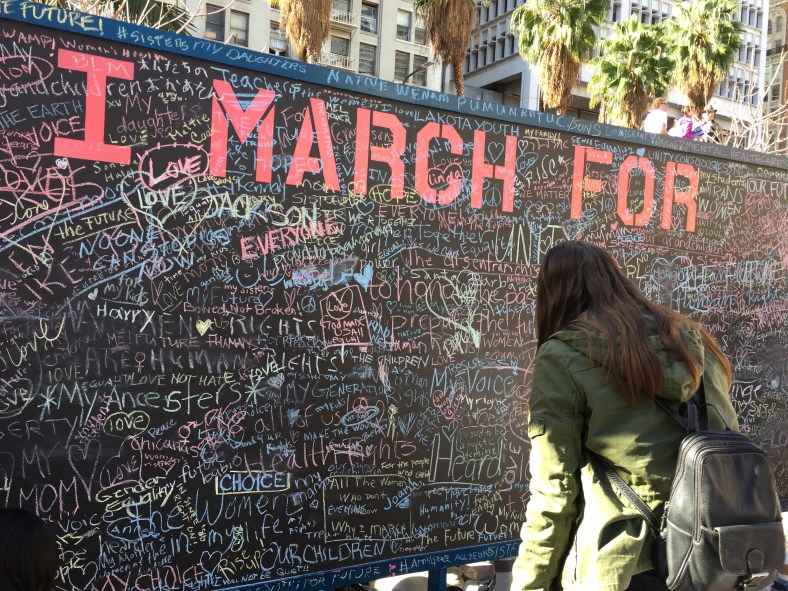
I got as far as Pershing Square in Downtown LA. There were too many people to ‘march’ to City Hall. The real estate in-between was occupied by a sea of veteran and newly-minted activists.

Eventually, we headed in the opposite direction along 6th and up Grand to the Disney Concert Hall. The thousands in the ‘tangent march’ I joined never heard the political speeches of the day, but were overjoyed in the surprise of the turnout.

We were a rainbow representation of the California we call home. We were messengers from divergent origin, chanting with one voice. “This is what democracy looks like”.

IMG_8183.jpgThis is what I want you to understand. The result of the U.S. election may have been the catalyst, but this is about families, values and redefining a new American dream. It’s not about following a 70 year old white man into the past, but creating a solid bridge to a viable global future for our children and grandchildren. It’s about legacy, not name calling.
IMG_8149.jpgIf we can harness the energy and creativity that knitted pink pussy hats, and illustrated catchy posters, we can change the world. The present day reality holds enough shock value without piling on with unproductive language that creates a diversion from authentic action.

 We are the parents who are the everyday role models for our children. It’s our lot in life to “go high, when others go low”. We are the adults in the room.

Many doubt our unity. They minimize our resolve. They write we cannot sustain the momentum initiated on 1/21/17.

img_8191How often, as women@work, have we heard those whispered doubts of our ability to get the job done – to compete? Enough.

I have great respect for those who have blazed trails so others might succeed, but it’s time to hand over the power to the next generation of dreamers – to trust their ability to employ genuine entrepreneurial skill to reimagine the future.

They were there on Saturday; on every street, in every city around the world.

IMG_8180.jpgWhere do we begin? Start local. Be a mentor, donate to organizations that support K-12 leadership initiatives. Invest in people.


Take any opportunity to start a conversation, and listen.

Read the constitution. Fill in the gaps in your knowledge of American history. Learn the words to ‘We Shall Overcome’.

Visit the library or local bookstore and read at least one book by an author from another culture.

Go to your state capitol, find your representative, and ask, what they are doing to encourage a new cohort of leaders? Offer to help.

If you have massive amounts of cash, avoid the temptation to create a private label on a building, and put your money toward those who will cement a more permanent legacy through public service.

If you can’t find an organization with a ‘mission match’ to your values, create one. It was one woman’s Facebook post that grew into the Women’s March.

IMG_8187.JPG

And so it begins…

Photo credit- Downtown LA – LA Mayor’s website 


The Friday Poem ‘To The Indifferent Women’ by Charlotte Anna Perkins Gilman

On the eve of the ‘Women’s March’, the Friday Poem reprises ‘To The Indifferent Women’ by Charlotte Anna Perkins Gilman. I originally posted the poem in July after the first woman in U.S. history accepted her party’s nomination for president.

Sometimes things don’t work out as planned.

Tomorrow, in Washington D.C. and cities around the country, women will join together in a nation that could not ratify an equal rights amendment, or elect the first woman president, and remind those elected that women’s rights are human rights.

“In the spirit of democracy and honoring the champions of human rights, dignity, and justice who have come before us, we join in diversity to show our presence in numbers too great to ignore. The Women’s March on Washington will send a bold message to our new government on their first day in office, and to the world that women’s rights are human rights. We stand together, recognizing that defending the most marginalized among us is defending all of us.”

There is something going on here, as there was in 1911 when Ms. Perkins was writing for the cause of women’s rights.

One of the more stunning stories, in advance of the D.C. march, appears in today’s NY Times and profiles an unlikely activist contingent – ‘From Wall Street to National Mall: Women Overcome Fears to Attend March’.

“They are professionals in trading, public relations, marketing, deal-making, investing and the law. They keep punishing schedules, fear losing business by offending their clients and often feel that in an industry still overwhelmingly populated by men, the less attention drawn to their sex, the better.

But the inauguration of Mr. Trump has prompted a striking number of Wall Street women to overcome their worries about demonstrating in public.”

For those who will march and be questioned why, and for those still without weekend plans – a beautiful question from 1911.

“Do you believe the sorrow of the world
Does not concern you in your little homes?”

To The Indifferent Women

A Sestina

You who are happy in a thousand homes,
Or overworked therein, to a dumb peace;
Whose souls are wholly centered in the life
Of that small group you personally love;
Who told you that you need not know or care
About the sin and sorrow of the world?

Do you believe the sorrow of the world
Does not concern you in your little homes? —
That you are licensed to avoid the care
And toil for human progress, human peace,
And the enlargement of our power of love
Until it covers every field of life?

The one first duty of all human life
Is to promote the progress of the world
In righteousness, in wisdom, truth and love;
And you ignore it, hidden in your homes,
Content to keep them in uncertain peace,
Content to leave all else without your care.

Yet you are mothers! And a mother’s care
Is the first step toward friendly human life.
Life where all nations in untroubled peace
Unite to raise the standard of the world
And make the happiness we seek in homes
Spread everywhere in strong and fruitful love.

You are content to keep that mighty love
In its first steps forever; the crude care
Of animals for mate and young and homes,
Instead of pouring it abroad in life,
Its mighty current feeding all the world
Till every human child can grow in peace.

You cannot keep your small domestic peace
Your little pool of undeveloped love,
While the neglected, starved, unmothered world
Struggles and fights for lack of mother’s care,
And its tempestuous, bitter, broken life
Beats in upon you in your selfish homes.

We all may have our homes in joy and peace
When woman’s life, in its rich power of love
Is joined with man’s to care for all the world.

Charlotte Anna Perkins Gilman ‘Suffrage Songs and Voices’ 1911

41py0cnjwl-_sx331_bo1204203200_

Photo credit: Screen shot from Women’s March LA website


The week@work – U.S. unemployment at nine year low, Rosberg and Schultz exit roles on top, and “mother nature needs her daughters”

If you weren’t paying attention, you would have thought the major story this week@work was about the 800 folks who will retain positions at Carrier, a division of United Technologies. You might have missed the news that U.S. unemployment reached a nine year low @4.6%, adding 178,000 jobs in November.

In ‘departures’, newly crowned Formula One champion, Nico Rosberg announced his retirement and Starbuck chief, Howard Schultz, will be stepping down from his position next year.  Seventy-six women scientists have embarked on an expedition to Antarctica to focus on climate change and women who work in the sciences.

Ana Swanson reported on the U.S. unemployment news for The Washington Post, Wonkblog.

“Data released on Friday showed a sharp drop in the unemployment rate from 4.9 percent the previous month, driven partly by the creation of new jobs and partly by people retiring and otherwise leaving the labor force.

A broader measure of unemployment, the U-6 rate, which includes those who have given up looking for work and part-time workers who would like to have full-time jobs, fell to 9.3 percent, the lowest reading since April 2008. The figure still remains elevated from average levels in the 2000s.”

Paul Weaver covered the announcement of F1 champion, Nico Rosberg’s decision to retire from racing five days after capturing the title for The Guardian.

551069_10152244647569874_65635453_n.png

“Nico Rosberg has stunned Formula One by announcing his retirement, just five days after the 31-year-old became the sport’s world champion…

He said he had “climbed my mountain”. Now he is going out at the peak.

Rosberg said he first started thinking about retiring when he won the Japanese Grand Prix in early October and realised the title was within his grasp. “From the moment when the destiny of the title was in my own hands, the big pressure started and I began to think about ending my racing career if I became world champion,” he wrote in a post on his Facebook page announcing his departure.”

At the other end of the career spectrum, the visionary leader of Starbucks, Howard Schultz announced he will be stepping away from his leadership position at the company he joined in 1982. Andrew Ross Sorkin reported on the change at the top for The New York Times.

“I wanted to build the company my father never got to work for,” he said.

Howard_Schultz_and_Kevin_Johnson.JPG

At an all-hands employee meeting at the company’s headquarters on Thursday, Mr. Schultz was greeted with tears and a standing ovation. “For me, perhaps there are other things that are part of my destiny,” he told them.”

Mr. Schultz said he intends for Starbucks to “maintain our moral courage.” And he defended efforts like the company’s “Race Together” campaign to spur a conversation about race relations, saying that it “was not a failure. I’d do it again.” He said such campaigns are deeply embedded in the company’s brand of “challenging the status quo about the role of a public company.” He is excited by the question, “Since we have stores in every community in America, how can we use our scale for good?”

How do folks successfully transition from one phase of their work life to the next?

Adam Bryant‘s ‘Corner Office’ interview with Nyansa chief executive, Abe Ankumah provides a hint.

“Be a lifelong student. That doesn’t mean go enroll in a bunch of classes all the time. It’s a mind-set. It means continuing to push yourself to learn rather than saying, “I’ve got this degree in this, and that’s what I’m going to do.”

The other thing is not to become too comfortable in a role. Chances are that if you’re comfortable, you’re not learning, you’re not pushing the envelope and you’re probably going to get stagnated.”

The last story this week@work is an example of pushing the envelope, for the greater good.

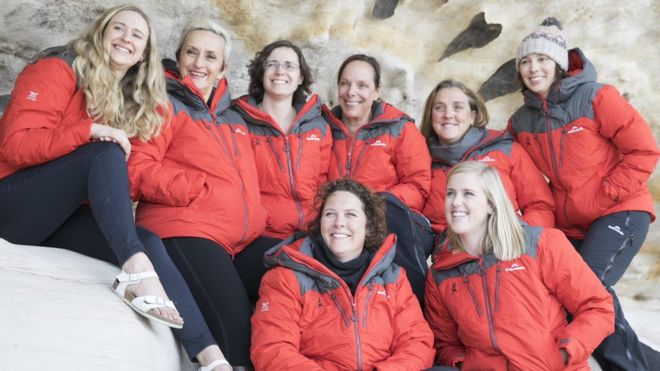
On Thursday I received a tweet from BBC Australia about an expedition of women scientists traveling to Antarctica. The tag line of their sponsor, ‘Homeward Bound’, is “mother nature needs her daughters”.

img_2600-1-1080x675

From the BBC  Australia story – “They call Ushuaia, a cold and windy port city in Argentina, the end of the world.

It’s from here that the largest ever all-female expedition to Antarctica will depart, with more than 70 women with backgrounds in science set to spend 20 days at sea.

The voyage is part of the Homeward Bound initiative, an Australian programme aimed at increasing the representation of women in top science jobs across the globe.

“We’re missing half the voice at the leadership table,” says Dr Jessica Melbourne-Thomas, who along with entrepreneur and management expert Fabian Dattner, came up with the idea.

The pair met during a leadership development course run by Dattner, and their frustration at the challenges faced by women in science quickly became a bold idea.

Two years later, the first of what is hoped to be several voyages is about to depart.”

We talk a lot about ‘dream jobs’ and whether ‘finding your passion’ is attainable. For those of you skeptics out there, I close with the closing paragraphs of Fabian Dattner‘s blog post, co-founder of Homeward Bound, who as I write is on her journey south.

“So, right now as I work with a group of leaders in my day job, my mind wanders effortlessly to what lies ahead – now only a few sleeps away – and I am finally lost for words, carried forward – as with all the people involved – on a deeply felt sense of rightness: right purpose, right time, right people, right outcome.

I know what ‘flow’ means now; I know what purpose, autonomy and freedom mean. I know what it means to lead and be led. And I know in my bones what is possible for humans, when leaders act on behalf of the greater good.

Stay with us on this journey. It’s for all of us.”  @HomewardBound16


Photo credits: Antarctica expedition – Homeward Bound, Kevin Johnson/Howard Schultz -Starbucks Newsroom

The mysteries of networking #5: Try it in reverse

Folks entering the job market for the first time are often hesitant to reach out to potential networking contacts. What do I have to give in return? is a common question. The answer may be to ‘network in reverse’.

Traditional networking is a commitment of mutual support over time. The majority of established professionals hold no expectation of immediate reciprocity when advising newbies to the job market.

Turns out, their expectations need revision; there’s quite a bit of knowledge to be shared by the most recent additions to the workplace. Just don’t be surprised when you get the call from someone twice your age asking, Will you mentor me?

That’s exactly what happened when The New York Times assignment editor, Phyllis Korkki approached social editor, Talya Minsberg.

Let’s start with a quick inventory of your skill set. What is the skill that has been burning a hole on your ‘to do’ list for the last six months? You know, that one thing you are a bit afraid of, but would catapult your career if you just spent some time learning?

Who do you know who can serve as a bridge to knowledge or provide a bit of training and support?

That’s basically the story of Phyllis and Talya, a ‘reverse mentorship’ initiated around the joys of technology, specifically Snapchat.

Phyllis shared her story, ‘Schooled by a Mentor Half My Age’.

“How on earth did I become an “older worker?”

It was only a few years ago, it seems, that I set out to climb the ladder in my chosen field. That field happens to be journalism, but it shares many attributes with countless other workplaces. For instance, back when I was one of the youngest people in the room, I was helped by experienced elders who taught me the ropes.

Now, shockingly, I’m one of the elders. And I’ve watched my industry undergo significant change. That’s why I recently went searching for a young mentor — yes, a younger colleague to mentor me.”

She found that ‘reverse mentor’ in Talya who was ‘Seeing Age With a New Lens’.

 “A few months ago, Phyllis Korkki, an assignment editor at The New York Times who sits a few cubicles away, approached me with a question that gave me pause. “Will you mentor me?” she asked.

I gave her what I imagine was a blank stare, and responded, “Wait, what?”

Phyllis is a longtime Times employee, an accomplished journalist and an author. So the fact that she was approaching me for mentorship was unexpected.

She wanted to do what she was calling a reverse mentorship. She wanted to challenge herself and learn something new, something outside her comfort zone, she said. She wanted to learn how to use Snapchat.

Snapchat is a popular social mobile app that features, among other things, stories that live for just a day. And she came to me because a large part of my role has been guiding editorial strategy in the brave new world of stories that disappear in 24 hours.

So of course I was happy to meet with Phyllis one on one.

But a mentorship? I was honored, albeit a bit perplexed.”

It was at this nexus of generational knowledge transfer, that the two connected in an informal ‘reverse networking’ relationship that has benefited both, and serves as a model for an ‘older brain’/ ‘younger brain’ mind meld.

Phyllis realized the benefit of utilizing a new application @work, as well as the learning experience itself.

“It was exhilarating to see my progress — and embarrassing to witness my missteps, like putting my finger over the camera at the close of the cat cafe video. (But have you ever tried to record yourself while trying to keep a cat on your shoulder?)”

Talya, the mentor, observed Phyllis’ first venture into Snapchat’s geofilters and emoji.

“Eventually, Phyllis took to the official New York Times Snapchat account to broadcast three stories. And three times I waited with bated breath to watch those stories, feeling like a teacher in the back of a classroom waiting for a student to give a big presentation. Each time, she got better — and I was eager to tell her about it in person.

When I gave Phyllis a glowing review, she kept saying, “Really? You like it?” I think we both recognized the moment as a milestone in the reverse mentorship. We both felt success.”

And  that’s the ultimate benefit of a mentoring relationship: both participants experience success.

Your assignment, this week@work, should you choose to accept it: go find your Phyllis or Talya and engage in the career energizing process of a ‘reverse mentorship.”