Beyond competence; resilience is the new competitive advantage

When we talk about failure, we have to talk about resilience. It’s the companion piece that measures our ability to become successful again after something bad happens. It’s not the mistake we value, it’s the recovery.

it’s what J.K. Rowling was talking about when she addressed the Harvard Class of 2008.

060508_COM_JC_425.jpg

“The knowledge that you have emerged wiser and stronger from setbacks means that you are, ever after, secure in your ability to survive. You will never truly know yourself, or the strength of your relationships, until both have been tested by adversity. Such knowledge is a true gift, for all that it is painfully won, and it has been worth more than any qualification I ever earned.”

In a recent interview , U.S. transportation secretary, Anthony Foxx, prioritized resilience over all other qualities he seeks in a potential candidate.

“What I’m trying to understand is whether the person, if things get really tough, is going to stay in there or fall apart. I’d rather hire somebody who’s maybe not a genius, but they will dig in on any assignment. I’d rather have resilience than almost any other quality. Competence is obviously critical, but a lot of people who are really smart actually end up walking away from some pretty tough assignments because they’re worried about whether they can do them or not.”

How do you demonstrate this new competence to a potential employer? How do you offer examples of your own ‘phoenix rising out of the ashes’ moment?

Andrea Ovans provides some hints in her article ‘What Resilience Means and Why It Matters’. Her survey of recent research on the topic broadens the definition of resilience to include adapting well to change, and pushing through in adversity.

“Resilient people possess three characteristics — a staunch acceptance of reality; a deep belief, often buttressed by strongly held values, that life is meaningful; and an uncanny ability to improvise. You can bounce back from hardship with just one or two of these qualities, but you will only be truly resilient with all three. These three characteristics hold true for resilient organizations as well.…Resilient people and companies face reality with staunchness, make meaning of hardship instead of crying out in despair, and improvise solutions from thin air. Others do not.”

It’s about confidence, ownership, continuous learning and an ability to adapt to a continually changing reality.

Resilience is not new. Robert Waterman, Judith Waterman and Betsy Collard were offering advice to workers and organizations over twenty years ago.

“By a career-resilient workforce, we mean a group of employees who not only are dedicated to the idea of continuous learning but also stand ready to reinvent themselves to keep pace with change; who take responsibility for their own career management; and, last but not least, who are committed to the company’s success. For each individual, this means staying knowledgeable about market trends and understanding the skills and behaviors the company will need down the road. It means being aware of one’s own skills—of one’s strengths and weaknesses—and having a plan for enhancing one’s performance and long-term employability. It means having the willingness and ability to respond quickly and flexibly to changing business needs. And it means moving on when a win-win relationship is no longer possible.”

What is new? Resilience is now a core competence, not an option. When an interviewer asks about a time you failed, respond with a narrative of strength and grit, and seize your competitive advantage.




The week@work: team spirit, setting boundaries@work, getting fired, & the first day of spring

This week@work we review articles on the effectiveness of teams, the risk of not setting boundaries @work, why getting fired isn’t always a bad thing, and a sign of spring.

Organizations are employing cross functional teams to solve a variety of business problems. The Economist explored new research on the effectiveness of teams.

20160319_wbd000

“Leigh Thompson of Kellogg School of Management in Illinois warns that, “Teams are not always the answer—teams may provide insight, creativity and knowledge in a way that a person working independently cannot; but teamwork may also lead to confusion, delay and poor decision-making.”

Profound changes in the workforce are making teams trickier to manage. Teams work best if their members have a strong common culture.

…the most successful teams have leaders who set an overall direction and clamp down on dithering and waffle. They need to keep teams small and focused: giving in to pressure to be more “inclusive” is a guarantee of dysfunction. Jeff Bezos, Amazon’s boss, says that “If I see more than two pizzas for lunch, the team is too big.”

…organisations need to learn something bigger than how to manage teams better: they need to be in the habit of asking themselves whether teams are the best tools for the job…Even in the age of open-plan offices and social networks some work is best left to the individual.”

Travis Bradberry lists ‘6 Things You Don’t Owe Your Boss’. Research at Northern Illinois University found that ‘telepressure’, the stress resulting from constant connection to work, negatively impacts health and cognitive performance.


“We need to establish boundaries between our personal and professional lives. When we don’t, our work, our health, and our personal lives suffer.

You need to make the critical distinction between what belongs to your employer and what belongs to you and you only. The items that follow are yours (health, family, sanity, identity, contacts & integrity). If you don’t set boundaries around them and learn to say no to your boss, you’re giving away something with immeasurable value.”

What if we replaced ‘getting fired’ with ‘moving on’ to describe separating from work? That’s just one of the strategies surveyed by Vivian Giang in ‘Why We Need To Stop Thinking Of Getting Fired As A Bad Thing’.

Unknown.jpeg

“…if we want to change the way we think about someone leaving a company, we need to change the way we think about work. In the book, The Alliance: Managing Talent in the Networked Age, LinkedIn cofounder Reid Hoffman, along with coauthors Chris Yeh and Ben Casnocha, say relationships between employers and employees should be viewed as an alliance where employers are upfront and honest with new hires about their “tour of duty,” and how long each mission will take. That way, it takes away the unrealistic expectation that either, or both, parties can have about the relationship being lifelong, where nothing ever changes.

…the alliance says there are two independent parties that are coming together around certain mutual goals,” says Yeh. “They are going to be very specific about how they work together, really spelling this out and managing expectations, so they’re able to be more honest with each other and build a greater sense of trust.”

That way, employers and employees have a clear sense of what they’re trying to get out of the other party from the beginning. Employees know their mission, and how it will benefit the company and their own career. Employers are able to admit—and be okay with—the knowledge that their employees won’t be there forever.”

The world of work is changing. We talk about the ‘gig economy’ as something new, when the idea of contract employment has been the norm in many industries. Consider a theater or film project. Each professional brings a specific expertise to create magic. Each individual an entrepreneur, each worker an owner; managing the totality of their career, with a mosaic of assignments.

It’s the first day of spring. If you are traveling to Washington D.C. this week, you will arrive in time for the peak bloom of the cherry blossoms. Cherry-Blossoms-Washington-DC-March-18-2016-07-678x453.jpg

“Each year, the National Cherry Blossom Festival commemorates the 1912 gift of 3,000 cherry trees from Mayor Yukio Ozaki of Tokyo to the city of Washington, DC. The gift and annual celebration honor the lasting friendship between the United States and Japan and the continued close relationship between the two countries.”

The Saturday Read ‘A Sense of Where You Are’ by John McPhee

In 1964 Bill Bradley was a senior at Princeton University, and a star player on the basketball team. John McPhee was just beginning his career as a writer. In a moment to make networking history, McPhee’s dad, the athletic department physician, suggested John visit campus and profile the Ivy League phenom.

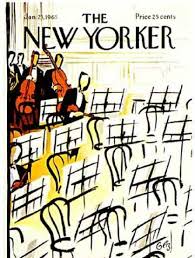
The Saturday Read this week is ‘A Sense of Where You Are’, the original New Yorker article, published in the January 23, 1965 issue.

images.jpeg

As the NCAA tournament narrows the field from 64 to 16 this weekend, let John McPhee be  your ‘throwback Saturday’ guide to Princeton University in the fall of 1964.

“The basketball locker room in the gymnasium at Princeton has no blackboard, no water fountain, and, in fact, no lockers. Up on the main floor, things go along in the same vein. Collapsible grandstands pull out of the walls and crowd up to the edge of the court. Jolly alumni sometimes wander in just before a game begins, sit down on the players’ bench, and are permitted to stay there. The players themselves are a little slow getting started each year, because if they try to do some practicing on their own during the autumn they find the gymnasium full of graduate students who know their rights and won’t move over. When a fellow does get some action, it can be dangerous. The gym is so poorly designed that a scrimmaging player can be knocked down one of two flights of concrete stairs. It hardly seems possible, but at the moment this scandalous milieu includes William Warren Bradley, who is the best amateur basketball player in the United States and among the best players, amateur or professional, in the history of the sport.”

McPhee introduces us to Bradley, his work ethic, and a time when basketball competition provided “a real period of relief from the academic load”.

Stay with me, fellow time traveller. This is not fiction. This is the future Pulitzer Prize winner, and pioneer of creative non-fiction, John McPhee, painting a picture of college life and basketball in the early 1960s.

In September of his senior year, Bradley competed on the U.S. Olympic basketball team in Tokyo, defeating Russia for the gold medal. In December, he was elected a Rhodes Scholar. He opted out of an opportunity to play for the NY Knicks to study at Oxford.

“Bradley says that when he was seventeen he came to realize that life was much longer than a few winters of basketball. He is quite serious in his application to the game, but he has wider interests and, particularly, bigger ambitions.”

Last year Marc Tracy revisited McPhee, the profile that began his career at The New Yorker, and Bradley’s last NCAA tournament.

“Fifty years earlier, McPhee had good reason to be at the Palestra for a basketball game, and for looking more than simply interested. He was covering an N.C.A.A. tournament game between Princeton and Penn State. Princeton won and then, at College Park, Md., defeated North Carolina State (whose zone press had just handled Duke) and Providence to advance to the Final Four in Portland, Ore. There, it lost to Michigan and, in the consolation game, devastated Wichita State, 118-82.”

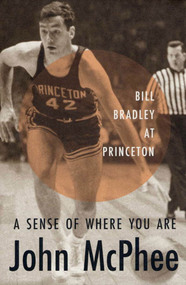
The profile, which was later expanded into a book of the same title, provides a tutorial on basketball, and the life of one true ‘student-athlete’, as he balances his academics, sport, and community involvement.

9780374526894.jpg

About that title:

“I asked him what he called his over-the-shoulder shot. He said that he had never heard a name for it, but that he had seen Oscar Robertson, of the Cincinnati Royals, and Jerry West, of the Los Angeles Lakers, do it, and had worked it out for himself. He went on to say that it is a much simpler shot than it appears to be, and, to illustrate, he tossed a ball over his shoulder and into the basket while he was talking and looking me in the eye. I retrieved the ball and handed it back to him. “When you have played basketball for a while, you don’t need to look at the basket when you are in close like this,” he said, throwing it over his shoulder again and right through the hoop. “You develop a sense of where you are.”

In 1964 his classmates predicted Bradley might run for governor in his home state of Missouri, and one day run for president.

With Bradley off to Oxford, McPhee closed his profile with this sentence.

“And like Hank Luisetti, of Stanford, who never played professional basketball, he will have the almost unique distinction of taking only the name of his college with him into the chronicles of the sport.”

That was not the end of the story.

Bradley returned after earning a masters degree at Oxford to play ten seasons with the NY Knicks, and was inducted into the Basketball Hall of Fame in 1983. He served as the U.S. Senator from New Jersey (not Missouri) from 1979-1997. And he ran for president in 2000.

In the 2015, NY Times article,“Bradley explained what the book’s title means to him”.

“You have a sense of where you are in life,” he said. “You don’t get carried away. You know who you are. You understand the environment, the context in which you’re living, and you make decisions based upon the centeredness.”

He added, “You’re also always working on who you are.”


‘One Art’ a poem by Elizabeth Bishop

This week a candidate competing in the Republican presidential primary suspended his campaign. Another continues to label his opponents ‘losers’. In the noise of our success driven culture we have lost respect for the fine art of losing. The Friday Poem this week is from American poet, Elizabeth Bishop, who reminds us that we all “Lose something every day.” 

Being a loser is not a bad thing, it’s a human thing.

One Art

The art of losing isn’t hard to master;
so many things seem filled with the intent
to be lost that their loss is no disaster.

Lose something every day. Accept the fluster
of lost door keys, the hour badly spent.
The art of losing isn’t hard to master.

Then practice losing farther, losing faster:
places, and names, and where it was you meant
to travel. None of these will bring disaster.

I lost my mother’s watch. And look! my last, or
next-to-last, of three loved houses went.
The art of losing isn’t hard to master.

I lost two cities, lovely ones. And, vaster,
some realms I owned, two rivers, a continent.
I miss them, but it wasn’t a disaster.

—Even losing you (the joking voice, a gesture
I love) I shan’t have lied. It’s evident
the art of losing’s not too hard to master
though it may look like (Write it!) like disaster.

Elizabeth Bishop   ‘The Complete Poems 1926-1979’

420278

How to use ‘bracketology’ to add a little ‘March Madness’ to your job search

This is the time of year when everyone, including the President is selecting who they believe will advance to the final four in the NCAA men’s and women’s basketball championships. With a little imagination, you can use the bracket concept as a decision matrix to manage career choice, job search or your network.

In 2007, sportswriters Richard Sandomir and Mark Reiter published ‘The Enlightened Bracketologist: The Final Four of Everything’, applying the methodology of March Madness to everyday decisions.

51rzCgAXA1L._SY498_BO1,204,203,200_

“Bracketology—the practice of parsing people, places, and things into discrete one-on-one matchups to determine which of the two is superior or preferable—works because it is simple. It is a system that helps us make clearer and cleaner decisions about what is good, better, best in our world. What could be simpler than breaking down a choice into either/or, black or white, this one or that one?”

How can we apply the scaffolding of March Madness to job search? Let’s say you are totally undecided (confused, terrified, ambivalent) about your next career move. All you know is you’re not happy with your current work situation. Where do you begin?

Try categorizing your interests using the bracket system. Instead of four regions, fill in four career fields that might interest you. Next, identify sixteen possible employers in each field. Once you have your potential employer roster identified, begin your research.

This may be a good time to develop a parallel list of contacts: a bracket representing your network. Use the same four career categories and identify folks who have broad expertise  in the profession. In this ‘exploration’ phase you are aggregating data about industry trends, market leaders, and potential for growth.

As you progress with your data gathering, you will begin to eliminate some organizations in favor of others. Once you get to your ‘elite eight’ employers, schedule your in-depth information interviews.

As you talk to people you will begin to establish a realistic assessment of ‘organization fit’, and evaluate your chances for success.

The ‘elite eight’ forms your target list. By the time you have narrowed your selection to eight, you should feel comfortable that each employer presents a realistic starting point in the next phase your career.

As with any selection process, you don’t have total control. The employer extends the offer and you have the choice to accept or continue to pursue other options.

The NCAA tournament lasts three weeks. If you start filling in your career brackets now, you will advance through the exploration process at a pace to be ready for interviews by ‘tip-off’ in the championship game.

Its time to add a little ‘March Madness’ to your job search, and some fun to a typically stressful routine.


The week@work: ‘idea debt’, interview questions & women@work: #pledgeforparity & the downside of being a trailblazer

‘Idea debt’, emotional intelligence, International Women’s Day, and lessons from the ‘girl next door who loved sports’, headline our survey of stories this week@work .

Are you a ‘wantrapreneur’? Journalist Oliver Burkeman debunks the belief that thinking about doing something is doing it.

1156.jpg

“I hadn’t seen the problem clearly until the other day, when I encountered the illustrator Kazu Kibuishi’s term for it: “idea debt”. You run up an idea debt, Kibuishi’s fellow artist Jessica Abel explained, when you spend “too much time picturing what a project is going to be like, too much time thinking about how awesome it will be… and too little time actually making the thing”.

Just as the accruing interest on a credit card makes it harder and harder to get back on your feet financially, idea debt impedes action. The more glorious and detailed the pictures in your mind, the more daunting it feels to start making them real.

As Gregg Krech writes in his book The Art Of Taking Action, external reality remains exactly the same after your decision to ask someone out, to write a book, or leave your job. What matters is “creating ripples”, as he puts it – actions, however tiny, that alter things in the world outside your head.”

What are the questions employers ask to determine if a job candidate possesses a solid set of ‘people skills’?  With her article, ‘7 Interview Questions That Determine Emotional Intelligence’, Carolyn Sun not only provides tips for interviewers, but explains the rationale behind the questions for potential hires.

images.jpeg

Here’s one example:

“Can you teach me something, as if I’ve never heard of it before? (It can be anything: A skill, a lesson or a puzzle.)
A job candidate’s answer to this question can reveal several qualities:

Whether the person is willing to take the time to think before speaking.

If the candidate has the technical ability to explain something to a person who is less knowledgeable in the subject.

Whether the candidate asks empathetic questions to the person being taught, such as, “Is this making sense?”

On March 8, International Women’s Day, the Economist “created a glass-ceiling index”, to show where women have the best chances of equal treatment at work. It combines data on higher education, labour-force participation, pay, child-care costs, maternity rights, business-school applications and representation in senior jobs. Each country’s score is a weighted average of its performance on nine indicators.

purple-woman.jpgTo no one’s surprise, Nordic countries come out well on educational attainment and labour-force participation. Women are also relatively well represented in their parliaments; Finland and Sweden were among the first countries to allow women to vote and stand for election. Yet even there women are paid less than men for similar work. In Finland and Sweden the gap is close to the OECD average of 15%, though in Norway it has fallen to 8%.
At the bottom of our index are Japan and South Korea. Too few women there have jobs, few senior managers or board members are women and pay gaps are large—in South Korea, at 37%, the largest in the OECD. If, in the UN’s words, “equality for women is progress for all”, both countries have a long way to go.”

If you are interested additional reporting on #pledgeforparity and IWD,  Washington Post journalist Danielle Paquette wrote two stories this week for Wonkblog:

‘It’s 2016, and women still make less for doing the same work as men’

‘Pay doesn’t look the same for men and women at top newspapers’

The next story falls into the category of ‘you should be safe when you pursue your dream job.’

When sports journalist Erin Andrews graduated from the University of Florida in 2000, she began a career that eventually brought her to sidelines of college football at both ESPN and Fox Sports, and the dance floor; first as a finalist and now as the co-host of ‘Dancing With The Stars’.

Sarah Kaplan, reporting for The Washington Post summarized what happened next.

“In 2008, Michael David Barrett, who served 2 1/2 years in federal prison after pleading guilty to interstate stalking — said he chose to target her because she was popular and trending on Yahoo.”

“Erin Andrews wanted to be “the girl next door who loved sports,” she said.

“And now I’m the girl with a hotel scandal,” the Fox sportscaster tearfully told a Tennessee courtroom Monday.”

The trial and jury verdict in her favor last week is just one story of ‘The Dangers of Being a Female Sportscaster’ described by Richard Sandomir and John Branch for The New York Times.

Unknown.jpeg

“Female sportscasters have unparalleled reach in an age of round-the-clock sports broadcasting and the widespread dissemination of their work across social media. There are more of them now than ever, across multiple channels and websites.

The stories Sandomir and Branch recount serve as a guide for all women@work, not just those with a high profile in social media.

“I’ll try to avoid ever being in the hall of a hotel by myself,” said Kim Jones, a reporter for NFL Network. “And I’ll allow whoever is behind me to pass me before I put my card or key in the door. You have to be so aware because unfortunately that one time out of 10,000, something can happen.”

Alyssa Roenigk, a reporter for ESPN the Magazine who also appears on the air, primarily covering action sports like the X Games, said she had rarely given her security much thought. For years, she usually walked from venues to her hotel, even late at night. But as she began to do more television and was recognized more often, she was told by her bosses to start taking the courtesy car provided by the network.

“At first I thought I was getting special treatment, and I don’t want special treatment,” Ms. Roenigk said. “It’s not special treatment. It’s being safe.”

Stay safe this week@work, create some ripples and start reducing that ‘idea debt’.


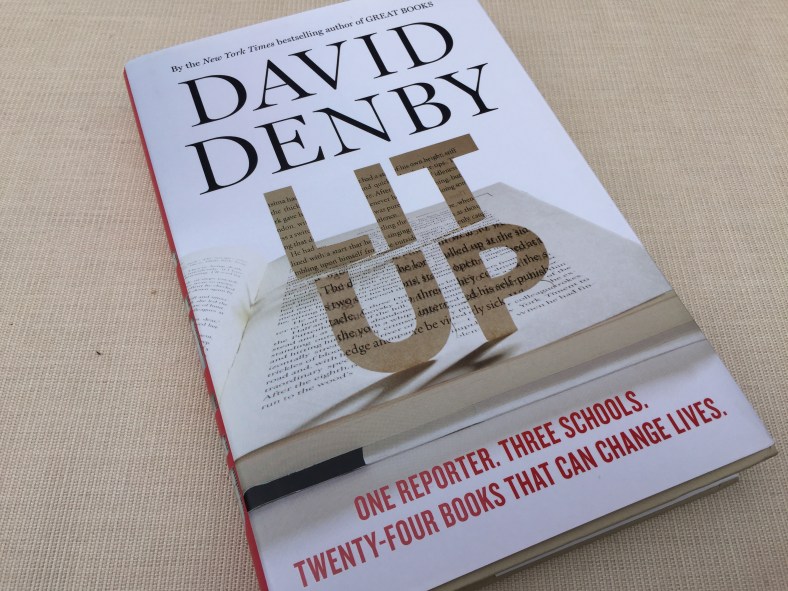
The Saturday Read ‘LIT UP: One Reporter, Three Schools. Twenty-Four Books That Can Change Lives.’ by David Denby

If you believe that the humanities are as critical as STEM skills in the 21st century workplace, take a trip back to high school with David Denby and this week’s Saturday Read, ‘LIT UP’: One Reporter. Three Schools. Twenty-Four Books That Can Change Lives.

We have this basic disconnect in our workplace today that is pitting generalists against specialists. The consequences are trickling down into our public education system.

If you’re a parent considering where to invest in your child’s college education, you’re probably looking at ‘vocational’ programs that ‘guarantee’ a job at graduation. If you’re that same parent, but now in the role of organization executive, you realize your recruiting efforts must consider ‘cultural contribution’; potential in addition to skill set. If you’re a student, you hear ‘STEM good, humanities bad; or worse, a waste of time’.

Writing in The New Yorker in February, Mr. Denby addressed the challenge in advocating for the humanities in today’s skill driven education/employer complex. He cited recent state government efforts to offer ‘bonus premiums’ in financial aid to students enrolled in STEM degree programs by cutting funding to students in the humanities.

“Lifetime readers know that reading literature can be transformative, but they can’t prove it. If they tried, they would have to buck the metric prejudice, the American notion that assertions unsupported with statistics are virtually meaningless. What they know about literature and its effects is literally and spiritually immeasurable. They would have to buck common marketplace wisdom, too: in an economy demanding “skill sets”—defined narrowly as technical and business skills—that deep-reading stuff won’t get you anywhere.” 

In ‘LIT UP’ David Denby is searching for the magic that transforms a young reader into a lifetime reader. “How do you establish reading pleasure in busy screen-loving teenagers – and in particular, pleasure in reading serious work? Is it still possible to raise teenagers who can’t live without reading something good? Or is that idea absurd? And could the struggle to create such hunger have any effect on the character of boys and girls?”

He chooses to go back to school for the 2011-12 academic year at Beacon, a New York City magnet high school, at the time located on West 61st St, observing teacher Sean Leon‘s tenth grade English class.

“School was the place to find out. And students in the tenth grade, I thought, were the right kids to look at. Recent work by neuroscientists has established that adolescence, as well as early childhood, is a period of tremendous “neuroplasticity”. At that age, the brain still has a genuine capacity to change.”

The book is structured by months, and reading selections. Mr. Leon introduces each book with inventive assignments, questions and at one point, a ‘digital fast’. Mr. Denby provides thumbnail plot sketches to shake the cobwebs from our ‘required reading’ memories. And we meet the students, by pseudonym, in their reactions to the literature.

At one point, the author gives the students a questionnaire to find out what books they read on their own, and their favorite authors. He finds three ‘real readers’ in a class of 32. “…unfairly or not, I was sorry that among Mr. Leon’s students there were no mad enthusiasms, no crazy loves, no compulsive reading of every book by a single author…”

In writing the book, he was encouraged by colleagues to create a scalable review, contrary to his initial approach, resisting quantification, and observing “a single place where literary education seemed to be working.” 

He realized that you can’t clone Beacon’s Sean Leon. He wanted other teachers to learn from Leon’s methods, but realized additional perspectives would add to his narrative.

“Typicality and comprehensiveness remained impossible to achieve, but variety was not. I delayed finishing the book, and, in the academic year 2013-14, I visited tenth-grade English classes in two other public schools – shuttling up many times during the year to James Hillhouse High School, an inner-city school in New Haven with a largely poor African American population; and five times in the spring to a school in a wealthy New York suburb, Mamaroneck, a “bedroom town” in the language of the fifties, where people sent their kids to good schools.”

Mr. Denby’s appendix includes the reading lists for each of the schools he visited and a ‘where are they now?’ college destination roster of the Beacon English Class of 2014. “There is, of course, no ideal reading list, no perfect syllabus, no perfect classroom manner, but only strategies that work or don’t work. In a reading crisis, we are pragmatists as well as idealists.”

“Teenagers, distracted, busy, self-obsessed, are not easy to engage – not by their teachers or by their parents. To keep them in the game, the teachers I watched experimented, altered the routine, changing the physical dimensions of the class. They kept the kids off balance in order to put them back in balance. They demanded more of students than the students expected to give.”

This is a book for parents, parents who are business leaders; teachers and the politicians who minimize their value; and students. We’re in a reading crisis and we need folks who have emotional intelligence, who can think, judge, make decisions and create a vision for an enterprise within a global world view.

“Teachers are the most maligned and ignored professionals in American life. In the humanities, the good ones are as central to our emotional and moral life as priests, ministers, rabbis, and imams. The good ones are not sheepish or silent in defense of literature and history and the rest. They can’t be; the children’s lives are right before them. In high-school English, if the teachers are shrewd and willing to take a few risks, they will try to reach the students where they live emotionally. They will engage, for instance, with “naïve” existential questions (what do I live for?) and also adolescent fascination with “dark” moods and the fear of being engulfed by adult society. Shakespeare, Mary Shelley, Poe, Hawthorne, Twain, Stevenson, Orwell, Vonnegut, and many others wrote about such things. And if teachers can make books important to kids—and forge the necessary link to pleasure and need—those kids may turn off the screens. At least for a few vital hours.”

‘Today’ a poem by Billy Collins


The signs of spring are around us. On Sunday we move the clocks ahead an hour and begin to fill in our NCAA tournament brackets. In the world beyond our workplace windows, nature quietly launches her ‘trickster season’.

“Spring has never been a reliable season. Some years it includes too much summer, some years too much winter, and some years too much of both.”

The Friday Poem this week comes from two time U.S. Poet Laureate, Billy Collins, who invites us to “throw open all the windows in the house” and enjoy the perfect spring day.

Today

If ever there were a spring day so perfect,
so uplifted by a warm intermittent breeze

that it made you want to throw
open all the windows in the house

and unlatch the door to the canary’s cage,
indeed, rip the little door from its jamb,

a day when the cool brick paths
and the garden bursting with peonies

seemed so etched in sunlight
that you felt like taking

a hammer to the glass paperweight
on the living room end table,

releasing the inhabitants
from their snow-covered cottage

so they could walk out,
holding hands and squinting

into this larger dome of blue and white,
well, today is just that kind of day.

Billy Collins   Poetry Magazine,  April 2000

176-1

“Accessibility is not a word often associated with great poetry. Yet Billy Collins has managed to create a legacy from what he calls being poetically “hospitable.” Preferring lyrical simplicity to abstruse intellectualism, Collins combines humility and depth of perception, undercutting light and digestible topics with dark and at times biting humor.”  (TED 2012)


We all need a ‘spring break’

We all need a ‘spring break’. And it’s not just for the vitamin D sunshine boost. A temporary change in location can stimulate a permanent change in perspective.

Nature reminds us to pause, celebrate, and welcome spring. As temperatures moderate and daylight hours lengthen we find ways to escape to the outdoors, contemplating great decisions on walks around the block or conferring with colleagues at courtyard conference tables.

But these are only ‘teaser’ experiences. If you have been running a marathon @work since the beginning of the new year, it’s time to break away from work and experience something new.

In the U.S. the concept of spring break is often synonymous with beach bacchanals and mindless cavorting. While that may be the choice for a minority, the perception masks the reality of those who take a week to travel outside their comfort zone to assist non-profits and NGOs in their work to improve the lives of others.

Spring break has many definitions, incorporating a variety of experience. Most describe renewal, not exhaustion; fun, not excess.

The ‘muscle memory’ of the academic calendar that guided our days beginning in pre-school, stimulates our recollection of past spring adventures, and the little earthquakes in our perceptions of the world.

What adventure will be your catalyst to discovery?

IMG_4001

I took this photo on a Saturday morning at the corner of Pico and Exposition in Los Angeles. The traffic stop sign, with the bicycle attached offered passersby an invitation to stop and consider an adventure accessible with a key.

You don’t need book a flight to Mexico or the Caribbean. Just stop. Your bike is outside, waiting for you.


The week@work – leadership, lawyers, student loans & the economy

What makes a great leader or a great lawyer? What’s the best strategy to retire student debt? This week@work surveys articles that provide some answers, and as the economy continues to strengthen, offers some practical advice on career advancement.

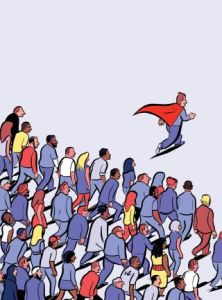
Joshua Rothman wrote ‘Shut Up and Sit Down: Why the leadership industry rules’ for The New Yorker. He gives us a quick tutorial on the history of leadership, why we value the concept, but are so often disappointed in the people. He alludes to the current presidential contest, and then focuses on change in both our expectations of leaders, and the roles they play in contemporary organizations.Print

“In recent years, technological and economic changes like social media and globalization have made leaders less powerful.

Leaders used to be titanic and individual; now they’re faceless guiders of processes. Once, only the people in charge could lead; now anyone can lead “emergently.” The focus has shifted from the small number of people who have been designated as leaders to the background systems that produce and select leaders in the first place.

Leaders, moreover, used to command; now they suggest. Conceptually, at least, leadership and power have been decoupled.

To some extent, leaders are storytellers; really, though, they are characters in stories. They play leading roles, but in dramas they can’t predict and don’t always understand. Because the serialized drama of history is bigger than any one character’s arc, leaders can’t guarantee our ultimate narrative satisfaction. Because events, on the whole, are more protean than people, leaders grow less satisfying with time, as the stories they’re ready to tell diverge from the stories we want to hear. And, because our desire for a coherent vision of the world is bottomless, our hunger for leadership is insatiable, too. Leaders make the world more sensible, but never sensible enough.”

The New York Times profiled two women who chose law as their profession and took divergent, pioneering paths to achieve success. What makes a good lawyer? Meet Kimberley Chongyong Motley and Damaris Hernandez.

David Jolly profiled Ms. Motley, who has been practicing her profession in Afghanistan for close to eight years and was recently the subject of an award winning documentary, ‘Motley’s Law’.

image.adapt.990.high.kimberley_motley_05feb2016_portrait.1454770287607“Ms. Motley, 40, a Marquette University Law School graduate, had never before traveled overseas when she enrolled in a Justice Department program to train Afghan lawyers and flew to one of the world’s more dangerous places.

After her nine-month assignment, she did not return home to Milwaukee, instead hanging out her own shingle in Kabul. She studied Shariah, the Islamic code that lies beneath the fragile new Afghan Constitution, and she established herself as the only foreign litigator in one of the world’s most conservative and male-dominated cultures.

Ms. Motley says she makes a point of closely studying the cultures of both Afghanistan and the courtroom. “I’m a sort of legal archaeologist,” she said. “I try to uncover laws that have not been used, and then use them for the benefit of my clients.”

Damaris Hernandez was recently promoted to partner at the firm Cravath, Swaine & Moore, becoming the first Latina to reach that position. Elizabeth Olson tells her story as a first generation college student, who advanced in her career with the support of a unique scholarship at NYU.

Hernandez web.jpg

That achievement is an acknowledgment of her talent and hard work. But the story of her route to the top also reveals how much more complex the journey is for minorities and women than for the white men who overwhelmingly dominate the firms. Skill is only one of the keys. Being able to navigate unspoken rules is at least as important.

“When I was the only one of color or the only woman in the room, I had the confidence to believe in my ability,” said Ms. Hernández, 36, describing the advantages of the program to her. “When you are the first, you need someone to have your back.”

Over the last decade and a half, she and 100 others who attended the New York University School of Law received that support from a scholarship program that paid their full tuition and also gave them access to a network of luminaries including federal judges, law firm partners and even Supreme Court justices.”

If you are seeking ways to reduce your student loan obligation, NPR’s Yuki Noguchi offers ‘Strategies For When You’re Starting Out Saddled With Student Debt’. It’s not just about individual liability, but also the long term impact on career choice and economic growth.

“Experts say studies show rising student debt is limiting peoples’ career options. They decide against graduate school. Or feel they can’t afford lower-paying public service jobs or the risk of starting a new business. That’s a problem, because new companies create new jobs.”

University Park campus of the University of Southern California

This past week the University of  Southern California announced a tuition increase that will bring the annual bill to over $51,000. Financing college involves loans as part of the  package. Having a repayment strategy is critical to long term career success.

“Chris Costello, CEO of Blooom, a personal finance advice firm targeting lower-net-worth people, advises his firm’s clients to tackle student debt with this strategy.

First, if your employer matches contributions to a retirement plan, such as a 401(k) or 403(b), max out on the matching contributions.

After maxing out on the matching contributions, pay off the debt with the lowest balance.

Check to see if you can qualify for loan forgiveness, refinancing or debt consolidation.

Do not incur new debts: in other words, live below your means.”

Chico Harlan of The Washington Post reported on the latest figures released by the U.S. Labor Department on Friday.

“U.S. employers continued their rapid hiring in February, new government data showed Friday, a sign of the nation’s economic durability during a tumultuous global slowdown.

The U.S. added 242,000 jobs as the unemployment rate held at 4.9 percent, the lowest mark during the seven-year recovery from the Great Recession.

That pace, consistent with gains over the last year, indicates Americans are returning rapidly to the labor force, helped by steady consumer spending that is bolstering demand and prompting employers to expand their workforces. In data released Friday by the Department of Labor, sluggish wages provided the only disappointing note — a signal that labor market still has room to improve.”

Two other articles of interest this week:

’15 things successful 20-somethings do in their spare time’ by Jacquelyn Smith and Rachel Gillett for Business Insider

‘How to Advance In Your Career Without Becoming A Workaholic’ by Lisa Evans for Fast Company