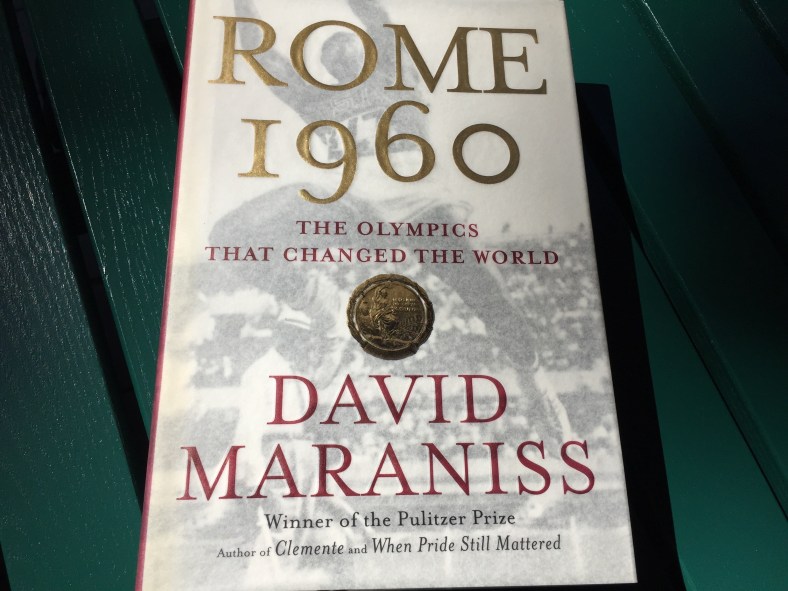
The Saturday Read ‘Rome 1960:The Olympics That Changed The World’ by David Maraniss

For the last weekend of summer 2016, the Saturday Read takes you to ‘Rome 1960: The Olympics That Changed The World’ by Pulitzer Prize winning journalist, David Maraniss.

In the summer of 1960 only 15 years had passed since the end of World War II. The superpowers were angling for global influence, and the XVII Olympiad in Rome provided one more stage to showcase the benefits of competing forms of government.

“History is replete with moments that ache with misplaced optimism, and that seemed true of the period of the 1960 Summer Olympics even as signs of a troubled world riddled those days of late August and early September. The Games were bookended by the Soviet spy trial of American U-2 pilot Frances Gary Powers and Khrushchev’s threat to stir up things at the UN, while in between came increasing tension in divided Berlin and violence in the rebellious Congo. Whatever Avery Brundage’s wishes, the Olympics were in no way isolated from the eruptions and disruptions of the modern world. Rome had its share of spies and propagandists looking to turn every situation to their advantage. Yet those days in Rome were infused with a golden hue nonetheless. The shimmering was literal – emanating from the autumnal sun; the ancient coloration of the streets, walls, and piazzas; the warm angles of refracted light – but it was also figurative, an illumining that comes with a moment of historical transition, when one era is dying and another is being born.”

The reader experiences the eighteen days of the Rome Olympics through Maraniss’ chronicle of events, athletes, coaches, sports writers, and a few nefarious government players. The narrative introduces us to the Americans and their competitors. It’s quite a cast of characters including then Cassius Clay, Rafer Johnson, C.K. Yang, Wilma Rudolph, and Abebe Bikila.

“The pressures of the cold war played an underappreciated role in forcing change in culture and sports, all much in evidence in Rome. At the opening Parade of Nations at the Stadio Olympico, the crowd was stirred by the sight of Rafer Johnson marching into the arena at the head of the U.S. delegation, the first black athlete to carry the American flag. Johnson’s historic act reflected his unsurpassed status as a world-class decathlete, but it also served as a symbolic weapon at a time when the United States was promoting freedom abroad but struggling to answer blatant racism at home, where millions of Americans were denied freedom because of the color of their skin.”

The author is at his best when sharing the story of Coach Edward Temple and his ‘Tigerbelles’ women’s track team from the Tennessee Agricultural and Industrial State University in Nashville. We time travel to an American South before the Civil Rights Act of 1964, when women’s sports were viewed as unimpressive adjuncts to the men’s competition.

“When Temple was named head coach at Tennessee A&I State after graduating in 1950, it was because nobody else wanted the job. His starting salary was $150 a month, which when added to his pay for teaching social science courses, brought a yearly sum of $5,196…By the mid fifties, even after Temple had established his program and led it to a national title, the athletic department still would not give him a desk, let alone an office. “

In Rome, as Olympic coach, Temple could only see a segment of the track from his position at the opening of the tunnel. One of his runners, Wilma Rudolph, who had overcome polio as a child, was competing in the 100 meter race. The day before, ‘Black Tuesday’, the U.S. men’s track and field team suffered its worst losses in the 100 meter, 200 meter, and 4×100 meter relay.

“Wilma won! Wilma won!” someone shouted at Temple in the tunnel. “You’re joking,” he said. Then he stepped into the golden late afternoon sunlight, and “they flashed it on the big scoreboard and put the time, the new Olympic record, ‘Wilma Rudolph, USA.’ and I said, ‘Hot Dog!’.

Earlier in the competition, Ed Temple’s greatest hope was just to get one of his runners on the medal stand. A bronze would do. But in the four days since Wilma Rudolph  won gold in the 100, all of that had changed. From a relative unknown, Rudolph had risen to international stardom, belle of the Olympics, the favorite in anything she did.”

Her success resonated with other athletes, including Anne Warner, a gold medal swimmer.

“I had read the stories about her fight against polio and what she had done. She was really a hero for a lot of us. It didn’t matter that it was a different sport. She was just such a beautiful runner. And I think that polio was such a part of our lives then, too, because we were swimmers. A lot of times your parents were nervous about going to swimming pools in that era. And there was no Salk vaccine yet when we were starting out. So the fact that she had polio meant something special to us.”

Maraniss’ command of the story places the reader ‘on location’ as events unfold.

Rafer Johnson was student body president at UCLA and a member of the track and field team along with CK Yang. On September 5, 1960 they met as competitors for the title of the world’s greatest athlete; Johnson representing the United States and C.K. Yang, Formosa. At the end of the first day of decathlon competition  Johnson led Yang by a slim 55 points.

“Few Olympic athletes know one another as thoroughly as Rafer Johnson and C.K. Yang. It was not that both had trained at UCLA for the same event under the same coaches. A deeper sensibility seemed at work in their symbiotic relationship, a spirited blend of admiration and competitiveness that pushed them to greater accomplishments together than they may have achieved apart.”

Across town, Cassius Clay was the unanimous winner in his bout with Zbigniew Pietrzkowski of Poland.

“Everyone seemed up and about early Tuesday morning. Cassius Clay paraded through the village before breakfast, gold medal dangling rom his neck. “I got to show this thing off!” he kept boasting…He was on his way to signing a professional contract, earning serious money, and becoming even more famous as the heavyweight champion of the world.”

Tuesday was day two of the decathlon.

“After back-to-back fourteen-hour days, ten events, draining humidity, evening chill, rain delays, unbearable tension, and the accumulation of an Olympic record 8392 points, (by the scoring system in 1960), Rafer Johnson left the Stadio Olimpico for the last time at eleven o’clock that night, retracing the steps he had taken nearly two weeks earlier as the captain and flag bearer for the U.S. Olympic team. As he trudged, relieved and exhausted, along the moonlit Tiber and over the bridge, C.K. Yang, now just a friend, no longer a competitor, walked once again at his side.”

The marathon was held on the final full day of competition in 1960. It was to produce one of the most remarkable stories in Olympic history.

Abebe Bikila of Ethiopia waited at the start, barefoot.

“Marathons traditionally were held during daylight and ended with the runners entering the main stadium…In the heat of Rome, the race began at twilight and proceeded into darkness; the finish line was not inside the Stadio Olympico but at the Arch of Constantine amid the Roman ruins.

The British writer Neil Allen, from his seat jammed amid his fellow journalists, feeling “the sudden chill of the night” and looking “dazedly at the floodlit Arch of Constantine,” could not believe it when the loudspeaker crackled the name of the leader, Abebe Bikila…”A completely unknown athlete from Ethiopia was going to win the Olympic marathon…Journalists and officials edged forward in their wooden stands, peering along the darkness of the Appian Way hoping to be the first to spot this last and most unexpected hero of the Games.” At last the lights of a convoy could be seen…There was a brief tussle with one of the persistent Lambretta scooters before it was bundled our of the way, and then – here he came!

The Rome Olympics were the first commercially televised summer games in history. In New York, Jim McKay was beginning his career in TV sports from a small studio in New York.

“It was all so minimal in Rome, with McKay in that little studio in New York, tapping our his own scripts on a portable typewriter, drawing information fro the Encyclopedia Britannica; and with Peter Molnar’s crew of fewer than fifty in Rome filming and editing on the fly, literally trying to beat the clock every night with their canisters winging west toward New York City in the bellies of commercial jets. The televising of the Olympic games grew from that infancy in Rome to an extravaganza, expanding every four years into an ever-larger enterprise that eventually entailed a broadcast army…”

As Rome prepares it’s bid to host the 2020 Olympics, enjoy David Maraniss’ account of the  first time the world came to compete for gold in ‘The Eternal City’.


The Friday Poem ‘Labor Day’ by Joseph Millar

Part of the year I live in a ‘swing state’ where the economy has not yet recovered, and politicians fill the airwaves with promises of transformational ‘greatness’. The Friday Poem this week is from Pennsylvania native, former telephone repairman, commercial fisherman, and poet Joseph Millar. ‘Labor Day’ captures the quiet of a national holiday, first celebrated in New York on September 5, 1882.

“The form that the observance and celebration of Labor Day should take was outlined in the first proposal of the holiday — a street parade to exhibit to the public “the strength and esprit de corps of the trade and labor organizations” of the community, followed by a festival for the recreation and amusement of the workers and their families. This became the pattern for the celebrations of Labor Day. Speeches by prominent men and women were introduced later, as more emphasis was placed upon the economic and civic significance of the holiday. Still later, by a resolution of the American Federation of Labor convention of 1909, the Sunday preceding Labor Day was adopted as Labor Sunday and dedicated to the spiritual and educational aspects of the labor movement.”

Labor Day

Even the bosses are sleeping late
in the dusty light of September.

The parking lot’s empty and no one cares.
No one unloads a ladder, steps on the gas

or starts up the big machines in the shop,
sanding and grinding, cutting and binding.

No one lays a flat bead of flux over a metal seam
or lowers the steel forks from a tailgate.

Shadows gather inside the sleeve
of the empty thermos beside the sink,

the bells go still by the channel buoy,
the wind lies down in the west,

the tuna boats rest on their tie-up lines
turning a little, this way and that.

Joseph Millar  from ‘Blue Rust’ Carnegie Mellon University Press, 2012

9780887485497.jpg

What are you going to do with those energy reserves you stored this summer?

As the sun sets on summer 2016, use the upcoming Labor Day weekend as a catalyst to recalibrate you career trajectory.

Why Labor Day? Timing is everything. This weekend marks a transition between seasons and a sense of ‘starting over’ as a new school year begins.

When you arrive @work on Tuesday morning your plans will collide with the competing interests of colleagues returning to work, equally energized and motivated. If you have a plan, and a schedule of activities already on your calendar you will be in a position to maintain the momentum, moving you closer to your ‘dream’.

Start with two questions:

What do I still want to accomplish?

What is one thing I can do move forward?

Your answer to the first question asserts your priorities, and the second sets the first item on your agenda.

When thinking about priorities, consider feedback you have received from managers, colleagues, mentors and friends. What skills need fine tuning? Is there additional expertise you need to acquire to advance in your current position or transition to a new workplace? Who can help you achieve your goals? Is it time for additional training or an advanced degree?

The ‘still want to accomplish’ question hits at the fundamental essence of who you are, who you want to become, and the legacy you want to leave behind. It has a workplace component, but also addresses work/life balance, and your role as a contributing member of your community.

The next step is to schedule a meeting to set your priorities in motion: coffee with a mentor to review your career direction, an information interview to establish a new professional connection, a visit to a local non-profit, or a meeting with an academic advisor to explore educational options.

Your priorities dictate your agenda.

Before the weekend comes to an end, take a few minutes to review your calendar and block out time for ‘summer energy reserves expenditures’. Send at least one email requesting a meeting and try to find time each week to sit down with folks who can expand your career horizons.

Effectively managing your work/life is an ongoing energy expense. It will keep you moving forward, recalibrating as needed.


The week@work – Grad students win right to unionize, the changing conversation about the economy, why America’s leaders fail and the story of Luke’s Lobster

Academia was in the headlines this week@work with the Tuesday announcement from the National Labor Relations Board, voting 3-1 to overturn a 2004 ruling allowing graduate students to form collective bargaining units. A Pew Research Center survey detected a shift in election season conversation from the economy (2012) to keeping the U.S. safe from terrorism. What conversation? The system isn’t working, and it may be we don’t have leaders who view their ‘calling’ as a ‘vocation’. And finally, a career transition story – from investment banker to ‘lobsterpreneur’ for this last week of summer.

images.jpeg

‘Ruling Pushes Door to Grad-Student Unions ‘Wide Open’ Peter Schmidt for The Chronicle of Higher Education

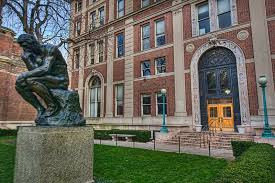
“Many more private universities can expect to see their graduate employees move to form unions in the wake of Tuesday’s National Labor Relations Board decision on such an effort at Columbia University.

The federal labor board’s 3-to-1 ruling resoundingly overturned a 2004 decision involving Brown University. In the Brown ruling, the board asserted that graduate employees should not be allowed to form unions because their doing so would intrude into the educational process.

In Tuesday’s decision, the majority held that such a belief “is unsupported by legal authority, by empirical evidence, or by the board’s actual experience.” It not only rejected the Brown precedent, but also overturned a 1974 ruling that had declared research assistants at Stanford University ineligible to unionize based on a belief that such research is part of the educational process.

The board’s decision in the Columbia case says graduate students employed by a private university are as eligible as any other type of worker to form collective-bargaining units under the National Labor Relations Act.”

In a letter to the Columbia University community, Provost John H. Coatsworth reiterated the long-held view of university administrators.

“Columbia and many of our peer universities have challenged this position. Nearly all of the students at Columbia affected by this decision are graduate students. We believe that the daily activities and the advisor-advisee relationships involved in the scholarly training of graduate students define an experience that is different from that of the typical workplace. Being a graduate student can take many years of intense research, teaching and study. But unlike university employees, graduate students who serve as teaching or research assistants come to this institution first and foremost to acquire through that work the knowledge and expertise that are essential to their becoming future scholars and teachers.”

The world of academia is changing, and with it the profile of the teaching community. As more adjunct faculty assume the classroom role, it may be harder to differentiate the job description of part-time faculty from that of grad assistant.

To be continued…

New-York-Stock-Exchange-1.jpg

‘Since 2012, The Economy Has Changed — And So Has The Conversation’ Marilyn Geewax for NPR

“Ah, 2012. You seem so long ago.

Back then, the economy was the star of the presidential election season, with more than 9 in 10 voters ranking it as Issue No. 1.

Voters worried about scarce jobs, expensive gasoline and a huge federal deficit.

Candidates proposed detailed solutions…

This year, the political conversation is very different, with much of the focus on non-economic issues: Republican Donald Trump’s temperament and Democrat Hillary Clinton’s trustworthiness.

And a Pew Research Center survey showed that the issue voters want to hear about most in a presidential debate is “keeping the US safe from terrorism.”

Of course, economic issues remain extremely important, but they are different from 2012. This year, the hottest money topics involve income inequality, trade deals and immigrants.”

Why are we focused on temperament and trustworthiness while the ‘big problems’ that effect our daily lives are ignored? David Brooks thinks it’s about career vs. calling, and he may be right.

Washington,_D.C._-_2007_aerial_view.jpg

‘Why America’s Leadership Fails’ David Brooks for The New York Times

“Over the past few decades, thousands of good people have gone into public service, but they have found themselves enmeshed in a system that drains them of their sense of vocation.

Let’s start with a refresher on the difference between a vocation and a career. A career is something you choose; a vocation is something you are called to.

A person choosing a career asks, How can I get the best job or win the most elections? A person summoned by a vocation asks, How can my existing abilities be put in service of the greatest common good?

A career is a job you do as long as the benefits outweigh the costs; a vocation involves falling in love with something, having a conviction about it and making it part of your personal identity.

A vocation involves promises to some ideal, it reveals itself in a sense of enjoyment as you undertake its tasks and it can’t be easily quit when setbacks and humiliations occur. As others have noted, it involves a double negative — you can’t not do this thing.

I do think there’s often an arc to vocation. People start with something outside themselves. Then, in the scramble to get established, the ambition of self takes over. But then at some point people realize the essential falseness of all that and they try to reconnect with their original animating ideals.

And so I think it possible to imagine a revival of vocation.”

The last story this week@work is an ‘end of summer’ career transition feature.

417562_10150602911837473_423900675_n.jpg

‘A Restaurant’s Sales Pitch: Know Your Lobster’  Janet Morrissey for The New York Times

“It was a steamy summer day in New York in 2009 when Luke Holden, an investment banker, had a craving for a lobster roll. Not just any lobster roll, though. He longed for the “fresh off the docks” taste he enjoyed growing up in Cape Elizabeth, Me.

After an exhaustive search on New York’s streets, he came up dissatisfied and disappointed.

“Every lobster was served over a white tablecloth, extremely expensive, drowning in mayo and diluted with celery,” he said. “I wondered why all the great chefs in this city had screwed this up so badly.”

So that year, Mr. Holden decided to open an authentic Maine lobster shack in Manhattan. To replicate that fresh taste that he remembered, he would need to oversee, track and, where possible, own every step in the process.

Today, he owns 19 Luke’s Lobster restaurants, two food trucks and a lobster tail cart in the United States, and five shacks in Japan.”

If you only  read one of these this week, spend some time with David Brooks…and reconnect with your “original animating ideals” and begin a “revival of vocation”. 

The Friday Poem: ‘The Boss’ by Deborah Garrison

One of the most important workplace relationships is the one between you and your direct supervisor. A good ‘boss’ will quickly sense your potential and connect your talents with work that challenges and enables professional growth. He/she employs personal experience to communicate the value of failure along with success. A good boss has a high EQ and a healthy dose of empathy for all.

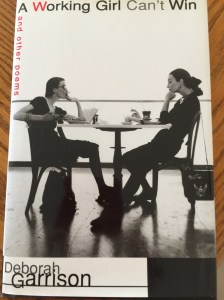
For this week’s Friday Poem, a meditation on ‘The Boss’ through the eyes of poet Deborah Garrison.

The Boss

A firecracker, even after middle age

set in, a prince of repression

in his coat and tie, with cynical words


for everything dear to him.

Once I saw a snapshot of the house

he lives in, its fence painted


white, the flowers a wife

had planted leaning into the frame

on skinny stalks, shaking little pom-poms


of color, the dazzle all

accidental, and I felt

a hot, corrective


sting: our lives would never

intersect. At some point

he got older, trimmer, became


the formidable man around the office.

His bearing upright, what hair he has

silver and smooth, he shadows my doorway,


jostling the change in his pocket –

milder now, and mildly vexed.

The other day he asked what on earth


was wrong with me, and sat me down

on his big couch, where I cried

for twenty minutes straight,


snuffling, my eyeliner

betraying itself in the stained

tears. Impossible to say I was crying


because he had asked. He passed

tissues, at ease with the fearsome

womanly squall that made me alien


even to myself. No, it didn’t make him

squirm. Across his seventy years,

over his glasses, he eyed me kindly,


and I thought what countless scenes

of tears, of love revealed

he must have known.


Deborah Garrison   ‘A Working Girl Can’t Win’ 1998

a working girl can't win

Click on this link to hear the author read the poem as part of a 1999 interview with Bill Moyers.

“In this episode of Sounds of Poetry, Garrison tells Bill that poetry is about “trying to find a way to understand and describe the world that lifts you a little bit out of it, instead of just being in it and being lost.”

Your first day @work is not that different from your first day @college

Late last month, The New York Times shared advice for incoming college freshman from 25 upperclassmen and recent grads. As I read the article, I noted a parallel in the seven topics offered for new students, and folks in their first months @work – from the first internship through every career transition.

“Freshman year is a chance to redefine yourself, to challenge assumptions, to lay the foundation for the rest of your life.”

The first day of work is also a chance to redefine yourself, challenge assumptions and begin to lay the foundation of your career.

Let’s examine the list of seven, and test their application to the workplace.

“Extend yourself”  You are the ‘newbie’ @work. You’re not expected to have all the answers on day one. Ask questions.  Explore the world beyond your cubicle. Find ‘community spaces’ where folks gather, and mingle.

“Do the work”  In college, this is basically showing up for class, @work it’s consistently engaging in projects. Don’t wait to be asked. Offer to participate in assignments that will stretch your talents.

“Understand the system and work it”  Every workplace has its unique culture, values and traditions. If you did your research before you started your new job, you should have an inkling of what to expect. Once you are on payroll, take some time to observe how folks communicate, how priorities are set, where the budget dollars are allocated, and who is making the decisions. Align yourself with the energized vs. the disgruntled.

“Be yourself”  Hopefully you selected a workplace that is a ‘fit’ with your values and talents. If the recruitment process was straightforward, being the ‘authentic’ you will contribute to your success.

You will change as part of a new work community, just as you evolved throughout your college years in an environment that fostered success, creativity, and diversity.  Check in periodically with friends outside your workplace to ensure you’re growing vs. losing your essential essence.

“Tend to yourself”, “Your grade in one class does not define you”  These tidbits of advice applied to work fall into the categories of work/life balance and recovering from failure. It’s very easy to be consumed by the work in the beginning. You’re learning new concepts, meeting new people, struggling to make deadlines, and communicating in a new workplace language. If you’re not spending time outside of work socializing, contributing to your community or maintaining a fitness routine; your work will eventually suffer.

When you do make a mistake, your career isn’t over. The upper strata of success is populated with folks who have recovered from both minor and major workplace calamity.

“Develop people skills”  Without solid communication skills, every day at work will be a challenge. Our work culture has traditionally rewarded the extrovert, but new research has shown the introvert is an equal partner in the success of any organization.

In college you may have been able to get an ‘A’ as an individual, rarely leaving your room, thinking great thoughts and rarely interacting with the campus community. @work you have to deal with people. You may be the most brilliant innovator, but at some point you have to explain your product to a client.

All of us can improve our communication skills and it’s to an organization’s advantage to support you in this effort. Find out if there are skill development programs available through your employer or professional association. Be proactive on this one.

 “Don’t get stuck” Life doesn’t always go according to plan. Entering college you may have thought you would be the next Bill Gates, when a Freshman Seminar introduced you to the wonderful world of philosophy. Tangents open up @work as well. Entering an organization for the first time, you cannot imagine the variety of opportunities that are available. You may be in a meeting with a client and realize the work his/her organization is doing is a better fit for you skills. Be open when an alternative is presented. There is no perfect career path, just one that is unique to you.

One more – always share what you learn with colleagues. Knowledge is power. Shared information can be transformative.

The week@work: Olympics close: memories remain, the power of vulnerability, workplace lessons from the cineplex, and Seattle’s millennials @work

This week@work the world’s best athletes headed to the airport and the rest of us, mere mortals, returned to our workplace. A CEO discussed the benefits of embracing vulnerability and a movie critic found workplace advice at the multiplex. In Seattle, the most recent additions to the workforce ‘gig’ their way to dream jobs.

As the Olympics came to a close on Sunday evening, there were three stories that continued to resonate from the ‘workplace’ of track and field.

‘That girl is the Olympic spirit’: After colliding, runners help each other cross finish line’ Marissa Payne for the Washington Post

Cp_KizoXgAA1MbY.jpg

For track and field athletes, the Olympics offers the biggest prize of their careers. A gold medal is a tangible symbol of years of hard work and dedication. But on Tuesday, long-distance runners Nikki Hamblin of New Zealand and Abbey D’Agostino of the United States proved hardware doesn’t always trump heart.

After the two collided on the track during the 5,000-meter race, resulting in a bad leg injury for D’Agostino, the two urged each other on and both eventually were able to finish the race, albeit seemingly sacrificing their chances at a finals berth along the way.

“Everyone wants to win and everyone wants a medal. But as disappointing as this experience is for myself and for Abbey, there’s so much more to this than a medal,” Hamblin told reporters after the race.”

‘This Great-Grandmother Coaches an Olympic Champion. Now Let Her By.’ Karen Crouse for The New York Times

634.jpg

“The great-grandmother who could pass as Barbara Bush’s kid sister waded through the stands at Olympic Stadium on Sunday night, trying to get close enough to congratulate the South African runner Wayde van Niekerk, who had just captured the gold medal in the 400 meters and broken one of the oldest world records in men’s track and field.

This is Botha’s first Olympics. She competed — without distinction, she said — in the sprints and the long jump when she was young and began coaching in 1968 while living in her native Namibia, then a territory under the rule of South Africa. Her first athletes were her son and daughter, but when they reached a certain level, she passed them off to other coaches, she said, “because I feel that’s not always a good thing as a parent to coach your own children.”

The woman who didn’t believe it prudent to coach her own children has earned the trust of her athletes by treating them as family.

“She doesn’t see us as athletes or as people; she sees us as her children,” said van Niekerk, who asked Botha in late 2012 if he could train under her at the University of the Free State, where she has been the head track and field coach since 1990.

Van Niekerk won the race from Lane 8, considered a disadvantageous position. Botha said it didn’t bother her that he was in an outside lane. “Because every lane is the same distance,” she said.”

Rio+Olympics+Athletic_Spof+(4).jpg

Can Ashton Eaton Save the Decathlon?  Mary Pilon for The New Yorker

“Ten years ago, Tate Metcalf, a high-school track coach in Bend, Oregon, was trying to find a college that would give one of his athletes a scholarship. Ashton Eaton was a talented sprinter with a fierce long jump, but Metcalf received mostly lukewarm responses. His coach felt that Eaton would have the best shot at getting into a Division I college if he competed in one of track and field’s multi-event disciplines, like the heptathlon or the decathlon. Metcalf knew it would make Eaton, who was raised by a single mother and had never had any private coaching, one of the first people in his family to go to college. So he suggested it. “Sure,” Eaton replied, as Metcalf recently recalled. Then Eaton said, “What’s the decathlon?”

Eaton, who is twenty-eight, is now the defending Olympic gold medallist and world-record holder in the event. “He’s the face of track and field,” Metcalf said, sitting underneath a giant banner of Eaton draped over Hayward Field, in Eugene, Oregon, at the Olympic trials earlier this summer. “But nobody knows it because he’s a decathlete.” It’s true: though he has a gleaming smile, press-perfect interview skills, and historic talent, Eaton has remained virtually unknown relative to his Olympic-champion counterparts and even some of his decathlete predecessors. The one place he’s remained indisputably famous is Eugene: here, his face graces billboards and bus signs; the local minor-league baseball team recently distributed Ashton Eaton bobblehead dolls as part of a tribute night to him. “I haven’t seen them yet,” Eaton told me. “It’s a little weird.”

The decathlon hasn’t always been a path to athletic obscurity. Many consider the winner of the event, which can trace its origins to ancient Greece, the “world’s greatest athlete.”

On Thursday evening, after two days of competition in ten events, Olympian Ashton Eaton repeated as gold medalist in the decathlon. He continues to hold the title of ‘the world’s greatest athlete’.

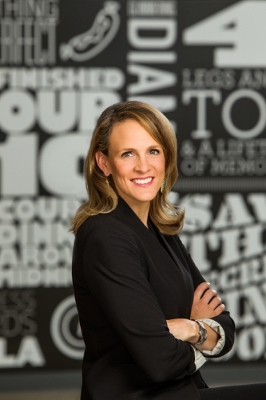
One of the best series in journalism is Adam Bryant‘s weekly column in The New York Times, ‘The Corner Office’. Bryant poses five or six questions to a selected CEO, and their responses appear in the Sunday Business Section. This past week, Christa Quarles of Open Table shared ‘early leadership lessons’.

287803.jpeg

“The importance of embracing vulnerability. Early on, especially when I worked on Wall Street, God forbid that you declare any granular weakness, because people would pounce on it.

But the paradox of owning what you know and what you don’t know is that you actually seem more powerful as you expose more vulnerability. I’ve become more comfortable with exposing my vulnerability and not being afraid to go there.

When I give criticism now, I’ll talk about how I failed in a similar situation. I try to humanize the criticism in a way that says this is about an action, it’s not about you as a person. I want to make you better. If somebody feels like they’re in a safe place and they can hear the message, they’re more likely to change.”

Theater critic A.O. Scott may seem an unlikely source of management wisdom. This week he suggests ‘Even Superheroes Punch the Clock’.

suicide-squad-14.jpg

“This summer, your local multiplex is home to an extended business seminar. There are sessions on crisis-management and how to deal with office romances (“Star Trek Beyond”); on office rivalries and mission-statement drafting (“Captain America: Civil War”); on start-ups (“Ghostbusters”) and I.T. disasters (“Jason Bourne”). Every action movie is a workplace sitcom in disguise.

What is “Suicide Squad”? A bad movie, to be sure — and yes, I’m aware of opinions to the contrary (thanks, Twitter) — but also a movie about difficult personnel issues….The central problem of “Suicide Squad” is one that bedevils department heads and midlevel employees in every corner of the modern economy: team building.”

The last story this week is journalist Kirk Johnson‘s profile, ‘Debt. Terror. Politics. To Seattle Millennials, the Future Looks Scary.’

“Part of Jillian Boshart’s life plays out in tidy, ordered lines of JavaScript computer code, and part in a flamboyant whirl of corsets and crinoline. She’s a tech student by day, an enthusiastic burlesque artist and producer by night. “Code-mode” and “show-mode,” she calls those different guises.

This year she won a coveted spot here at a nonprofit tech school for women, whose recent graduates have found jobs with starting salaries averaging more than $90,000 a year. Seattle, where she came after college in Utah to study musical theater, is booming with culture and youthful energy.

But again and again, life has taught Ms. Boshart, and others in her generation, that control can be elusive.

Even for someone who seems to have drawn one of her generation’s winning hands, it feels like a daunting time to be coming of age in America.

“I don’t just expect things to unfold, or think, ‘Well, now I’ve got it made,’ because there’s always a turn just ahead of you and you don’t know what’s around that corner,” she said.”

A final thought this week @work – When we find that ‘dream job’, in an uncertain global economy, we realize there is more to what we do than the compensation: money or medals. The Olympics is our quadrennial reminder to honor our values. Thanks to @abbey_dags and @NikkiHamblin.


Photo credits: ‘Fireworks explode during the Rio 2016 closing ceremony’   Robert Gauthier Los Angeles Times, ‘Abbey D’Agostino and Nikki Hamblin’ @NCAA, ‘Ashton Eaton’ Matt Slocum for AP, ‘Ans Botha and Wayde van Niekerk’ Twitter, ‘Suicide Squad’ courtesy of Warner Bros.

‘The Ageing Athlete’ a poem by Neil Weiss

As the Games of the XXXI Olympiad come to an end, a ‘Friday Poem’ to consider life after sport…and other career transitions.

The Aging Athlete

You’re through – no walking up and down,

you think of speed and dig your heels,

testing this soil and that for a start,

but it’s no go…Practicing for leaps,

you start forward but exhaust the push

and end up with a damaging rush,

arms hanging, hands twitching at your sides,

chin bobbing on your chest: no pride

that once sustained you as you leapt

the next hurdle, hair up then down,

the wind in your ears, the crowd beside

itself, shouting, Come on! Come on!

and you smashed the tape with your chest

and sank into the arms of many lovers.

Neil Weiss      Poetry Magazine, August 1956

1955-08.jpg

Photo Credit: Getty Images/USA TODAY Sports 8/15/16

The week@work or on vacation-what leadership looks like, what leadership reads & ‘wasting time’ on the Internet

This week@work, desks and cubicles are vacant as colleagues are catching a few last days of escape away from work. Among those still @work: a journalist shared a relic of presidential transition to remind us what leadership looks like, the White House tweeted the President’s vacation reading choices, Olympians continue to compete in Rio, and we may not be wasting time on the internet.

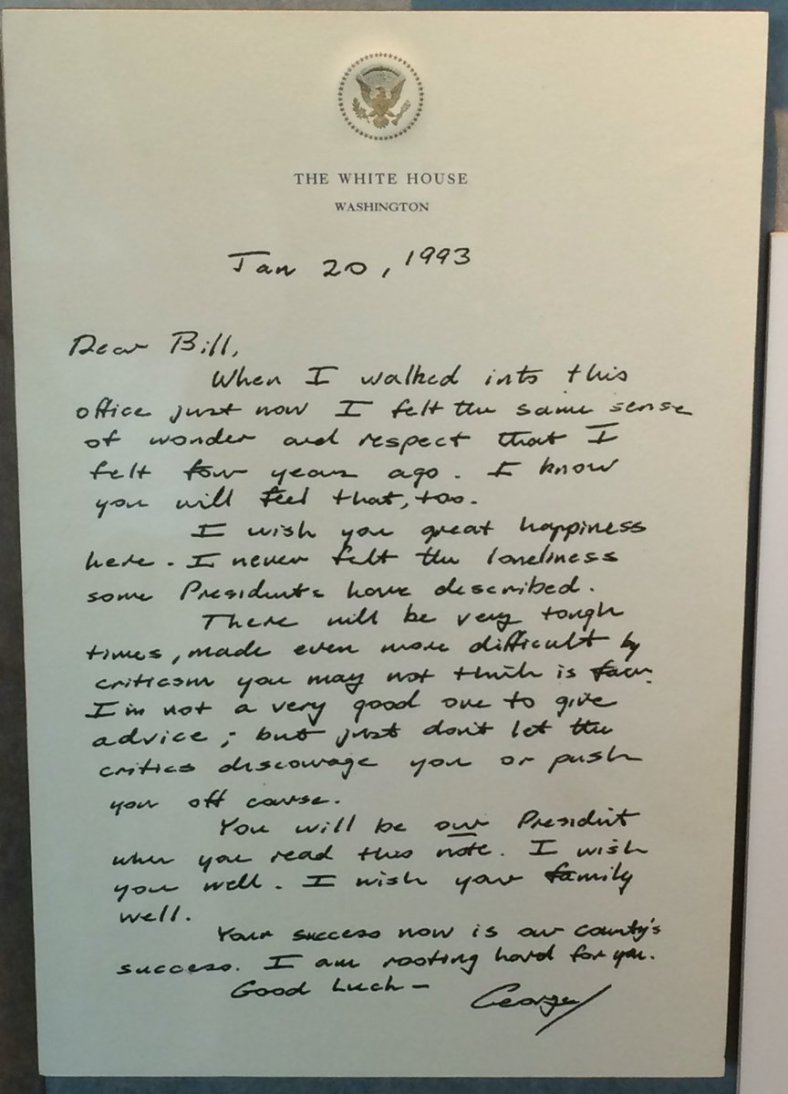
There’s been a copy of a letter circulating recently on the Internet. It arrived in my Twitter account this week via journalist Joyce Karam. It’s a handwritten note written on Inauguration Day, 1993 by departing President George H.W. Bush to his successor, President Bill Clinton.

bush to clinton.jpg

Imagine arriving at your new job on Monday morning and finding a handwritten note from your predecessor, wishing you great happiness @work. “Your success is now our success”.

What if you wrote a letter to the person taking over your desk on Monday morning? Could you convey a “sense of wonder and respect” for your workplace and your work?

Think about it. This is what leadership looks like.

While we are on the topic of U.S. Presidents, current President Obama is on vacation with family, friends and five ‘summer reads’ including Oprah’s recent Book Club selection and one of Bill Gates’ favorites.

readinglist2016_1200.jpeg

(A quick aside here on the Olympics. The photo at the top of the page captures the vacant volleyball nets this morning in Manhattan Beach, California. It’s the place where two U.S. Olympians, Kerry Walsh Jennings and April Ross went to work to get ready for Rio.)

Back to work, and reading, and surfing the Internet.

Kenneth Goldsmith, artist, professor and first poet laureate of the Museum of Modern Art, urged LA Times readers to ‘Go ahead: Waste time on the Internet’ with his OpEd this weekend.

“The notion that the Internet is bad for you seems premised on the idea that the Internet is one thing — a monolith. In reality it’s a befuddling mix of the stupid and the sublime, a shattered, contradictory, and fragmented medium. Internet detractors seem to miss this simple fact, which is why so many of their criticisms disintegrate under observation.”

He recently discussed his University of Pennsylvania course and new book ‘Wasting Time on the Internet’ with Quentin Hardy of The New York Times. Drawing on his personal observations of students and family, he imagined what an educated person will look like in the 21st century.

We still read great books, and there is a place for great universities. But an educated person in the future will be a curious person who collects better artifacts. The ability to call up and use facts is the new education. How to tap them, how to use them.

I’ve got a 10-year-old and 17-year-old. They’re thinking differently from me. They stay connected all the time, and they’re smart, they play baseball, they read, they spend time online. They’re not robots. Basic human qualities haven’t changed. I can find Plato in online life. When I read Samuel Pepys’s diary I see Facebook posts. We just find new ways to express things.

Go ahead, take a break this week@work. Stream the last week of the Olympics, read a great book, and follow the tangents of Internet exploration.

The one thing every Olympian should do before they leave Rio 2016

The one thing every Olympian should do before they leave Rio is update their social media identity across all platforms.

For a brief moment in time Olympic athletes capture the global stage and water cooler conversations. It’s not only those who make the podium, but those we discover in the diverse narratives of their journeys to Rio. The majority will return to their home countries as national heroes, contributing to society, away from the media spotlight. A few may return as coaches or commentators in four years. Most will miss the opportunity to capture the Olympic experience as a bridge to the next phase of their career.

In the past I have worked with returning  Olympians who hesitate to include their achievements in sport on their resume. The most competitive athletes are the most reticent to record their accomplishments.

They just don’t think it’s relevant. It is.

In the global workplace, it’s not just the resume; social media communicates talent instantaneously to potential employers. Your professional image is transmitted through your social media identity.

On Saturday, American Virginia Thrasher won the first gold medal awarded at the games in the women’s the 10-meter air rifle. Within a few hours she was taking her first TV interview on NBC, describing her hectic schedule of additional events and starting her sophomore year at West Virginia University.

In describing her life over the next couple of weeks, Thrasher gave voice to the stress that accompanies the life of every student athlete, combining sport with academics. Often lost, is time for reflection on how these experiences transform the athlete into a professional @work.

How do you build the bridge from sport to work on social media?

Take a look at your social media presence across all platforms: Facebook, Instagram, Snapchat, LinkedIn, Twitter…

Do all the pieces fit into a unifying narrative? If not, it’s time to edit. As an Olympian, expectations have been raised and your online image should reflect your aspirations vs. social missteps.

Have you created links to videos and press coverage of your accomplishments?

Do you post videos and press coverage on your Twitter account?

Have you checked with third party sites to ensure your profile information is up to date?

Do you have an account on LinkedIn? (If you’re making the transition from sport to your next career, this component of your professional online identity is critical as you build your ‘next career’ network.)

There are many athletes who hesitate to be defined by their sport, but the skills developed in pursuit of Olympic gold closely match those sought by potential employers: teamwork, goal orientation, communications, problem-solving, and resilience.

Whether you are a summer Olympian, or a star on your own professional stage, it’s time to seize the moment and refresh you social media identity.


Photo credit: US Women’s Rugby Seven – Geoff Burke for USA TODAY Sports