The Saturday Read – Summer Reading Suggestions from TED speakers and attendees

Last week BuzzFeed Books posted a short quiz that professed to know how old you are based on your reading habits. Go ahead, take the quiz. You may find you have shaved 10 – 20 years from your chronological age. I’m once again enjoying my 23rd year.

The good news, we have more time to read, and this year the folks at TED have provided us with over 70 summer book suggestions from speakers and attendees.

After reviewing the list, I’ve picked a quartet of speakers and stories they recommend.

David Eagleman, neuroscientist and author:

Invisible Cities by Italo Calvino. “A series of very short stories that are all about the same thing: a single city in Kublai Khan’s empire. It’s mother’s milk for my own fiction writing.”

Dave Isay of StoryCorps:

The Bridge: The Building of the Verrazano-Narrows Bridge by Gay Talese. “An ode to the men who built the Verrazano-Narrows, it centers around the question, ‘Who are the high-wire walkers wearing boots and hard hats, earning their living by risking their lives in places where falls are often fatal and where the bridges and skyscrapers are looked upon as sepulchers by the families and coworkers of the deceased?’”

David Rothkopf, foreign policy thinker and senior editor of the FP Group:

The Idea Factory: Bell Labs and the Great Age of American Innovation by Jon Gertner. “My dad worked at Bell Labs, and my first summer jobs were there as well. It epitomized the power of pure research, and showed how big science and big government could collaborate. It is gone now, and its disappearance raises many questions about our future.”

Tony Fadell, Founder and CEO of Nest:

How Children Succeed: Grit, Curiosity, and the Hidden Power of Character by Paul Tough. “By offering evidence that traits like empathy, determination and self-control tend to be better predictors of success than IQ, Tough will make you think differently about raising kids in a highly competitive world.”

‘A Step Away From Them’ a poem by Frank O’Hara

The ‘Friday Poem’ this week invites us back to a summer lunch hour in the early 1960s. ‘A Step Away From Them’ was written by poet Frank O’Hara.

O’Hara’s work was first brought to the attention of the wider public, like that of so many others of his generation, by Allen’s timely and historic anthology, The New American Poetry (1960). It was not until O’Hara’s Lunch Poems was published in 1965 that his reputation gained ground and not until after his sudden death that his recognition increased. Now his reputation is secure as an important and even popular poet in the great upsurge of American poetry following World War II.”

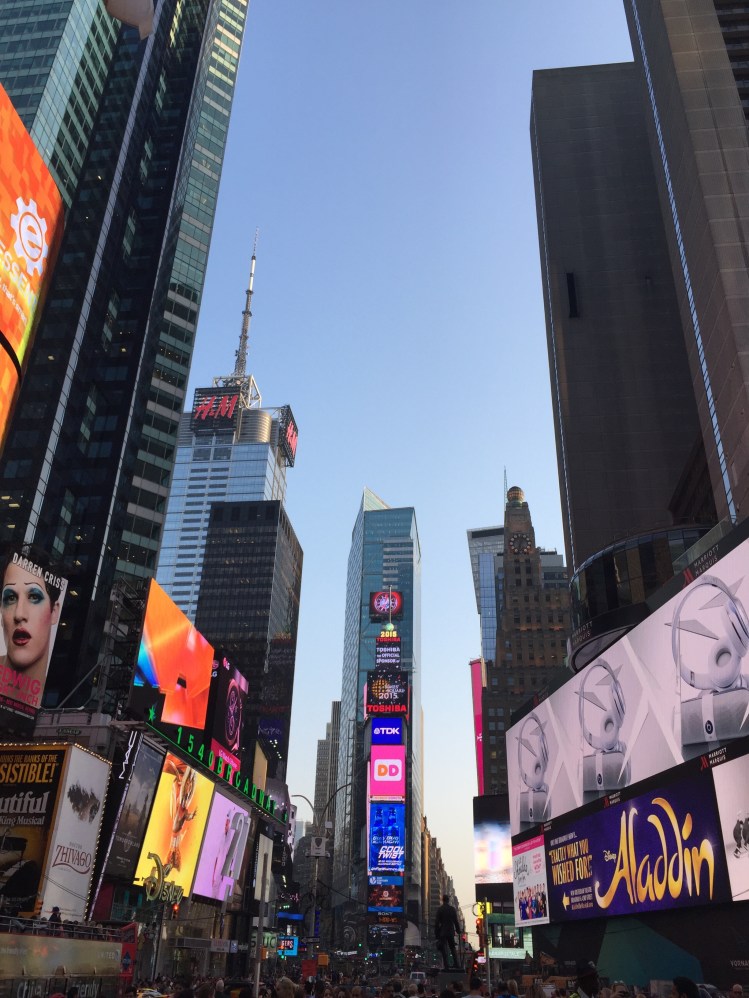
The Times Square of 2015 differs, yet in some ways echoes the observations of O’Hara in 1964. Today electronic billboards create daylight 24×7, parts of the street is a promenade and Uber drivers vie for passengers with yellow cabs. But office workers still pour into the streets at lunchtime as the heat rises from subway grates and bursts of cool air are released by revolving doors.

Take a walk at lunch and enjoy the ‘Friday Poem.’

A Step Away from Them

It’s my lunch hour, so I go
for a walk among the hum-colored
cabs. First, down the sidewalk
where laborers feed their dirty
glistening torsos sandwiches
and Coca-Cola, with yellow helmets
on. They protect them from falling
bricks, I guess. Then onto the
avenue where skirts are flipping
above heels and blow up over
grates. The sun is hot, but the
cabs stir up the air. I look
at bargains in wristwatches. There
are cats playing in sawdust.
On
to Times Square, where the sign
blows smoke over my head, and higher
the waterfall pours lightly. A
Negro stands in a doorway with a
toothpick, languorously agitating.
A blonde chorus girl clicks: he
smiles and rubs his chin. Everything
suddenly honks: it is 12:40 of
a Thursday.
Neon in daylight is a
great pleasure, as Edwin Denby would
write, as are light bulbs in daylight.
I stop for a cheeseburger at JULIET’S
CORNER. Giulietta Masina, wife of
Federico Fellini, è bell’ attrice.
And chocolate malted. A lady in
foxes on such a day puts her poodle
in a cab.
There are several Puerto
Ricans on the avenue today, which
makes it beautiful and warm. First
Bunny died, then John Latouche,
then Jackson Pollock. But is the
earth as full as life was full, of them?
And one has eaten and one walks,
past the magazines with nudes
and the posters for BULLFIGHT and
the Manhattan Storage Warehouse,
which they’ll soon tear down. I
used to think they had the Armory
Show there.
A glass of papaya juice
and back to work. My heart is in my
pocket, it is Poems by Pierre Reverdy.

Frank O’Hara ‘Lunch Poems’ 1964

Has social media rendered ‘Tell me about yourself’ redundant?

Remember when an employer’s first impression of a candidate was formed in a face to face interview? Today a recruiter will probably make an initial judgement on applicant potential from an online social media presence. Does this mean that some of the traditional interview questions are redundant?

In the past, many recruiters would initiate an interview with the traditional ‘tell me about yourself’. This was either a cover for the fact they didn’t have time to review your resume or a sincere effort to encourage an applicant to tell their story in their own words.

Today, even a cursory effort at data mining will provide a significant amount of information about a candidate. The good news, if you have made it to the interview you have passed the initial screening. Your challenge, is to recapture ownership of your story and make the connections between the job requirements and your experience.

How do you do that?

Manage your social platforms to convey a consistent, professional image.

Create a professional narrative that links the information on your social platforms to your answers.

There is no shortcut to managing your online presence. Establishing your credibility as a candidate begins with a quick inventory of how you are presenting yourself to the world beyond friends and family. Consider your postings from the perspective of a future employer. Does the content add competitive value to your application?

Next, visualize yourself as a productive member of the team you hope to join. What does that look like? Craft your narrative to tell the ‘short story of you’ with your first year in the new position as your next chapter. Connect the dots from your online content to your ambition to be hired.

‘Tell me about yourself’ is not redundant.

It’s an icebreaker. In a formal interview it gives a potential employer the opportunity to listen to you. You are being asked to provide a general framework for discussion. You set the stage for follow-up questions addressing various aspects of your academic and work life. It’s your opportunity to set the tone for the rest of the interview.

Throughout the interview an employer is seeking an answer to the question ‘Why should I hire you?’ Even when the question is not asked directly, your responses should create a successful argument in your favor.

Here are a few ideas to incorporate into your story:

What are the top five things you want an interviewer to know about you? (Focus on academics and experience.)

What are your strengths?

How will these strengths contribute to the success of the organization?

How does your current situation lay the groundwork for the next step in your career?

The week@work – Holacracy@Zappos, Exploring Pluto, Earthquakes in Seattle and Every Job in America on a Map

This week@work Harvard Ph.D. student Robert Manduca shared his visual representation of every job on a map of the United States. Three of the locations plotted were sites of interesting stories about work this week: Las Vegas and Zappos‘ experiment with ‘holacracy’, Laurel, Maryland home to the Pluto exploring ‘New Horizons’ team and Seattle…well more about that later.

Thanks to the research of Robert Manduca, we can now see concentrations of economic sectors across the U.S. Writing in the Washington Post, ‘Wonkblog’ author Emily Badger cited the significance of his work:

“Among all the things that distinguish American cities from one another — their architecture, their demographics, their history and their terrain — their economies vary widely, too. Washington is, of course, a city of government work. Charlotte is a banking hub, Manhattan a financial center, Boston an education mecca. Metropolitan Cleveland remains relatively industrial, while Las Vegas runs on tourism.

These differences form economic identities that shape each city as much as their culture and geography do.”

Where we choose to work, geographically, can have a significant impact on our success. Cultures of organizations fit within the larger communities where they are located. When considering career advancement it’s important to examine the size of a particular sector within the local economy. Will the geography lend itself to a variety of opportunities when you decide to move on?

Maybe even more important is your social life outside of work. The folks that make up your community will in some ways reflect the values of the places they go to work each day. If you really didn’t like your classmates in that ‘Intro to Finance’ class, you may want to think twice about living and working where these same folks are now grown-ups working in investment banking.

Las Vegas is one place you might consider if you were interested in the hospitality industry. It’s also the home to online retailer Zappos.com.

In his article, ‘At Zappos, Pushing Shoes and a Vision’ NY Times reporter David Gelles chronicles the experiment in ‘holacracy’ or self management which began in 2013. Tony Hsieh has run Zappos for 16 years. He has been viewed as a visionary by many and realized change was needed to sustain the corporate culture he built.

“The goal of Holacracy is to create a dynamic workplace where everyone has a voice and bureaucracy doesn’t stifle innovation.

At Zappos, this means traditional corporate hierarchy is gone. Managers no longer exist. The company’s 1,500 employees define their own jobs. Anyone can set the agenda for a meeting. To prevent anarchy, processes are strictly enforced.

At Zappos, Mr. Hsieh seems to regard Holacracy as a way to revive the close-knit community feeling that made the company so special 10 years ago, when it was just a few hundred people taking on the giants of e-commerce. “Once you have that level of friendship, there’s higher levels of trust,” he said. “Communication is better; you can send emails without fear of being misinterpreted; people do favors for one another.”

If only it were so simple. Holacracy has been met with everything from cautious embrace to outright revulsion at Zappos, but little unequivocal enthusiasm.”

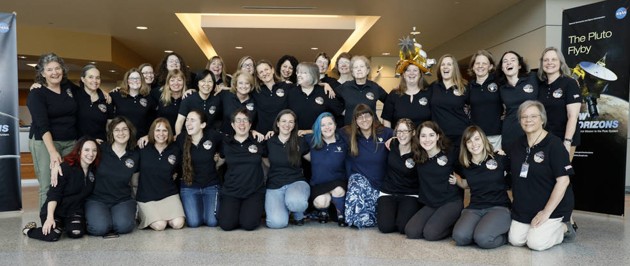
Another point on the map is Laurel, Maryland home to the ‘New Horizons’ team that piloted a piano sized spacecraft to Pluto and beyond. The workplace story here is the dedication of a team to a long term goal, the implementation of a ‘longevity plan’ to ensure program success over nine years and the joy of scientific discovery way outside the box.

It’s that shear joy that was expressed by New Horizons scientist Carey Lysse in an NBC interview:

“I love to explore. It’s one of the reasons I’m a scientist. This is one of those red letter days that doesn’t happen every day and so I’ll remember it for the rest of my life. It’s incredible.”

And now about Seattle. If you are thinking of relocating you may want to read Kathryn Shultz’s  New Yorker Magazine article, ‘The Really Big One’.

“Most people in the United States know just one fault line by name: the San Andreas, which runs nearly the length of California and is perpetually rumored to be on the verge of unleashing “the big one.” That rumor is misleading, no matter what the San Andreas ever does. Every fault line has an upper limit to its potency, determined by its length and width, and by how far it can slip. For the San Andreas, one of the most extensively studied and best understood fault lines in the world, that upper limit is roughly an 8.2—a powerful earthquake, but, because the Richter scale is logarithmic, only six per cent as strong as the 2011 event in Japan.

Just north of the San Andreas, however, lies another fault line. Known as the Cascadia subduction zone, it runs for seven hundred miles off the coast of the Pacific Northwest, beginning near Cape Mendocino, California, continuing along Oregon and Washington, and terminating around Vancouver Island, Canada. The “Cascadia” part of its name comes from the Cascade Range, a chain of volcanic mountains that follow the same course a hundred or so miles inland. The “subduction zone” part refers to a region of the planet where one tectonic plate is sliding underneath (subducting) another. Tectonic plates are those slabs of mantle and crust that, in their epochs-long drift, rearrange the earth’s continents and oceans. Most of the time, their movement is slow, harmless, and all but undetectable. Occasionally, at the borders where they meet, it is not.”

The Saturday Read – Ta-Nehisi Coates ‘Between the World and Me’

Early in his career, The Atlantic writer, Ta-Nehisi Coates was mentored by journalist, David Carr. In February he wrote ‘King David’, acknowledging his friend and brother. “David Carr convinced me that, through the constant and forceful application of principle, a young hopper, a fuck-up, a knucklehead, could bring the heavens, the vast heavens, to their knees.”

“I miss you terribly. I do not want to say goodbye. Tony says you were our champion. How can we go on, David? How can all of it just go on? Who will be our champion, now?”

In ‘Between the World and Me’ the author has brought ‘the vast heavens, to their knees’ and takes on the role of the champion he lost with the passing of Mr. Carr.

The ‘Saturday Read’ is not a ‘summer beach read’. It’s an important addition to the canon of the social sciences and business.

This book should be required reading for every member of the workforce, educators and in particular, those who pride themselves as leaders of diversity.

An excerpt of the book is available on The Atlantic website. Written as a letter to his son, the book needs to be read in its’ entirety.

“…Perhaps struggle is all we have. So you must wake up every morning knowing that no natural promise is unbreakable, least of all the promise of waking up at all. This is not despair. These are the preferences of the universe itself: verbs over nouns, actions over states, struggle over hope.

The birth of a better world is not ultimately up to you, though I know, each day, there are grown men and women who tell you otherwise. I am not a cynic. I love you, and I love the world, and I love it more with every new inch I discover. But you are a black boy, and you must be responsible for your body in a way that other boys cannot know. Indeed, you must be responsible for the worst actions of other black bodies, which, somehow, will always be assigned to you. And you must be responsible for the bodies of the powerful—the policeman who cracks you with a nightstick will quickly find his excuse in your furtive movements. You have to make your peace with the chaos, but you cannot lie. You cannot forget how much they took from us and how they transfigured our very bodies into sugar, tobacco, cotton, and gold.”

Among the positive reviews, Syreeta McFadden for The Guardian:

“I am in near-total agreement with Coates’s view of this world we share. Yet I did wonder where the stories of black women feature in all this death and plunder. Their names are not included in this work, and I am not the only one who has noticed it. Coates seems aware of the omission, but he still only manages to surface the experiences of black women through their (very real) pain at the death of black men. That lens isn’t Coates’s alone, but it’s one worth interrogating.

In fact, Between the World and Me doesn’t aspire to anything so large – or vague – as “overcoming” or “transcending” race to defeat racism. It is simply about surviving, and remembering. Coates’s preoccupation is not with saving the soul of America. It’s urging it, to borrow a phrase you see around a lot lately, to “stay woke”.

At the end of his tribute to David Carr, Mr. Coates reflects on Mr. Carr as a “tireless advocate of writers of color, of writers who were women, and of young writers of all tribes.”

“And I know that even I, who am no longer a young writer, do not always wear my best face for young writers. And among the many things I am taking from David’s death is to be better with young writers, and young people in general. Because every single time some editor shoved me down, David picked me back up.”

‘Between the World and Me’ is a gift to young writers. It’s a testament to the power of the written word amid the distractions of technology’s sound bites.

‘Working Together’ a poem, by David Whyte

I first encountered David Whyte when a mentor recommended his 1994 book, ‘The Heart Aroused:Poetry and the Preservation of the Soul in Corporate America’.  For the ‘Friday Poem’ this week, I was looking for one that reflected a bit of the ‘magic’ of teamwork. My search brought me back to the poet and author. ‘Working Together’ was composed by David Whyte for Boeing to mark the introduction of the 777 jetliner.

Writing in the preface to the revised edition of ‘The Heart Aroused’ the poet cited his challenge:

“The impossible task was to bring together the supposedly strategic world of business with the great inheritance of the human literary imagination, particularly through the difficult art, poetry, and particularly through the fierce, unremitting wish for the dangerous truth that is poetry’s special gift.”

On the occasion of the ‘fly by’ of the dwarf planet Pluto and in celebration of creativity, engagement and courage in the workplace, enjoy ‘Working Together’.

Working Together

We shape our self
to fit this world

and by the world
are shaped again.

The visible
and the invisible

working together
in common cause,

to produce
the miraculous.

I am thinking of the way
the intangible air

passed at speed
round a shaped wing

easily
holds our weight.

So may we, in this life
trust

to those elements
we have yet to see

or imagine,
and look for the true

shape of our own self,
by forming it well

to the great
intangibles about us.

— David Whyte
from The House of Belonging
©1996 Many Rivers Press

Why we do science and the triumph of NASA’s ‘New Horizons’ team

Last week we celebrated the team play of the US Women’s National Team, this week we honor NASA’s ‘New Horizons’ team for piloting a spacecraft the size of a small piano through space for 3,463 days and three billion miles.

Remember Pluto? You know, the ninth planet in order from the sun. Is there anyone who did not do a science project on the planets? Very few of us can trace our choice of career back to the grade school science fair, but some folks used those dioramas as a foundation to build a career in space exploration.

Think about what you were doing at work nine years ago. Now imagine you were part of a team that started a journey toward that ninth planet in 2006. And then your planet was demoted to dwarf status. Can you imagine sustaining a team for almost a decade?

Daniel Terdiman examined the success factors in a post for Fast Company.

“Not everyone on the original team stayed on board throughout the 14 years between proposal and today, but many have. Besides Hersman and principal investigator Stern, others who are still deeply involved include Alice Bowman, the New Horizons mission operations manager, Glen Fountain, the New Horizons project manager, Mark Holdridge, the Pluto encounter mission manager, and many other team leads and sub-leads who worked on everything from propulsion to communications.

That’s impressive stability. Of course, all these people have other tasks beyond the New Horizons project, but everyone knew it was about to be show time. “People ramped down so they weren’t working much on the project,” Hersman said, “but when the time comes to fly past Pluto, a lot of other stuff gets put on hold, or they find time.”

Terdiman found that a ‘longevity document’ provided the blueprint for the mission including requirements and contact information for every team member. “One other essential element of preparing for the nine-year mission was compiling a spreadsheet of contingencies for when things went wrong. This was useful when ground control temporarily lost communications with the New Horizons probe on July 4 of this year.” And finally, “When it’s all over, look back.”

If the shear wonder of the team’s achievement was not enough, Adrienne Lafrance, writing for the Atlantic, identified another major milestone for the ‘New Horizons’ team:

“For all the firsts coming out of the New Horizons mission—color footage of Pluto, photos of all five of its moons, and flowing datastreams about Pluto’s composition and atmosphere—there’s one milestone worth noting on Earth: This may be the mission with the most women in NASA history.”

“The New Horizons team includes about 200 people today, but there have been thousands of scientists and engineers who have contributed to the mission since it began more than a decade ago. Women make up about one-quarter of the flyby team, those responsible for the high-stakes mission taking place this month, according to NASA.”

And now, for you skeptics who either believe all of this is happening on a sound stage in Burbank or just don’t get why we do science and stretch the limits of our knowledge, I turn to Neil deGrasse Tyson.

In an interview with Lester Holt for NBC Nightly News on Tuesday, the American astrophysicist and director of New York’s Hayden Planetarium answered the question of why we do science.

“One of the greatest aspects of what it is to do science is to reach a new vista and then discover that you can now ask questions undreamt of before you got there.”

Tonight, go outside and look up. What do you see? What questions do you have? Imagine being part of a team working to find the answers to those ‘undreamt of’ questions from our new vantage point.

The week@work – soccer, tennis, ballet & other places we work – & returning to work after vacation

It was a good week for women and little girls. The week@work began with the US women who go to work playing soccer and brought home the world cup trophy. And ended with the women who go to work on a tennis court, with Serena Williams winning her sixth Wimbledon championship and twenty-first major. And, while I was away, Misty Copeland was promoted to principal dancer with the American Ballet Theater.

And now for the bad news, good news – compensation. An article in the Washington Post on Thursday detailed the gap in prize money for women and men in major sport.

“The female players who were just crowned the best in the world brought home $2 million, a tiny fraction of the $35 million the German men’s team pocketed for winning the World Cup in Brazil last year. It was even significantly less than the $9 million the U.S. men’s team took home for getting knocked out in the round of 16.

And yet, some sports have reached parity. When the women take Centre Court this Saturday at Wimbledon, the winner will earn the exact same amount — about $2.9 million — as the winner of the men’s final match on Sunday. Since 2007, when Wimbledon and the French Open joined the other Grand Slam tournaments, tennis has provided equal prize money to men and women.”

The ‘places’ we work and returning to those ‘places’ after vacation were also on the week’s agenda.

Fast Company posed the question on Twitter, are you tired of your cubicle? And suggested working from the woods:

“If a quick view of nature at work—or even a lonely plant on your desk—can make you more creative and focused and less stressed, what would happen if you worked from middle of the woods?

When Amsterdam office workers get tired of sitting in a cubicle, they can head out to work from a forest instead. A new caravan of mobile micro-offices—fully equipped with Wi-Fi and solar-powered coffeemakers—is traveling across a network of national parks in the Netherlands.

“The inspiration to create this comes from a longing to be more deeply connected to nature,” says KantoorKaravaan founder Tom van de Beek. “These times of technological innovation and wireless connectivity provide us with the ultimate combination: getting back to nature and self sufficiency in terms of food and energy, and still be able to do our day to day business. In other words: we can now create the 21st-century equivalent of the Garden of Eden.”

The New York Times reported on a new development in the industrial zone of downtown Philadelphia hoping to attract companies in media, advertising and technology.

“They wanted to be able to recruit, to have millennials think that this would be a great place to work,” said Richard R. Previdi, the firm’s operating managing partner.

Mr. Previdi said the new space — named SoNo, for south of Northern Liberties — will be designed to encourage the collaboration that is highly valued by tenants like software companies. “They want everybody talking; they want everybody sharing ideas,” he said.

The redesign will minimize the amount of individual employee space while allowing more for common areas like a cafeteria, a gym and parking space for 70 bicycles. Alliance plans to begin construction by the end of this year, and to complete the project within 24 months.

Over all, the building’s location and design are intended for a “live-work-play” lifestyle in which young urban professionals live near their workplaces and the shops, restaurants and entertainment sites that spring up to meet that demand in Philadelphia and other cities, Mr. Previdi said.”

For many of us, tomorrow marks a return to our work ‘place’ after an extended Fourth of July holiday. Believe it or not, there is post vacation syndrome – PVS. Really. Glamour Magazine recommends limiting your meetings on your first day back. They also suggest you schedule lunches outdoors to maintain that level of fresh air you grew accustomed to on vacation. Great ideas if they fit into your work culture.

If you love what you do, although you miss the sand in your toes or the views from a mountaintop, you will find a way to insinuate your vacation experience into your work day.

The Saturday Read – Leona Francombe ‘The Sage of Waterloo’

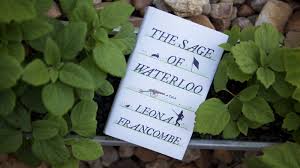
This year marks the bicentennial of the Battle of Waterloo. A number of books have been published to coincide with the anniversary, but it’s the unique storytelling of author Leona Francombe that gives us a very different view of the conflict. The ‘Saturday Read’ this week is ‘The Sage of Waterloo’.

The story begins when a French drummer boy releases a white rabbit into the Hougoumont gardens during the battle on June 18, 1815. Our narrator, William, is guided on his journey by his grandmother, Old Lavender and a wise researcher, Arthur. He invites us to join him along the route the rabbits call the ‘Hollow Way’:

“There are many soft hillocks and hollows along this part of the Way on which one can rest and look back, and I suggest that you do this, too, because the view behind is as clear as the view ahead, and offers some valuable lessons besides.”

Yes, we are talking bunnies. Or, the bunny is talking to us. And along his path we join the Battle of Waterloo.

“Waterloo is small as battlefields go…the Hougoumont part of it even smaller. How extraordinary, then, that my farm – my tiny corner of Belgium, which even today people have difficulty locating on a map – should have made history in just a few hours.”

For those readers unfamiliar with history, the Economist provides a thumbnail description:

“Waterloo not only brought to an end the extraordinary career of Napoleon Bonaparte, whose ambitions had led directly to the deaths of up to 6m people. It also redrew the map of Europe and was the climax of what has become known as the second Hundred Years War, a bitter commercial and colonial rivalry between Britain and France that had begun during the reign of Louis XIV. Through its dogged resistance to France’s hegemonic ambitions in the preceding 20 years, Britain helped create the conditions for the security system known as the Concert of Europe, established in 1815. The peace dividend Britain enjoyed for the next 40 years allowed it to emerge as the dominant global power of the 19th century.”

Which brings us back to our story and Arthur, the researcher, and did I mention black bird?, questioning humans’ short term memory.

“…they think they know what happened there. But their evolutionary process seems to be in reverse. They gradually forget the magnitude of what they’ve done – or at least, they’ve managed to disguise their violence as glory – so eventually, in the course of time, they can no longer feel what still hangs in the air. Not the way we do. So they don’t have any qualms about building cafes on burial grounds. They’ve never really stamped out their zeal for warmongering – quite the opposite, actually. They can’t seem to get enough of it.”

Near the end of the book William calculates an alternative if the soldiers had refused to fight: “approximately fifty thousand men would have lived. And ten thousand horses. And who knows how many rabbits?”

“Where did you learn all this?” I asked Arthur, after I’d finished my mulling. “Oh, you wouldn’t believe the things that remain in the woods around Hougoumont,” he said. “The resonance is quite astounding. Small creatures for miles around are still aware of the story.”

This small novel is a unique oral history of the Battle of Waterloo. Blending historical fact with fiction, author Francombe creates an unlikely ‘sage’ to carry the “collective memory…and resonance.” And reminds us to “feel what still hangs in the air” when we visit historic sites.

‘We Are The Champions’ by songwriter Freddie Mercury

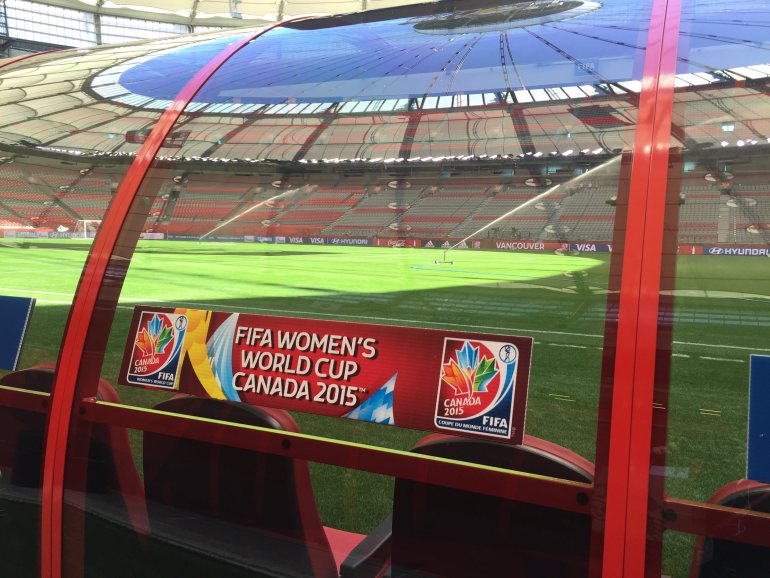
On Sunday evening or Monday morning, depending where you were in the world, the US Women’s National Soccer Team defeated the women representing Japan 5-2 in the final of the Women’s World Cup in Vancouver, Canada.

At the end of the game, midfielder Carli Lloyd, who scored three goals in the first sixteen minutes of the final, commented on the victory.

“It’s been a long journey, my career. I’ve had a lot of people believe in me, in my corner, from day one,” said the midfielder, who turns 33 on July 16. “I’ve dedicated my whole life to this. Everything else comes second. But I wouldn’t want to do it any other way.”

On Tuesday, the New York Times reported on New York mayor, Bill de Blasio’s decision to recognize the women’s team:

“New York City will hold a ticker-tape parade on Friday for the United States women’s national soccer team, breaking with decades of precedent to bestow a rare honor upon a group that competes outside the metropolitan area.”

The Friday poem this week, on the day of the ticker tape parade, is the lyrics written by Freddie Mercury in 1977 and recorded by Queen. This one is for the members of the team, their families and coaches. And for all the young women and young men who have been inspired by the hard work, dedication and resilience of the US Women’s National Team.

We Are The Champions

I’ve paid my dues
Time after time
I’ve done my sentence
But committed no crime
And bad mistakes
I’ve made a few
I’ve had my share of sand
Kicked in my face
But I’ve come through

And we mean to go on and on and on and on

We are the champions – my friends
And we’ll keep on fighting
Till the end
We are the champions
No time for losers
‘Cause we are the champions of the World

I’ve taken my bows
And my curtain calls
You brought me fame and fortune
And everything that goes with it
I thank you all
But it’s been no bed of roses
No pleasure cruise
I consider it a challenge before
The whole human race
And I ain’t gonna lose

And we mean to go on and on and on and on

We are the champions – my friends
And we’ll keep on fighting
Till the end
We are the champions
No time for losers
‘Cause we are the champions of the World

We are the champions – my friends
And we’ll keep on fighting
Till the end
We are the champions
No time for losers
‘Cause we are the champions

Songwriter: Freddie Mercury, 1977