The week@work – It’s in the stars: Hollywood stories, #YearInSpace & 18,300 applications

The stories behind the headlines this week@work originate in Hollywood, Geneva, Washington D.C., and on the International Space Station.

The careers of a U.S. deputy trade ambassador and an executive editor for the Washington Post converge in Hollywood, astronaut Scott Kelly captures the final week of his #YearInSpace in photos, and 18,300 applicants aspire to take his place.

Unknown

Would you get up at 4:30 AM every day to pursue your dream? Alexandra Alter reported on a ‘behind the scenes’ Hollywood story about working beyond your ‘day job’.

One of the most successful global trade negotiators added a few hours to his work day 17 years ago to write a novel about fur trader Hugh Glass. His book, ‘The Revenant’ was published in 2002 and sold 15,000 copies. Last year publisher Picador reissued the novel, selling over half a million copies.
images

Michael Punke, the deputy United States Trade Representative and the United States ambassador to the World Trade Organization and author, has become a rock star among colleagues in global trade.

“We all think it’s quite cool,” said Keith Rockwell, a spokesman for the W.T.O., who added that colleagues occasionally tease Mr. Punke by asking him how his buddy Leo is doing. “The W.T.O. isn’t normally known for having a Hollywood connection.”

Some of his colleagues marvel that he has such a successful side career, while steering the country’s international trade policy from his post in Geneva.

“The guy is so talented, you read his bio, and it’s like he has two lives,” said Christopher Wenk, the executive director for international policy at the U.S. Chamber of Commerce.”

Joining Ambassador Punke at the Dolby Theater on Oscar night is current Washington Post executive editor and former Boston Globe editor Martin Baron.

In November, Esquire Magazine ran a career profile asking ‘Is Martin Baron the Best News Editor of All Time?’. In the Oscar nominated film, ‘Spotlight’, actor Liev Schreiber’s performance channels the editor who led the Pulitzer Prize winning team investigating the child abuse scandal in the Catholic Church.
Unknown-1.jpeg

This week, Mr. Baron used his time in the Oscar ‘spotlight’ to reflect on the long term rewards of the film and journalism today, ‘I’m in ‘Spotlight’, but it’s not really about me. It’s about the power of journalism.’

“Aside from the acclaim of critics, “Spotlight” already has delivered one gratifying result. In emails, tweets and Facebook posts, journalists have declared themselves inspired, buoyed and affirmed. That is no small matter in this badly bruised profession. We have felt the traumatizing financial effect of the Internet and been berated by just about everyone, especially politicians in a campaign season that has seen us cynically labeled “scum.”

One journalist wrote me that “the story that inspired the movie serves as a wonderful, wonderful reminder why so many of us got into this business in the first place and why so many stayed despite all the gloom and doom and all the left hooks that landed squarely on our chins along the way.”

The article is required reading for all who earn a living pursuing a journalism career. It should be framed on the walls of journalism schools and be the first google search result on the world ‘journalism’.

Two additional stories about work in Hollywood this week addressed the ongoing conversation on inclusion:

‘From C-Suite to Characters on Screen: How inclusive is the entertainment industry?’ USC Annenberg professor Stacy L. Smith authored the MDSC Initiative’s first report on diversity in the entertainment industry.

Melena Ryzik profiled 27 industry professionals in ‘What It’s Really Like to Work in Hollywood*  (*If you’re not a straight white man.)’

Before leaving the week@work, let’s travel to the International Space Station where astronaut Scott Kelly is completing his 240 day mission in space.

CTeSzSOWIAApQID

“10,944 sunrises and sunsets

“The International Space Station zips around Earth at more than 17,000 miles per hour, or once every 90 minutes. That means over the course of Mr. Kelly’s stay, the space station will have made 5,440 orbits, and the sun will have gone up and down 10,944 times from the perspective of the astronauts aboard. Of course, Mr. Kelly did not see all of them. He is not continuously looking out the window, and he sleeps, too.”

(Scott Kelly tweeted the photo above of sunrise on February 27 and ice earlier today)CcT9mfcW4AAZFvx.jpg

NASA announced this week that it had received 18,300 applications for 14 open spots in the new astronaut class. The recruiting effort which began in the fall demonstrates a rekindled interest in exploration and discovery.

“Now that NASA’s Feb. 18 deadline for applicants has passed, the agency’s 18-month winnowing process has begun.

NASA staff will look at 400 to 600 applicants who survive the initial purge and identify those who pass reference and background checks. Then 120 will be invited to the Johnson Space Center for interviews.

The final 14 will be announced in July 2017 and begin two years of extensive training on spacecraft systems, spacewalking skills, team building and Russian language. Those who complete the program will be assigned to NASA’s Orion deep space exploration ship, the International Space Station or one of two commercial vehicles in development.”

As @StationCDRKelley vacates his spot on the ISS, it’s good to know there are thousands who hope to fill his seat.

This week@work – it’s in the stars, and the dreams of those who aspire to be actors, film makers, journalists, writers, astronauts, and international trade negotiators.
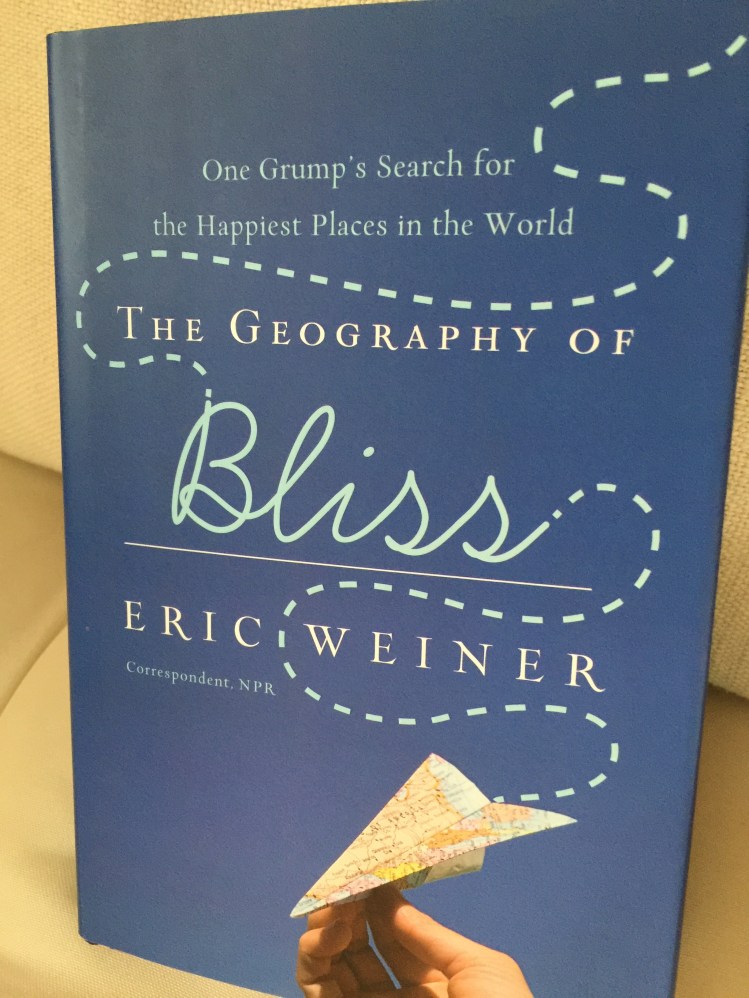
 

The Saturday Read ‘The Geography of Bliss’ by Eric Weiner

The Saturday Read this week is ‘The Geography of Bliss: One Grump’s Search for the Happiest Places in the World’, by former NPR correspondent and self-described philosophical traveler, Eric Weiner. It’s a travelogue of personal discovery with a universal  message, “where we are is vital to who we are”.

Early in his career decision process, Weiner decided travel was a necessary component to success – free travel. He started out as a foreign correspondent, going to some of the most unhappy global places. After a number of years covering conflicts in Iraq, Afghanistan and Indonesia he decided it was time to consider the alternative, the happy places.

“What if, I wondered, I spent a year traveling the globe, seeking out not the world’s well-trodden trouble spots but, rather, its unheralded happy places? Places that possess, in spades, one or more of the ingredients that we consider essential to the hearty stew of happiness: money, pleasure, spirituality, family and chocolate, among others.”

And we’re off. First to the Netherlands and the World Database of Happiness to meet Ruut Veenhoven, Professor of Happiness Studies.

Veenhoven was a graduate student in sociology when he found his calling in a new discipline, happiness studies. In a career story that may resonate with others in academia, he describes a meeting with his advisor. He was interested in the study of healthy minds and happy places. “His advisor, a sober man with solid academic credentials, told him, in no uncertain terms, to shut up and never mention that word again. Happiness was not a serious subject…Today, Veenhoven is at the forefront of a field that churns out hundreds of research papers each year.”

By simply asking folks if they are happy, researchers have found:

“Extroverts are happier than introverts; optimists are happier than pessimists; married people are happier than singles, though people with children are no happier than childless couples; Republicans are happier than Democrats; people who attend religious services are happier than those who do not; people with college degrees are happier than those without, though people with advanced degrees are less happy than those with just a B.A….people are least happy when commuting to work; busy people are happier than those with too little to do; wealthy people are happier than poor ones, but only slightly.”

Before returning home to the U.S., Weiner traveled to Switzerland, Bhutan, Qatar, Iceland, Moldova, Thailand, Great Britain, and India. Finding your bliss is subjective, but deeply rooted in culture.

“The glue that holds the entire enterprise together is culture.”  He embarked on an odyssey to find happiness, and discovered one of the key elements to success in life and work.

“…where we are is vital to who we are.”

“By ‘where’, I’m speaking not only of our physical environment but also of our cultural environment. Culture is the sea we swim in – so pervasive, so all-consuming, that we fail to notice its existence until we step out of it. It matters more than we think.”

Each new chapter invites the reader to experience another place, a new culture, citizens adapting to change, and challenges preconceived notions of the happiest places.

Sitting in an airport bar at the end of his journey, Weiner reflects on what he has learned. “Money matters, but less than we think and not in the way that we think. Family is important. So are friends. Envy is toxic. So is excessive thinking. Beaches are optional. Trust is not. Neither is gratitude…Happiness is not a noun or a verb. It’s a conjunction. Connective tissue.”

The shelves of bookstores are brimming with self help tomes on happiness. Eric Weiner’s global journey sets this book apart from the competition, transporting the reader on a round trip from domestic familiarity to places of contrasting mindsets, and back. It’s the perfect book for a winter read.


The week@work – It’s still 3 minutes to midnight, an engineer’s regret, a world run by millennials and the myth of the ‘best jobs’ lists

This week@work began with the announcement that the ‘Doomsday Clock’ has remained at 3 minutes to midnight, and ended with a remembrance day for NASA astronauts lost. Millennials will soon assume a larger role in global leadership and may move the hands of that clock backward, and ‘astronaut’ does not appear on either list released last week, ranking top jobs for 2016.

“Martyl Langsdorf’s “Doomsday Clock,” which first graced the cover of the Bulletin’s print edition in 1947, has served for 69 years to focus the world’s attention on the most pressing global threats. The time on the Clock reflects whether we are more or less safe than last year, and compares the current situation to years further in the past; the decision on where to set the Clock’s hands is an attempt to reconcile the achievements and breakdowns in security efforts, broadly defined, that occur each and every year.

Last year, the Science and Security Board moved the Doomsday Clock forward to three minutes to midnight, noting: ‘The probability of global catastrophe is very high, and the actions needed to reduce the risks of disaster must be taken very soon.’ That probability has not been reduced. The Clock ticks. Global danger looms. Wise leaders should act—immediately.” Bulletin of the Atomic Scientists, 2016

While many hold personal memories of where we were on January 28, 1986, those closest to the program provide a cautionary tale on leadership, communication and the value of trusting the voice of your employees.

As NASA observed a ‘Day of Remembrance’, NPR correspondent, Howard Berkes, returned to Bringham City, Utah to interview Bob Ebling, ’30 Years After Explosion, Challenger Engineer Still Blames Himself’.

“Thirty years ago, as the nation mourned the loss of seven astronauts on the space shuttle Challenger, Bob Ebeling was steeped in his own deep grief.

The night before the launch, Ebeling and four other engineers at NASA contractor Morton Thiokol had tried to stop the launch. Their managers and NASA overruled them.

That night, he told his wife, Darlene, “It’s going to blow up.”

When Challenger exploded 73 seconds after liftoff, Ebeling and his colleagues sat stunned in a conference room at Thiokol’s headquarters outside Brigham City, Utah. They watched the spacecraft explode on a giant television screen and they knew exactly what had happened.”

The Economist contemplated a new global order when the millennials take charge, ‘When the young get older: their time will come’.

“Where some see a generation in crisis, others think the young are adapting quite well to the challenges of a changing world. They flit from job to job not because they are fickle but because job security is a thing of the past. They demand flexible hours and work-life balance because they know they don’t have to be in the office to be productive. They spend six hours a day online because that is how they work, and also how they relax. Their enthusiasm for new ideas (and lack of spare cash) has kickstarted money-saving technologies from Uber to WhatsApp. They take longer to settle down and have children, but so what? They will also be working far later in life than their parents did.

In every generation, the young are the first to take to the streets to demand reform. Sometimes their fury leads nowhere, but autocrats still fear it. That is why China’s government rolled tanks over the Tiananmen Square protesters, and why it censors social media today. Young Africans, for their part, may not put up indefinitely with gerontocrats such as 91-year-old Robert Mugabe of Zimbabwe and 82-year-old Paul Biya of Cameroon.

In democracies, young people will some day realise that signing online petitions is no substitute for voting (just as their elders started voting when they acquired grey hairs and mortgages and sent their children to government schools). When the young show up at polling stations, democratic governments will heed their views. And when the millennials start calling the shots more widely in society, they will do so for a long time. For thanks to steady advances in medical technology, they will remain healthy and able to work for longer than any previous generation. Indeed, if scientists’ efforts to crack the “ageing code” in human genes bear fruit, many of them will live past 120.”

Where are the jobs? That’s the question the experts try to answer each year, identifying the best jobs and best places to work.

U.S. News and World Report announced their 2016 Best Jobs Rankings and glassdoor.com ranked the 25 Best Jobs in America. Orthodontist, dentist, computer systems analyst, nurse anesthetist and physician assistant led the U.S. News Top 100. The glassdooor.com list’s top five included data scientist, tax manager, solutions architect, engagement manager and mobile developer.

It’s always good to have a snapshot of market driven job titles, but it doesn’t help if your ‘dream job’ doesn’t make the list, or even exist. The myth of these lists lie in the impermanence of work. The top jobs this year may vanish from the list next year. It’s about the work you want to do, and the job title you imagine or may create.

Three additional stories this week were reported by journalists at The New York Times: an analysis of the success of Iowa’s economic development, commentary on the career of a veteran NFL quarterback who found joy in his sport but will now have the long off season to consider lessons from a loss, and advice on how to raise a creative child.

‘In Iowa, Jobs Are Plentiful but Workers Are Not’ Patricia Cohen

“At 3.4 percent, Iowa’s unemployment rate is among the lowest in the country. With major metropolitan areas — crowded with hard-hat construction sites — painting an alluring picture of steady economic progress, business leaders here retain a sunny optimism that is rarely heard from the presidential candidates.

But now that Iowa has achieved a tightening labor market that is the envy of most other states, many companies are confronted with a different set of challenges pushing them to rethink everything from recruiting to economic development.”

‘Carson Palmer’s Memorable Season Ends With a Forgettable Night’  William C. Rhoden

“I’ll look back at this season at some point, but not tonight,” Palmer said. “This is the only game that’s on my mind, not the other 16, 17.”

Despite Sunday’s disaster, this was a season in which Palmer reclaimed some of the joy that the business of football and the grind of the sport had taken away.”

‘How to Raise a Creative Child. Step One: Back Off’  Adam Grant

“Child prodigies rarely become adult geniuses who change the world…What holds them back is that they don’t learn to be original. They strive to earn the approval of their parents and the admiration of their teachers. But as they perform in Carnegie Hall and become chess champions, something unexpected happens: Practice makes perfect, but it doesn’t make new.”


The week@work – agents of change, NY values and imagining a windfall

The week@work was dominated by stories of the small group of workers in entertainment, sports and politics. It was also the week that everyone had the opportunity to imagine entry into the world of celebrity via the purchase of a single $2 lottery ticket.

On Sunday evening the Hollywood Foreign Press Association handed out their annual Golden Globes, with the surprise winner being Mexican actor, Gael Garcia Bernal for his role as conductor of the fictional ‘New York Symphony’ in Amazon’s Golden Globe winning ‘Mozart in the Jungle’. “I want to dedicate this to music, to all the people that find the music and common ground for communication, for justice for happiness.”

As Huell Howser might say, “This is amazing!”, that a series about classical musicians led by a talented Mexican actor, wins an award in a year of political polarization and classical music’s declining prominence in our culture.

On Thursday, the actor who played Severus Snape in the Harry Potter series, Alan Rickman died. “With the last film it was very cathartic because you were finally able to see who he was,” Mr. Rickman said “It was strange, in a way, to play stuff that was so emotional. A lot of the time you’re working in two dimensions, not three.”

CYs2JjqWkAAWSqZ

Agents of change in theater, music, and the workplace challenge our thinking. On Monday we learned of the death of another transformational icon, David Bowie.

“In his dazzling artistry, daring style, unabashed intelligence, intensity of emotion, cultivation of magic, mystery and imagination, Bowie was a figure who bridged high and low culture, reverberating on so many different levels.”

On Monday morning, NPR replayed his 2002 interview with ‘Fresh Air’ host Terry Gross.

“I’m not actually a very keen performer. I like putting shows together. I like putting events together. In fact, everything I do is about the conceptualizing and realization of a piece of work, whether it’s the recording or the performance side. And kind of when I put the thing together, I don’t mind doing it for a few weeks, but then, quite frankly, I get incredibly, incredibly bored because I don’t see myself so much as a – I mean, I don’t live for the stage. I don’t live for an audience.”

David Bowie event planner? When we think of careers, we make assumptions about success, only to realize that each of us holds a unique definition which sculpts our approach to a calling.

“People often forgot, but up until his death, on Sunday at age 69, Mr. Bowie was a New Yorker

And though Mr. Bowie was enormously wealthy, he wasn’t one of those rich guys who kept an apartment in the city, along with a portfolio of global real estate holdings, and flew in. Aside from a mountain retreat in Ulster County, N.Y., his Manhattan apartment was his only home.

You may not have considered all this because Mr. Bowie was an apparition in the city, rarely glimpsed. You heard it mentioned that he lived here. Somewhere downtown, someone thought. But seeing him out? Good luck.”

Which brings us to the political discourse on ‘New York values’ and its relevance to job search. Relocation is a major consideration for many seeking career advancement. Understanding the character of the community you join outside of your workplace is equally, if not more important to understanding the values of your workplace community.

How many folks have decided to take a job in New York or LA only to later realize a major disconnect? This is not a value judgement, just a realization that we all need to find a place where we can be successful. Unfortunately, the job perks sometimes outweigh the geographical/cultural component in the decision making mix and it’s only when we are fully committed to our workplace that we begin to realize our success is being eroded by deficiencies in our neighborhood.

On to the world of sports. On Monday evening, two college football teams competed in the College Football National Championship game in Arizona. The University of Alabama’s team won by a score of 45-40 over Clemson. A few days later at the NCAA’s annual meeting, “NCAA president Mark Emmert praised student-athlete activism during his annual speech Thursday at the NCAA convention.”

During his 20-minute address at the NCAA’s opening business session, Emmert urged schools to continue to emphasize academics, fairness and the health and well-being of student-athletes.”

And yet, actions speak louder than words. Inside Higher Education reported“While the time demands on college athletes ­became the central focus of the National Collegiate Athletic Association’s annual meeting here this week, several proposals to deal with the issue were seemingly tabled the day before the NCAA’s five wealthiest conferences were scheduled to vote on them.”

Here’s the thing. With the exception of college coaches, everyone is in agreement that the ‘student’ in the ‘student-athlete’ equation takes priority. ‘Official’ time demands don’t begin to reflect the ‘unofficial’ time requirements of competing in Division I sports. And with only a select few moving on to compete in their sport as professionals, these students need the flexibility to explore career opportunities and participate in internships.

“Roderick McDavis, president of Ohio University, said it would be a mistake for colleges to wait for NCAA policy changes to prompt that shift. “Policies don’t change behavior,” he said. “People change behavior. We can hope that the NCAA catches up with us all one day, but what I know I can control is I can go home tomorrow and make a difference on my campus.”

And then there were the omnipresent billboards advertising the Powerball Jackpot at $999 million. Except the amount had grown to over $1.5 billion, which gave us all an opportunity to contemplate what we would do with that amount of money.

On a CNN broadcast the night before the drawing, international anchor Richard Quest asked anchor Anderson Cooper what he would do with the winnings if he had the lucky set of numbers. (You may know that Mr. Cooper is a Vanderbilt by ancestry.) His response, “I would buy a watch.” And he would be back at work the next day.

Here are a few additional articles that you may have missed from the past week.

‘Why I Always Wanted to Be a Secretary’ by Bryn Greenwood – Does your work define you? What if your dream job is central to an organization, but society’s definition is demeaning?

‘At Work And Feeling All Alone’ by Phyllis Korkki – In the world of telecommuting, new research indicates those left behind in the office have ended up feeling lonely and disconnected.

‘60% of Women in Silicon Valley Have Been Sexually Harassed’ by Lydia Dishman – Results of a survey of 200 women demonstrates a serious level of dysfunction in the tech giants’ workplace.

‘Yahoo’s Brain Drain Shows a Loss of Faith Inside the Company’ by Vindu Goel – “More than a third of the company’s work force has left in the last year, say people familiar with the data. Worried about the brain drain, Ms. Mayer has been approving hefty retention packages — in some cases, millions of dollars — to persuade people to reject job offers from other companies. But those bonuses have had the side effect of creating resentment among other Yahoo employees who have stayed loyal and not sought jobs elsewhere.”


The Saturday Read ‘Patience and Fortitude’ by Scott Sherman

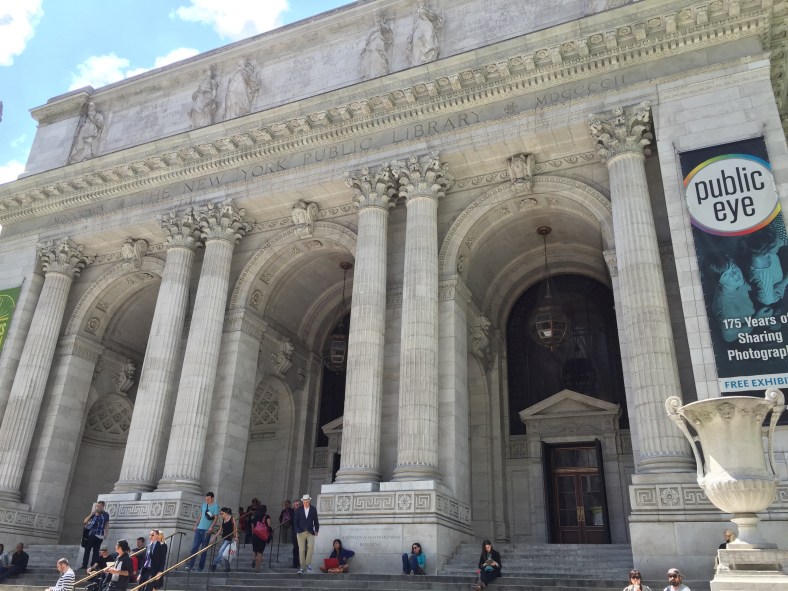
In times of financial crisis, you start looking around the house for things you might sell off until you realize all you have left is the real estate under your roof. For the New York Public Library in the early years of the 21st century, the fine art had been sold at auction, the staff had been ‘right sized’ and all that was left to remain solvent were the private donors and the coveted real estate footprint of branch locations.

This week’s ‘Saturday Read’ is ‘Patience and Fortitude: Power, Real Estate, And The Fight To Save A Public Library’ by Scott Sherman.

“This is a book about a world-class library that lost its way in the digital age.”

patience and fortitude

A public library is a community sanctuary that has historically offered immigrants a way to the middle class. In the Preface, author Sherman retells the story of former New York Senator, Daniel Patrick Moynihan who was working as a boot-black in 1940s Times Square, visiting the main library at 42nd Street.  “It was the first time I was taught that I was welcome in a place of education and learning. I would go into that great marble palace, and I would check my shoeshine box. A gentleman in a brown cotton jacket would take it as if I’d passed over an umbrella and bowler hat.”

This is a New York story, but one that illustrates the fate of the non-profit organization in an economic downturn. In the case of the NYPL, originally founded by bankers and corporate titans, the seismic shifts in the economy forced the influential board, of modern day financiers, to engage big name consultants in an attempt to apply “free-market solutions to complex institutional problems.”

The central narrative of the book was first reported by author Sherman in the December 2011 issue of ‘The Nation’. ‘Upheaval at the New York Public Library’ made public a four year old ‘Central Library Plan’, conceived and ratified by the NYPL’s trustees.

“The core trustees – led by the developer Marshall Rose – did what came naturally to them: they sold the NYPL’s land and took steps to shrink an institution they may have viewed as bureaucratic and inefficient…Personal enrichment was certainly not the trustees’ intention; they were sincere in their desire to assist the Library. It was hubris that drove them forward, and which ultimately led them astray: they believed that corporate logic could be effortlessly applied to a sprawling, decrepit library system.”

Consider this the first shot across the bow, as the Sherman chronicles the response from writers, researchers, NYPL employees, politicians and library patrons.

A 2012 Op-Ed piece written by Theodore Roosevelt biographer, Edmund Morris for The New York Times offers a sample of the opposition.

“I read newspaper reports about the determination of Anthony W. Marx, the president of the library, to spend $300 million to transform the main building, long devoted to reference, into what sounds like a palace of presentism. He wants to close the library system’s biggest circulating branch, the Mid-Manhattan (located just across the street) and the Science, Industry and Business Library (also in Midtown) and somehow wedge their contents into the already overstocked central research library.

For that he will need all the spatial ingenuity of his trendy architect-designate, Norman Foster. But something’s going to have to give, and you can be sure that what is new and hard and digital will prevail over what is old and papery and transportable elsewhere.”

On May 7, 2014 Robin Pogrebin reported that the NYPL has abandoned its renovation plan.

Last month, Tom Mashberg of The New York Times reported on the new plan to create a high-tech space under Bryant Park to house 2.5 million research works from the original stacks.

“This was not, of course, Plan A. That plan entailed a makeover of the flagship Fifth Avenue library that would have sent the research books to Princeton, N.J. But it set off a virtual Fahrenheit 451 of outrage among scholars and others for whom the library’s role as a research mecca seemed endangered. Critics, who hoped the old steel stacks could stay in use, remain apprehensive about the new stocking and retrieval system, which they say is impressive but has not been tested.”

To be continued…

And while you wait, catch up on the history and the cast of characters who bring ‘Patience and Fortitude’ to life.


‘The Last Hours’ a poem by Stephen Dunn

The ‘Friday poem’ this week is ‘Last Hours’ from the Pulitzer Prize winning collection, ‘Different Hours’ by Stephen Dunn. The poem is set in an office in 1964 at nineteen minutes to five.

NPR editor Barrie Hardymon selected her interview with the poet as a favorite in 2014. “This was one of these moments where, you know, he writes this very accessible poetry – and I mean that not to damn it with faint praise. You are still in the chapel of language that poetry is, but it is so – it still feels like a friend is whispering in your year very wise things. And he had that quality about him.”

The interview began with “how he has used poetry in his own life”.

“What good literature has always done is give me the language with the occasion – a lot of times not, of course. But I think the poems that matter to me are the ones that speak to that which cannot easily be said.”

“I was not a particularly good student, and I was a pretty good basketball player. I’ve written an essay called “Basketball And Poetry,” in which I try not to push the metaphor too far. But one of the points that I make in the essay is the similarity between poetry and basketball is the chance to be better than yourself, to transcend yourself, if you’re hot that day. And that happens in writing in our best moments, where we find ourselves saying what we didn’t know we knew or couldn’t have said in any other circumstance. Those are the moments in poetry I live for now.”

Does our ‘work place’ also gives us a chance to be better than ourselves? Enter ‘the chapel of language’ in the Friday poem, The Last Hours.

The Last Hours

There’s some innocence left,
and these are the last hours of an empty afternoon
at the office, and there’s the clock
on the wall, and my friend Frank
in the adjacent cubicle selling himself
on the phone.
I’m twenty-five, on the shaky
ladder up, my father’s son, corporate,
clean-shaven, and I know only what I don’t want,
which is almost everything I have.
A meeting ends.
Men in serious suits, intelligent men
who’ve been thinking hard about marketing snacks,
move back now to their window offices, worried
or proud. The big boss, Horace,
had called them in to approve this, reject that–
the big boss, a first-name, how’s-your-family
kind of assassin, who likes me.
It’s 1964.
The sixties haven’t begun yet. Cuba is a larger name
than Vietnam. The Soviets are behind
everything that could be wrong. Where I sit
it’s exactly nineteen minutes to five. My phone rings.
Horace would like me to stop in
before I leave. Stop in. Code words,
leisurely words, that mean now.
Would I be willing
to take on this? Would X’s office, who by the way
is no longer with us, be satisfactory?
About money, will this be enough?
I smile, I say yes and yes and yes,
but–I don’t know from what calm place
this comes–I’m translating
his beneficence into a lifetime, a life
of selling snacks, talking snack strategy,
thinking snack thoughts.
On the elevator down
it’s a small knot, I’d like to say, of joy.
That’s how I tell it now, here in the future,
the fear long gone.
By the time I reach the subway it’s grown,
it’s outsized, an attitude finally come round,
and I say it quietly to myself, I quit,
and keep saying it, knowing I will say it, sure
of nothing else but.

Stephen Dunn, from Different Hours (W.W. Norton)

The week@work – The Pope on climate change and more, Disney reverses a decision and the importance of staring out the window

This week@work has been spent planning a European adventure. For the next two weeks I will be taking leave of our conversation on work and career. I will continue to share thoughts and articles on Twitter. Please follow @Eileen Kohan or @workthoughts.

Before I go, let’s take a look at the week@work. This week included the major story of Pope Francis’ encyclical, Disney ABC Television reversing a decision on layoffs and the insights we gain from staring out the window.

Elizabeth Kolbert commented on the content of the encyclical in The New Yorker “A Papal Message That Spares No One”:

“…though its focus is on man’s relationship to nature, it also has much to say about man’s relationship to his fellow man and to himself—little of it laudatory. The vision that Pope Francis offers in his encyclical is of a world spiralling toward disaster, in which people are too busy shopping and checking their cell phones to do, or even care, much about it.

“The pace of consumption, waste and environmental change has so stretched the planet’s capacity that our contemporary lifestyle, unsustainable as it is, can only precipitate catastrophes,” the Pope writes. At another point, he says, “Many people will deny doing anything wrong because distractions constantly dull our consciousness of just how limited and finite our world really is.”

According to Francis, the problems of environmental degradation and global poverty are intimately related. Both can be traced to a way of thinking that regards the world as a means, rather than an end. This way of thinking rules the marketplace—“Finance overwhelms the real economy”—and dominates our data-driven culture: “Technology tends to absorb everything into its ironclad logic.”

The Guardian noted: “He says iPhones and all our other gadgets are getting in the way of our relationship with nature.”

“Real relationships with others, with all the challenges they entail, now tend to be replaced by a type of internet communication which enables us to choose or eliminate relationships at whim, thus giving rise to a new type of contrived emotion which has more to do with devices and displays than with other people and with nature.”

And finally, the pope’s tweet: “The earth, our home, is beginning to look more and more like an immense pile of filth.” Proving you can distill 180 pages into 140 characters.

Variety reported on the decision by Disney executives to keep 35 tech employees who not only been notified that their jobs were being eliminated, but they were expected to train their replacements.

“The Disney ABC Television Group has reversed course on cutting jobs for up to 35 application developers, two weeks after informing the employees that they were being laid off.

But the Disney ABC TV Media Technology and Strategy development team subsequently decided to rescind the layoffs. First reported by Computerworld, Disney ABC spokesman Kevin Brockman confirmed the plans on Wednesday.

When the layoffs were rescinded, some of the affected employees had already started training their Cognizant Technology replacements in what’s dubbed the “knowledge transfer” process.”

For more detail on this story, check the NPR interview with Computerworld senior editor,  Patrick Thibodeau.

The last story this week is from The School of Life on ‘The importance of staring out the window’.

“The point of staring out of a window is, paradoxically, not to find out what is going on outside. It is, rather, an exercise in discovering the contents of our own minds. It’s easy to imagine we know what we think, what we feel and what’s going on in our heads. But we rarely do entirely. There’s a huge amount of what makes us who we are that circulates unexplored and unused. Its potential lies untapped. It is shy and doesn’t emerge under the pressure of direct questioning. If we do it right, staring out the window offers a way for us to listen out for the quieter suggestions and perspectives of our deeper selves.”

“…some of our greatest insights come when we stop trying to be purposeful and instead respect the creative potential of reverie. Window daydreaming is a strategic rebellion against the excessive demands of immediate (but ultimately insignificant) pressures – in favour of the diffuse, but very serious, search for the wisdom of the unexplored deep self.”

The lessons of the week@work – Looking from space we share the same ‘home’ and the responsibility to care for that common home. How? Taking time off, paying attention to nature, disconnecting from technology and reclaiming our humanity.

The Saturday Read – Summer Books

We have summer in our sights, anticipating travel, adventure, rest and relaxation. Harbingers of the coming season are the summer reading lists from the traditional print book review sources, the icons of Silicon Valley and the titans of Wall Street.

The act of picking up a book, unrelated to work or school, has moved away from the center and occurs only on the periphery of our lives. We seem to have relegated reading to the category of indulgence vs. necessity. We give ourselves permission to read in summer, during an interval when we step away from work.

Writing in The Irish Times, Isabelle Cartwright considered the question of why we read.

“…the simple answer is for pleasure. But what exactly is the nature of that pleasure? Reading removes us from the structure of our lives, from the routine, the sequential habits of our day-to-day living. We enter instead another time zone. The plot, characters and setting occupy us, and while we read we inhabit the others’ reality. The pleasure therefore is derived from escaping our own small, limited and often repetitive lives and entering an exotic elsewhere.

But perhaps there is also the attraction of reserving something private for ourselves, something outside of the public world of relationship, family, work and occupation; something that is not encumbered by the stricture of time and self.”

For those of you who need a utilitarian rationale to set aside time to read, there is research to show we are morally and socially better as a result of our efforts:

Raymond Mar, a psychologist at York University in Canada, and Keith Oatley, a professor emeritus of cognitive psychology at the University of Toronto, reported in studies published in 2006 and 2009 that individuals who often read fiction appear to be better able to understand other people, empathize with them and view the world from their perspective. This link persisted even after the researchers factored in the possibility that more empathetic individuals might choose to read more novels. A 2010 study by Mar found a similar result in young children: the more stories they had read to them, the keener their “theory of mind,” or mental model of other people’s intentions.”

We become more emotionally intelligent as we read.

If that doesn’t convince you, the ‘Lifehack blog’ lists ’10 Benefits of Reading: Why You Should Read Every Day’ (not just in summer): “Mental stimulation, stress reduction, knowledge, vocabulary expansion, memory improvement, stronger analytical skills, improved focus and concentration, better writing skills, tranquility and free entertainment.”

I think they’re on to something here, for all you skeptics. A few of these skills match exactly to what employers look for in potential candidates: communications and problem solving. Maybe reading is a necessity and not an indulgence.

Here is a menu of links to the popular reading lists this summer:

The Los Angeles Times – Summer reading guide: The 136 books you’ll want to read

The New York Times – When the Water’s Too Cold, Something Else to Dive Into, A Critic’s Survey of Summer Books

USA Today – 25 Hot Books for Summer

The Washington Post – A great leadership reading list — without any business books on it

Bloomberg – Books Worth Reading This Summer

NPR – Four Books That Deliver Unexpected And Delightful Surprises This Summer

A Year of Books, Mark Zuckerberg

Beach Reading (and More), Bill Gates

10 Beach Books from J.P. Morgan’s Summer Reading List

Happy sand in your toes, head in the clouds, sea spray on your face reading!

The week@work – Nail salon workers, Sally Mann, sacrifices of the successful and Dan Abromowitz shares his potential job list

The dominant story of work this week was told in a two part series for The New York Times, ‘Unvarnished‘, by reporter, Sarah Maslin Nir, “examining the working conditions and potential health risks endured by nail salon workers”.

“Once an indulgence reserved for special occasions, manicures have become a grooming staple for women across the economic spectrum. There are now more than 17,000 nail salons in the United States, according to census data. The number of salons in New York City alone has more than tripled over a decade and a half to nearly 2,000 in 2012.

But largely overlooked is the rampant exploitation of those who toil in the industry. The New York Times interviewed more than 150 nail salon workers and owners, in four languages, and found that a vast majority of workers are paid below minimum wage; sometimes they are not even paid. Workers endure all manner of humiliation, including having their tips docked as punishment for minor transgressions, constant video monitoring by owners, even physical abuse. Employers are rarely punished for labor and other violations.”

The series received an immediate response from the New York governor.

“Gov. Andrew M. Cuomo ordered emergency measures on Sunday to combat the wage theft and health hazards faced by the thousands of people who work in New York State’s nail salon industry.

Effective immediately, he said in a statement, a new, multiagency task force will conduct salon-by-salon investigations, institute new rules that salons must follow to protect manicurists from the potentially dangerous chemicals found in nail products, and begin a six-language education campaign to inform them of their rights.”

In a follow-up report for The New Yorker, James Surowiecki examined ‘The Economics of New York’s Low Nail-Salon Prices’.

“…one of the most surprising, and economically telling, facts in the piece is also among the most mundane: namely, that the price of a manicure hasn’t budged much, if at all, in the past two decades.”

“What the nail-salon owners have done…is to pay their workers much less than a market wage. Maslin Nir’s nuanced account of who nail-salon workers are and how they live helps explain just how the nail salons are doing this: they hire workers who have fewer choices for employment because of language barriers, immigration status, and so on. These workers also have less bargaining power, and many are presumably leery of using the legal system to gain redress, which gives nail-salon owners the freedom to violate minimum-pay and overtime laws with little fear of being punished. The result is that these salons can stay profitable and still keep offering their customers the same low prices for decades. From this perspective, the cheap manicures New Yorkers have been getting have come, quite literally, at the expense of nail-salon workers.”

These articles, letters to the editor, media follow-up combined with good old fashioned customer guilt, will hopefully continue a conversation to improve the working conditions of these folks whose day is spent making others feel beautiful.

In other news this week@work:

Charlie Rose interviewed photographer Sally Mann. In an exchange taped for the CBS Morning News they shared their mutual concept of work: “In the end it’s love and work. Work to find your place so you can stand and leave your mark.”

Lifehack, a productivity and lifestyle blog reported on the ‘8 Things Successful People Sacrifice for Their Success’: “time, stability, personal life, sleep, health, quiet times, sanity and immediate desires.” 

Writer and comedian Dan Abromowitz shared a list of ‘Jobs I’d Be Well Suited For’ in The New Yorker, “As part of my current job hunt, I conducted a thorough inventory of my unique skills. From that, I’ve generated a list of professions at which I believe I’d excel. Please contact me if you are recruiting for any of these positions.” 

A sampling: “History Channel alien expert, Lobbyist, if that meant what it sounds like it means, Night watchman at Sleepy’s & Night watchman at the Museum of Natural History, provided that “Night at the Museum” is true, but lower-key than that.”

We are now in the ‘high season’ of university commencements. NPR has collected ‘The Best Commencement Speeches Ever’ from their archive. “We’ve hand-picked over 300 addresses going back to 1774. Search by name, school, date or theme, and see our blog n.pr/ed for more.”