‘Vocation’ a poem by Sandra Beasley

How many times have you asked someone, What would you like to do next @work? And how often have your received the response, “I’m not sure, but I would like to work with people”. It can be the beginning of an extremely frustrating conversation because there are many ways you can work with people and not all of them pleasant.

The Friday Poem this week is from poet Sandra Beasley’s Barnard Women Poets Prize winning poetry collection, ‘I Was the Jukebox’. In reading the poem, what caught my eye was the twist on the ‘working with people’ ambition in the last lines of the poem.

Her words give voice to all of us who struggle to find our perfect place @work.

“If it calls you, its your calling, right?”

Maybe there’s more to career choice than hearing voices.

Vocation

For six months I dealt Baccarat in a casino.
For six months I played Brahms in a mall.
For six months I arranged museum dioramas;
my hands were too small for the Paleolithic
and when they reassigned me to lichens, I quit.
I type ninety-one words per minute, all of them
Help. Yes, I speak Dewey Decimal.
I speak Russian, Latin, a smattering of Tlingit.
I can balance seven dinner plates on my arm.
All I want to do is sit on a veranda while
a hard rain falls around me. I’ll file your 1099s.
I’ll make love to strangers of your choice.
I’ll do whatever you want, as long as I can do it
on that veranda. If it calls you, it’s your calling,
right? Once I asked a broker what he loved
about his job, and he said Making a killing.
Once I asked a serial killer what made him
get up in the morning, and he said The people.

Sandra Beasley  ‘I Was the Jukebox: Poems’  2010

9780393339666_198

‘Poet’s work’ a poem by Lorine Niedecker

Do you remember the first bit of career advice you received from a grown-up? Poet Lorine Niedecker captured the advice given to her and her subsequent career choice in ‘Poet’s Work’ this week’s Friday Poem. “She is admired for the subtlety of her tightly crafted, nuanced and deliciously ironic poems, as well as for her total devotion to her calling.”

The biographical summary on the Poetry Foundation site describes the work of this twentieth century rural Wisconsin poet.

“Niedecker’s verse is praised for its stark, vivid imagery, subtle rhythms, and spare language…Concerned with the distillation of images and thoughts into concise expression, Niedecker described her work as a “condensery,” and several critics have compared her poetry to the delicate yet concrete verse of Chinese and Japanese writers. Although Niedecker’s long correspondence with Louis Zukofsky, who frequently submitted her poems to the journal, Origin, and contact with such respected writers as Cid Corman and Basil Bunting, brought her some critical notice, her work was generally overlooked until late in her life. Since her death in 1970, several critics have identified Niedecker as a significant and original voice in contemporary American poetry.”

Poet’s work

Grandfather
advised me:
Learn a trade

I learned
to sit at desk
and condense

No layoff
from this
condensery

A complete collection of her work was published by The University of California Press in 2004.

‘My Triumph’ a poem by John Greenleaf Whittier

The ‘Friday Poem’ this week marks the autumnal equinox with the words of American poet, John Greenleaf Whittier. The name may be familiar only in the memory of attending a ‘Whittier Elementary School’. Whittier was a courageous abolitionist whose essays and poems provided a way to communicate his views.

“His first book, Legends of New England in Prose and Verse, was published in 1831; from then until the Civil War, he wrote essays and articles as well as poems, almost all of which were concerned with abolition. In 1833 he wrote Justice and Expedience urging immediate abolition. In 1834 he was elected as a Whig for one term to the Massachusetts legislature; mobbed and stoned in Concord, New Hampshire, in 1835. He moved in 1836 to Amesbury, Massachusetts, where he worked for the American Anti-Slavery Society. During his tenure as editor of the Pennsylvania Freeman, in May 1838, the paper’s offices burned to the ground and were sacked during the destruction of Pennsylvania Hall by a mob.”

The Civil War was a turning point in his writing. Until his death in 1892 he wrote of religion, nature and rural life. ‘My Triumph’, written in 1870 reflects on seasonal and life transitions.

My Triumph

The autumn-time has come;
On woods that dream of bloom,
And over purpling vines,
The low sun fainter shines.

The aster-flower is failing,
The hazel’s gold is paling;
Yet overhead more near
The eternal stars appear!

And present gratitude
Insures the future’s good,
And for the things I see
I trust the things to be;

That in the paths untrod,
And the long days of God,
My feet shall still be led,
My heart be comforted.

O living friends who love me!
O dear ones gone above me!
Careless of other fame,
I leave to you my name.

Hide it from idle praises,
Save it from evil phrases:
Why, when dear lips that spake it
Are dumb, should strangers wake it?

Let the thick curtain fall;
I better know than all
How little I have gained,
How vast the unattained.

Not by the page word-painted
Let life be banned or sainted:
Deeper than written scroll
The colors of the soul.

Sweeter than any sung
My songs that found no tongue;
Nobler than any fact
My wish that failed of act.

Others shall sing the song,
Others shall right the wrong,—
Finish what I begin,
And all I fail of win.

What matter, I or they?
Mine or another’s day,
So the right word be said
And life the sweeter made?

Hail to the coming singers!
Hail to the brave light-bringers!
Forward I reach and share
All that they sing and dare.

The airs of heaven blow o’er me;
A glory shines before me
Of what mankind shall be,—
Pure, generous, brave, and free.

A dream of man and woman
Diviner but still human,
Solving the riddle old,
Shaping the Age of Gold!

The love of God and neighbor;
An equal-handed labor;
The richer life, where beauty
Walks hand in hand with duty.

Ring, bells in unreared steeples,
The joy of unborn peoples!
Sound, trumpets far off blown,
Your triumph is my own!

Parcel and part of all,
I keep the festival,
Fore-reach the good to be,
And share the victory.

I feel the earth move sunward,
I join the great march onward,
And take, by faith, while living,
My freehold of thanksgiving.

John Greenleaf Whittier  1870

The week@work – VP Biden on leadership, Serena@US Open and #NeverForget

This week@work captured snapshots of genuine human moments: a vp expressing emotion in a late night talk show conversation, a tennis champion’s loss to an unseeded and 43rd world ranked competitor and commemorations of a day 14 years ago that we will #NeverForget.

In the U.S. we are in the midst of a presidential selection process that accentuates the loud and outrageous vs. the rational and purposeful. So it was refreshing to read an article by David Zweig, ‘The Myth of the Larger Than Life Leader’.

“The reality, as many professionals who tend to fall more on the quiet end of the spectrum can attest to, is that many of the best workers—be they at the top of the pyramid or somewhere in the middle—go about their business, achieving great results without fanfare. And while it may feel as though the whole world is beguiled by those who make the most noise in conference rooms and boardrooms, it’s encouraging and, critically, worth noting that that’s not actually the case.”

Which brings me to the extraordinary interview by Steven Colbert with Vice President Biden on Thursday evening. In a conversation that ranged from the personal to the professional, the vice president shared his perspective on the interview process for president.

Unknown-1

He began by posing a question to the audience, that’s relevant to each of us when we are looking for work. “Would you want a job, that in fact, every day you had to get up and you had to modulate what you said and believed?”

He continued with more career advice. “If you can’t state why you want the job, then there’s a lot more lucrative opportunities in other places.”

He then talked in specifics about the requirements to interview for the top job. “I don’t think any man or woman should run for president unless, number one, they know exactly why they would want to be president, and two, they can look at the folks out there and say, “I promise you, you have my whole heart, my whole soul, my energy and my passion to do this.”

On Friday, one of tennis’ greatest players, Serena Williams, lost her semi-final match at the US Open and ended her quest for the calendar Grand Slam. It’s a reminder to all of us that there are no guarantees. In any competitive situation, there is always the chance we will fail. This week it was an unseeded, 33 year old player from Taranto, Italy, Roberta Vinci who prevailed in three sets.

Unknown-2

The stage was set for a women’s final between two former Italian tennis academy roommates, Flavia Pennetta and Roberta Vinci. Cue the author, Elena Ferrante to script this story worthy of her heroines Elena and Lila of the Neopolitan novels.

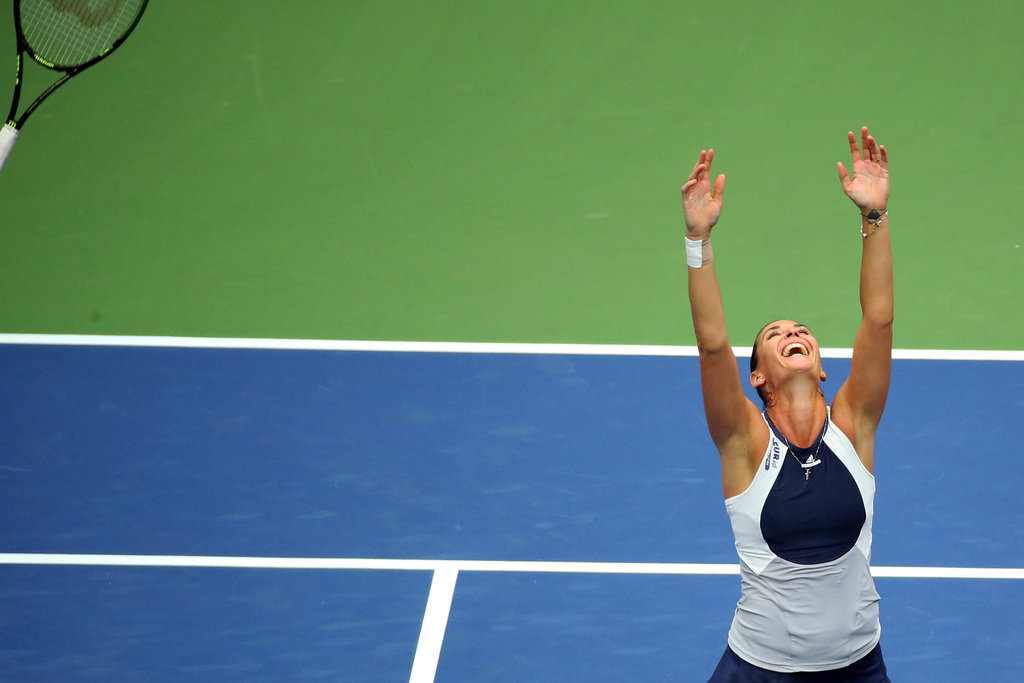
In front of a sold out crowd, including Italian Prime Minister, Matteo Renzi, Flavia won in straight sets on Saturday, announcing her retirement as she accepted the US Open Championship trophy. Just as we met her, she shared a career lesson and  stepped away to reinvent her life.

13OPENWOMENshow-slide-DQRY-jumbo

So we #NeverForget, a poem written for the 43 members of Hotel Employees and Restaurant Employees Local l00, working at the Windows on the World restaurant, who lost their lives in the attack on the World Trade Center

Martín Espada’s “Alabanza: In Praise of Local 100″

Alabanza. Praise the cook with a shaven head
and a tattoo on his shoulder that said Oye,
a blue-eyed Puerto Rican with people from Fajardo,
the harbor of pirates centuries ago.
Praise the lighthouse in Fajardo, candle
glimmering white to worship the dark saint of the sea.
Alabanza. Praise the cook’s yellow Pirates cap
worn in the name of Roberto Clemente, his plane
that flamed into the ocean loaded with cans for Nicaragua,
for all the mouths chewing the ash of earthquakes.
Alabanza. Praise the kitchen radio, dial clicked
even before the dial on the oven, so that music and Spanish
rose before bread. Praise the bread. Alabanza.

Praise Manhattan from a hundred and seven flights up,
like Atlantis glimpsed through the windows of an ancient aquarium.
Praise the great windows where immigrants from the kitchen
could squint and almost see their world, hear the chant of nations:
Ecuador, México, Republica Dominicana,
Haiti, Yemen, Ghana, Bangladesh.
Alabanza. Praise the kitchen in the morning,
where the gas burned blue on every stove
and exhaust fans fired their diminutive propellers,
hands cracked eggs with quick thumbs
or sliced open cartons to build an altar of cans.
Alabanza. Praise the busboy’s music, the chime-chime
of his dishes and silverware in the tub.

Alabanza. Praise the dish-dog, the dishwasher
who worked that morning because another dishwasher
could not stop coughing, or because he needed overtime
to pile the sacks of rice and beans for a family
floating away on some Caribbean island plagued by frogs.
Alabanza. Praise the waitress who heard the radio in the kitchen
and sang to herself about a man gone. Alabanza.

After the thunder wilder than thunder,
after the shudder deep in the glass of the great windows,
after the radio stopped singing like a tree full of terrified frogs,
after night burst the dam of day and flooded the kitchen,
for a time the stoves glowed in darkness like the lighthouse in Fajardo,
like a cook’s soul. Soul I say, even if the dead cannot tell us
about the bristles of God’s beard because God has no face,
soul I say, to name the smoke-beings flung in constellations
across the night sky of this city and cities to come.
Alabanza I say, even if God has no face.

Alabanza. When the war began, from Manhattan and Kabul
two constellations of smoke rose and drifted to each other,
mingling in icy air, and one said with an Afghan tongue:
Teach me to dance. We have no music here.
And the other said with a Spanish tongue:
I will teach you. Music is all we have.

Unknown

‘To David, About His Education’ a poem by Howard Nemerov

As students return to school, the conversation once again turns to the value of education. Sitting at your desk you may look back and wonder why you had to take courses that seemed to have no relevance to your current position. Or you may have figured out that all disciplines are linked, even if those connections lie just beneath the surface.

This week’s ‘Friday Poem’ comes from Harvard alum, poet laureate, and photographer, Diane Arbus‘ big brother, Howard Nemerov. It answers the question, what will you have to learn to become one of the grownups?

To David, About His Education

The world is full of mostly invisible things,
And there is no way but putting the mind’s eye,
Or its nose, in a book, to find them out,
Things like the square root of Everest
Or how many times Byron goes into Texas,
Or whether the law of the excluded middle
Applies west of the Rockies. For these
And the like reasons, you have to go to school
And study books and listen to what you are told,
And sometimes try to remember. Though I don’t know
What you will do with the mean annual rainfall
On Plato’s Republic, or the calorie content
Of the Diet of Worms, such things are said to be
Good for you, and you will have to learn them
In order to become one of the grown-ups
Who sees invisible things neither steadily nor whole,
But keeps gravely the grand confusion of the world
Under his hat, which is where it belongs,
And teaches small children to do this in their turn.

Howard Nemerov, “To David, About His Education” from ‘War Stories: Poems About Long Ago and Now’.

‘Summer Wind’ a poem by William Cullen Bryant

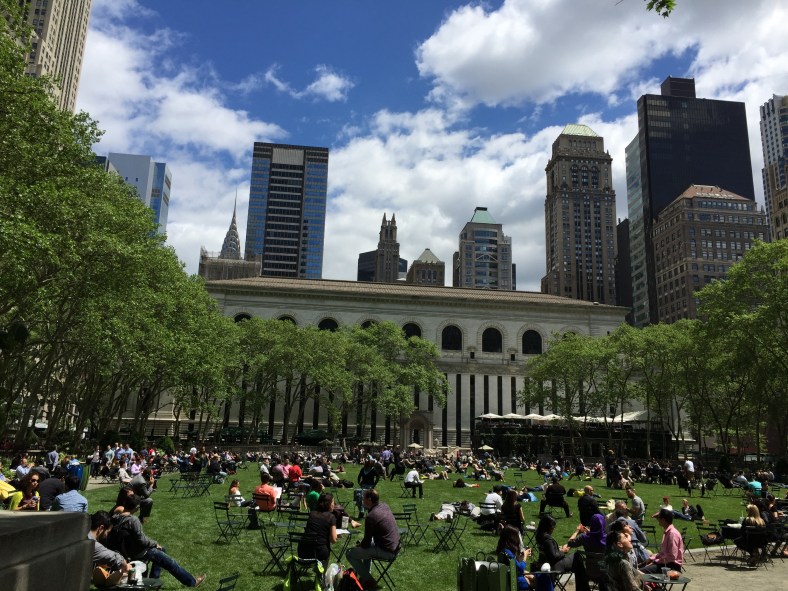
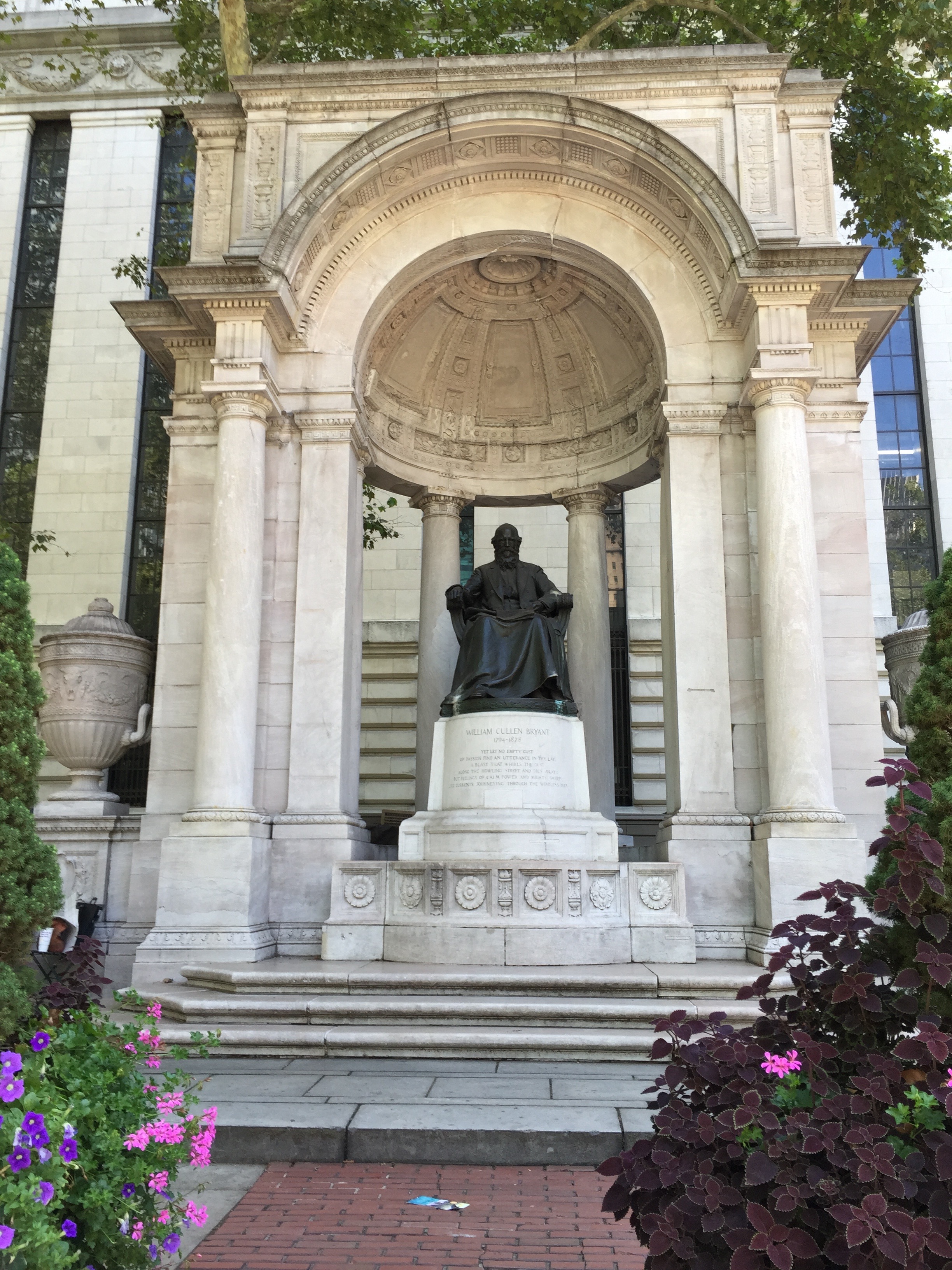
If you are in midtown Manhattan on a summer afternoon you may want to take a break from work in Bryant Park. The park’s namesake is honored in a bronze memorial sculpted by Herbert Adams. From his pedestal on the rear terrace of the New York Public Library William Cullen Bryant presides over generations of fellow New Yorkers.

Bryant arrived in New York in 1826 to become assistant editor of the New York Evening Post, founded in 1801 by Alexander Hamilton. He his tenure with the paper would last five decades. He became one of America’s most popular poets, a civic leader and led the effort to create Central Park.

“No line of his poetry survives in the consciousness of his nation, and none of his editorial pronouncements still resonates from his five decades with the New-York Evening Post, yet William Cullen Bryant stood among the most celebrated figures in the frieze of nineteenth-century America. The fame he won as a poet while in his youth remained with him as he entered his eighties; only Longfellow and Emerson were his rivals in popularity over the course of his life.” (Poetry Foundation)

His memorial was dedicated in 1911, coinciding with completion of construction on the library.

bryant

The Friday poem this week is ‘Summer Wind’ by William Cullen Bryant.

The poem was one of a series of 23 he submitted for publication in the Literary Gazette in 1824 while he was practicing law in Massachusetts. The image created by his verse recalls his memory of the landscape in the Berkshires.

Take a seat on one of those less than comfortable folding green chairs in Bryant Park and enjoy the Friday poem.

Summer Wind

It is a sultry day; the sun has drunk
The dew that lay upon the morning grass;
There is no rustling in the lofty elm
That canopies my dwelling, and its shade
Scarce cools me. All is silent, save the faint
And interrupted murmur of the bee,
Settling on the sick flowers, and then again
Instantly on the wing. The plants around
Feel the too potent fervors: the tall maize
Rolls up its long green leaves; the clover droops
Its tender foliage, and declines its blooms.
But far in the fierce sunshine tower the hills,
With all their growth of woods, silent and stern,
As if the scorching heat and dazzling light
Were but an element they loved. Bright clouds,
Motionless pillars of the brazen heaven–
Their bases on the mountains–their white tops
Shining in the far ether–fire the air
With a reflected radiance, and make turn
The gazer’s eye away. For me, I lie
Languidly in the shade, where the thick turf,
Yet virgin from the kisses of the sun,
Retains some freshness, and I woo the wind
That still delays his coming. Why so slow,
Gentle and voluble spirit of the air?
Oh, come and breathe upon the fainting earth
Coolness and life! Is it that in his caves
He hears me? See, on yonder woody ridge,
The pine is bending his proud top, and now
Among the nearer groves, chestnut and oak
Are tossing their green boughs about. He comes;
Lo, where the grassy meadow runs in waves!
The deep distressful silence of the scene
Breaks up with mingling of unnumbered sounds
And universal motion. He is come,
Shaking a shower of blossoms from the shrubs,
And bearing on their fragrance; and he brings
Music of birds, and rustling of young boughs,
And sound of swaying branches, and the voice
Of distant waterfalls. All the green herbs
Are stirring in his breath; a thousand flowers,
By the road-side and the borders of the brook,
Nod gayly to each other; glossy leaves
Are twinkling in the sun, as if the dew
Were on them yet, and silver waters break
Into small waves and sparkle as he comes.

William Cullen Bryant  1824

‘The Last Hours’ a poem by Stephen Dunn

The ‘Friday poem’ this week is ‘Last Hours’ from the Pulitzer Prize winning collection, ‘Different Hours’ by Stephen Dunn. The poem is set in an office in 1964 at nineteen minutes to five.

NPR editor Barrie Hardymon selected her interview with the poet as a favorite in 2014. “This was one of these moments where, you know, he writes this very accessible poetry – and I mean that not to damn it with faint praise. You are still in the chapel of language that poetry is, but it is so – it still feels like a friend is whispering in your year very wise things. And he had that quality about him.”

The interview began with “how he has used poetry in his own life”.

“What good literature has always done is give me the language with the occasion – a lot of times not, of course. But I think the poems that matter to me are the ones that speak to that which cannot easily be said.”

“I was not a particularly good student, and I was a pretty good basketball player. I’ve written an essay called “Basketball And Poetry,” in which I try not to push the metaphor too far. But one of the points that I make in the essay is the similarity between poetry and basketball is the chance to be better than yourself, to transcend yourself, if you’re hot that day. And that happens in writing in our best moments, where we find ourselves saying what we didn’t know we knew or couldn’t have said in any other circumstance. Those are the moments in poetry I live for now.”

Does our ‘work place’ also gives us a chance to be better than ourselves? Enter ‘the chapel of language’ in the Friday poem, The Last Hours.

The Last Hours

There’s some innocence left,
and these are the last hours of an empty afternoon
at the office, and there’s the clock
on the wall, and my friend Frank
in the adjacent cubicle selling himself
on the phone.
I’m twenty-five, on the shaky
ladder up, my father’s son, corporate,
clean-shaven, and I know only what I don’t want,
which is almost everything I have.
A meeting ends.
Men in serious suits, intelligent men
who’ve been thinking hard about marketing snacks,
move back now to their window offices, worried
or proud. The big boss, Horace,
had called them in to approve this, reject that–
the big boss, a first-name, how’s-your-family
kind of assassin, who likes me.
It’s 1964.
The sixties haven’t begun yet. Cuba is a larger name
than Vietnam. The Soviets are behind
everything that could be wrong. Where I sit
it’s exactly nineteen minutes to five. My phone rings.
Horace would like me to stop in
before I leave. Stop in. Code words,
leisurely words, that mean now.
Would I be willing
to take on this? Would X’s office, who by the way
is no longer with us, be satisfactory?
About money, will this be enough?
I smile, I say yes and yes and yes,
but–I don’t know from what calm place
this comes–I’m translating
his beneficence into a lifetime, a life
of selling snacks, talking snack strategy,
thinking snack thoughts.
On the elevator down
it’s a small knot, I’d like to say, of joy.
That’s how I tell it now, here in the future,
the fear long gone.
By the time I reach the subway it’s grown,
it’s outsized, an attitude finally come round,
and I say it quietly to myself, I quit,
and keep saying it, knowing I will say it, sure
of nothing else but.

Stephen Dunn, from Different Hours (W.W. Norton)

‘Questions of Travel’ a poem by Elizabeth Bishop

It’s summer, and despite all the grim forecasts of the end of vacations, a significant segment of the population will take a break from work. In that interval folks will travel locally, internationally or vicariously through the writings of others. They will record adventures on Instagram, tweet locations and post blogs, sharing their experience along the way. Very few will memorialize their travels in poetry.

The Friday Poem this week is Elizabeth Bishop’s ‘Questions of Travel’

In 2010, author William Boyd travelled to the house in Brazil where poet Elizabeth Bishop lived, and recorded his visit in an article for The Guardian newspaper.

“‘Questions of Travel” is one of the rare Bishop poems that one can easily interpret as autobiographical. Set squarely in the house at Samambaia, it analyses Bishop’s decision to leave America and seek her destiny, whatever that might have been, elsewhere. “Should we have stayed at home and thought of here?”, the poet asks. “Must we dream our dreams / and have them, too?” And then, in the very last lines, it prompts another question: “Should we have stayed at home, / wherever that may be?” The answer we are meant to infer is, I believe, a confident “no”. Bishop – born in Worcester, Massachusetts, a New Englander through and through – was made by her life in Brazil. Brazil became her home – however eccentric, irritating, enthralling, frightening, exotic and perplexing a place it might seem to be, depending on the occasion. When she finally left it in 1971, for the last time, the happiest period of her life was over.”

‘Questions of Travel’

There are too many waterfalls here; the crowded streams
hurry too rapidly down to the sea,
and the pressure of so many clouds on the mountaintops
makes them spill over the sides in soft slow-motion,
turning to waterfalls under our very eyes.
–For if those streaks, those mile-long, shiny, tearstains,
aren’t waterfalls yet,
in a quick age or so, as ages go here,
they probably will be.
But if the streams and clouds keep travelling, travelling,
the mountains look like the hulls of capsized ships,
slime-hung and barnacled.

Think of the long trip home.
Should we have stayed at home and thought of here?
Where should we be today?
Is it right to be watching strangers in a play
in this strangest of theatres?
What childishness is it that while there’s a breath of life
in our bodies, we are determined to rush
to see the sun the other way around?
The tiniest green hummingbird in the world?
To stare at some inexplicable old stonework,
inexplicable and impenetrable,
at any view,
instantly seen and always, always delightful?
Oh, must we dream our dreams
and have them, too?
And have we room
for one more folded sunset, still quite warm?

But surely it would have been a pity
not to have seen the trees along this road,
really exaggerated in their beauty,
not to have seen them gesturing
like noble pantomimists, robed in pink.
–Not to have had to stop for gas and heard
the sad, two-noted, wooden tune
of disparate wooden clogs
carelessly clacking over
a grease-stained filling-station floor.
(In another country the clogs would all be tested.
Each pair there would have identical pitch.)
–A pity not to have heard
the other, less primitive music of the fat brown bird
who sings above the broken gasoline pump
in a bamboo church of Jesuit baroque:
three towers, five silver crosses.
–Yes, a pity not to have pondered,
blurr’dly and inconclusively,
on what connection can exist for centuries
between the crudest wooden footwear
and, careful and finicky,
the whittled fantasies of wooden footwear
and, careful and finicky,
the whittled fantasies of wooden cages.
–Never to have studied history in
the weak calligraphy of songbirds’ cages.
–And never to have had to listen to rain
so much like politicians’ speeches:
two hours of unrelenting oratory
and then a sudden golden silence
in which the traveller takes a notebook, writes:

“Is it lack of imagination that makes us come
to imagined places, not just stay at home?
Or could Pascal have been not entirely right
about just sitting quietly in one’s room?

Continent, city, country, society:
the choice is never wide and never free.
And here, or there . . . No. Should we have stayed at home,
wherever that may be?”

Elizabeth Bishop, 1965

‘Spent’ Poetry in Music by Amy Speace & Nielson Hubbard

Amy Speace is a songwriter. A graduate of Amherst College and a former touring member of the National Shakespeare Company she now lives in East Nashville, Tennessee. In The New York Times article, ‘A Singer-Songwriter, Just Trying to Make Do’, she describes the economic impact of gentrification on the lives of artists and the inspiration for her new song, ‘Spent’.

“…many of us working-class musicians, painters, artists and writers live a precarious financial existence of our own choosing. When I got together with Neilson Hubbard, a writer and producer, to write a song about a financial turning point, it was easy for us to look around at ourselves and find our subject matter.”

Spent

Come take my hand let’s walk to the end of this rainbow

Do you think that we’ll ever know

Where to find all that gold

Once I heard someone singing a dream we could have and hold

Something of our own

A place to call home

We’re head over heels

In over our heads

We borrow and steal to pay the rent

How we gonna save any money when it’s already spent

Years keep rolling the houses keep falling like dominoes

They’re throwing up condos

The for the old

It’s not enough to hear your own song on the radio

When your credit is far below

What they need for a loan

We’re head over heels

In over our heads

We borrow and steal to pay the rent

How we gonna save any money when it’s already spent

Can we stay or do we have to go

Could this be the end of the road

How we gonna save any money…

We’re head over heels

In over our heads

We borrow and steal to pay the rent

How we gonna save any money when it’s already spent

Amy Speace/Nielson Hubbard 2015

‘The Workforce’ – A Poem by James Tate

How often do you find yourself in negotiation with management and suppliers to acquire the resources necessary to meet your objectives?

In the poem ‘The Workforce’, Pulitzer Prize and National Book Award winning poet, James Tate creates a dialog about the ‘resources’ needed to complete a job. It’s up to your imagination to visualize what these workers are trying to accomplish. To perform their task they need a variety of supplies…and women. We are left with the question: Are the women motivation to work or are the women workers who will help complete the task?

In a 2006 Paris Review interview Tate described his process: “I love to take a poem, for instance that starts with something seemingly frivolous or inconsequential and then grows in gravity until by the end it’s something very serious.”

The Workforce

Do you have adequate oxen for the job?
No, my oxen are inadequate.
Well, how many oxen would it take to do an adequate job?
I would need ten more oxen to do the job adequately.
I’ll see if I can get them for you.
I’d be obliged if you could do that for me.
Certainly. And do you have sufficient fishcakes for the men?
We have fifty fishcakes, which is less than sufficient.
I’ll have them delivered on the morrow.
Do you need maps of the mountains and the underworld?
We have maps of the mountains but we lack maps of the underworld.
Of course you lack maps of the underworld,
there are no maps of the underworld.
And, besides, you don’t want to go there, it’s stuffy.
I had no intention of going there, or anywhere for that matter.
It’s just that you asked me if I needed maps. . . .
Yes, yes, it’s my fault, I got carried away.
What do you need, then, you tell me?
We need seeds, we need plows, we need scythes, chickens,
pigs, cows, buckets and women.
Women?
We have no women.
You’re a sorry lot, then.
We are a sorry lot, sir.
Well, I can’t get you women.
I assumed as much, sir.
What are you going to do without women, then?
We will suffer, sir. And then we’ll die out one by one.
Can any of you sing?
Yes, sir, we have many fine singers among us.
Order them to begin singing immediately.
Either women will find you this way or you will die
comforted. Meanwhile busy yourselves
with the meaningful tasks you have set for yourselves.
Sir, we will not rest until the babes arrive.

James Tate, “The Workforce” from Memoir of the Hawk: Poems. Copyright © 2001 by James Tate