The Times They Are A-Changin’

On Thursday morning Professor Sara Danius, Permanent Secretary of the Swedish Academy, announced the 2016 Nobel Prize in Literature.

“The Nobel Prize in Literature for 2016 is awarded to Bob Dylan “for having created new poetic expressions within the great American song tradition”.

In the hours that followed, the surprise decision was debated by the literati. A frequently mentioned candidate for the prize in literature, author Salman Rushdie, placed the choice in context via Twitter.

“From Orpheus to Faiz, song & poetry have been closely linked. Dylan is the brilliant inheritor of the bardic tradition. Great choice.”

In honor of that choice, the Friday Poem this week is Dylan’s ‘The Times They Are A-Changin’.


The Times They Are A-Changin’

Come gather ’round people
Wherever you roam
And admit that the waters
Around you have grown
And accept it that soon
You’ll be drenched to the bone
If your time to you is worth savin’
Then you better start swimmin’ or you’ll sink like a stone
For the times they are a-changin’

Come writers and critics
Who prophesize with your pen
And keep your eyes wide
The chance won’t come again
And don’t speak too soon
For the wheel’s still in spin
And there’s no tellin’ who that it’s namin’
For the loser now will be later to win
For the times they are a-changin’

Come senators, congressmen
Please heed the call
Don’t stand in the doorway
Don’t block up the hall
For he that gets hurt
Will be he who has stalled
There’s a battle outside and it is ragin’
It’ll soon shake your windows and rattle your walls
For the times they are a-changin’

Come mothers and fathers
Throughout the land
And don’t criticize
What you can’t understand
Your sons and your daughters
Are beyond your command
Your old road is rapidly agin’
Please get out of the new one if you can’t lend your hand
For the times they are a-changin’

The line it is drawn
The curse it is cast
The slow one now
Will later be fast
As the present now
Will later be past
The order is rapidly fadin’
And the first one now will later be last
For the times they are a-changin’

Bob Dylan, 1963

3992253_159.jpg

Photo credit: Rolling Stone Magazine

The Friday Poem ‘Calling Him Back from Layoff’ by Bob Hicok

The Friday Poem this week captures a moment when a telephone rings and life changes for two American workers. ‘Calling Him Back from Layoff’ is poet and English professor Bob Hickok’s intimate portrait of the effects of economic downturn.

Written at a time when Detroit was the epicenter of job losses in manufacturing, the words continue to resonate today, as we address income inequality and the impermanence of the ‘gig’ economy.

Calling Him Back from Layoff 

I called a man today. After he said
hello and I said hello came a pause
during which it would have been

confusing to say hello again so I said
how are you doing and guess what, he said
fine and wondered aloud how I was

and it turns out I’m OK. He
was on the couch watching cars
painted with ads for Budweiser follow cars

painted with ads for Tide around an oval
that’s a metaphor for life because
most of us run out of gas and settle

for getting drunk in the stands
and shouting at someone in a t-shirt
we want kraut on our dog. I said

he could have his job back and during
the pause that followed his whiskers
scrubbed the mouthpiece clean

and his breath passed in and out
in the tidal fashion popular
with mammals until he broke through

with the words how soon thank you
ohmyGod which crossed his lips and drove
through the wires on the backs of ions

as one long word as one hard prayer
of relief meant to be heard
by the sky. When he began to cry I tried

with the shape of my silence to say
I understood but each confession
of fear and poverty was more awkward

than what you learn in the shower.
After he hung up I went outside and sat
with one hand in the bower of the other

and thought if I turn my head to the left
it changes the song of the oriole
and if I give a job to one stomach other

forks are naked and if tonight a steak
sizzles in his kitchen do the seven
other people staring at their phones

hear?

Bob Hicok  ‘Insomnia Diary’ University of Pittsburgh Press, 2004

insomnia-diary

Listen to Bob Hicok read the poem for ‘Poetry Everywhere’


The Friday Poem ‘Labor Day’ by Joseph Millar

Part of the year I live in a ‘swing state’ where the economy has not yet recovered, and politicians fill the airwaves with promises of transformational ‘greatness’. The Friday Poem this week is from Pennsylvania native, former telephone repairman, commercial fisherman, and poet Joseph Millar. ‘Labor Day’ captures the quiet of a national holiday, first celebrated in New York on September 5, 1882.

“The form that the observance and celebration of Labor Day should take was outlined in the first proposal of the holiday — a street parade to exhibit to the public “the strength and esprit de corps of the trade and labor organizations” of the community, followed by a festival for the recreation and amusement of the workers and their families. This became the pattern for the celebrations of Labor Day. Speeches by prominent men and women were introduced later, as more emphasis was placed upon the economic and civic significance of the holiday. Still later, by a resolution of the American Federation of Labor convention of 1909, the Sunday preceding Labor Day was adopted as Labor Sunday and dedicated to the spiritual and educational aspects of the labor movement.”

Labor Day

Even the bosses are sleeping late
in the dusty light of September.

The parking lot’s empty and no one cares.
No one unloads a ladder, steps on the gas

or starts up the big machines in the shop,
sanding and grinding, cutting and binding.

No one lays a flat bead of flux over a metal seam
or lowers the steel forks from a tailgate.

Shadows gather inside the sleeve
of the empty thermos beside the sink,

the bells go still by the channel buoy,
the wind lies down in the west,

the tuna boats rest on their tie-up lines
turning a little, this way and that.

Joseph Millar  from ‘Blue Rust’ Carnegie Mellon University Press, 2012

9780887485497.jpg

The Friday Poem: ‘The Boss’ by Deborah Garrison

One of the most important workplace relationships is the one between you and your direct supervisor. A good ‘boss’ will quickly sense your potential and connect your talents with work that challenges and enables professional growth. He/she employs personal experience to communicate the value of failure along with success. A good boss has a high EQ and a healthy dose of empathy for all.

For this week’s Friday Poem, a meditation on ‘The Boss’ through the eyes of poet Deborah Garrison.

The Boss

A firecracker, even after middle age

set in, a prince of repression

in his coat and tie, with cynical words


for everything dear to him.

Once I saw a snapshot of the house

he lives in, its fence painted


white, the flowers a wife

had planted leaning into the frame

on skinny stalks, shaking little pom-poms


of color, the dazzle all

accidental, and I felt

a hot, corrective


sting: our lives would never

intersect. At some point

he got older, trimmer, became


the formidable man around the office.

His bearing upright, what hair he has

silver and smooth, he shadows my doorway,


jostling the change in his pocket –

milder now, and mildly vexed.

The other day he asked what on earth


was wrong with me, and sat me down

on his big couch, where I cried

for twenty minutes straight,


snuffling, my eyeliner

betraying itself in the stained

tears. Impossible to say I was crying


because he had asked. He passed

tissues, at ease with the fearsome

womanly squall that made me alien


even to myself. No, it didn’t make him

squirm. Across his seventy years,

over his glasses, he eyed me kindly,


and I thought what countless scenes

of tears, of love revealed

he must have known.


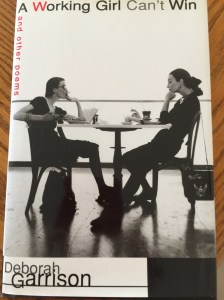
Deborah Garrison   ‘A Working Girl Can’t Win’ 1998

a working girl can't win

Click on this link to hear the author read the poem as part of a 1999 interview with Bill Moyers.

“In this episode of Sounds of Poetry, Garrison tells Bill that poetry is about “trying to find a way to understand and describe the world that lifts you a little bit out of it, instead of just being in it and being lost.”