The week@work – “our culture is changing”, internship access, sexual harassment@Fox & the June jobs report

For the 67th time in his term, President Obama ordered the flag of the United States be flown at half-staff; this time in memory of the police officers in Dallas. Sixty-seven times, a record for a presidential administration.

This week@work we look at two responses to the violence, consider an opinion on internship access, examine a high profile workplace harassment lawsuit, and the implications of the June jobs report.

“As a mark of respect for the victims of the attack on police officers perpetrated on Thursday, July 7, 2016, in Dallas, Texas, by the authority vested in me as President of the United States by the Constitution and the laws of the United States of America, I hereby order that the flag of the United States shall be flown at half-staff at the White House and upon all public buildings and grounds, at all military posts and naval stations, and on all naval vessels of the Federal Government in the District of Columbia and throughout the United States and its Territories and possessions until sunset, July 12, 2016. I also direct that the flag shall be flown at half-staff for the same length of time at all United States embassies, legations, consular offices, and other facilities abroad, including all military facilities and naval vessels and stations.”

images.jpeg

On Friday morning, veteran CBS newsman, Bob Schieffer, was asked to provide context to the events of the past week, drawing on his 50 years as a journalist.

“One thing we overlook: our culture is changing…We are becoming a less patient society, we are becoming a more demanding society, for want of a better word, we are becoming a ruder society, and we see this playing out in road rage, in the way we treat one another…Nobody is satisfied with anything now…People are dissatisfied, frustrated and they act out…”

Libby Hill of the Los Angeles times reported on host of the Daily Show Trevor Noah‘s, seven-minute monologue “in the wake of the police-involved killings of Alton Sterling and Philando Castile.”

“It always feels like, in America, if you take a stand for something, you are automatically against something else…It’s either one or the other…But with police shootings it shouldn’t have to work that way.

 You can be to be pro-cop and pro-black. Which is what we should all be. It is what we should all be aiming for…The point is you shouldn’t have to choose between the police and the citizens they are sworn to protect.”

If the world is changing outside our workplace, what’s the impact on our daily work lives? Does frustration on the 405 translate into contention in the conference room? Our lives don’t fit neatly into the ‘work’ and ‘life’ box. We will need to draw on every ounce of empathy to listen, reflect, respect and respond.

Sometimes we just don’t think about how the system is ‘rigged’ and why people are angry. Skeptical? Let’s talk internships.
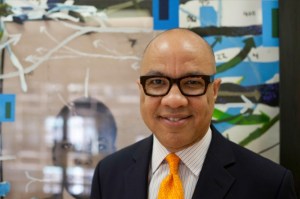
photo_61045_landscape_650x433

On Tuesday, Darren Walker, the president of the Ford Foundation penned an opinion for the New York Times, ‘Internships Are Not A Privilege’.

“Talent is equally distributed, but opportunity is not. And while many Americans believe fervently and faithfully in expanding opportunity, America’s internship-industrial complex does just the opposite.

And whether it’s an internship, college admission or any of the many other factors that determine a successful life, leaders who say they want to address inequality actually — and often unconsciously — reinforce the dynamics that create inequality in their own lives.

The broader implication is privilege multiplied by privilege, a compounding effect prejudiced against students who come from working-class or lower-income circumstances. By shutting out these students from entry-level experiences in certain fields, entire sectors engineer long-term deficits of much-needed talent and perspective. In other words, we’re all paying the price for unpaid internships.

For countless Americans, me among them, internships have provided a foothold on the path to the American dream. Simply by making them more accessible to all, we can narrow the inequality gap while widening the circle of opportunity, long after the summer ends.”

Another major workplace story broke on Wednesday with news that Gretchen Carlson had filed a lawsuit against Fox News chairman, Roger Ailes, exposing a culture of sexism and workplace sexual harassment.

-J3Fem6E_400x400.jpg

Gabriel Sherman covered the story for New York Magazine, reporting:

“Fox News host Gretchen Carlson may be the highest-profile woman to accuse Roger Ailes of sexual harassment, but she is not the first. In my 2014 biography of the Fox News chief, I included interviews with four women who told me Ailes had used his position of power to make either unwanted sexual advances or inappropriate sexual comments in the office.

And it appears she won’t be the last, either. In recent days, more than a dozen women have contacted Carlson’s New Jersey-based attorney, Nancy Erika Smith, and made detailed allegations of sexual harassment by Ailes over a 25-year period dating back to the 1960s when he was a producer on The Mike Douglas Show. “These are women who have never told these stories until now,” Smith told me. “Some are in lot of pain.” Taken together, these stories portray Ailes as a boss who spoke openly of expecting women to perform sexual favors in exchange for job opportunities. “He said that’s how all these men in media and politics work — everyone’s got their friend,” recalled Kellie Boyle, who says Ailes propositioned her in 1989, shortly after he helped George H.W. Bush become president, serving as his chief media strategist.”

And while we are on the topic of women@work, Andrew Das reported on the ongoing story, ‘U.S. Women’s Soccer Players Renew Their Fight for Equal Pay’.

screenshot-11.png“Beaten in federal court and rebuffed at the negotiating table, the United States women’s national soccer team is taking its fight for equal pay back to friendlier turf: the court of public opinion.

Beginning with an exhibition match this weekend in Chicago and continuing through the Olympics next month in Brazil, members of the team said on Thursday that they would embark on a campaign that they hope will increase the pressure on the United States soccer federation to pay the women compensation equal to their counterparts on the men’s national team in their next collective bargaining agreement.”

On Friday, Adam Shell of USA TODAY, analyzed the June jobs report from the U.S. Labor Department.

“After stalling briefly, the U.S. job-creation engine is again revving into high gear, rejuvenating Wall Street and sending stocks close to record highs.

The U.S. economy created 287,000 new jobs in June, which was 100,000 more than economists had forecast and the best monthly gain since October 2015.

And that is about as good a news headline as Wall Street could ask for after May’s gloomy jobs report (the initial 38,000 May jobs count was revised down to a paltry 11,000 in Friday’s report) and all the Brexit-related doom-and-gloom the past few weeks that put a scare into investors.”

cm-p12vwiaeczwd-jpg-large.jpegOn Saturday evening, for ‘one last time‘ –  “Lin-Manuel Miranda, the creator and star of the Broadway smash “Hamilton,” made a subdued final bow Saturday alongside two other departing stars — Leslie Odom Jr. and Phillipa Soo — in the show that has become a cultural phenomenon.”

Miranda’s final performance Saturday at the Richard Rodgers Theatre was also the last for Odom Jr., who won a Tony Award as Aaron Burr, and Soo, a Tony nominee who portrayed Eliza Schuyler. The three — plus an ensemble member — took their bows together but none said anything.”

Hoping for a better week@work to come.


The generational divide – #wearehere and #Brexit

A collection of amateur photos taken by ordinary British citizens, on the 100th anniversary of the Battle of the Somme, served to bridge a century, and punctuate the generational divide that led ‘the lost generation’ to war, and ‘the millennials’ to #Brexit.

The topic #wearehere started trending early Friday morning as British citizens headed to work and encountered young men clad in the uniforms of World War I. For a few hours, in London, Aberystwyth, Birmingham, Sheffield, Salisbury, and Plymouth, the ghost soldiers of the Somme walked among their contemporaries.

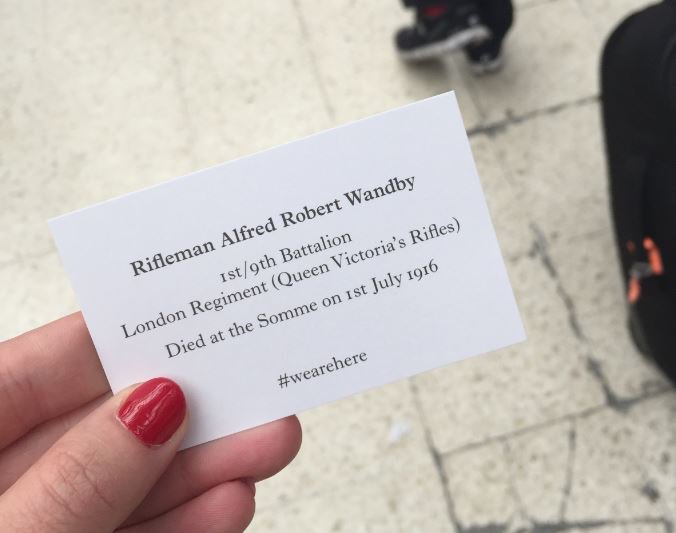
Many of those first encounters were recorded on Twitter and Instagram, as commuters received cards from these ‘soldiers’.CmRNYS-UkAUqr3d“Thousands of volunteers took part in a UK-wide event on Friday 1 July 2016, as a modern memorial to mark the centenary of the Battle of the Somme. 19,240 men were killed on the first day of the battle in 1916 – the bloodiest day in British military history.
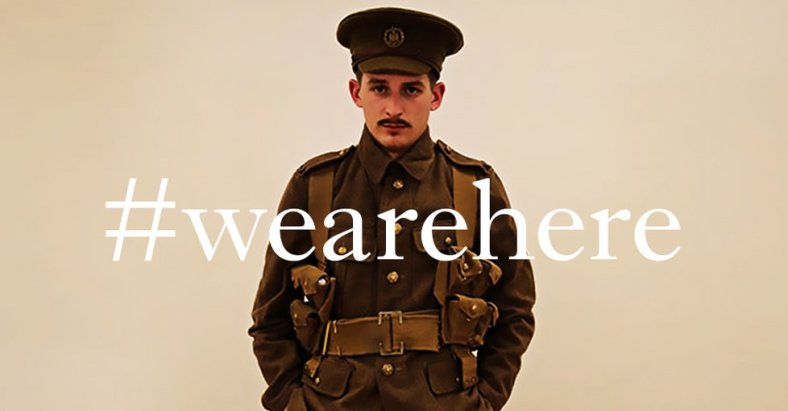
‘we’re here because we’re here’ saw around 1400 voluntary participants dressed in First World War uniform appear unexpectedly in locations across the UK. Each participant represented an individual soldier who was killed on that day one hundred years before.”

proxy.jpg

Charlotte Higgins reported on the day for The Guardian newspaper. “The event, which unfolded without advance publicity, can now be revealed as a work by Jeremy Deller, the Turner prize-winning artist…Deller worked with Rufus Norris, the artistic director of the National Theatre in London, and theatres throughout the UK to train the volunteer army.

Deller was approached to devise an artwork to mark the centenary of the first day of the Battle of the Somme by 14-18 NOW, the body responsible for art commissions commemorating the war. “I quickly realised that what I didn’t want was a static memorial that the public went to to be sad,” he said. “In the 21st century I felt we had do something different. So I thought about the memorial being human, and travelling round the country. It would take itself to the public rather than the public taking itself to the memorial.”

somme.jpg

“And also the public wouldn’t know in advance that there was this thing happening – they would encounter it in the shopping centres and carparks and outside schools and in everyday British life. And I wanted to avoid heritage places – churches, war memorials. I wanted to take it to the public.” His key idea, he said, was to “avoid sentimentality”.

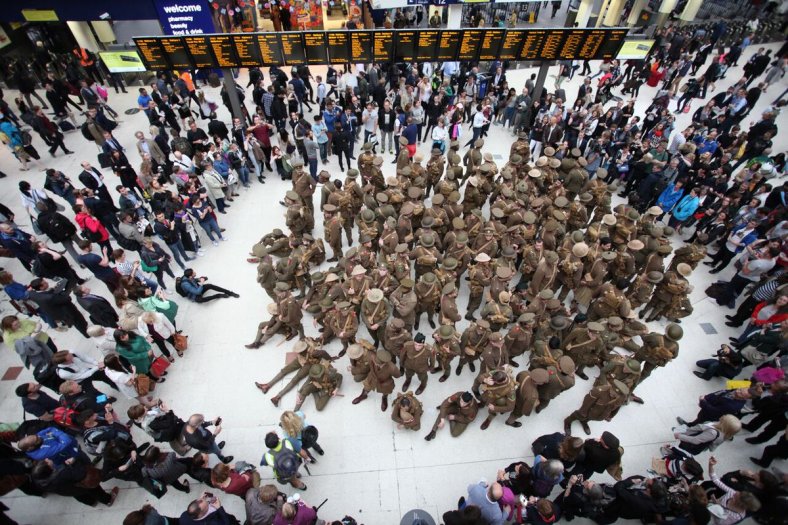
Look at the photo of the finale at Waterloo Station. A group of soldiers at the center are surrounded by their contemporaries, telegraphing the moment to social media. Two generations, a century apart facing unknown fates @war, and after #Brexit.

CmcwkjWWcAAb1sy.jpgThe politics of the early 20th century led to over a million British, French and German casualties in the Battle of the Somme between July 1 and November 18, 1916.


The rhetoric of current political leaders called into question today’s younger generation’s European identity.

So what have we learned in 100 years?

Someone thought it would be a great idea to preserve the peace and form a European Union. For all its frailties, its crowning achievement was replacing nationalism with an overlay of a ‘European’ identity; a multilingual, multicultural generation that travels freely across the continent to study, work, live and love.

Francesca Barber, a self-described ‘transnational’, gave voice to this dilemma of altered identity in the wake of #Brexit.

“I was born in Washington in the late 1980s, grew up in Brussels, moved to London and then returned to the United States, where I lived in New York City; Providence, R.I.; and San Francisco.

My parents are English. My first language was French. I went to a Belgian school and the European School in Brussels, where my classmates almost always spoke at least three languages.

My childhood was defined by endless car journeys across Europe. And as an adult, I have enjoyed the benefits of cheap deals on low-cost European airlines. Most of my friends have gone to school and worked in at least two European countries. I am part of the Erasmus generation. My friends and my roots are everywhere — and only now do I realize how much I took that for granted.

The “Brexit” vote on June 23 was the most serious geopolitical event for Europe since the fall of the Berlin Wall. But lost in all the geopolitics is another important message: It was a resounding vote against globalization from a country that has for so long been a proud champion of globalization.

But this vote was also a rejection by my fellow countrymen, from my parents’ generation to mine, of everything I cherished about Europe, Britain and my own childhood: the sense that our differences were less important than our shared experiences.”

Maybe it’s time for a ‘we are here’ for the European millennials – a ‘counter Brexit’, public art project.  What if, on a Friday morning, all over Britain, young workers approached commuters with CV profile cards, each participant representing a dream lost to Brexit? Mr. Deller, Mr. Norris we could use your help here.


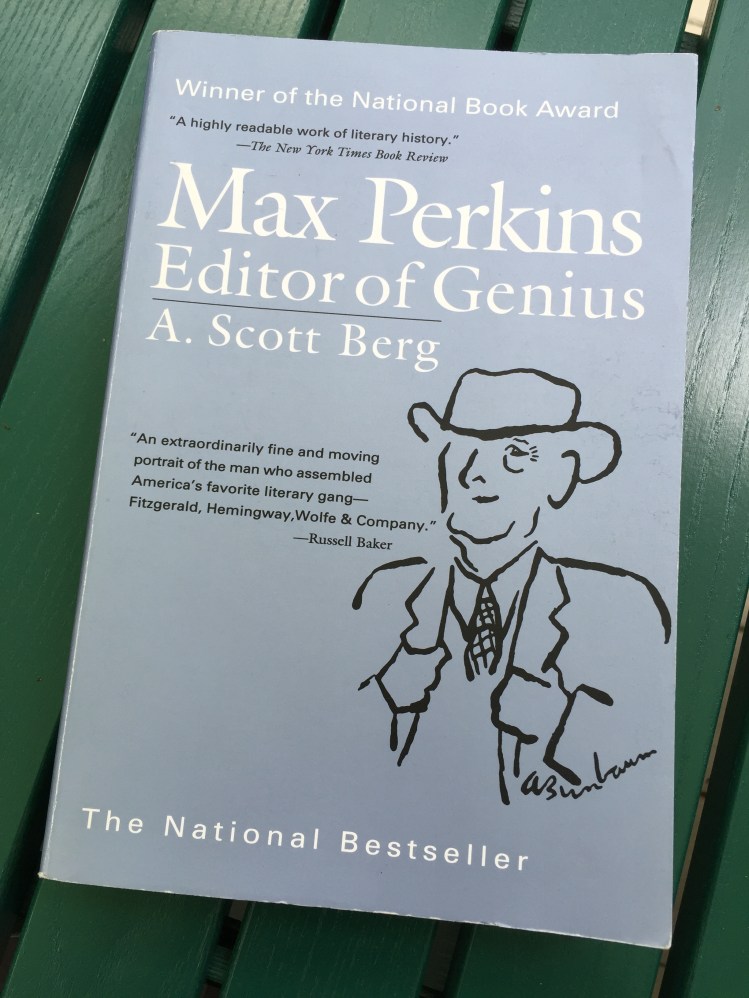
The Saturday Read ‘Max Perkins: Editor of Genius’ by A.Scott Berg

How many of you have turned your senior thesis into a career?

In 1971, recent Princeton graduate, A. Scott Berg began the seven-year process of expanding his college research into the biography of book editor Max Perkins. Earlier this month, a 38 year long journey, from the first film option of the 1978 National Book Award winning biography, ended with the opening of ‘Genius’ in theaters.

The Saturday Read this week is ‘Max Perkins:Editor of Genius’, a story that defines the role of a professional mentor as the narrative unfolds.

Allison Silver interviewed the author in 1981 for an article on the relationships between biographers and their subjects.

“Scott Berg’s biography ”Max Perkins: Editor of Genius” grew out of a fascination, bordering on fixation, for F. Scott Fitzgerald. At Princeton, Mr. Berg wrote his senior thesis on Perkins’s relations with Ernest Hemingway, Thomas Wolfe and Fitzgerald during the 1920’s. Mr. Berg realized there was a book in the life of the Scribner’s editor, and felt he was the one to write it. On graduation day, 1971, he told his roommate, ”I’ll take three months to research it, three months to write it and then another three months to get it published.” Mr. Berg remembers this philosophically. ”I was only six years off.”

Berg introduces Perkins at age sixty-one, in 1946, as he enters a storefront on Forty-third street in Manhattan, to speak to a group of students enrolled in an extension course on book publishing. “All were eager to find a foothold publishing and were attending the weekly seminars to increase their chances.”

“Maxwell Everts Perkins was unknown to the general public, but to people in the world of books he was a major figure, a kind of hero. For he was the consummate editor. As a young man he had discovered great new talents – such as F. Scott Fitzgerald, Ernest Hemingway, and Thomas Wolfe – and he had staked his career on them, defying the established tastes of the earlier generation and revolutionizing American literature. He had been associated with one firm, Charles Scribner’s Sons, for thirty-six years, and during that time, no editor at any house even approached his record for finding gifted authors and getting them into print.”

For many years this biography has been a ‘bible’ for aspiring editors. In this time of book publishing ‘disruption’, when editors have become an endangered species, it’s worth the readers’ time to travel to post WWI New York, when a different type of disruption was taking place as the novels of Fitzgerald, Hemingway and Wolfe began to appear on book shelves.

Let’s return to the 1946 extension class, as Berg continues his first chapter.

‘”The first thing you must remember,” he said, without quite facing his audience: “An editor does not add to a book. At best he serves as a handmaiden to an author. Don’t ever get to feeling important about yourself, because an editor at most releases energy. He creates nothing…A writers best work…comes entirely from himself…Because in the end an editor can get only as much out of an author as the author has in him.”‘

This advice, shared with folks pursuing a career in publishing, could be edited for any contemporary management text to define the modern day mentoring relationship.

“Beginning with Fitzgerald and continuing with each new writer he took on, he slowly altered the traditional notion of the editor’s role. He sought out authors who were not just “safe”, conventional in style and bland in content, but who spoke in a new voice about the values of the postwar world. In this way, as an editor he did more than reflect the standards of his age; he consciously influenced and changed them by the new talents he published…

The successful editor is one who is constantly finding new writers, nurturing their talents, and publishing them with critical and financial success. The thrill of developing fresh writing makes the search worthwhile, even when the waiting and working becomes months, sometimes years, of drudgery and frequent disappointment.”

The biography offers a chronological timeline of relationships with the icons of early twentieth century American literature: Fitzgerald, Hemingway, Wolfe and Ring Lardner. It also includes his nurturing of emerging women writers in the 1930s: Marcia Davenport, Marjorie Kinnan Rawlings, and Taylor Caldwell. In the final chapter, we meet two of the last authors Perkins edits in 1946 and 1947: James Jones, author of ‘From Here to Eternity’ and Alan Paton, author of ‘Cry, the Beloved Country’. Max Perkins died on June 17, 1947.

How do you turn you senior thesis into a career? In the 1981 interview with Allison Silver, Berg shared his secret.

“During his first months of research, the scope of his work broadened every day until, by the end of that summer, he says, ”I made a private pact with myself then that I would work on the book until I finished it.” Mr. Berg remembers deciding ”that I was not going to be a slave to arbitrary dates; because, in truth, I owed Max Perkins more than that. Suddenly I went into twilight-zone time.”

This attitude toward deadlines has remained with Mr. Berg. He recommends that anyone involved in a long project should ”move to Los Angeles, because the seasons don’t change and you’re not aware of the passage of time. To this day I cannot account for three months between May and September, 1974.”

The week@work – Tonys, LinkedIn, Microsoft, ‘Brexit’, Orlando, and how to make a good teacher

This week@work the amazing Broadway production of Hamilton took home eleven Tony awards, Microsoft absorbed LinkedIn, young workers in Great Britain contemplated life after ‘Brexit’, journalist Anderson Cooper reported from Orlando, and we learned teaching can be taught.

Rolling Stone Magazine reporters Amy Plitt and Phoebe Reilly tallied the ’20 Best, Worst and WTF Moments at 2016 Tony Awards’.

“On a night that was marked by tragedy — and occurring mere hours after news broke of the deadly mass shooting in Orlando, Florida — the Tonys provided a much-needed bit of levity. The performers and honorees didn’t shy away from speaking about the shocking events of the day, but the overall mood was one of celebration. Part of the credit goes to the master of ceremonies James Corden, best known as the goofy host CBS’s Late Late Show, yet still a dorky theater kid at heart; his charming, cheerful persona brought an upbeat mood to the proceedings. And the Hamilton effect — and the fact that it was just a strong year for Broadway in general, with plenty of wonderful productions to celebrate — surely had something to do with it as well.”

2016 Tony Awards 16-06-112 Photo: Anita & Steve Shevett

One of the best moments was James Cordon’s resume review of Tony nominated actors and their appearances on Law and Order.

“If you’ve ever thumbed through a Playbill wondering “Where have I seen that actor before?!?,” the answer is usually: Law & Order. Corden made very rewarding use of this New York actor résumé mainstay last night when he called on Claire Danes for her memorable portrayal of … L&O’s Tracy Brandt. The joke only got better as Corden showed footage of Hamilton’s Daveed Diggs and Leslie Odom Jr. (who were in the same episode!) and poor Danny Burstein — the Fiddler on the Roof star played six different roles on the series, and each time Corden flashed the photo of another character, the audience (and Burstein) laughed harder. Apparently, there is absolutely no continuity on Law & Order.”

And now you know.

The breaking business story on Monday was news of the Microsoft/LinkedIn acquisition. The New Yorker’s Nicholas Lemann examined ‘LinkedIn’s Complicated Bet on the Future of Work’.

MS-Linkedin-2016-06-12-1-c.jpg

“LinkedIn, the business-oriented social-networking company that Microsoft acquired, this week, for $26.2 billion, was founded on two premises. The first was that, even in the winner-take-all world of Internet businesses, there would still be room for a niche company (meaning, in this case, only four hundred million registered users, and a hundred million users per month). The second was that what it means to work in a business is now profoundly different from what it was in the Organization Man era. White-collar employees are highly unlikely to spend a lifetime with a single employer, and more and more are not employees at all in the traditional sense. They self-manage their careers, in part by maintaining online personal networks, rather than have them managed by a corporate human-relations department.”

Now LinkedIn will function as part of a Fortune 50 corporate structure and employees will move from an entrepreneurial culture/ stock option pay structure to an “alternative universe, where, by tech-company standards, employees stay an unusually long time—the average tenure at Microsoft is five years, versus two years at Google, according to data from the consulting firm PayScale—and are unlikely to get rich from their stock options zooming up in value, as was the case for Microsoft employees back in the twentieth century. They are going to be their world’s equivalent of corporate lifers, with generous salaries and benefits and some measure of job security, while working to promote the continued growth of a very different kind of work arrangement elsewhere in the economy.

The technology world seems to be creating a small number of extremely successful people, a larger number of well-treated corporate employees, and an even larger number of people who wish they could be employees.”

And then there are the rest of us who now face the prospect of LinkedIn ads invading our quiet space as we commit great thoughts to Word and fill in Excel spreadsheets.

Randall Stross shared his opinion, ‘Why LinkedIn Will Make You Hate Microsoft Word’.

“My version of Word, a relatively recent one, is not that different from the original, born in software’s Pleistocene epoch. It isn’t networked to my friends, family and professional contacts, and that’s the point. Writing on Word may be the only time I spend on my computer in which I can keep the endless distractions in the networked world out of sight.

Matthew G. Kirschenbaum, an associate professor of English at the University of Maryland and author of “Track Changes: A Literary History of Word Processing,” said the move reflected a failure to understand what writers need. “Most of the most innovative writing tools now on the market position themselves precisely as distraction-free platforms,” he said.

What Mr. Nadella fails to see is how extending LinkedIn’s “social fabric” to Word will kill the magic, not speed it up.”

On Thursday, voters in Great Britain will choose to leave or remain in the European Union. Kimiko De Freitas-Tamura reported ‘Brexit’ Vote Worries European Up-and-Comers Lured to Britain’.

europe_2114838b-small_trans++qVzuuqpFlyLIwiB6NTmJwZwVSIA7rSIkPn18jgFKEo0.jpg

“For years, Britain’s relatively vibrant economy has attracted a steady flow of young people fleeing a lack of opportunity in their home countries on the Continent. London in particular is full of young Europeans, who have helped give the city its dynamic, global feel. From entrepreneurs, bankers and fashion designers to artists, waiters and students, all are free to resettle in Britain and make their futures here without so much as a visa.

No one knows for sure what would happen to them if Britain voted to leave the European Union — their immigration status would have to be worked out in the negotiations that would follow — but the debate itself has left some of the young people feeling fearful, frustrated and even angry.

Journalist Anderson Cooper covered the mass shootings in Orlando this week, demonstrating empathy for the victims and tenacity in interviews with politicians. Michael M. Grynbaum profiled the CNN anchor for The New York Times.

Unknown.jpeg

“Anderson Cooper was reading the names of victims of the Orlando massacre on CNN this week when, uncharacteristically, his voice wavered and he drew up short. For moments, viewers around the country heard only silence, and then the sounds of the anchor struggling to compose himself.

As the news industry descended on Florida this week in the aftermath of a mass shooting in a gay nightclub, Mr. Cooper’s raw, activist-style coverage has stood out. He has held a prime-time vigil of sorts, reciting a list of the dead; refused to name the gunman, saying he wanted to focus on victims; and, in a widely viewed exchange, grilled Florida’s attorney general for defending a state ban on same-sex marriage.”

It was a very tough week@work. Colleagues celebrating their day off late Saturday into Sunday morning were viciously murdered in a gay nightclub in Orlando, and on Thursday, Member of Parliament Jo Cox was murdered as she went to work to meet with her constituents in West Yorkshire.

The last story, from The Economist, ‘How to Make a Good Teacher’.

20160611_LDD001_0.jpg

“Big changes are needed in schools, too, to ensure that teachers improve throughout their careers. Instructors in the best ones hone their craft through observation and coaching. They accept critical feedback—which their unions should not resist, but welcome as only proper for people doing such an important job. The best head teachers hold novices’ hands by, say, giving them high-quality lesson plans and arranging for more experienced teachers to cover for them when they need time for further study and practice.

Money is less important than you might think. Teachers in top-of-the-class Finland, for example, earn about the OECD average. But ensuring that the best stay in the classroom will probably, in most places, mean paying more. People who thrive in front of pupils should not have to become managers to earn a pay rise. And more flexibility on salaries would make it easier to attract the best teachers to the worst schools.

Improving the quality of the average teacher would raise the profession’s prestige, setting up a virtuous cycle in which more talented graduates clamoured to join it. But the biggest gains will come from preparing new teachers better, and upgrading the ones already in classrooms.”

Here’s what I think. Improving the quality of teachers will improve the quality of content taught. It will ensure a ‘safe space’ to openly discuss the issues facing our neighborhoods, counties, countries and continents. Good teachers remove the blinders of hate and discrimination. A courageous teacher at the front of the classroom cautions the young against the errors of the past, and is the best antidote to history repeating itself.

A good teacher reminds us that we are all teachers.

paris


The Friday Poem @ the intersection of Maya Angelou, Hillary Clinton and Muhammad Ali

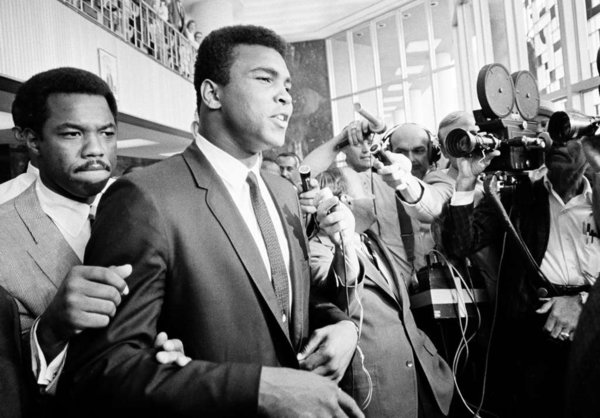
Maya, Muhammad and Hillary. Not three names you would intuitively link together, but that’s what history claimed this week, as a ‘political poet’ passed, and a deceased poet’s 2008 words echoed in the background of a rally at the Brooklyn Navy Yard.

The news of the death of Muhammad Ali literally stopped the presses at the New York Times early Saturday morning. On Wednesday, newspapers across the country led with the history making headline reporting “Hillary Clinton‘s nomination: A win 96 years in the making”.

It will not be an easy road to November for Secretary Clinton as reported by Patrick Healy and Sheryl Gay Stolberg.

“When Hillary Clinton swept onto the stage at her victory rally Tuesday night, the thunderbolt of history struck many Americans, no matter their love or loathing for her: A woman could be the next president of the United States.

But like so much about Mrs. Clinton, her speech, which lit up televisions and smartphones and social media all day Wednesday, produced conflicting emotions.

For some, it was an inspiring moment that brought home in a visceral way that Mrs. Clinton is the first woman to become the presumptive nominee of a major party. For others, there were chills and discomfort that this next step forward in our national story was unfolding with this particular woman.”

IMG_4810.jpg

The candidate might take heart from the poem Maya Angelou submitted to The Observer in 2008, with the backstory told by Vanessa Thorpe for The Guardian.

“She is supporting Clinton despite her close friendship with television personality and philanthropist Oprah Winfrey, a prominent backer of rival Democrat Barack Obama, the first black presidential hopeful with a real chance of reaching the White House.

Angelou is steadfast in her loyalty to Clinton. She said recently: ‘I made up my mind 15 years ago that if she ever ran for office I’d be on her wagon. My only difficulty with Senator Obama is that I believe in going out with who I went in with.’

Andrew Motion, the Poet Laureate, said of the poem: ‘This is a great thing for The Observer to have.’ He favourably compared it with the ‘vivid flourishes’ of Angelou’s recent work. ‘With this kind of poem Angelou has decided to interpret public writing as a verbal equivalent of making a poster, and there’s nothing wrong with this. The rhetoric is full of big gestures that make a direct appeal to our feelings, rather than getting to it by the little winding ways more personal poetry might use.'”

The poem:

State Package for Hillary Clinton

You may write me down in history

With your bitter, twisted lies,

You may tread me in the very dirt

But still, like dust, I’ll rise.

This is not the first time you have seen Hillary Clinton seemingly at her wits’ end, but she has always risen, always risen, don’t forget she has always risen, much to the dismay of her adversaries and the delight of her friends.

Hillary Clinton will not give up on you and all she asks of you is that you do not give up on her.

There is a world of difference between being a woman and being an old female. If you’re born a girl, grow up, and live long enough, you can become an old female. But to become a woman is a serious matter. A woman takes responsibility for the time she takes up and the space she occupies. Hillary Clinton is a woman. She has been there and done that and has still risen. She is in this race for the long haul. She intends to make a difference in our country. Hillary Clinton intends to help our country to be what it can become.

She declares she wants to see more smiles in the family, more courtesies between men and women, more honesty in the marketplace. She is the prayer of every woman and man who longs for fair play, healthy families, good schools, and a balanced economy.

She means to rise.

Don’t give up on Hillary. In fact, if you help her to rise, you will rise with her and help her make this country the wonderful, wonderful place where every man and every woman can live freely without sanctimonious piety and without crippling fear.

Rise, Hillary.

Rise.

Maya Angelou, 2008

20131006_dn_0mu24lap.jpg

On Thursday, Henry Louis Gates Jr. recalled ‘Muhammad Ali, the Political Poet’. In the essay he linked Angelou and Ali by their poetry, often labeled ‘doggerel’.

“Perhaps Maya Angelou, whose own poetry is sometimes labeled doggerel, said it best: “It wasn’t only what he said and it wasn’t only how he said it; it was both of those things, and maybe there was a third thing in it, the spirit of Muhammad Ali, saying his poesies — ‘Float like a butterfly, sting like a bee.’ I mean, as a poet, I like that! If he hadn’t put his name on it, I might have chosen to use that!”

“It would be a mistake to say that Ali made black oral poetry more sophisticated or complex, but he did make it more political. After learning his local draft board had declared him eligible for induction into the Army in 1966, Ali recited this poem:

Keep asking me, no matter how long,
On the war in Vietnam,
I sing this song:
I ain’t got no quarrel with no Viet Cong.

On this Friday, we pause to remember the athlete, humanitarian and role model who was Muhammad Ali, we celebrate a milestone for women, and reflect on the words of two American poets who significantly influenced our culture.


‘The Work of Happiness’ a poem by May Sarton

The Friday Poem this week is ‘The Work of Happiness’ by May Sarton a writer whose talent was expressed in fiction, autobiography and poetry.

“My first book was a book of poems, Encounter in April, followed by my first novel, The Single Hound. There was quite an interval before the second novel, The Bridge of Years. And then Shadow of a Man. Then it goes on and on for a long time with a book of poems between every novel. That was my wish, that the poems should be equal in number, that the novels should not be more important than the poems because the poems were what I cared about most. Much later, when I was forty-five or so, I began to do nonfiction—first the memoirs and finally the journals, which came as the last of the forms which I have been using. Altogether now I think it amounts to seventeen novels, I don’t know, five or six memoirs and journals, and then twelve books of poems, which are mostly in the collected poems now.”  The Paris Review interview, Fall 1983

Her poetry emerges from reflection and solitude, a choice she explored in a 1974 essay, ‘The Rewards of Living a Solitary Life’.

“The other day an acquaintance of mine, a gregarious and charming man, told me he had found himself unexpectedly alone in New York for an hour or two between appointments. He went to the Whitney and spent the “empty” time looking at things in solitary bliss. For him it proved to be a shock nearly as great as falling in love to discover that he could enjoy himself so much alone…Solitude is the salt of personhood. It brings out the authentic flavor of every experience.”

In the poem, Ms. Sarton provides an alternate view of happiness – “for what is happiness but growth in peace”.

The Work of Happiness

I thought of happiness, how it is woven
Out of the silence in the empty house each day
And how it is not sudden and it is not given
But is creation itself like the growth of a tree.
No one has seen it happen, but inside the bark
Another circle is growing in the expanding ring.
No one has heard the root go deeper in the dark,
But the tree is lifted by this inward work
And its plumes shine, and its leaves are glittering.

So happiness is woven out of the peace of hours
And strikes its roots deep in the house alone:
The old chest in the corner, cool waxed floors,
White curtains softly and continually blown
As the free air moves quietly about the room;
A shelf of books, a table, and the white-washed wall—
These are the dear familiar gods of home,
And here the work of faith can best be done,
The growing tree is green and musical.

For what is happiness but growth in peace,
The timeless sense of time when furniture
Has stood a life’s span in a single place,
And as the air moves, so the old dreams stir
The shining leaves of present happiness?
No one has heard thought or listened to a mind,
But where people have lived in inwardness
The air is charged with blessing and does bless;
Windows look out on mountains and the walls are kind.

May Sarton   ‘Collected Poems 1930 – 1993’

51rZ+x+OVKL._SX322_BO1,204,203,200_


The week@work – Millennial myths, millennials@home and relocation stagnation

Apparently, Americans are less geographically mobile today than at any point since 1948. Interesting fact to contemplate as 38 million of us return from our adventures over the holiday weekend. It probably doesn’t help that for the first time, young adults between the ages of 18 and 34 are more likely to live at home, with their parents. Experts, not just parents, are voicing concerns about how this relocation stagnation is destroying what economists refer to as ‘dynamism’ in the job market.

This week@work we take a look back at the week’s stories of millennial myths and our dwindling pioneer spirit.

In April we reached a generational tipping point, when the number of folks between the ages of 18 and 34, aka millennials, overtook Americans between 51 and 69, the baby boomers, by 75.4 million to 74.9 million. And, as every move of the post WWII generation was observed and chronicled, so have we had this new majority under the microscope. It has been quite a lucrative vocation for the thousands of corporate consultants who advise executives on recruitment and retention.

130904259.jpg

But what if they got it wrong? Farad Manjoo thinks the “collectively homogenous cliche” portrayed in the media is a far cry from reality and believes it’s time to break away from the stereotypes. Thank-you.

“If your management or marketing theories involve collapsing all millennials into a catchall anthropological category — as if you’re dealing with space aliens or some newly discovered aboriginal tribe that’s suddenly invaded modernity — you’re doing it wrong.

Kim Parker, director of social trends research at the Pew Research Center, said demographers have noted large differences in millennials: Compared to older cohorts, they tend to be more socially liberal when it comes to issues like gay marriage and marijuana use, they marry later in life, and they are less enamored of traditional religious and political institutions. Looking at these shifts over time “is a useful construct when you’re trying to analyze a whole population,” Ms. Parker said.

But these broad trends leave lots of room for individual differences that matter in the real world, and that are often papered over when we talk about millennials as a monolithic collective.

Considering that millennials are the most diverse generation — spanning many racial, ethnic and income categories — intragenerational differences are bound to play an important role when you’re talking about individual people. Though both are “millennials,” a young immigrant working three sharing-economy gigs is likely to look at the world very differently from a trust-fund baby who’s tending his Tumblr in Brooklyn. Yet only one of these stereotypes tends to make it into media accounts of millennials.”

The busy folks at Pew Research released additional millennial data this week, “For First Time in Modern Era, Living With Parents Edges Out Other Living Arrangements for 18- to 34-Year-Olds”.

gettyimages-556631959_wide-cc80d12838d4eee05e43c4d54f2386d9de9581b7-s1400-c85.jpg

“It’s worth noting that the overall share of young adults living with their parents was not at a record high in 2014. This arrangement peaked around 1940, when about 35% of the nation’s 18- to 34-year-olds lived with mom and/or dad (compared with 32% in 2014). What has changed, instead, is the relative share adopting different ways of living in early adulthood, with the decline of romantic coupling pushing living at home to the top of a much less uniform list of living arrangements.”

Gillian B. White examined ‘The False Stereotypes About Millennials Who Live at Home’ for The Atlantic.

“…the Millennials who are most likely to wind up living with their relatives are those who come from already marginalized groups that are plagued with low employment, low incomes, and low prospects for moving up the economic ladder. Millennials who live at home are also more likely to be minorities, more likely to be unemployed, and less likely to have a college degree. Living at home is particularly understandable for those who started school and took out loans, but didn’t finish their bachelor’s degree. These Millennials shoulder the burden of student-loan debt without the added benefits of increased job prospects, which can make living with a parent the most viable option.

And while there may be comedic fodder in the idea of adult children trying to share space with their parents, staying at home for many Millennials and their family isn’t all that funny. For parents who are struggling to make ends meet, an extra mouth to feed or the inability to downsize to a smaller place can be truly burdensome. For many Millennials, moving out, even if they want to, could lead them to make financial decisions that would put them in an even more precarious place, and that’s precisely the opposite of what they, or the economy, need.”

Why will we travel 2,500 miles from home to attend our ‘first choice’ college, and yet resist relocation to a new urban environment for a job? Why do we spend a semester abroad in an internship or academic program and fail to accept a job offer fifty miles from home?

Has our pioneering spirit disappeared in the noise of descending helicopter parents, or are there more serious institutional prohibitions to career adventure?

american-pioneers.jpg

American Enterprise Institute president, and conservative author, Arthur C. Brooks offered advice on how to get America moving again, painting a grim picture of our current adventure deficit.

“Through census data, we know that Americans are less geographically mobile today than at any point since 1948. Other scholarship suggests that the decline stretches back further. This might help explain why our country is having such a hard time getting out of its national funk.

Mobility is more than just a metaphor for getting ahead. In America, it has been a solution to economic and social barriers. If you descended from immigrants, I’m betting your ancestors didn’t come to this country for the fine cuisine. More likely they came in search of the opportunity to work hard and get ahead.

Even for those already here, migration has long been seen as a key to self-improvement. As Horace Greeley so famously advised in 1865: “Go west, young man, and grow up with the country.”

Patricia Cohen followed up with a more in-depth review, ‘A Dearth of Pioneers’.

“Staying put can mean that workers are not moving to jobs where they would be more productive. At the same time, many are forgoing the raises and ascents on the career ladder that often come with a job switch. Fewer openings can also have a ripple effect, shrinking the bargaining power of workers in general, making it tougher to ask for a bump up in pay.

The declining churn in the labor market may surprise those who assumed that the era of lifelong employment capped by a gold watch had given way to serial job-hopping. But the reality is more complicated, said Abigail Wozniak, an economist at the University of Notre Dame and one of the authors of a new report on the subject. While it is true that fewer people have very long tenures at a single company, she said, that trend has been swamped by a countervailing one: People are not moving as much out of what used to be entry-level and temporary jobs.

One of the more intriguing findings was the role of declining social trust and what is known as social capital — the web of family, friends and professional contacts. For example, the proportion of people who agree with the statement, “Most people can be trusted,” has been shrinking for more than three decades. Researchers found that states with larger declines in social trust also had larger declines in labor market fluidity. The lack of trust may increase the cost of job-hunting and make both employees and employers more risk-averse.

As social trust diminishes, people may feel more comfortable sticking closer to home where the faces are familiar even if job opportunities are scarcer, researchers suggested.”


‘Mind the gap’ – the advantages of ‘full disclosure’ on your resume

The twenty-first century resume doesn’t follow the format suggested by experts in the past. The CV of the ‘gig economy worker’ offers a mosaic of diverse experiences, but it also includes gaps – periods of time not working. A recent study shows the competitive advantage goes to the candidate who ‘minds the gap’ and candidly discloses these career ‘sabbaticals’.

The golden rule of job search is to present yourself as who you are: not your social media presence, not through the biased lens of family and friends, and definitely not ‘shape shifted’ to match a particular job description.

Finding a job is about finding a ‘fit’, discovering a close match between your talent, values and aspirations. If an employer is dismissive of your qualifications because of breaks, you have met ‘the canary in the coal mine’, so take the hint and move on to a place where the value of those  gaps is understood.

Patricia Cohen examined the issue as it relates to family leave. Do you explain a child care gap in your resume?

“For women hoping to return to the workplace after caring for their children, the advice is often “don’t ask, don’t tell.” Many women who described themselves as stay-at-home mothers can attest to receiving denigrating nods and hasty rebuffs. Researchers have repeatedly found ample evidence of discrimination against mothers in the hiring process and the workplace.

But women may be better off explaining their decision to stay home to a potential employer upfront, said Joni Hersch, a professor of law and economics at Vanderbilt Law School, and co-author of a new study on the subject, “Something to Talk About: Information Exchange Under Employment Law.” Employers, afraid of running afoul of anti-discrimination laws, don’t bring up the subject, she said, and female applicants, picking up on those cues, often don’t offer information, leaving hirers to guess at the reasons behind a hiatus.

But, Professor Hersch said, “women who conceal personal information dramatically lower their hiring prospects.”

What’s the ‘take-away’ here?

Reliance on your resume as a single point of introduction to an employer is not your best job search strategy – it never has been.

The best job search strategy is a lifelong management of relationships. Maintaining professional connections, through career success and career breaks establishes your professional credibility. There is no substitute for a career advocate who ‘gets you’ and sees the complete picture of your career plan, warts and all. Someone who can advise you as you develop your script, tell your story and mind the gaps.


The week@work – An astronaut in Greenland, a McDonald’s worker in Edinburgh, Facebook’s identity crisis, and how to design a happier life

This week@work, a former astronaut and climate scientist, and a McDonald’s employee in Edinburgh challenged expectations and stereotypes, journalists questioned Facebook’s content algorithm, and a leading happiness scholar shared his formula.

In January, Piers J. Sellers, Deputy Director of the Sciences and Exploration Directorate and Acting Director of the Earth Sciences Division at NASA/GSFC wrote an opinion for The New York Times Sunday Review, ‘Cancer and Climate Change’.

“I’m a climate scientist who has just been told I have Stage 4 pancreatic cancer.

This diagnosis puts me in an interesting position. I’ve spent much of my professional life thinking about the science of climate change, which is best viewed through a multidecadal lens. At some level I was sure that, even at my present age of 60, I would live to see the most critical part of the problem, and its possible solutions, play out in my lifetime. Now that my personal horizon has been steeply foreshortened, I was forced to decide how to spend my remaining time. Was continuing to think about climate change worth the bother?

1024px-Piers_Sellers_spacewalk.jpg

Journalist and author, Jon Gertner continued the story this week with ‘An Astronaut Finds Himself in Greenland’ for The New Yorker.

“Piers Sellers landed in Greenland on a frigid Monday morning in April, and as he stepped off the plane at Thule Air Base he regarded the surrounding snow-covered hills with delight…Sellers was visiting the country for the first time. “I didn’t even see this from space, since the farthest north the shuttle goes is fifty-one degrees latitude,” he said. “We’re at seventy-six degrees now, right? Fantastic.” Sellers’s plan was to rendezvous with NASA researchers at Thule (pronounced “TOO-lee”) and accompany them on Operation IceBridge, an annual mission to collect data on the diminishing ice in the Arctic Ocean and on the Greenland ice sheet. “These guys at IceBridge are always saying, ‘Oh, you should come along, see where the rubber meets the road,’ and I say that I’m too busy, with too much piled on my desk,” Sellers explained. “But, given my current situation, of all the things that we’re doing in the field, this one is probably the most critical right now.”

After the diagnosis, he briefly considered living his final year or so—assuming his doctors’ expectations prove correct—as a rich man might, in a tropical, hedonistic splurge. “I thought of myself sitting for weeks on a beach,” he said. “What would I do? I’d be thinking about climate.”

So Sellers went back to his desk job at Goddard, where he oversees the work of about sixteen hundred people, and considered how he could fit a few modest adventures between his office duties and chemotherapy sessions. Soon it occurred to him to go to the Arctic, which is warming faster than any other part of the world.

The second story this week comes via Mashable and writer Davina Merchant‘s coverage of the Facebook post of McDonald’s employee, Mike Waite. Bravo for debunking stereotypes!

Unknown.png

“Today I have had enough of the judgemental criticism. Let me be clear. YES I work at Mcdonalds and do it nearly 50 hours a week. Why? Not because I have no aspiration, motivation or intelligence…but for the opposite…because in a few months time like a great number of people I work with I will be going back into higher education. McDonalds has this reputation which is quite unfounded in the recent age, every person I work with has a story and every person is working their ass off in what can be a very tough job for their own reasons…be it they are in school, uni, have family, have kids, saving…etc. The one thing McDonalds is is a job which is extremely (extremely) flexible, has opportunities for growth and can allow you to do what you want to do. There are people becoming pilots, lawyers, designers, architects, and people who are at a point in their life that they will do whatever it takes to look after their family. I work with people I would aspire to be like, who have strengths in areas I wish I had, who have overcome situations I never could and who have the determination to not fade away on handouts but rather step up and work for their living unlike a huge number of people in this country. In the past I have known and worked with very rich folks in very high end jobs, and a few of them could never match the resilience and work ethic of some of the current lads/lassies. After the ending of a big part of my life McD’s is not only letting me save up for University, but setting me up with flexible work I can continue over the next years to come. Not only that but I intend on eventually progressing into the management side of things, something which ties in directly to my degree and will enhance my future job prospects.”

Beyond brilliant posts to its site, Facebook was in the news this week when Gizmodo reported that content on the platform was being ‘subjectively’ curated.

14LfacebookWeb-mediumThreeByTwo210.jpg

David Uberti reported ‘Facebook wants you to think it’s just a platform. It’s not.’ for the Columbia Journalism Review.

“As prominently argued by Emily Bell, director of Columbia’s Tow Center for Digital Journalism, Facebook is increasingly shaping the contours of the public square, and citizens and news organizations have little choice but to go along for the ride. The power shift raises the all-important question of how information travels in free societies—and what we know about it.

“This is an unregulated field. There is no transparency into the internal working of these systems,” Bell said in a University of Cambridge speech earlier this year. “We are handing the controls of important parts of our public and private lives to a very small number of people, who are unelected and unaccountable.”

News organizations once had a more central role in setting the terms of public debate, balancing money-making aspects of publishing with more civically minded accountability journalism. They also generally followed widely accepted journalistic standards. Social networks have assumed much of the same power, Bell and others have argued, though they typically use more opaque processes and have a greater focus on those profitable slices of publishing. That’s not to say this new construct is necessarily worse, but it is foreign. And Facebook has little incentive to open up about its methodology.”

Fast Company’s Elizabeth Segran introduced us to London School of Economics professor and happiness scholar, Paul Dolan in ‘How To Intentionally Design A Happier Life’.

37398b0

“After decades of studying happiness, Dolan has developed a happiness formula. He says that happy people pay attention to the everyday experiences that give them pleasure and purpose, then organize their lives so that they are doing more of those things. It sounds obvious, right? Sure, but the problem is that we spend so much of our lives on autopilot instead of consciously focusing on doing things that make us happy. “We are creatures of habit and we automate processes very quickly,” Dolan says. “We do a lot of what we do because we’ve always done it, not because it is good for us or because we enjoy it.” The good news, however, is that Dolan offers two tangible ways for us create more happy moments in our lives. The first is creating a mental habit of paying attention to what makes us happy and the second is designing our lives so it is easier to do those things.”

Two additional stories of interest this week@work:

‘It’s a Tough Job Market for the Young Without College Degrees’  by Patricia Cohen for The New York Times

“Only 10 percent of 17- to 24-year-olds have a college or advanced degree, according to a new study by the Economic Policy Institute, although many more of them will eventually graduate.

And for young high school graduates, the unemployment rate is disturbingly high: 17.8 percent. Add in those who are underemployed, either because they would like a full-time job but can only find part-time work, or they are so discouraged that they’ve given up actively searching, and the share jumps to more than 33 percent.”

‘The Miserable French Workplace’ by Pamela Druckerman opinion for The New York Times

“While many other European countries have revamped their workplace rules, France has barely budged. The new labor bill — weakened after long negotiations — wouldn’t alter the bifurcated system, in which workers either get a permanent contract called a “contrat à durée indéterminée,” known as a C.D.I., or a short-term contract that can be renewed only once or twice. Almost all new jobs have the latter.

(French workers) believe that a job is a basic right — guaranteed in the preamble to their Constitution — and that making it easier to fire people is an affront to that. Without a C.D.I., you’re considered naked before the indifferent forces of capitalism.

No matter what the government does, the workplace is becoming less secure.”

To close this week@work, let’s return to Piers Sellers’ January 2016 NYT opinion piece.

“As for me, I’ve no complaints. I’m very grateful for the experiences I’ve had on this planet. As an astronaut I spacewalked 220 miles above the Earth. Floating alongside the International Space Station, I watched hurricanes cartwheel across oceans, the Amazon snake its way to the sea through a brilliant green carpet of forest, and gigantic nighttime thunderstorms flash and flare for hundreds of miles along the Equator. From this God’s-eye-view, I saw how fragile and infinitely precious the Earth is. I’m hopeful for its future.

And so, I’m going to work tomorrow.”

The week@work – wage gaps, low expectations, false assumptions,’Confirmation’, and reflections on a 50 year career

After reviewing the stories selected for this week@work, I realized there was a common theme in all except one: women who are pursuing their dream jobs in male dominated fields. The last story, and exception to the theme, is Alberto Tomasi’s, a cabdriver for the past 50 years in Rome.

There have been many conversations recently about the wage gap between men and women@work. One of the most egregious discrepancies occurs on the global stage of world cup soccer. Earlier this month, five members of the U.S. Women’s National Team filed a wage discrimination action against the U.S. Soccer Federation. Carli Lloyd, co-captain of the team outlined her position in an essay, ‘Why I’m Fighting for Equal Pay’.

“I’ve worn a U.S. Soccer uniform for 12 years and have done so proudly. I’ve had some of the greatest moments of my life — winning two Olympic gold medals and the 2015 Women’s World Cup — wearing that uniform. So when I joined four teammates in filing a wage-discrimination complaint against U.S. Soccer late last month, it had nothing to do with how much I love to play for my country.

IMG_2458.jpg

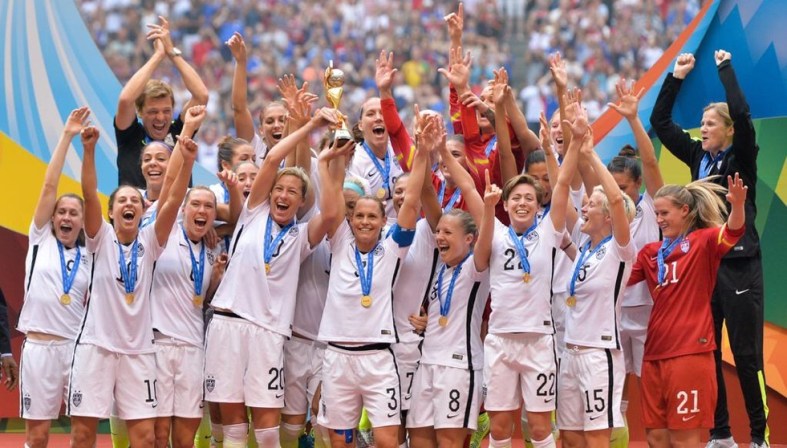
When we talk about the wage gap in today’s workplace, experts estimate women earn 79% of a man’s salary for the same job. For U.S. women’s soccer, it’s 17% for the top players and 21% for the rest. There is no overtime pay in a career that requires a player to be on the road for 260 days a year.

In a sport where the women’s team revenue will exceed $5million vs. a $1million deficit for the men’s team, the top five women’s annual salaries are $72K vs the men’s at $406K. Members of the women’s world cup team earn $15K to the men’s $69K. When the women won the world cup last year they earned a $75K bonus. If the men were to win, they would bring home $390K.

The fact that women are being mistreated financially is, sadly, not a breaking news story. It goes on in every field. We can’t right all the world’s wrongs, but we’re totally determined to right the unfairness in our field, not just for ourselves but for the young players coming up behind us and for our soccer sisters around the world.”

In a related story, New York Magazine writer, Dayna Evans reports on the ‘expectation gap’ in salary negotiations uncovered by job marketplace, Hired – ‘Study Finds That Women in Tech Ask for Lower Salaries Than Men Do’.

womenwhocode1

“After analyzing 100,000 interview requests and job offers over the last year, tech job marketplace Hired found that, on average, tech companies offer women 3% less than men for the same roles. Among the most interesting—and troubling—pieces of data is that men receive higher salaries 69% of the time than women for the same job titles at the same companies.

Some of that disparity could be attributable to women not setting their demands high enough. Because Hired’s marketplace lets job seekers specify the salaries they’re seeking, the report provides a glimpse into both expectations and final offers. In roles that are more male dominated, women often set their salary expectations lower than their male counterparts.

Overall, Hired’s data shows that the average woman on our platform sets her expected salary at $14k less per year than the average man on our platform. When we break the expectation gap down by role — comparing women and men in the same job category — we found as the ratio of men to women in the role increases, so does the gap.”

The death of Pritzker Prize winning architect, Zaha Hadid on March 31 prompted The New York Times to send an “informal online questionnaire” asking “female architects among its readers to talk candidly about their experiences in the profession: the progress they’ve made and the obstacles they still face on construction sites and in client meetings.”

“For a woman to go out alone in architecture is still very, very hard,” the architect Zaha Hadid said. “It’s still a man’s world.” Ms. Hadid often stated that she did not want to serve as a symbol of progress for women in her profession. But, inevitably, she did. A study on diversity in the profession released this year by the American Institute of Architects found that “women strongly believe that there is not gender equity in the industry”; that women and minorities say they are less likely to be promoted to more senior positions; and that gender and race are obstacles to equal pay for comparable positions. Since Ms. Hadid won the Pritzker Prize in 2004, the percentage of female architects in the United States has barely grown, increasing to 25.7 percent from 24 percent, according the Bureau of Labor Statistics.”

The article is a series of snapshots of successful architects@work, encountering obstacles in a still white-male dominated field. One example from Yen Ha, Principal of Front Studio Architects in New York.

13archwomen-span-master675

“We absolutely face obstacles. Every single day. It’s still largely a white, male-dominated field, and seeing a woman at the job site or in a big meeting with developers is not that common. Every single day I have to remind someone that I am, in fact, an architect. And sometimes not just an architect, but the architect. I’m not white, wearing black, funky glasses, tall or male. I’m none of the preconceptions of what an architect might be, and that means that every time I introduce myself as an architect, I have to push through the initial assumptions. Every new job site means a contractor who will assume I am the assistant, decorator or intern. It usually isn’t until the third meeting that the project team looks to me for the answers to the architectural problems.”

In 1991 there was a vacancy on the U.S. Supreme Court. Then President George H.W. Bush nominated U.S. Circuit Court of Appeals Justice Clarence Thomas to fill the vacancy. This past weekend, HBO aired ‘Confirmation’, the story of former colleague Anita Hill testifying before the Senate Judiciary Committee that Thomas had sexually harassed her.

Unknown.jpeg

‘The Real Story Behind HBO’s ‘Confirmation’ From The NPR Reporter Who Broke The Story’ provides a Q & A with NPR correspondent, Nina Totenberg.

“I’d been hearing all summer long that there were women who said they were harassed by Clarence Thomas when he was at the EEOC and when he was at the Education Department,” Totenberg said. “But I could never really prove it. And then I heard about this woman, Anita Hill.”

That’s when everything changed.

You don’t recognize this now, but sexual harassment was a dirty little secret that most women had but they didn’t talk about. They were embarrassed by it; it was a hindrance and not a help in any way. Now suddenly, it gets popped into the open. … But all of those silent, female experiences materialized in the … phones exploding on Capitol Hill.”

Thomas was confirmed by a vote of 52-48. The legacy of Hill’s action was a dramatic increase in the number of sexual harassment claims filed with the EEOC.

“NPR received the prestigious George Foster Peabody Award for its gavel-to-gavel coverage — anchored by Totenberg — of both the original hearings and the inquiry into Anita Hill’s allegations, and for Totenberg’s reports and exclusive interview with Hill.”

Totenberg received individual accolades as well, but there was a downside.

“I was pilloried during this. I had one of the great stories of any reporter’s life. I had worked very hard to get it. And the cost was enormous in terms of negative publicity and people trashing me a lot and senators yelling at me. At one point I had a driver at Nightline who went around the corner [and] stopped and he said to me … “Lady, you better get a gun.”

The final story this week is ’50 Years in a Cab: A Long, Winding Trip for One Driver, and His City’, from Elisabetta Povoledo.

Rome_airal_picture.jpg

“From his front-seat perch, Alberto Tomassi, a Roman cabdriver for 50 years, has been both eavesdropper and confessor. He has played impromptu tour guide, thwarted muggings and rushed countless clients to the emergency room.

Expertly navigating Rome’s narrow, potholed streets — many conceived centuries before the internal combustion engine — he has developed the unflappable calm of a Zen monk.

“If you can get through the first 15 years without getting really angry, you can do it forever,” Mr. Tomassi said. “I just take things as they come.”

“You don’t get rich doing this job, but it’s honest work,” he said. “You can raise a family, put your kids through school.”

His only disappointment this year was in not being recognized for his service.

“…no party, no gold watch, no tribute — so he decided to place a round silver sticker emblazoned with “50 years of taxi” on the rear window of his cab.”