The Saturday Read ‘A Sense of Where You Are’ by John McPhee

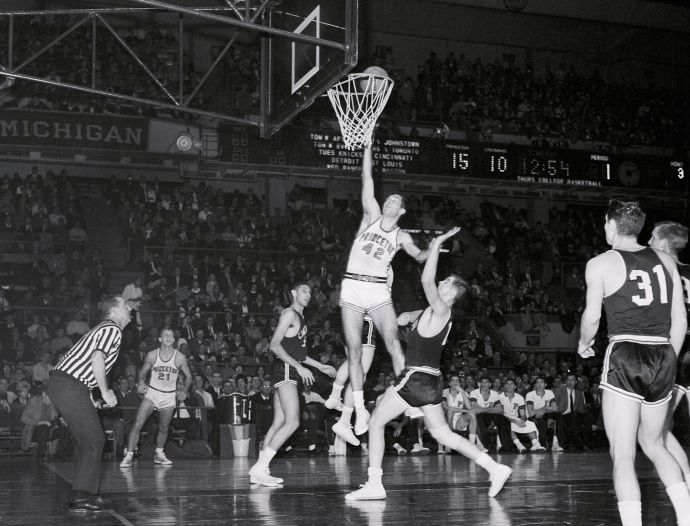
In 1964 Bill Bradley was a senior at Princeton University, and a star player on the basketball team. John McPhee was just beginning his career as a writer. In a moment to make networking history, McPhee’s dad, the athletic department physician, suggested John visit campus and profile the Ivy League phenom.

The Saturday Read this week is ‘A Sense of Where You Are’, the original New Yorker article, published in the January 23, 1965 issue.
images.jpeg

As the NCAA tournament narrows the field from 64 to 16 this weekend, let John McPhee be  your ‘throwback Saturday’ guide to Princeton University in the fall of 1964.

“The basketball locker room in the gymnasium at Princeton has no blackboard, no water fountain, and, in fact, no lockers. Up on the main floor, things go along in the same vein. Collapsible grandstands pull out of the walls and crowd up to the edge of the court. Jolly alumni sometimes wander in just before a game begins, sit down on the players’ bench, and are permitted to stay there. The players themselves are a little slow getting started each year, because if they try to do some practicing on their own during the autumn they find the gymnasium full of graduate students who know their rights and won’t move over. When a fellow does get some action, it can be dangerous. The gym is so poorly designed that a scrimmaging player can be knocked down one of two flights of concrete stairs. It hardly seems possible, but at the moment this scandalous milieu includes William Warren Bradley, who is the best amateur basketball player in the United States and among the best players, amateur or professional, in the history of the sport.”

McPhee introduces us to Bradley, his work ethic, and a time when basketball competition provided “a real period of relief from the academic load”.

Stay with me, fellow time traveller. This is not fiction. This is the future Pulitzer Prize winner, and pioneer of creative non-fiction, John McPhee, painting a picture of college life and basketball in the early 1960s.

In September of his senior year, Bradley competed on the U.S. Olympic basketball team in Tokyo, defeating Russia for the gold medal. In December, he was elected a Rhodes Scholar. He opted out of an opportunity to play for the NY Knicks to study at Oxford.

“Bradley says that when he was seventeen he came to realize that life was much longer than a few winters of basketball. He is quite serious in his application to the game, but he has wider interests and, particularly, bigger ambitions.”

Last year Marc Tracy revisited McPhee, the profile that began his career at The New Yorker, and Bradley’s last NCAA tournament.

“Fifty years earlier, McPhee had good reason to be at the Palestra for a basketball game, and for looking more than simply interested. He was covering an N.C.A.A. tournament game between Princeton and Penn State. Princeton won and then, at College Park, Md., defeated North Carolina State (whose zone press had just handled Duke) and Providence to advance to the Final Four in Portland, Ore. There, it lost to Michigan and, in the consolation game, devastated Wichita State, 118-82.”

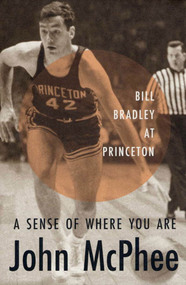
The profile, which was later expanded into a book of the same title, provides a tutorial on basketball, and the life of one true ‘student-athlete’, as he balances his academics, sport, and community involvement.
9780374526894.jpg

About that title:

“I asked him what he called his over-the-shoulder shot. He said that he had never heard a name for it, but that he had seen Oscar Robertson, of the Cincinnati Royals, and Jerry West, of the Los Angeles Lakers, do it, and had worked it out for himself. He went on to say that it is a much simpler shot than it appears to be, and, to illustrate, he tossed a ball over his shoulder and into the basket while he was talking and looking me in the eye. I retrieved the ball and handed it back to him. “When you have played basketball for a while, you don’t need to look at the basket when you are in close like this,” he said, throwing it over his shoulder again and right through the hoop. “You develop a sense of where you are.”

In 1964 his classmates predicted Bradley might run for governor in his home state of Missouri, and one day run for president.

With Bradley off to Oxford, McPhee closed his profile with this sentence.

“And like Hank Luisetti, of Stanford, who never played professional basketball, he will have the almost unique distinction of taking only the name of his college with him into the chronicles of the sport.”

That was not the end of the story.

Bradley returned after earning a masters degree at Oxford to play ten seasons with the NY Knicks, and was inducted into the Basketball Hall of Fame in 1983. He served as the U.S. Senator from New Jersey (not Missouri) from 1979-1997. And he ran for president in 2000.

In the 2015, NY Times article,“Bradley explained what the book’s title means to him”.

“You have a sense of where you are in life,” he said. “You don’t get carried away. You know who you are. You understand the environment, the context in which you’re living, and you make decisions based upon the centeredness.”

He added, “You’re also always working on who you are.”



How to use ‘bracketology’ to add a little ‘March Madness’ to your job search

This is the time of year when everyone, including the President is selecting who they believe will advance to the final four in the NCAA men’s and women’s basketball championships. With a little imagination, you can use the bracket concept as a decision matrix to manage career choice, job search or your network.

In 2007, sportswriters Richard Sandomir and Mark Reiter published ‘The Enlightened Bracketologist: The Final Four of Everything’, applying the methodology of March Madness to everyday decisions.

51rzCgAXA1L._SY498_BO1,204,203,200_

“Bracketology—the practice of parsing people, places, and things into discrete one-on-one matchups to determine which of the two is superior or preferable—works because it is simple. It is a system that helps us make clearer and cleaner decisions about what is good, better, best in our world. What could be simpler than breaking down a choice into either/or, black or white, this one or that one?”

How can we apply the scaffolding of March Madness to job search? Let’s say you are totally undecided (confused, terrified, ambivalent) about your next career move. All you know is you’re not happy with your current work situation. Where do you begin?

Try categorizing your interests using the bracket system. Instead of four regions, fill in four career fields that might interest you. Next, identify sixteen possible employers in each field. Once you have your potential employer roster identified, begin your research.

This may be a good time to develop a parallel list of contacts: a bracket representing your network. Use the same four career categories and identify folks who have broad expertise  in the profession. In this ‘exploration’ phase you are aggregating data about industry trends, market leaders, and potential for growth.

As you progress with your data gathering, you will begin to eliminate some organizations in favor of others. Once you get to your ‘elite eight’ employers, schedule your in-depth information interviews.

As you talk to people you will begin to establish a realistic assessment of ‘organization fit’, and evaluate your chances for success.

The ‘elite eight’ forms your target list. By the time you have narrowed your selection to eight, you should feel comfortable that each employer presents a realistic starting point in the next phase your career.

As with any selection process, you don’t have total control. The employer extends the offer and you have the choice to accept or continue to pursue other options.

The NCAA tournament lasts three weeks. If you start filling in your career brackets now, you will advance through the exploration process at a pace to be ready for interviews by ‘tip-off’ in the championship game.

Its time to add a little ‘March Madness’ to your job search, and some fun to a typically stressful routine.


The week@work: ‘idea debt’, interview questions & women@work: #pledgeforparity & the downside of being a trailblazer

‘Idea debt’, emotional intelligence, International Women’s Day, and lessons from the ‘girl next door who loved sports’, headline our survey of stories this week@work .

Are you a ‘wantrapreneur’? Journalist Oliver Burkeman debunks the belief that thinking about doing something is doing it.

1156.jpg

“I hadn’t seen the problem clearly until the other day, when I encountered the illustrator Kazu Kibuishi’s term for it: “idea debt”. You run up an idea debt, Kibuishi’s fellow artist Jessica Abel explained, when you spend “too much time picturing what a project is going to be like, too much time thinking about how awesome it will be… and too little time actually making the thing”.

Just as the accruing interest on a credit card makes it harder and harder to get back on your feet financially, idea debt impedes action. The more glorious and detailed the pictures in your mind, the more daunting it feels to start making them real.

As Gregg Krech writes in his book The Art Of Taking Action, external reality remains exactly the same after your decision to ask someone out, to write a book, or leave your job. What matters is “creating ripples”, as he puts it – actions, however tiny, that alter things in the world outside your head.”

What are the questions employers ask to determine if a job candidate possesses a solid set of ‘people skills’?  With her article, ‘7 Interview Questions That Determine Emotional Intelligence’, Carolyn Sun not only provides tips for interviewers, but explains the rationale behind the questions for potential hires.

images.jpeg

Here’s one example:

“Can you teach me something, as if I’ve never heard of it before? (It can be anything: A skill, a lesson or a puzzle.)
A job candidate’s answer to this question can reveal several qualities:

Whether the person is willing to take the time to think before speaking.

If the candidate has the technical ability to explain something to a person who is less knowledgeable in the subject.

Whether the candidate asks empathetic questions to the person being taught, such as, “Is this making sense?”

On March 8, International Women’s Day, the Economist “created a glass-ceiling index”, to show where women have the best chances of equal treatment at work. It combines data on higher education, labour-force participation, pay, child-care costs, maternity rights, business-school applications and representation in senior jobs. Each country’s score is a weighted average of its performance on nine indicators.

purple-woman.jpgTo no one’s surprise, Nordic countries come out well on educational attainment and labour-force participation. Women are also relatively well represented in their parliaments; Finland and Sweden were among the first countries to allow women to vote and stand for election. Yet even there women are paid less than men for similar work. In Finland and Sweden the gap is close to the OECD average of 15%, though in Norway it has fallen to 8%.
At the bottom of our index are Japan and South Korea. Too few women there have jobs, few senior managers or board members are women and pay gaps are large—in South Korea, at 37%, the largest in the OECD. If, in the UN’s words, “equality for women is progress for all”, both countries have a long way to go.”

If you are interested additional reporting on #pledgeforparity and IWD,  Washington Post journalist Danielle Paquette wrote two stories this week for Wonkblog:

‘It’s 2016, and women still make less for doing the same work as men’

‘Pay doesn’t look the same for men and women at top newspapers’

The next story falls into the category of ‘you should be safe when you pursue your dream job.’

When sports journalist Erin Andrews graduated from the University of Florida in 2000, she began a career that eventually brought her to sidelines of college football at both ESPN and Fox Sports, and the dance floor; first as a finalist and now as the co-host of ‘Dancing With The Stars’.

Sarah Kaplan, reporting for The Washington Post summarized what happened next.

“In 2008, Michael David Barrett, who served 2 1/2 years in federal prison after pleading guilty to interstate stalking — said he chose to target her because she was popular and trending on Yahoo.”

“Erin Andrews wanted to be “the girl next door who loved sports,” she said.

“And now I’m the girl with a hotel scandal,” the Fox sportscaster tearfully told a Tennessee courtroom Monday.”

The trial and jury verdict in her favor last week is just one story of ‘The Dangers of Being a Female Sportscaster’ described by Richard Sandomir and John Branch for The New York Times.

Unknown.jpeg

“Female sportscasters have unparalleled reach in an age of round-the-clock sports broadcasting and the widespread dissemination of their work across social media. There are more of them now than ever, across multiple channels and websites.

The stories Sandomir and Branch recount serve as a guide for all women@work, not just those with a high profile in social media.

“I’ll try to avoid ever being in the hall of a hotel by myself,” said Kim Jones, a reporter for NFL Network. “And I’ll allow whoever is behind me to pass me before I put my card or key in the door. You have to be so aware because unfortunately that one time out of 10,000, something can happen.”

Alyssa Roenigk, a reporter for ESPN the Magazine who also appears on the air, primarily covering action sports like the X Games, said she had rarely given her security much thought. For years, she usually walked from venues to her hotel, even late at night. But as she began to do more television and was recognized more often, she was told by her bosses to start taking the courtesy car provided by the network.

“At first I thought I was getting special treatment, and I don’t want special treatment,” Ms. Roenigk said. “It’s not special treatment. It’s being safe.”

Stay safe this week@work, create some ripples and start reducing that ‘idea debt’.


The Saturday Read ‘LIT UP: One Reporter, Three Schools. Twenty-Four Books That Can Change Lives.’ by David Denby

If you believe that the humanities are as critical as STEM skills in the 21st century workplace, take a trip back to high school with David Denby and this week’s Saturday Read, ‘LIT UP’: One Reporter. Three Schools. Twenty-Four Books That Can Change Lives.

We have this basic disconnect in our workplace today that is pitting generalists against specialists. The consequences are trickling down into our public education system.

If you’re a parent considering where to invest in your child’s college education, you’re probably looking at ‘vocational’ programs that ‘guarantee’ a job at graduation. If you’re that same parent, but now in the role of organization executive, you realize your recruiting efforts must consider ‘cultural contribution’; potential in addition to skill set. If you’re a student, you hear ‘STEM good, humanities bad; or worse, a waste of time’.

Writing in The New Yorker in February, Mr. Denby addressed the challenge in advocating for the humanities in today’s skill driven education/employer complex. He cited recent state government efforts to offer ‘bonus premiums’ in financial aid to students enrolled in STEM degree programs by cutting funding to students in the humanities.

“Lifetime readers know that reading literature can be transformative, but they can’t prove it. If they tried, they would have to buck the metric prejudice, the American notion that assertions unsupported with statistics are virtually meaningless. What they know about literature and its effects is literally and spiritually immeasurable. They would have to buck common marketplace wisdom, too: in an economy demanding “skill sets”—defined narrowly as technical and business skills—that deep-reading stuff won’t get you anywhere.” 

In ‘LIT UP’ David Denby is searching for the magic that transforms a young reader into a lifetime reader. “How do you establish reading pleasure in busy screen-loving teenagers – and in particular, pleasure in reading serious work? Is it still possible to raise teenagers who can’t live without reading something good? Or is that idea absurd? And could the struggle to create such hunger have any effect on the character of boys and girls?”

He chooses to go back to school for the 2011-12 academic year at Beacon, a New York City magnet high school, at the time located on West 61st St, observing teacher Sean Leon‘s tenth grade English class.

“School was the place to find out. And students in the tenth grade, I thought, were the right kids to look at. Recent work by neuroscientists has established that adolescence, as well as early childhood, is a period of tremendous “neuroplasticity”. At that age, the brain still has a genuine capacity to change.”

The book is structured by months, and reading selections. Mr. Leon introduces each book with inventive assignments, questions and at one point, a ‘digital fast’. Mr. Denby provides thumbnail plot sketches to shake the cobwebs from our ‘required reading’ memories. And we meet the students, by pseudonym, in their reactions to the literature.

At one point, the author gives the students a questionnaire to find out what books they read on their own, and their favorite authors. He finds three ‘real readers’ in a class of 32. “…unfairly or not, I was sorry that among Mr. Leon’s students there were no mad enthusiasms, no crazy loves, no compulsive reading of every book by a single author…”

In writing the book, he was encouraged by colleagues to create a scalable review, contrary to his initial approach, resisting quantification, and observing “a single place where literary education seemed to be working.” 

He realized that you can’t clone Beacon’s Sean Leon. He wanted other teachers to learn from Leon’s methods, but realized additional perspectives would add to his narrative.

“Typicality and comprehensiveness remained impossible to achieve, but variety was not. I delayed finishing the book, and, in the academic year 2013-14, I visited tenth-grade English classes in two other public schools – shuttling up many times during the year to James Hillhouse High School, an inner-city school in New Haven with a largely poor African American population; and five times in the spring to a school in a wealthy New York suburb, Mamaroneck, a “bedroom town” in the language of the fifties, where people sent their kids to good schools.”

Mr. Denby’s appendix includes the reading lists for each of the schools he visited and a ‘where are they now?’ college destination roster of the Beacon English Class of 2014. “There is, of course, no ideal reading list, no perfect syllabus, no perfect classroom manner, but only strategies that work or don’t work. In a reading crisis, we are pragmatists as well as idealists.”

“Teenagers, distracted, busy, self-obsessed, are not easy to engage – not by their teachers or by their parents. To keep them in the game, the teachers I watched experimented, altered the routine, changing the physical dimensions of the class. They kept the kids off balance in order to put them back in balance. They demanded more of students than the students expected to give.”

This is a book for parents, parents who are business leaders; teachers and the politicians who minimize their value; and students. We’re in a reading crisis and we need folks who have emotional intelligence, who can think, judge, make decisions and create a vision for an enterprise within a global world view.

“Teachers are the most maligned and ignored professionals in American life. In the humanities, the good ones are as central to our emotional and moral life as priests, ministers, rabbis, and imams. The good ones are not sheepish or silent in defense of literature and history and the rest. They can’t be; the children’s lives are right before them. In high-school English, if the teachers are shrewd and willing to take a few risks, they will try to reach the students where they live emotionally. They will engage, for instance, with “naïve” existential questions (what do I live for?) and also adolescent fascination with “dark” moods and the fear of being engulfed by adult society. Shakespeare, Mary Shelley, Poe, Hawthorne, Twain, Stevenson, Orwell, Vonnegut, and many others wrote about such things. And if teachers can make books important to kids—and forge the necessary link to pleasure and need—those kids may turn off the screens. At least for a few vital hours.”

The Saturday Read ‘West of Eden: An American Place’ by Jean Stein

Were the initial seeds of relocation planted when you read a novel or work of non-fiction that transported you to that place on the globe where you could find success? In the Saturday Read this week we arrive in Hollywood, where author Jean Stein interweaves oral history and memory to tell the story, ‘West of Eden: An American Place’.

If you read the book through the lens of work, you come away with the story of the three industries that built LA: oil, real estate and the movies. As you turn the page, you listen to voices describing the culture and its effects on lives and careers.

When Po Bronson wrote his book, ‘What Should I Do With My Life?’, he had already spent time as a producer and writer in television. His observations on culture echo through Ms. Stein’s narrative.

“Every industry has a culture. And every culture is driven by a value system. In Hollywood, where praise is given too easily and thus has been devalued, the only honest metric is box-office receipts. So box-office receipts are all-important.

One of the most common mistakes is not recognizing how these value systems will shape you. People think that they can insulate themselves, that they’re different. They’re not. The relevant question in looking at a job is not What will I do? but Who will I become? What belief system will you adopt, and what will take on heightened importance in your life? Because once you’re rooted in a particular system — whether it’s medicine, New York City, Microsoft, or a startup — it’s often agonizingly difficult to unravel yourself from its values, practices, and rewards. Your money is good anywhere, but respect and status are only a local currency. They get heavily discounted when taken elsewhere. If you’re successful at the wrong thing, the mix of praise and opportunity can lock you in forever.”

‘West of Eden’ is the story of five families: the Dohenys, the Warners, Jane Garland, Jennifer Jones and the author’s own family, the Steins. As I read each section, I was reminded of Bronson’s comment. For the most part, the real life actors in the book were chasing the dream of wealth, status and celebrity; not considering the consequences, finding themselves in a world of praise and opportunity, locked in, in some cases, with tragic results.

Writer and historian, Mike Davis opens the book with his memories as a guide for Grey Line Tours, and it’s the map of celebrity homes that provides an outline for the book. We are introduced to the five stories by street address. Second stop, 1801 Angelo Drive, Beverly Hills, the Warner home. Arthur Miller captures the essence of early Hollywood.

“Jack Warner’s generation invented what turned out to be the major world culture – not just American, but a world culture. The world’s dream to escape the dreadful, ordinary, industrial, technological life. An you can understand how it happened if you think of where they came from, a place where there was absolutely no chance for anybody to do anything. They were living in a mud hole, but here the dreams were absolutely feasible. If you could think it, you could do it. It was magic. And they filled the movies with magic. George Cukor told me once, “Our object was to escape reality. We were quite conscious of all that.” It was a never-never land, a construct. These immigrants, these Jews from Eastern Europe, had developed this dream that had blond hair, blue eyes, and a straight nose. It all had to be beautiful. This was a fairy tale, because they were immigrants who saw this country as a fairy tale. It was incredible: it captured the whole country.”

These were the ‘culture builders’ whose legacy remains in the mansions, oil wells and studios, that fund the dreams of workers today. Their stories are told through neighbors, colleagues, family members and employees. David Geffen, who purchased Jack Warner’s home connects past to present:

“Jack Warner was a great character, like all of them. They were remarkable guys, but they were monsters. The movie business is a hard business, and you had to be a monster to create this industry. 

Jean Stein has called upon a lifetime network to craft and preserve the unique story of a place built on escape from the ordinary. A set of biographical notes at the end gives the reader thumbnail bios of each narrator, and it’s quite a cast of characters!

The book is required reading for the uninitiated and aspiring L.A. resident. There is drama worthy of an academy award, in every category from acting to costume design to hair and makeup and of course, visual effects.

“Another quality that all Californians who have spent any time on the edge of the Pacific are aware of is that the light is different. There’s a pressure on the eyes from the light. I’ve never felt it on the other coast.” (art curator, Walter Hopps)

The Saturday Read ‘The Geography of Bliss’ by Eric Weiner

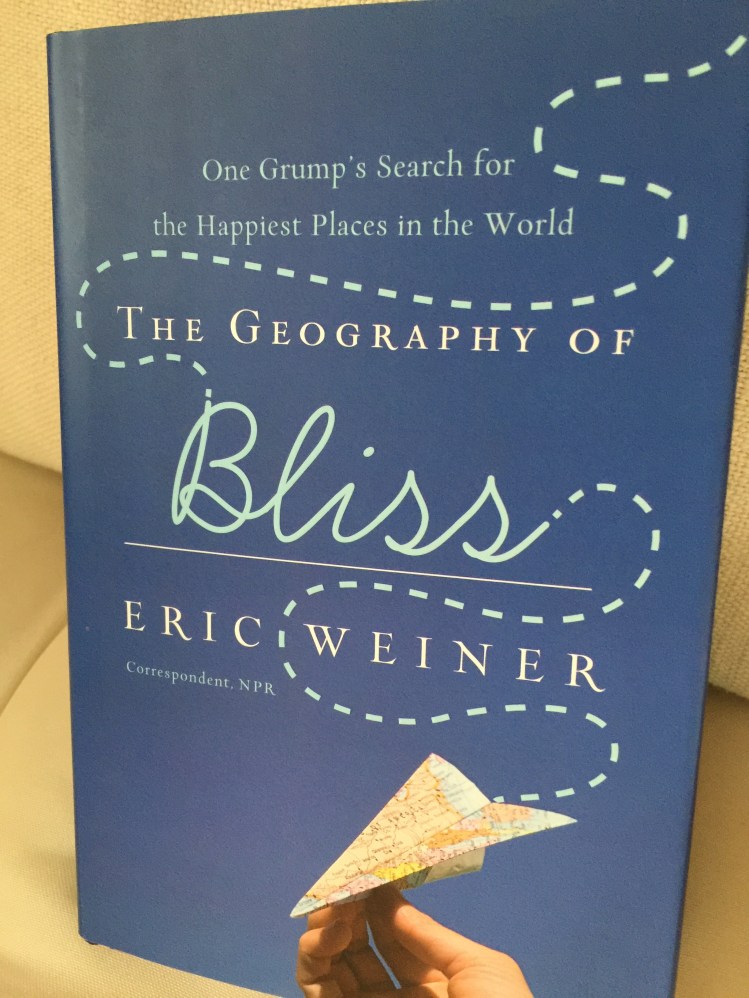
The Saturday Read this week is ‘The Geography of Bliss: One Grump’s Search for the Happiest Places in the World’, by former NPR correspondent and self-described philosophical traveler, Eric Weiner. It’s a travelogue of personal discovery with a universal  message, “where we are is vital to who we are”.

Early in his career decision process, Weiner decided travel was a necessary component to success – free travel. He started out as a foreign correspondent, going to some of the most unhappy global places. After a number of years covering conflicts in Iraq, Afghanistan and Indonesia he decided it was time to consider the alternative, the happy places.

“What if, I wondered, I spent a year traveling the globe, seeking out not the world’s well-trodden trouble spots but, rather, its unheralded happy places? Places that possess, in spades, one or more of the ingredients that we consider essential to the hearty stew of happiness: money, pleasure, spirituality, family and chocolate, among others.”

And we’re off. First to the Netherlands and the World Database of Happiness to meet Ruut Veenhoven, Professor of Happiness Studies.

Veenhoven was a graduate student in sociology when he found his calling in a new discipline, happiness studies. In a career story that may resonate with others in academia, he describes a meeting with his advisor. He was interested in the study of healthy minds and happy places. “His advisor, a sober man with solid academic credentials, told him, in no uncertain terms, to shut up and never mention that word again. Happiness was not a serious subject…Today, Veenhoven is at the forefront of a field that churns out hundreds of research papers each year.”

By simply asking folks if they are happy, researchers have found:

“Extroverts are happier than introverts; optimists are happier than pessimists; married people are happier than singles, though people with children are no happier than childless couples; Republicans are happier than Democrats; people who attend religious services are happier than those who do not; people with college degrees are happier than those without, though people with advanced degrees are less happy than those with just a B.A….people are least happy when commuting to work; busy people are happier than those with too little to do; wealthy people are happier than poor ones, but only slightly.”

Before returning home to the U.S., Weiner traveled to Switzerland, Bhutan, Qatar, Iceland, Moldova, Thailand, Great Britain, and India. Finding your bliss is subjective, but deeply rooted in culture.

“The glue that holds the entire enterprise together is culture.”  He embarked on an odyssey to find happiness, and discovered one of the key elements to success in life and work.

“…where we are is vital to who we are.”

“By ‘where’, I’m speaking not only of our physical environment but also of our cultural environment. Culture is the sea we swim in – so pervasive, so all-consuming, that we fail to notice its existence until we step out of it. It matters more than we think.”

Each new chapter invites the reader to experience another place, a new culture, citizens adapting to change, and challenges preconceived notions of the happiest places.

Sitting in an airport bar at the end of his journey, Weiner reflects on what he has learned. “Money matters, but less than we think and not in the way that we think. Family is important. So are friends. Envy is toxic. So is excessive thinking. Beaches are optional. Trust is not. Neither is gratitude…Happiness is not a noun or a verb. It’s a conjunction. Connective tissue.”

The shelves of bookstores are brimming with self help tomes on happiness. Eric Weiner’s global journey sets this book apart from the competition, transporting the reader on a round trip from domestic familiarity to places of contrasting mindsets, and back. It’s the perfect book for a winter read.


‘Sending Flowers’ by Hannah Stephenson

On this Friday of Valentines weekend, a poem that celebrates the work of the florist, in a creative presentment of the vendor/customer relationship. The Friday Poem this week is ‘Sending Flowers’ by Hannah Stephenson.

Sending Flowers

The florist reads faces, reaches into the mouths of customers.
Turns curled tongues into rose petals,

teeth clinking against one another into baby’s breath.
She selects a cut bloom, a bit of leaf,

lays stem alongside of stem, as if building a wrist
from the inside. She binds them

when the message is right, and sighs at the pleasure
of her profession. Her trade:

to wrangle intensity, to gather blooms and say, here,
these do not grow together

but in this new arrangement is language. The florist
hands you a bouquet

yanked from your head, the things you could not say
with your ordinary voice.

Hannah Stephenson

The week@work – Super Bowl@50, Facebook@12 and unemployment@4.9%

This week@work the center of the media universe shifted from Iowa to New Hampshire, and Silicon Valley where, separated by about 12 miles on Highway 101, Levi Stadium in Santa Clara will host the 50th Super Bowl game, and Facebook celebrated it’s twelfth birthday at corporate HQ in Menlo Park. And, in the U.S. the unemployment rate dropped to 4.9%, the lowest since 2008.

In the lead up to the big game there were hundreds of stories about those who choose football as a career, from the high school senior announcing a college choice to the veteran player rewarded with membership in the Football Hall of Fame.

The typical NFL player takes their first step in their career at the annual February ritual, ‘National Signing Day’. It’s the day high school football players sign a ‘Letter of Intent’ to accept an offer of admission and commit to play football at the collegiate level. This year, Tom Brady and Derek Jeter were on hand in Ann Arbor, Michigan to participate in ‘The Signing of the Stars’ “a flamboyant national signing day pep rally streamed live on Wednesday by The Players’ Tribune — the website founded by Jeter, a Michigan native — and intended to build the hype around this year’s class of prospective Wolverines football players.”

Time will tell if the top college recruit, Rashan Gary, from Paramus Catholic High School in New Jersey will advance beyond his playing days at Michigan.

On the other end of the football career spectrum is recognition as an inductee into the NFL Hall of Fame. The class of 2016 includes former Oakland Raiders quarterback, Ken Stabler who let his team to their first Super Bowl victory after the 1976 season.

“While generally a cause for celebration, Saturday’s announcement of the class of 2016 for the Pro Football Hall of Fame carried a somber tone as Ken Stabler, a Super Bowl-winning quarterback for the Oakland Raiders, was elected days after it was publicly revealed that he had had Stage 3 chronic traumatic encephalopathy, or C.T.E., a degenerative brain disease, before his death in July.

Stabler, known as the Snake, who won a Most Valuable Player Award for the 1974 season and led the Raiders to the team’s first Super Bowl victory after the 1976 season, was previously a finalist for election three times, but this year, as a senior candidate, he was elected alongside Dick Stanfel, a star offensive lineman in the 1950s. The modern-era electees were Brett Favre, Marvin Harrison, Kevin Greene, Orlando Pace and Tony Dungy, as well as Edward J. DeBartolo Jr., who owned the San Francisco 49ers for all five of their Super Bowl wins and was elected as a contributor.”

On Wednesday, journalist, John Branch’s profile of Stabler, and his life after football with chronic traumatic encephalopathy (C.T.E.) was published in The New York Times.

“After retiring from football, Stabler worked as a broadcast analyst for the N.F.L. and for the University of Alabama, where he had played quarterback under Coach Bear Bryant. His damaged knees became such a problem in the past 10 years that he rarely ventured out.

“His vision of what a leader is, what a strong person is, is someone who did not show signs of weakness,” said Alexa Stabler, 29, the second of Stabler’s three grown daughters. “Because it would affect the people he relied on and the people he cared about, whether that was his family or his teammates.”

When Stabler was 31, a 1977 Sports Illustrated feature story detailed his penchant for honky-tonks and marinas, usually with a drink in one hand and a pretty woman in the other…He pondered what he might do after football.

“My lifestyle is too rough — too much booze and babes and cigarettes — to be a high school coach,” Stabler said. “I’d hardly be a shining example to the young athletes of the future.”

His family hopes that the most powerful lesson he provides is the one delivered after he was gone.

In between signing day and induction into the Football Hall of Fame, if you’re impossibly lucky, is a chance to compete in the national championship of professional football, the Super Bowl.

The annual spectacle, held this year in the vortex of Silicon Valley has exposed the growing economic divide, “gentrification, sky-high housing prices and the technology industry’s influence on local government, even the nation’s biggest party has become a battleground.”

“The cost of hosting the Super Bowl — estimated at about $5 million for the city — has unleashed a storm of anger among residents already resentful of the influx of expensive restaurants, high-end stores and rich, young tech workers who have snapped up apartments in historically low-income neighborhoods. To tidy up for the tourists, the city’s large homeless population has been swept out of view, which some people here see as evidence that this city, long a seat of leftist activism, has sold itself to corporate interests.

“In San Francisco, we’re supposed to be the bastion of crazy liberals,” Ms. Leitner said. “Instead of raising wages for teachers so they can afford to live here, why are we spending money on a party for people who work for the N.F.L.?”

Fast Company writer, Michael Grothaus marked the birthday celebration on Thursday at Facebook.

“It’s a bit crazy when you think about it, but Facebook is 12 years old today. On February 4, 2004, Mark Zuckerberg launched his fledgling social media site at Harvard. And the rest, as they say, is history. Twelve years on, Facebook has become the largest social media company ever. It influences myriad aspects of our lives and recently passed a billion active users each day.

It’s also kind of doing what candy makers and online retailers have tried to do in the past by deeming February 4th as an unofficial holiday that it hopes catches on: Friend’s Day.”

A look back to the 2004 Harvard Crimson article about ‘thefacebook.com’ may be the best  argument for why venture capitalists should be reading their alma mater’s student newspaper.

“Thousands of students across the country use it. Major corporations are falling over themselves to buy it.

But nearly a semester after creating thefacebook.com, a social networking website launched on Feb. 4, Mark E. Zuckerberg ’06 doesn’t seem to have let things go to his head.

Wearing a yellow t-shirt, blue jeans, and open-toe Adidas sandals, Zuckerberg sits on a ragged couch in the middle of a messy Kirkland House common room, surrounded by strewn clothes and half-closed boxes.

Amidst this squalor, he smiles.

“I’m just like a little kid. I get bored easily and computers excite me. Those are the two driving factors here.”

Thefacebook.com allows university students to create personal profiles listing their interests, contact info, relationship status, classes and more.

It started locally at Harvard. It now has almost 160,000 members from across the country.”

Twelve years later, Thomas Friedman considers the question, ‘Social Media: Destroyer or Creator?’

“Over the last few years we’ve been treated to a number of “Facebook revolutions,” from the Arab Spring to Occupy Wall Street to the squares of Istanbul, Kiev and Hong Kong, all fueled by social media. But once the smoke cleared, most of these revolutions failed to build any sustainable new political order, in part because as so many voices got amplified, consensus-building became impossible.

Question: Does it turn out that social media is better at breaking things than at making things?

Recently, an important voice answered this question with a big “ yes.” That voice was Wael Ghonim, the Egyptian Google employee whose anonymous Facebook page helped to launch the Tahrir Square revolution in early 2011 that toppled President Hosni Mubarak — but then failed to give birth to a true democratic alternative.

“Five years ago,” concluded Ghonim, “I said, ‘If you want to liberate society, all you need is the Internet.’ Today I believe if we want to liberate society, we first need to liberate the Internet.”

Beyond the Super Bowl and Facebook, the economy continues to improve. The jobless rate is under 5% and wages are rising.

“It’s not that the new data blew the lid off expectations or pointed to some radical acceleration in job growth in the opening weeks of 2016. Quite the contrary. The nation added 151,000 jobs in January, which was below analysts’ expectations and well below the revised 262,000 jobs added in December. That looks an awful lot like “reversion to the mean,” and it wouldn’t be surprising if final revisions show a slower pace of job growth across the two months.

But while economists and financial markets have traditionally placed the greatest weight on that payroll number as the key indicator of whether economic growth is speeding up or slowing down, we’re entering a phase where some other components of the jobs report are more important.”

Two additional articles of interest this week profile the executive who created the culture at Netflix and a BBC photo essay on the career dreams of the children who have fled Syria.

‘The Woman Who Created Netflix’s Enviable Company Culture’  Vivian Giang for Fast Company – “The woman behind “Netflix Culture: Freedom & Responsibility” was the company’s chief talent officer at the time, Patty McCord…Instead of listing the company’s core values like every other company was doing, McCord decide to write down the things the company valued, what mattered to them, what they expected in their people.”

‘When I grow up I want to be…’ (BBC) “Despite their current predicament, children who have fled the conflict in Syria and are now living in neighbouring countries dream of what the future holds for them, and the International Rescue Committee (IRC) sent photographer Meredith Hutchison to find out.”

To end this week@work, let me introduce you to Rama, age 13, and her dream of becoming a doctor, as a reminder to honor your dreams.

_88034777_a80f7902-6be1-4991-913e-aed456838390.jpg“Walking down the street as a young girl in Syria or Jordan, I encountered many people suffering – sick or injured – and I always wanted to have the power and skills to help them.
“Now, as a great physician in my community, I have that ability. Easing someone’s pain in the most rewarding aspect of my job. To be able to give them relief is the most rewarding aspect of my job. To be able to give them relief and make them smile – this is what I love most.”


workthoughts@one

Happy Groundhog Day! A day immortalized in the 1993 Bill Murray movie, as our national holiday of second chances.

I launched ‘workthoughts’ a year ago, on Groundhog Day, because I believed a blog about work should consider career evolution, lifelong learning and several second chances. It was never meant to be a place to find a job, rather a place to consider choices, share ideas and reconnect with dreams.

‘Workthoughts’ had its origin in a Tuesday afternoon course I taught for college students who were employed as interns for the semester. Most arrived thinking it was a waste of time, an added commitment to an already crowded schedule of classes, commuting and work.

As the semester progressed we dealt with the situations that develop in any workplace: disconnect in expectations, dysfunctional communications, poor leadership, lack of meaningful assignments, and recognition. We also talked about the bigger picture: global trends, leadership, teamwork, generations in the workplace, diversity and gender issues, work/life balance. It was about the humanities and social sciences, and building relationships with mentors, colleagues and clients.

“What would you do if you were stuck in one place and everything was exactly the same and nothing that you did mattered?” (Bill Murray, Groundhog Day)

Success@work begins with a clear understanding of self and a broad knowledge of the world@work. How can you connect the dots if you’re stuck in one place, everything is exactly the same and nothing you do matters?

‘Workthoughts’ provides weekly supplements in the humanities with the ‘Friday Poem’, sampling a variety of lyrical interpretations of work, and ‘The Saturday Read’, a book or long form article recommendation to illuminate the work experience and offer alternate views to problem solving. The ‘week@work’ summarizes selected stories from a variety of journalists and experts. And in-between are the conversations about fun, joy, success, and failure @work.

Work is about relationships. We build them, not on the technical aspects of the work to be accomplished, but on the human connections that grow beyond, in shared interests and experience.

Thank you to all who have connected and shared your ‘workthoughts’ this year. And thank you to all the alumni of MDA 250 – who stay connected, continue to inspire, and know the value of second chances.


The week@work – Davos, Sundance, transparency and the benefits of procrastination

This week@work world leaders and policy gurus headed to Davos, Switzerland for the annual World Economic Forum, actors and directors arrived in Park City, Utah for the Sundance Film Festival and the rest of us enjoyed a snow day without the airfare. Transparency was suggested as a way to close the pay gap and provide a fair balloting process for the Oscars. And finally, for you procrastinators, research finds your approach to problem solving is more creative.

Of all the tweets emanating from the World Economic Forum, the most stunning came from Sharan Burrow, participating on ‘The New Climate and Development Imperative’ panel. Ms. Burrow is General Secretary of the International Trade Union Confederation. In discussing the drivers of action for development and climate targets she stated, “For workers, there are no jobs on a dead planet.” If that doesn’t bring home the reality of climate change to each global citizen, I’m not sure what will.

One of the ten major global challenges identified by the WEF poses the question, What does the world of work look like today and what will it look like in the future?

x_XWsHJRi2iKmV_VfOn05Y-3m7PnuCjow9VbC0kvDgc

“The scale of the employment challenge is vast. The International Labour Organization estimates that more than 61 million jobs have been lost since the start of the global economic crisis in 2008, leaving more than 200 million people unemployed globally.

Nearly 500 million new jobs will need to be created by 2020 to provide opportunities to those currently unemployed and to the young people who are projected to join the workforce over the next few years.

At the same time, many industries are facing difficulty hiring qualified staff. One 2015 survey found that, globally, 38% of all employers are reporting difficulty filling jobs, a two-percentage point rise from 2014.

Put simply, we need jobs for the hundreds of millions of unemployed people around the world, and we need the skilled employees that businesses are struggling to find.”

Two additional perspectives of the Davos conference were provided by Alexandra Stevenson for The New York Times, ‘Glass Ceilings at Davos, Now on the Agenda’, and Anne Marie Slaughter‘s ‘A Tale of Two Feminisms at Davos’.

Several time zones west, the Sundance Film Festival began its ten day run in Park City, Utah. Since 1978, it has been the place for independent film makers to show their dramatic and documentary films. A number of these films eventually became Oscar nominees, which brings us to a conversation on transparency.

For the past two weeks, since the announcement of the Academy Awards, the major recognition for those who work in film, the conversation has centered on the lack of progress in diversifying the industry and its major export, films. How many of us even knew how the voting was done as we mindlessly watch red carpet arrivals and comment on fashion, performances and our bets to win?

Glenn Whipp of the LA Times shared ‘Here’s How Oscar Voting Is Done’.

“Who nominates the actors for the Oscars? And how does the voting process work? Here’s a step-by-step primer:

The Motion Picture Academy of Arts and Sciences has 6,261 voting members. The entire body votes for best picture.

Nominations for most of the remaining categories are determined by the balloting of the academy’s various branches. A committee selects the foreign-language film nominees.”

The full article, though short, will definitely make your hair hurt, and prompt the question, why the delay in reform?

Film mogul, actor and producer, Tyler Perry offered his solution “If the Academy – I think all this would go away if they revealed the votes,” Perry said. “If you look at a movie like ‘Straight Outta Compton’ right and just say it got 1,000 votes and ‘The Revenant’ got 1, 001 votes, is that racism or is it just this is the way the votes went?”

We might all benefit from transparency and a clear set of rules beyond the intersection of Hollywood and Vine. Claire Cain Miller proposes we “publish everyone’s pay” as one answer to ‘What We Can Do to Close the Pay Gap’.

“When the comedian Ricky Gervais joked that he was paid the same to host the Golden Globes as the actresses Tina Fey and Amy Poehler — combined — his barbed humor most likely resonated in many workplaces.

When employers publish people’s salaries, the pay gap shrinks.

Jake Rosenfeld, a sociologist at Washington University, has found that salary transparency raises wages, in part by lending legitimacy to employees’ arguments in wage bargaining. “Even being cognizant of gender pay disparity being an issue can change norms,” he said.

That has been true in the public sector, where disclosing pay information is often required. Alexandre Mas, an economist at Princeton, studied the effects of a 2010 California law that required cities to publish municipal salaries. It prompted pay cuts, but only among men.

Women might have been spurred to negotiate after seeing that their salaries were lower, he theorized, or cities might have made salaries more equitable to avoid lawsuits.”

Bottom line, there are a lot of global and domestic problems to be solved and they require serious thought, teamwork and creativity.

Wharton professor Adam Grant shared the benefits of re-thinking his pre-crastination habit in ‘Why I Taught Myself to Procrastinate’, and found “..while procrastination is a vice for productivity, I’ve learned — against my natural inclinations — that it’s a virtue for creativity. It turns out postponement can encourage divergent thinking.

A few years ago, though, one of my most creative students, Jihae Shin, questioned my expeditious habits. She told me her most original ideas came to her after she procrastinated. I challenged her to prove it. She got access to a couple of companies, surveyed people on how often they procrastinated, and asked their supervisors to rate their creativity. Procrastinators earned significantly higher creativity scores than pre-crastinators like me.”