The week@work: terror on the way to work, a factory fire anniversary, values-based leadership@Starbucks, a millennial workplace, & a new job benefit


How do you share work thoughts when so many were killed and injured on their way to work on Tuesday morning? Apparently, we go on. I have to agree with the sentiment expressed by writer Pamela Druckerman in today’s New York Times ‘Je Suis Sick of This’.

“To Europeans, Brussels was supposed to be a dull place that you didn’t have to think much about until you had to change planes there. There’s a parlor game in which you stump people by asking them to name 10 famous Belgians. “Brussels, the anti-fanatic attacked by the fanatics,” French journalist Laurent Joffrin wrote in Wednesday’s Libération. “Brussels, a cousin whom one is content to know is there.”

Right after an attack it’s easy to say that everything feels different. People are horrified. Parents keep their kids home from school. Newspapers run headlines like “Europe at War.” There is the sad, familiar search for a slogan: This time, I prefer the Belgian frites arranged to make a rude gesture resembling a finger, and the banner reading, “Je suis sick of this” followed by an expletive.”

We don’t stop working. Maybe we are a bit more vigilant, the slogan ‘If you see something, say something’, temporarily gets more attention.

Journalist Druckerman continued, “Despite the inevitable false positives, it’s hard not to be on guard. I’m constantly making a series of mundane existential calculations: Is it worth it to risk going to a movie? Should I let my kids ride the metro to soccer practice? Daily life has a chiaroscuro quality: One minute you’re riding a bus and enjoying a view of the river; the next you’re wondering about the fellow with an unusually large backpack.”

There were other stories this week@work.

Friday was the 105th anniversary of the Triangle Shirtwaist Factory fire. It resonates with workers today because it was a story of immigrant workers, and led to changes in U.S. factory regulations and safety.

triangle fire.jpeg

Joseph Berger summarized the events in a 2011 article.

“A block east of Washington Square, not far from the neighborhood’s boutiques and chic restaurants, was the site of one of the nation’s worst industrial disasters. Many New Yorkers might be unaware of this.

Some labor advocates are trying hard to change that. They have organized an effort to build a memorial to the infamous Triangle Shirtwaist Factory fire of 1911, in which 146 workers died. Most of them were young immigrant women from Eastern Europe and Italy, and more than 50 jumped to their deaths from the factory’s ninth floor.

Two years ago, Tom Marshall posed the question, “Can disasters make life better for future generations?”  He went on to draw a parallel between the Triangle Shirtwaist factory fire and the 2013 garment factory collapse in Dhaka, Bangladesh.

“In both cases, inspectors visited and filed critical safety reports, but scores of people still died while making clothes for others. The American disaster is now hailed as a turning point that led to safer workplaces and broad support for a minimum standard of workers’ rights, while the Bangladeshi disaster’s impact is less certain.”

This week@work Starbucks chairman and CEO, Howard Schultz spoke at the annual shareholders meeting, and expanded on a conversation begun two years ago on the role and responsibility of a for-profit corporation. “What is the role and responsibility of all of us, as citizens?”
K9sMR38U-1650-1650

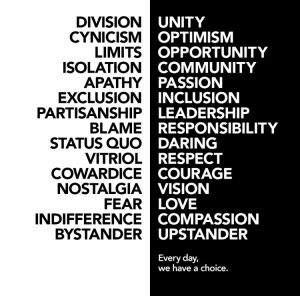
“Viewing the American Dream as a “reservoir” that is replenished with the values, work ethic and integrity of the American people, Schultz said, “Sadly, our reservoir is running dry, depleted by cynicism, despair, division, exclusion, fear and indifference.”

He suggested citizens fill the reservoir of the American Dream back up, “not with cynicism, but with optimism. Not with despair, but with possibility. Not with division, but with unity. Not with exclusion, but with inclusion. Not with fear, but with compassion. Not with indifference, but with love.”

“It’s not about the choice we make every four years,” Schultz said. “This is about the choices we make every day.”

One of the ‘most read’ articles last week, ‘What Happens When Millennials Run the Workplace?’, provided one more illustration that work issues are people issues, and it really doesn’t matter how you generationally identify.

“Joel Pavelski, 27, isn’t the first person who has lied to his boss to scam some time off work.

But inventing a friend’s funeral, when in fact he was building a treehouse — then blogging and tweeting about it to be sure everyone at the office noticed? That feels new.

Such was a recent management challenge at Mic, a five-year-old website in New York that is vying to become a leading news source created by and for millennials.”

The workplace is changing and the 80 million millennials @work will make a significant impact on work/life and the global economy. As a group, the 40 million with college degrees enter the workforce taxed with student loans that are the equivalent of a mortgage. Fidelity Investments announced a new employee benefit last week to address student loan repayment.  Tara Siegel Bernard provided the details.

“Fidelity will apply up to $2,000 annually to the principal of its employees’ student debts.

Fidelity is one of the more prominent employers to announce the student loan repayment benefit in recent months, a policy that seems likely to gain traction. The benefit helps address what some employers describe as a challenge attracting and retaining younger workers, many of whom can’t see beyond the burden of their student debt. Most employers that are offering the new perk also cap their costs at, say, $10,000 total per employee.”

At the end of a difficult week, spring wishes and Happy Easter!

IMG_4148


Beyond competence; resilience is the new competitive advantage

When we talk about failure, we have to talk about resilience. It’s the companion piece that measures our ability to become successful again after something bad happens. It’s not the mistake we value, it’s the recovery.

it’s what J.K. Rowling was talking about when she addressed the Harvard Class of 2008.

060508_COM_JC_425.jpg

“The knowledge that you have emerged wiser and stronger from setbacks means that you are, ever after, secure in your ability to survive. You will never truly know yourself, or the strength of your relationships, until both have been tested by adversity. Such knowledge is a true gift, for all that it is painfully won, and it has been worth more than any qualification I ever earned.”

In a recent interview , U.S. transportation secretary, Anthony Foxx, prioritized resilience over all other qualities he seeks in a potential candidate.

“What I’m trying to understand is whether the person, if things get really tough, is going to stay in there or fall apart. I’d rather hire somebody who’s maybe not a genius, but they will dig in on any assignment. I’d rather have resilience than almost any other quality. Competence is obviously critical, but a lot of people who are really smart actually end up walking away from some pretty tough assignments because they’re worried about whether they can do them or not.”

How do you demonstrate this new competence to a potential employer? How do you offer examples of your own ‘phoenix rising out of the ashes’ moment?

Andrea Ovans provides some hints in her article ‘What Resilience Means and Why It Matters’. Her survey of recent research on the topic broadens the definition of resilience to include adapting well to change, and pushing through in adversity.

“Resilient people possess three characteristics — a staunch acceptance of reality; a deep belief, often buttressed by strongly held values, that life is meaningful; and an uncanny ability to improvise. You can bounce back from hardship with just one or two of these qualities, but you will only be truly resilient with all three. These three characteristics hold true for resilient organizations as well.…Resilient people and companies face reality with staunchness, make meaning of hardship instead of crying out in despair, and improvise solutions from thin air. Others do not.”

It’s about confidence, ownership, continuous learning and an ability to adapt to a continually changing reality.

Resilience is not new. Robert Waterman, Judith Waterman and Betsy Collard were offering advice to workers and organizations over twenty years ago.

“By a career-resilient workforce, we mean a group of employees who not only are dedicated to the idea of continuous learning but also stand ready to reinvent themselves to keep pace with change; who take responsibility for their own career management; and, last but not least, who are committed to the company’s success. For each individual, this means staying knowledgeable about market trends and understanding the skills and behaviors the company will need down the road. It means being aware of one’s own skills—of one’s strengths and weaknesses—and having a plan for enhancing one’s performance and long-term employability. It means having the willingness and ability to respond quickly and flexibly to changing business needs. And it means moving on when a win-win relationship is no longer possible.”

What is new? Resilience is now a core competence, not an option. When an interviewer asks about a time you failed, respond with a narrative of strength and grit, and seize your competitive advantage.


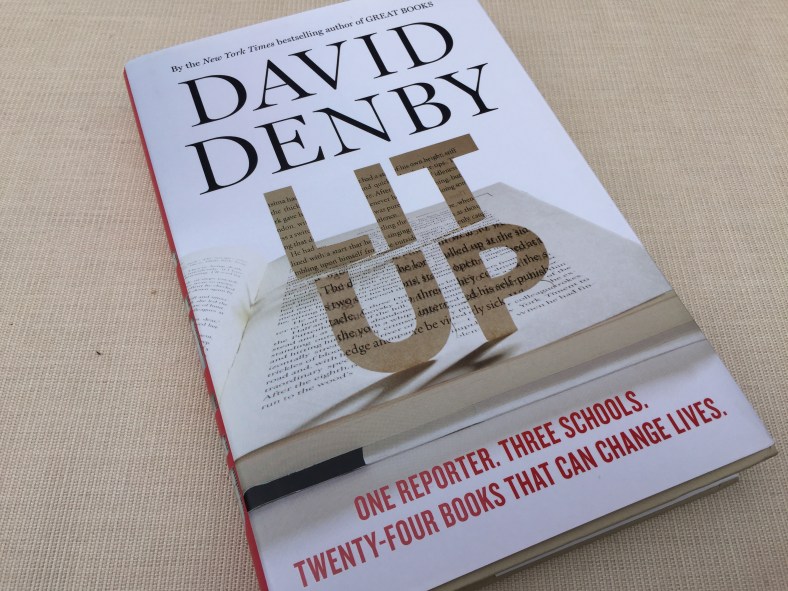
The Saturday Read ‘LIT UP: One Reporter, Three Schools. Twenty-Four Books That Can Change Lives.’ by David Denby

If you believe that the humanities are as critical as STEM skills in the 21st century workplace, take a trip back to high school with David Denby and this week’s Saturday Read, ‘LIT UP’: One Reporter. Three Schools. Twenty-Four Books That Can Change Lives.

We have this basic disconnect in our workplace today that is pitting generalists against specialists. The consequences are trickling down into our public education system.

If you’re a parent considering where to invest in your child’s college education, you’re probably looking at ‘vocational’ programs that ‘guarantee’ a job at graduation. If you’re that same parent, but now in the role of organization executive, you realize your recruiting efforts must consider ‘cultural contribution’; potential in addition to skill set. If you’re a student, you hear ‘STEM good, humanities bad; or worse, a waste of time’.

Writing in The New Yorker in February, Mr. Denby addressed the challenge in advocating for the humanities in today’s skill driven education/employer complex. He cited recent state government efforts to offer ‘bonus premiums’ in financial aid to students enrolled in STEM degree programs by cutting funding to students in the humanities.

“Lifetime readers know that reading literature can be transformative, but they can’t prove it. If they tried, they would have to buck the metric prejudice, the American notion that assertions unsupported with statistics are virtually meaningless. What they know about literature and its effects is literally and spiritually immeasurable. They would have to buck common marketplace wisdom, too: in an economy demanding “skill sets”—defined narrowly as technical and business skills—that deep-reading stuff won’t get you anywhere.” 

In ‘LIT UP’ David Denby is searching for the magic that transforms a young reader into a lifetime reader. “How do you establish reading pleasure in busy screen-loving teenagers – and in particular, pleasure in reading serious work? Is it still possible to raise teenagers who can’t live without reading something good? Or is that idea absurd? And could the struggle to create such hunger have any effect on the character of boys and girls?”

He chooses to go back to school for the 2011-12 academic year at Beacon, a New York City magnet high school, at the time located on West 61st St, observing teacher Sean Leon‘s tenth grade English class.

“School was the place to find out. And students in the tenth grade, I thought, were the right kids to look at. Recent work by neuroscientists has established that adolescence, as well as early childhood, is a period of tremendous “neuroplasticity”. At that age, the brain still has a genuine capacity to change.”

The book is structured by months, and reading selections. Mr. Leon introduces each book with inventive assignments, questions and at one point, a ‘digital fast’. Mr. Denby provides thumbnail plot sketches to shake the cobwebs from our ‘required reading’ memories. And we meet the students, by pseudonym, in their reactions to the literature.

At one point, the author gives the students a questionnaire to find out what books they read on their own, and their favorite authors. He finds three ‘real readers’ in a class of 32. “…unfairly or not, I was sorry that among Mr. Leon’s students there were no mad enthusiasms, no crazy loves, no compulsive reading of every book by a single author…”

In writing the book, he was encouraged by colleagues to create a scalable review, contrary to his initial approach, resisting quantification, and observing “a single place where literary education seemed to be working.” 

He realized that you can’t clone Beacon’s Sean Leon. He wanted other teachers to learn from Leon’s methods, but realized additional perspectives would add to his narrative.

“Typicality and comprehensiveness remained impossible to achieve, but variety was not. I delayed finishing the book, and, in the academic year 2013-14, I visited tenth-grade English classes in two other public schools – shuttling up many times during the year to James Hillhouse High School, an inner-city school in New Haven with a largely poor African American population; and five times in the spring to a school in a wealthy New York suburb, Mamaroneck, a “bedroom town” in the language of the fifties, where people sent their kids to good schools.”

Mr. Denby’s appendix includes the reading lists for each of the schools he visited and a ‘where are they now?’ college destination roster of the Beacon English Class of 2014. “There is, of course, no ideal reading list, no perfect syllabus, no perfect classroom manner, but only strategies that work or don’t work. In a reading crisis, we are pragmatists as well as idealists.”

“Teenagers, distracted, busy, self-obsessed, are not easy to engage – not by their teachers or by their parents. To keep them in the game, the teachers I watched experimented, altered the routine, changing the physical dimensions of the class. They kept the kids off balance in order to put them back in balance. They demanded more of students than the students expected to give.”

This is a book for parents, parents who are business leaders; teachers and the politicians who minimize their value; and students. We’re in a reading crisis and we need folks who have emotional intelligence, who can think, judge, make decisions and create a vision for an enterprise within a global world view.

“Teachers are the most maligned and ignored professionals in American life. In the humanities, the good ones are as central to our emotional and moral life as priests, ministers, rabbis, and imams. The good ones are not sheepish or silent in defense of literature and history and the rest. They can’t be; the children’s lives are right before them. In high-school English, if the teachers are shrewd and willing to take a few risks, they will try to reach the students where they live emotionally. They will engage, for instance, with “naïve” existential questions (what do I live for?) and also adolescent fascination with “dark” moods and the fear of being engulfed by adult society. Shakespeare, Mary Shelley, Poe, Hawthorne, Twain, Stevenson, Orwell, Vonnegut, and many others wrote about such things. And if teachers can make books important to kids—and forge the necessary link to pleasure and need—those kids may turn off the screens. At least for a few vital hours.”

The Saturday Read ‘Worklife: Rethinking the office for an always-on economy’

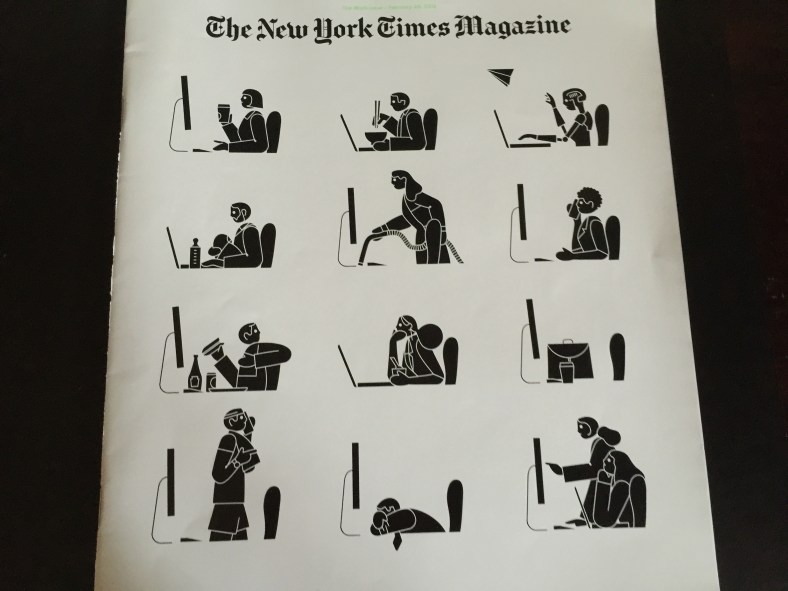
The Saturday Read this week is a compilation of articles that appeared in the February 28, 2016 ‘work issue’ of The New York Times Magazine.

A group of journalists and writers contributed coverage on a variety of work/life topics, adding new perspectives from groundbreaking research, demonstrating that, regardless of profession, it’s all about the culture. And the culture is in need of change.

Organization culture determines who succeeds, fails, and communicates ‘hints’ through recruiting practices, and the daily process of getting things done; meetings, teamwork and office space.

“We do often work at home. But we also work at work, before going home to work more. The office has persisted, becoming even bigger, weirder, stranger: a symbol of its outsize presence in our lives.”

The ‘work issue’ is an interesting survey of some of the most pressing issues @work today. The sampling of the content below is meant to serve as an introduction, with a recommendation to take the time to read the edition in its entirety.

NYT staff writer, Susan Dominus challenges us to think about balance beyond policies by ‘Rethinking the Work-Life Equation’, reporting on the research of Phyllis Moen of the University of Minnesota and Erin Kelly of M.I.T.

“Workers in the experimental group were told they could work wherever, and whenever, they chose so long as projects were completed on time and goals were met; the new emphasis would be on results rather than on the number of hours spent in the office. Managers were trained to be supportive of their employees’ personal issues and were formally encouraged to open up about their own priorities outside work — an ill parent, or a child wanting her mom to watch her soccer games. Managers were given iPods that buzzed twice a day to remind them to think about the various ways they could support their employees as they managed their jobs and home lives.

The research found that employees in the experimental group met their goals as reliably as those in the control group, and they were, in short, much happier: They were sleeping better, were healthier and experienced less stress. Other studies examining the same workplace found that the effects even cascaded down to employees’ children, who reported less volatility around their own daily stresses; adolescents saw the quality of their sleep improve. A year out, and then three years out, employees in the experimental group reported less interest in leaving the organization than those in the control group.

…sometimes there is little more than tradition holding organizations back from making meaningful changes that bring tremendous peace of mind to their employees.”

Five years ago, Google decided to determine what makes a ‘perfect team’. Pulitzer prize winning New York Times reporter Charles Duhigg reports on the results in an excerpt from his new book, ‘Smarter Faster Better: The Secrets of Being Productive in Life and Business’.

“For Project Aristotle, research on psychological safety pointed to particular norms that are vital to success. There were other behaviors that seemed important as well — like making sure teams had clear goals and creating a culture of dependability. But Google’s data indicated that psychological safety, more than anything else, was critical to making a team work.

However, establishing psychological safety is, by its very nature, somewhat messy and difficult to implement. You can tell people to take turns during a conversation and to listen to one another more. You can instruct employees to be sensitive to how their colleagues feel and to notice when someone seems upset. But the kinds of people who work at Google are often the ones who became software engineers because they wanted to avoid talking about feelings in the first place.

What Project Aristotle has taught people within Google is that no one wants to put on a ‘‘work face’’ when they get to the office. No one wants to leave part of their personality and inner life at home. But to be fully present at work, to feel ‘‘psychologically safe,’’ we must know that we can be free enough, sometimes, to share the things that scare us without fear of recriminations. We must be able to talk about what is messy or sad, to have hard conversations with colleagues who are driving us crazy. We can’t be focused just on efficiency. Rather, when we start the morning by collaborating with a team of engineers and then send emails to our marketing colleagues and then jump on a conference call, we want to know that those people really hear us. We want to know that work is more than just labor.”

Nikil Saval, who wrote about the evolution of the office in ‘Cubed: The Secret History of the Workplace’, writes about new experiments with office space, ‘Labor/atories’

“The sudden efflorescence of the tech industry in the late ’90s took us from the desert of cubicles to the milk-and-honey offices of today. Many of the dot-commers had graduated from (or, very often, dropped out of) cozy university campuses to toil in big corporations. Starting their own companies, they recreated the effortless drift between work and play that characterized their college lives. The cubicle walls came down, and in the wide, open warehouse and loft spaces they occupied, exceptionally long workdays would be punctuated by frenzied Mario Kart races or fierce Ping-Pong battles. Creating a playful office became one of the standard ways of attracting skilled employees in a competitive environment: The hope was that a talented engineer wouldn’t leave a tech behemoth for the dinky start-up next door that didn’t have a gym and a resistance pool. Thus has the ‘‘fun office’’ spread throughout the world.”

Each of the articles provides a ‘take away’ to apply @work. If you’re a leader, you’ll rethink your approach as you begin to understand what your competitors are doing to recruit and retain employees. As a manager, you’ll learn ways to improve the daily routine of meetings, but more important, reinforce behavior that will encourage employees to be productive. For the rest of us, a window has been opened to view alternative approaches to work and workplace. What will you do on Monday to turn policy into practice?


Imagining the Monday morning conversation at PwC

I have two questions. What happened to the PricewaterhouseCoopers lead partner for the Academy of Motion Picture Arts and Sciences and his colleague, and Oscar balloting co-leader, Sunday night? How did they face their colleagues on Monday morning after the Oscar host turned their most visible annual ‘guest spot’ into the saddest stereotype ‘joke’?

Melena Ryzik described what happened at the point in the award ceremony when the team from the PwC was brought on stage.

“Introducing the accountants from PricewaterhouseCoopers, which tabulates the vote results, Mr. Rock instead brought onstage two boys and a girl of Asian heritage, whom he named Ming Zu, Bao Ling and David Moskowitz. As they clutched briefcases, they visually illustrated the stereotype that Asians are diligent workers who excel at math.

“If anybody’s upset about that joke, just tweet about it on your phone that was also made by these kids,” Mr. Rock added, a punch line interpreted as a reference to child labor in Asia.”

What happened to Matt Damon ‘look alike’ and managing partner for the Academy of Motion Picture Arts and Sciences, Brian Cullinan and his colleague, Martha Ruiz ?

The conversation on social media since the Oscar broadcast has centered on the ‘joke’, and the fine line between satire and slur. But what happened as hundreds of PwC’s employees arrived at work on Monday morning? What was the conversation between corporate recruiters and expectant applicants on college campuses? How did the meeting start between engagement managers and clients? Why did a company that values diversity allow it’s moment in the spotlight to turn into an epic fail?

PwC’s corporate website and recruiting site advertise the diversity of the firm as a core value.

“Role models inspire others by bringing possibilities to life. And I believe we all have the power to shape the course of other people’s careers. Active sponsorship makes all the difference when it comes to advancing diverse professionals.”

Maria Castañón Moats
Chief Diversity Officer

“At PwC, we foster an inclusive culture by acknowledging the unique experiences and perspectives all of our people bring to work. Our goal is to be known as the place to build a career, regardless of one’s background, beliefs, gender or sexual orientation. Diversity, in all its dimensions, is a key element of our people and our client strategy, and we continue to invest in the area diversity and inclusion knowing we will ultimately be measured on the progress we make.”

Bob Moritz
US Chairman and Senior Partner

Who makes the decision to violate corporate values for a moment of ill timed humor? On Sunday, a company with a publicized core value of diversity allowed itself to be manipulated in the midst of a nationwide controversy about the lack of inclusion.

In February, journalist Iris Quo wrote an article for the Washington Post, posing the question,  ‘Why do my co-workers keep confusing me with other people? Because I’m Asian.’

“All my life I’ve been mistaken for other people of my race. It’s a degrading and thoughtless error that boils away my identity and simplifies me as one thing: “that Asian.” One reason is that our society has so few Asians and people of color in positions of prominence that some people have little exposure to them. Diversity is so lacking in film and television that a director thinks it’s okay to cast a white person as Chinese, as Cameron Crowe did with Emma Stone in “Aloha,” and the Hollywood Reporter mistakes “Master of None” actor Kelvin Yu for show co-creator Alan Yang, who tweeted in response, “Same race, different dude.”

On Sunday night, I was thinking about Iris Quo, ‘degrading and thoughtless errors’, PwC employees and all the college students who are considering offers from PwC. An aberration, or a catalyst to revise the resume?


“Know something about something…”

What is this thing; lifelong learning? David Brooks called it the ‘question-driven life’, and the late diplomat Richard Holbrooke delivered one of the best defining quotes: “Know something about something. Don’t just present your wonderful self to the world. Constantly amass knowledge and offer it around.” 

Lifelong learning = Curiosity

Recently, in a response to a consultant survey, Michael Dell, the chief executive of Dell, Inc. identified curiosity as the one attribute a leader will need to succeed in the future.

Journalist and questionologist, Warren Berger reports ‘Why Curious People Are Headed To the C-Suite’ for the Harvard Business Review.

“Dell was responding to a 2015 PwC survey of more than a thousand CEOs, a number of whom cited “curiosity” and “open-mindedness” as leadership traits that are becoming increasingly critical in challenging times. Another of the respondents, McCormick & Company CEO Alan D. Wilson, noted that business leaders who “are always expanding their perspective and what they know—and have that natural curiosity—are the people that are going to be successful.

“These days, a leader’s primary occupation must be to discover the future,” Panera Bread CEO Ron Shaich told me. It’s “a continual search,” Shaich says, requiring that today’s leader keep exploring new ideas—including ideas from other industries or even from outside the business world.”

OK, you’re not the head of a multi-national corporation, but you have questions, and not just about the technical aspects of work. It’s the human stuff that’s a bit more difficult to unbundle.

There have been continuing education and extension programs catering to adult learning for a hundred years. Most are connected to an academic institution and offer ‘lite’ versions of curricula taught to college students.

In the summer of 2008, ‘philosopher of life’ Alain deBotton founded ‘The School of Life’ in London a few blocks walk from the Russell Square Underground Station. Since then it has evolved into the new model for lifelong learning, employing non-traditional faculty to deliver programing focused on “developing emotional intelligence through the help of culture. We address such issues as how to find fulfilling work, how to master the art of relationships, how to understand one’s past, how to achieve calm and how better to understand, and where necessary change, the world.”

In the Marchmont Street location, and recently opened global sites, professionals come together to learn, share and evolve in a safe space of respectful interaction. This past weekend, SOL offered a ‘pop-up’ sampling of programs in Los Angeles. I attended three of the five sessions led by philosopher and trust consultant, Brennan Jacoby.

On a beautiful California Saturday morning, a diverse group of students arrived at the Design Matters Gallery to begin a day of three, 90 minute sessions. The content informed, inspired and provoked lively discussion.

The School of Life model works because talented faculty deliver contemporary topics, using an instructional technique that allows for the right balance of introspection, sharing and networking. Sessions seemed to end too soon, with attendees lingering to continue conversations.

For the Los Angeles weekend the topics included: How to Find A Job You Love, How to Be Creative, How to Think Like an Entrepreneur, How to be Confident and How to Have Better Conversations.

The School of Life is a catalyst for the question-driven life. If you’ve decided your ‘wonderful self’ is not quite perfect yet, and you’re “ready to amass knowledge and offer it around”, set you lifelong learning GPS on London, or visit the website to begin your quest.


The week@work – innovative organizations, AT&T’s new culture, Shonda Rhimes @TED, the online platform economy and pausing to enjoy the view

The week@work was dominated by the story of Apple’s opposition to the court order to unlock the San Bernardino gunman’s IPhone. Simultaneously, news was being made as Fast Company released its annual list of the ‘Most Innovative Companies’, AT&T’s leadership challenged workers to reinvent themselves,  Shonda Rhimes shared her ‘year of yes’ @TED, and the JP Morgan Chase Institute released a study examining the online platform economy, and its impact on one million of its customers.

And for balance, in this centennial year of the National Park Service, enjoy the view of Horsetail Fall in Yosemite National Park as sunset transforms the waterfall into an apparent stream of hot lava. Sangeeta Day captured the photo above for National Geographic.

On Monday, Fast Company released their list of The Most Innovative Companies of 2016. The top five are BuzzFeed, Facebook, CVS Health, Uber and Netflix.

3055973-poster-c-1-TOC-march-2016.jpg

BuzzFeed CEO, Jonah Peretti’s vision drew on his fascination with Paramount Pictures, CNN and JayZ. “BuzzFeed has built its success, like Paramount a century ago, by owning all the elements of a modern media business: a global news team, its own video pro­duction studio, a sophisticated data operation, and an in-house creative ad agency.” 

“The “bored-at-work network,” as Peretti himself once called it, was merely a single U.S. website. In late 2014, he foresaw that people wouldn’t want to leave their social apps, so Peretti drastically shifted his company’s strategy: Instead of trying to lure eyeballs to its own website, the way most publishers do, BuzzFeed would publish original text, images, and video directly to where its audience already spent its time, some 30 different global platforms, from Facebook to the Russian social networks VK and Telegram. Rather than write one definitive article and publish it on every platform (the de facto standard in the media business), BuzzFeed would tailor content specifically for the network and audience where it’s being viewed.

How’d that turn out? Across all the platforms where it now publishes content, the company generates 5 billion monthly views—half from video, a business that effectively did not exist two years ago. Traffic to the website has remained steady—80 million people in the U.S. every month, putting it ahead of The New York Times—even though as much as 75% of BuzzFeed’s content is now published somewhere else.”

at-and-t-squarelogo.png


One company that has lost its standing in the top 50 innovators is legacy telecom AT&T. As the competitors have changed with the shift from traditional phone and cellular carriers to Internet and cloud computing, the company’s leadership team is making new demands on its workforce, resetting the culture, again.

“AT&T’s competitors are not just Verizon and Sprint, but also tech giants like Amazon and Google. For the company to survive in this environment, Mr. Stephenson needs to retrain its 280,000 employees so they can improve their coding skills, or learn them, and make quick business decisions based on a fire hose of data coming into the company.

In an ambitious corporate education program that started about two years ago, he is offering to pay for classes (at least some of them) to help employees modernize their skills. But there’s a catch: They have to take these classes on their own time and sometimes pay for them with their own money.

To Mr. Stephenson, it should be an easy choice for most workers: Learn new skills or find your career choices are very limited.”

Adapting to change, learning new skills, saying yes, and taking time to play were all part of television producer Shonda Rhimes’ TED Talk in Vancouver.

d80be53df8b115a4e19b5182ccfd653380dee585_254x191.jpg

“You can do it too, say yes every time your child asks you to play. Are you thinking that maybe I’m an idiot in diamond shoes? You’re right, but you can still do this. You have time. You know why? Because you’re not Rihanna and you’re not a Muppet. Your child does not think you’re that interesting.

I said yes to less work and more play, and somehow I still run my world. My brain is still global. My campfires still burn. The more I play, the happier I am, and the happier my kids are. The more I play, the more I feel like a good mother. The more I play, the freer my mind becomes. The more I play, the better I work. The more I play, the more I feel the hum, the nation I’m building, the marathon I’m running, the troops, the canvas, the high note, the hum, the hum, the other hum, the real hum, life’s hum. The more I feel that hum, the more this strange, quivering, uncocooned, awkward, brand new, alive non-titan feels like me. The more I feel that hum, the more I know who I am. I’m a writer, I make stuff up, I imagine. That part of the job, that’s living the dream. That’s the dream of the job. Because a dream job should be a little bit dreamy.”

de3d8aa4bfe6c55dba2d3a5e60101d6f9ffde7cb_800x600.jpg

In other news @TED, the annual $1 million TED Prize was awarded to Sarah H. Parcak, a space archaeologist who uses satellite imagery to discover ancient sites, and map looting.

“I wish for us to discover the millions of unknown archaeological sites across the globe. By building an online citizen science platform and training a 21st century army of global explorers, we’ll find and protect the world’s hidden heritage, which contains clues to humankind’s collective resilience and creativity.”

Unknown.jpegEric Morath reported the findings of a JP Morgan Institute Study of market volatility and the emergence of  “a new marketplace for work by unbundling a job into discrete tasks and directly connecting individual sellers with consumers.” 

Call it ‘gig’ or ‘sharing’, the economy is being supported by folks who are supplementing their income with ‘app jobs’.

“The share of Americans earning income from digital platforms such as Uber and Airbnb is growing rapidly, but those gigs typically supplement incomes rather than replace full-time work.

Nearly 1% of U.S. adults earned income in September 2015 via one of the growing number of firms that are part of the sharing or gig economy, according to a study of bank transactions by the JPMorgan Chase Institute, released Thursday. Participation has exploded since October 2012, when just 0.1% of adults were paid by such platforms.

At 2.5 million, the sharing labor force is roughly equivalent to the number of teachers and others that work for public schools in the U.S., though the study finds that people driving for Lyft or selling crafts on eBay typically have other sources of income.

The average monthly income for someone who provided labor via one of the platforms was $533, representing a third of total income. The share of active participants earning 50% or more of their monthly income has fallen since the summer of 2014, as the total number making some money increased.”

In other stories of interest this week@work:

‘Channing Dungey to Succeed Paul Lee as Chief of ABC Entertainment’ by Brooks Barnes and John Koblin   “Channing Dungey, previously ABC’s drama chief, will take over as the head of ABC entertainment, making her the first black network president.

Ms. Dungey’s elevation is a breakthrough for an industry that has often struggled with diversity, especially among the senior executive ranks.”

‘Fashion Week’s Shift Toward Diversity’ by Ruth La Ferla  “Well before the Oscars stirred a diversity debate, Seventh Avenue had been the target of stinging criticism for the sin of omission, routinely parading mostly white models on its runways.

In this latest round of shows, which ended on Thursday, many designers appeared to have taken a hard look at the highly charged issue of casting, stepping up their efforts to hire racial and ethnic minorities and sounding a chord for inclusiveness.”

And because it’s the beginning of Oscar Week:

b67e67830551ea34f84eb0edf7900236553b83045ca648f52711fe9838b7a681‘Films once were an escape from work. Now, they celebrate it. What gives?’ by Charles McNulty  “There was a time when Americans went to the movies to escape the workplace. These days, in keeping with the way our offices have taken over our lives, filmmakers have turned the big screen into one long career day.
Audiences have been invited to experience first-hand the everyday grind of being a journalist (“Spotlight”), an astronaut (“The Martian”), a screenwriter (“Trumbo”), a fur trapper (“The Revenant”) and even an inventor of kitchen mops (“Joy”).”

Pleasant dreams of gold for all, this week@work.


The week@work – A vacancy on the Supreme Court, the power of creative cross training, deciding to ‘jump ship’ and targeting teachers

The headline story of the week@work came with the late Saturday evening announcement of the death of U.S. Supreme Court Justice Antonin Scalia. The theme of transition was echoed in other stories this week, on creative cross-training and deciding when to make your next career move. If you are a teacher, you may be considering both, as educational reform efforts seem to be targeting those leading the classroom vs. students.

A few hours before the Republican candidates were to take the stage in their on-going interview process for the job of U.S. president, news broke that conservative Supreme Court Justice Antonin Scalia had died. Within seconds, it seemed, politicians were redefining the rules on the naming of a successor. In terms of job openings, it’s one of the most coveted appointments in government. The vacancy in the judicial branch will be added to the open position of President and 469 seats in Congress on November 8. It’s enough to overwhelm your average Human Resources manager. Oh, wait, we are the human resources manager here. Time to start paying attention to resumes and experience.

Most of us hope to find meaning in our work, and make some impact on our community with our efforts. For Justice Scalia, his impact was described by Jeffrey Toobin for The New Yorker.

“The loss of Justice Antonin Scalia is immensely significant on two levels. First, Scalia himself ranks among the most influential Justices in American history, alongside such figures as John Marshall, Oliver Wendell Holmes, Jr., and William Brennan. Second, Scalia was the linchpin of the Supreme Court’s five-justice conservative majority. His departure gives President Obama—or a Democratic successor—the opportunity to reshape the ideological balance among the Justices.

When Scalia joined the court, in 1986, the leading school of constitutional interpretation was the “living Constitution”—the claim that the meaning of the document evolves with changes in American society. Scalia brought with him the concept of “originalism”—that the Constitution should be interpreted as its eighteenth-century framers understood it. In practical terms, originalism gives constitutional sanction to conservative politics.

In interpreting laws, he was the leading spokesperson for “textualism,” the idea that, when interpreting laws, courts should look not to legislative history, or congressional “intent,” but rather only to the words of the law itself. While originalism remains controversial within the legal community, textualism won support from nearly all his colleagues (all except Stephen Breyer). This means that the Justices will limit the reach of laws to their precise terms, expanding the court’s power over Congress.”

Srinivas Rao writes about ‘The Power of Creative Cross Training: How Experimentation Creates Possibility’.

Although he is describing the careers of creative professionals, his suggestions to immerse  yourself in tangential activities to broaden your thinking and portfolio, has broad application across career disciplines.

“For most creative professionals, we have a tendency to live within the limitations of our labels: copywriter, web designer, filmmaker, illustrator, and author. Those are the things we do and we get paid for.

The point of creative cross training is to immerse yourself for a short period of time in an art form that is not your primary one. For a writer that could mean designing or drawing something. For a visual artist, that could mean learning to write code.”

An entrepreneur doesn’t have the luxury of labels, and must continually cross train to develop a suite of skills in marketing, finance, customer relations and communication. If you have the mindset of an entrepreneur, creative cross training will become your mandatory daily ritual to stay competitive irrespective of profession.

Creative cross training allows you to take ownership of your career and be prepared for changes @work. Paul Sullivan explored the risks for folks who have ‘jumped ship’, leaving  a stable career to pursue a passion.

“…a Gallup Poll in October found that when American workers make a career change, they almost always do so by leaving their employer instead of taking a new job within the company. Some 93 percent said they took a new role elsewhere. The survey found this was true whether the job change occurred 30 years ago or within the last year.

…consider the tale of DeJuan Stroud, a former Wall Street broker and compliance officer…he gave up his well-paid job and put their modest savings at risk to turn a hobby — floral design, which he had learned from his grandmother growing up in Alabama — into a business.

Now, two decades later, Mr. Stroud is one of the most sought-after floral and event designers in New York City.

His is a success story. But there are big risks in following a similar path — giving up a regular salary and losing your savings for one; throwing away the security of a career is another. For those who go forward, the payoff may be more psychic than monetary, and they need to feel comfortable that the chance of a more modest lifestyle is worth it.”

For some reason, its become ok in our society to devalue the folks who inspire, encourage and transfer knowledge to each generation. Well, it’s not ok and David Denby urges us to ‘Stop Humiliating Teachers’.

“A necessary commonplace: Almost everyone we know has been turned around, or at least seriously shaken, by a teacher—in college, maybe, but often in high school, often by a man or a woman who drove home a point or two about physics, literature, or ethics, and looked at us sternly and said, in effect, You could be more than what you are. At their best, teachers are everyday gods, standing at the entryway to the world. If they are fair and good, they are possibly the most morally impressive adults that their students will ever know. For a while, they are the law, they are knowledge, they are justice.

Our view of American public education in general has been warped by our knowledge of these failing kids in inner-city and rural schools. In particular, the system as a whole has been described by “reformers” as approaching breakdown. But this is nonsense. There are actually many good schools in the United States—in cities, in suburbs, in rural areas. Pathologizing the system as a whole, reformers insist on drastic reorganization, on drastic methods of teacher accountability. In the past dozen or so years, we’ve seen the efforts, often led by billionaires and hedge-fund managers and supported by elected officials, to infuse K-12 education with models and methods derived from the business world—for instance, the drive to privatize education as much as possible with charter schools, which receive public money but are independently run and often financed by entrepreneurs. This drive is accompanied by a stream of venom aimed at unions, as if they were the problem in American education. (Most charter schools hire non-union teachers.) In the real world, however, highly unionized areas of the country, such as the Northeast, produce students with scores higher than the national average in standardized tests; the Deep South, where union teachers are more scarce, produces scores that are lower. So unions alone can hardly be the problem.”

Many recent college graduates, and career changers consider teaching as a career. In reality, our society values the profession at 70% of what peers in other professions earn.  Teachers may not be motivated by money, but that doesn’t allow the rest of us to abdicate our responsibility. It’s time to place a higher premium on those who significantly influence our future.

Two additional articles of interest to consider this week@work:

‘Women in Company Leadership Tied to Stronger Profits, Study Says’ by Daniel Victor “Having women in the highest corporate offices is correlated with increased profitability, according to a new study of nearly 22,000 publicly traded companies in 91 countries.”

‘Why do my co-workers keep confusing me with other people? Because I’m Asian.’ by Iris Kuo   “All my life I’ve been mistaken for other people of my race. It’s a degrading and thoughtless error that boils away my identity and simplifies me as one thing: “that Asian.”


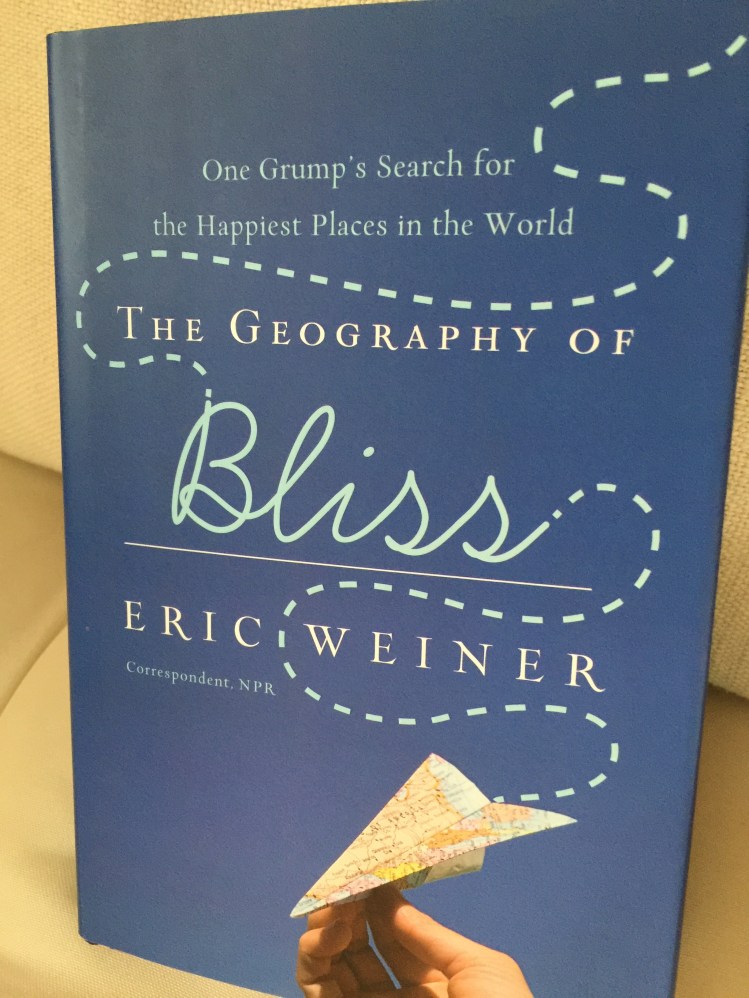
The Saturday Read ‘The Geography of Bliss’ by Eric Weiner

The Saturday Read this week is ‘The Geography of Bliss: One Grump’s Search for the Happiest Places in the World’, by former NPR correspondent and self-described philosophical traveler, Eric Weiner. It’s a travelogue of personal discovery with a universal  message, “where we are is vital to who we are”.

Early in his career decision process, Weiner decided travel was a necessary component to success – free travel. He started out as a foreign correspondent, going to some of the most unhappy global places. After a number of years covering conflicts in Iraq, Afghanistan and Indonesia he decided it was time to consider the alternative, the happy places.

“What if, I wondered, I spent a year traveling the globe, seeking out not the world’s well-trodden trouble spots but, rather, its unheralded happy places? Places that possess, in spades, one or more of the ingredients that we consider essential to the hearty stew of happiness: money, pleasure, spirituality, family and chocolate, among others.”

And we’re off. First to the Netherlands and the World Database of Happiness to meet Ruut Veenhoven, Professor of Happiness Studies.

Veenhoven was a graduate student in sociology when he found his calling in a new discipline, happiness studies. In a career story that may resonate with others in academia, he describes a meeting with his advisor. He was interested in the study of healthy minds and happy places. “His advisor, a sober man with solid academic credentials, told him, in no uncertain terms, to shut up and never mention that word again. Happiness was not a serious subject…Today, Veenhoven is at the forefront of a field that churns out hundreds of research papers each year.”

By simply asking folks if they are happy, researchers have found:

“Extroverts are happier than introverts; optimists are happier than pessimists; married people are happier than singles, though people with children are no happier than childless couples; Republicans are happier than Democrats; people who attend religious services are happier than those who do not; people with college degrees are happier than those without, though people with advanced degrees are less happy than those with just a B.A….people are least happy when commuting to work; busy people are happier than those with too little to do; wealthy people are happier than poor ones, but only slightly.”

Before returning home to the U.S., Weiner traveled to Switzerland, Bhutan, Qatar, Iceland, Moldova, Thailand, Great Britain, and India. Finding your bliss is subjective, but deeply rooted in culture.

“The glue that holds the entire enterprise together is culture.”  He embarked on an odyssey to find happiness, and discovered one of the key elements to success in life and work.

“…where we are is vital to who we are.”

“By ‘where’, I’m speaking not only of our physical environment but also of our cultural environment. Culture is the sea we swim in – so pervasive, so all-consuming, that we fail to notice its existence until we step out of it. It matters more than we think.”

Each new chapter invites the reader to experience another place, a new culture, citizens adapting to change, and challenges preconceived notions of the happiest places.

Sitting in an airport bar at the end of his journey, Weiner reflects on what he has learned. “Money matters, but less than we think and not in the way that we think. Family is important. So are friends. Envy is toxic. So is excessive thinking. Beaches are optional. Trust is not. Neither is gratitude…Happiness is not a noun or a verb. It’s a conjunction. Connective tissue.”

The shelves of bookstores are brimming with self help tomes on happiness. Eric Weiner’s global journey sets this book apart from the competition, transporting the reader on a round trip from domestic familiarity to places of contrasting mindsets, and back. It’s the perfect book for a winter read.


‘Into the Lincoln Tunnel’ a poem by Deborah Garrison

The Friday Poem this week is for all the commuters who leave New Jersey every day and enter Manhattan via the Lincoln Tunnel. The poet, Deborah Garrison gives voice to the thoughts we sometimes entertain as passengers on a bus, in uncertain times, inhaling the fumes, the indigenous scent of New York Hudson crossings. “…please smile upon these good people who want to enter the city and work. Because work is good…”

Into the Lincoln Tunnel

The bus rolled into the Lincoln Tunnel,
and I was whispering a prayer
that it not be today, not today, please
no shenanigans, no blasts, no terrors,
just please the rocking, slightly nauseating
gray ride, stop and start, chug-a
in the dim fellowship of smaller cars,
bumper lights flickering hello and warning.
Yes, please smile upon these good
people who want to enter the city and work.
Because work is good, actually, and life is good,
despite everything, and I don’t mean to sound
spoiled, but please don’t think I don’t know
how grateful I should be
for what I do have —

I wonder whom I’m praying to.
Maybe Honest Abe himself,
craggy and splendid in his tall chair,
better than God to a kid;
Lincoln whose birthday I shared,
in whom I took secret pride: born, thus I was,
to be truthful, and love freedom.

Now with a silent collective sigh
steaming out into the broken winter sun,
up the ramp to greet buildings, blue brick
and brown stone and steel, candy-corn pylons
and curving guardrails massively bolted and men
in hard hats leaning on resting machines
with paper cups of coffee —

a cup of coffee, a modest thing to ask
Abe for,
dark, bitter, fresh
as an ordinary morning.

Deborah Garrison   ‘The Second Child’   Random House, 2008