workthoughts@one

Happy Groundhog Day! A day immortalized in the 1993 Bill Murray movie, as our national holiday of second chances.

I launched ‘workthoughts’ a year ago, on Groundhog Day, because I believed a blog about work should consider career evolution, lifelong learning and several second chances. It was never meant to be a place to find a job, rather a place to consider choices, share ideas and reconnect with dreams.

‘Workthoughts’ had its origin in a Tuesday afternoon course I taught for college students who were employed as interns for the semester. Most arrived thinking it was a waste of time, an added commitment to an already crowded schedule of classes, commuting and work.

As the semester progressed we dealt with the situations that develop in any workplace: disconnect in expectations, dysfunctional communications, poor leadership, lack of meaningful assignments, and recognition. We also talked about the bigger picture: global trends, leadership, teamwork, generations in the workplace, diversity and gender issues, work/life balance. It was about the humanities and social sciences, and building relationships with mentors, colleagues and clients.

“What would you do if you were stuck in one place and everything was exactly the same and nothing that you did mattered?” (Bill Murray, Groundhog Day)

Success@work begins with a clear understanding of self and a broad knowledge of the world@work. How can you connect the dots if you’re stuck in one place, everything is exactly the same and nothing you do matters?

‘Workthoughts’ provides weekly supplements in the humanities with the ‘Friday Poem’, sampling a variety of lyrical interpretations of work, and ‘The Saturday Read’, a book or long form article recommendation to illuminate the work experience and offer alternate views to problem solving. The ‘week@work’ summarizes selected stories from a variety of journalists and experts. And in-between are the conversations about fun, joy, success, and failure @work.

Work is about relationships. We build them, not on the technical aspects of the work to be accomplished, but on the human connections that grow beyond, in shared interests and experience.

Thank you to all who have connected and shared your ‘workthoughts’ this year. And thank you to all the alumni of MDA 250 – who stay connected, continue to inspire, and know the value of second chances.


The week@work – It’s still 3 minutes to midnight, an engineer’s regret, a world run by millennials and the myth of the ‘best jobs’ lists

This week@work began with the announcement that the ‘Doomsday Clock’ has remained at 3 minutes to midnight, and ended with a remembrance day for NASA astronauts lost. Millennials will soon assume a larger role in global leadership and may move the hands of that clock backward, and ‘astronaut’ does not appear on either list released last week, ranking top jobs for 2016.

“Martyl Langsdorf’s “Doomsday Clock,” which first graced the cover of the Bulletin’s print edition in 1947, has served for 69 years to focus the world’s attention on the most pressing global threats. The time on the Clock reflects whether we are more or less safe than last year, and compares the current situation to years further in the past; the decision on where to set the Clock’s hands is an attempt to reconcile the achievements and breakdowns in security efforts, broadly defined, that occur each and every year.

Last year, the Science and Security Board moved the Doomsday Clock forward to three minutes to midnight, noting: ‘The probability of global catastrophe is very high, and the actions needed to reduce the risks of disaster must be taken very soon.’ That probability has not been reduced. The Clock ticks. Global danger looms. Wise leaders should act—immediately.” Bulletin of the Atomic Scientists, 2016

While many hold personal memories of where we were on January 28, 1986, those closest to the program provide a cautionary tale on leadership, communication and the value of trusting the voice of your employees.

As NASA observed a ‘Day of Remembrance’, NPR correspondent, Howard Berkes, returned to Bringham City, Utah to interview Bob Ebling, ’30 Years After Explosion, Challenger Engineer Still Blames Himself’.

“Thirty years ago, as the nation mourned the loss of seven astronauts on the space shuttle Challenger, Bob Ebeling was steeped in his own deep grief.

The night before the launch, Ebeling and four other engineers at NASA contractor Morton Thiokol had tried to stop the launch. Their managers and NASA overruled them.

That night, he told his wife, Darlene, “It’s going to blow up.”

When Challenger exploded 73 seconds after liftoff, Ebeling and his colleagues sat stunned in a conference room at Thiokol’s headquarters outside Brigham City, Utah. They watched the spacecraft explode on a giant television screen and they knew exactly what had happened.”

The Economist contemplated a new global order when the millennials take charge, ‘When the young get older: their time will come’.

“Where some see a generation in crisis, others think the young are adapting quite well to the challenges of a changing world. They flit from job to job not because they are fickle but because job security is a thing of the past. They demand flexible hours and work-life balance because they know they don’t have to be in the office to be productive. They spend six hours a day online because that is how they work, and also how they relax. Their enthusiasm for new ideas (and lack of spare cash) has kickstarted money-saving technologies from Uber to WhatsApp. They take longer to settle down and have children, but so what? They will also be working far later in life than their parents did.

In every generation, the young are the first to take to the streets to demand reform. Sometimes their fury leads nowhere, but autocrats still fear it. That is why China’s government rolled tanks over the Tiananmen Square protesters, and why it censors social media today. Young Africans, for their part, may not put up indefinitely with gerontocrats such as 91-year-old Robert Mugabe of Zimbabwe and 82-year-old Paul Biya of Cameroon.

In democracies, young people will some day realise that signing online petitions is no substitute for voting (just as their elders started voting when they acquired grey hairs and mortgages and sent their children to government schools). When the young show up at polling stations, democratic governments will heed their views. And when the millennials start calling the shots more widely in society, they will do so for a long time. For thanks to steady advances in medical technology, they will remain healthy and able to work for longer than any previous generation. Indeed, if scientists’ efforts to crack the “ageing code” in human genes bear fruit, many of them will live past 120.”

Where are the jobs? That’s the question the experts try to answer each year, identifying the best jobs and best places to work.

U.S. News and World Report announced their 2016 Best Jobs Rankings and glassdoor.com ranked the 25 Best Jobs in America. Orthodontist, dentist, computer systems analyst, nurse anesthetist and physician assistant led the U.S. News Top 100. The glassdooor.com list’s top five included data scientist, tax manager, solutions architect, engagement manager and mobile developer.

It’s always good to have a snapshot of market driven job titles, but it doesn’t help if your ‘dream job’ doesn’t make the list, or even exist. The myth of these lists lie in the impermanence of work. The top jobs this year may vanish from the list next year. It’s about the work you want to do, and the job title you imagine or may create.

Three additional stories this week were reported by journalists at The New York Times: an analysis of the success of Iowa’s economic development, commentary on the career of a veteran NFL quarterback who found joy in his sport but will now have the long off season to consider lessons from a loss, and advice on how to raise a creative child.

‘In Iowa, Jobs Are Plentiful but Workers Are Not’ Patricia Cohen

“At 3.4 percent, Iowa’s unemployment rate is among the lowest in the country. With major metropolitan areas — crowded with hard-hat construction sites — painting an alluring picture of steady economic progress, business leaders here retain a sunny optimism that is rarely heard from the presidential candidates.

But now that Iowa has achieved a tightening labor market that is the envy of most other states, many companies are confronted with a different set of challenges pushing them to rethink everything from recruiting to economic development.”

‘Carson Palmer’s Memorable Season Ends With a Forgettable Night’  William C. Rhoden

“I’ll look back at this season at some point, but not tonight,” Palmer said. “This is the only game that’s on my mind, not the other 16, 17.”

Despite Sunday’s disaster, this was a season in which Palmer reclaimed some of the joy that the business of football and the grind of the sport had taken away.”

‘How to Raise a Creative Child. Step One: Back Off’  Adam Grant

“Child prodigies rarely become adult geniuses who change the world…What holds them back is that they don’t learn to be original. They strive to earn the approval of their parents and the admiration of their teachers. But as they perform in Carnegie Hall and become chess champions, something unexpected happens: Practice makes perfect, but it doesn’t make new.”


The week@work – agents of change, NY values and imagining a windfall

The week@work was dominated by stories of the small group of workers in entertainment, sports and politics. It was also the week that everyone had the opportunity to imagine entry into the world of celebrity via the purchase of a single $2 lottery ticket.

On Sunday evening the Hollywood Foreign Press Association handed out their annual Golden Globes, with the surprise winner being Mexican actor, Gael Garcia Bernal for his role as conductor of the fictional ‘New York Symphony’ in Amazon’s Golden Globe winning ‘Mozart in the Jungle’. “I want to dedicate this to music, to all the people that find the music and common ground for communication, for justice for happiness.”

As Huell Howser might say, “This is amazing!”, that a series about classical musicians led by a talented Mexican actor, wins an award in a year of political polarization and classical music’s declining prominence in our culture.

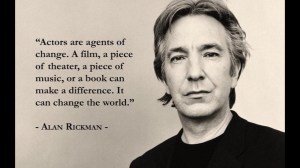
On Thursday, the actor who played Severus Snape in the Harry Potter series, Alan Rickman died. “With the last film it was very cathartic because you were finally able to see who he was,” Mr. Rickman said “It was strange, in a way, to play stuff that was so emotional. A lot of the time you’re working in two dimensions, not three.”

CYs2JjqWkAAWSqZ

Agents of change in theater, music, and the workplace challenge our thinking. On Monday we learned of the death of another transformational icon, David Bowie.

“In his dazzling artistry, daring style, unabashed intelligence, intensity of emotion, cultivation of magic, mystery and imagination, Bowie was a figure who bridged high and low culture, reverberating on so many different levels.”

On Monday morning, NPR replayed his 2002 interview with ‘Fresh Air’ host Terry Gross.

“I’m not actually a very keen performer. I like putting shows together. I like putting events together. In fact, everything I do is about the conceptualizing and realization of a piece of work, whether it’s the recording or the performance side. And kind of when I put the thing together, I don’t mind doing it for a few weeks, but then, quite frankly, I get incredibly, incredibly bored because I don’t see myself so much as a – I mean, I don’t live for the stage. I don’t live for an audience.”

David Bowie event planner? When we think of careers, we make assumptions about success, only to realize that each of us holds a unique definition which sculpts our approach to a calling.

“People often forgot, but up until his death, on Sunday at age 69, Mr. Bowie was a New Yorker

And though Mr. Bowie was enormously wealthy, he wasn’t one of those rich guys who kept an apartment in the city, along with a portfolio of global real estate holdings, and flew in. Aside from a mountain retreat in Ulster County, N.Y., his Manhattan apartment was his only home.

You may not have considered all this because Mr. Bowie was an apparition in the city, rarely glimpsed. You heard it mentioned that he lived here. Somewhere downtown, someone thought. But seeing him out? Good luck.”

Which brings us to the political discourse on ‘New York values’ and its relevance to job search. Relocation is a major consideration for many seeking career advancement. Understanding the character of the community you join outside of your workplace is equally, if not more important to understanding the values of your workplace community.

How many folks have decided to take a job in New York or LA only to later realize a major disconnect? This is not a value judgement, just a realization that we all need to find a place where we can be successful. Unfortunately, the job perks sometimes outweigh the geographical/cultural component in the decision making mix and it’s only when we are fully committed to our workplace that we begin to realize our success is being eroded by deficiencies in our neighborhood.

On to the world of sports. On Monday evening, two college football teams competed in the College Football National Championship game in Arizona. The University of Alabama’s team won by a score of 45-40 over Clemson. A few days later at the NCAA’s annual meeting, “NCAA president Mark Emmert praised student-athlete activism during his annual speech Thursday at the NCAA convention.”

During his 20-minute address at the NCAA’s opening business session, Emmert urged schools to continue to emphasize academics, fairness and the health and well-being of student-athletes.”

And yet, actions speak louder than words. Inside Higher Education reported“While the time demands on college athletes ­became the central focus of the National Collegiate Athletic Association’s annual meeting here this week, several proposals to deal with the issue were seemingly tabled the day before the NCAA’s five wealthiest conferences were scheduled to vote on them.”

Here’s the thing. With the exception of college coaches, everyone is in agreement that the ‘student’ in the ‘student-athlete’ equation takes priority. ‘Official’ time demands don’t begin to reflect the ‘unofficial’ time requirements of competing in Division I sports. And with only a select few moving on to compete in their sport as professionals, these students need the flexibility to explore career opportunities and participate in internships.

“Roderick McDavis, president of Ohio University, said it would be a mistake for colleges to wait for NCAA policy changes to prompt that shift. “Policies don’t change behavior,” he said. “People change behavior. We can hope that the NCAA catches up with us all one day, but what I know I can control is I can go home tomorrow and make a difference on my campus.”

And then there were the omnipresent billboards advertising the Powerball Jackpot at $999 million. Except the amount had grown to over $1.5 billion, which gave us all an opportunity to contemplate what we would do with that amount of money.

On a CNN broadcast the night before the drawing, international anchor Richard Quest asked anchor Anderson Cooper what he would do with the winnings if he had the lucky set of numbers. (You may know that Mr. Cooper is a Vanderbilt by ancestry.) His response, “I would buy a watch.” And he would be back at work the next day.

Here are a few additional articles that you may have missed from the past week.

‘Why I Always Wanted to Be a Secretary’ by Bryn Greenwood – Does your work define you? What if your dream job is central to an organization, but society’s definition is demeaning?

‘At Work And Feeling All Alone’ by Phyllis Korkki – In the world of telecommuting, new research indicates those left behind in the office have ended up feeling lonely and disconnected.

‘60% of Women in Silicon Valley Have Been Sexually Harassed’ by Lydia Dishman – Results of a survey of 200 women demonstrates a serious level of dysfunction in the tech giants’ workplace.

‘Yahoo’s Brain Drain Shows a Loss of Faith Inside the Company’ by Vindu Goel – “More than a third of the company’s work force has left in the last year, say people familiar with the data. Worried about the brain drain, Ms. Mayer has been approving hefty retention packages — in some cases, millions of dollars — to persuade people to reject job offers from other companies. But those bonuses have had the side effect of creating resentment among other Yahoo employees who have stayed loyal and not sought jobs elsewhere.”


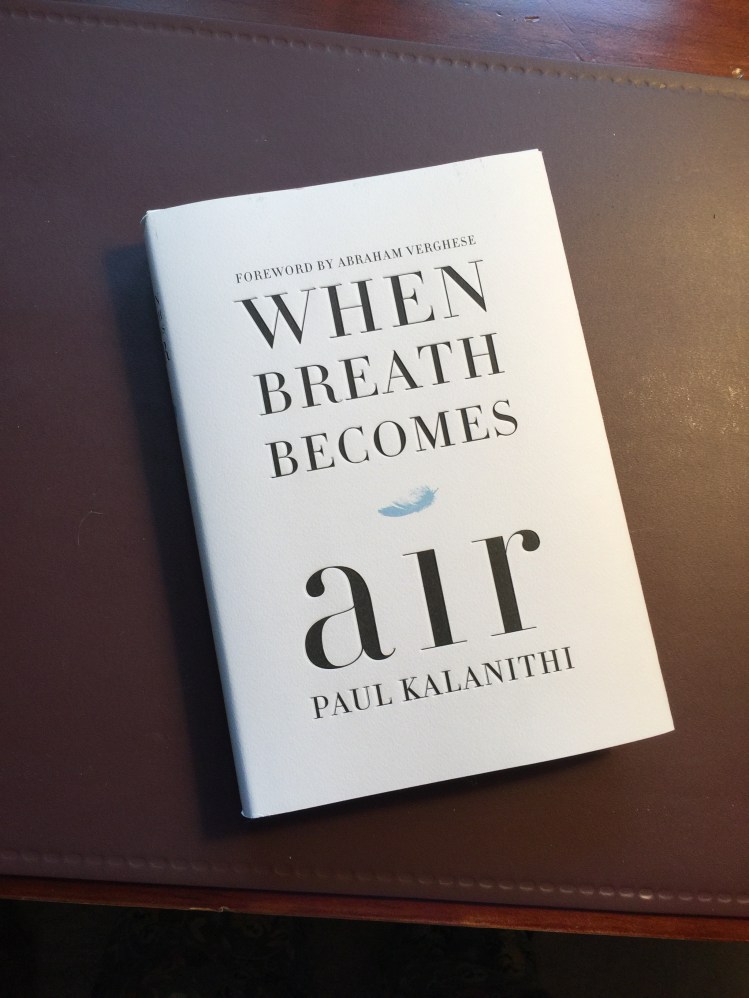
The Saturday Read – ‘When Breath Becomes Air’ by Paul Kalanithi

“I knew with certainty that I would never be a doctor.”  How many of us eliminated career options with such conviction in our final year of high school?

The Saturday Read is ‘When Breath Becomes Air’ by Paul Kalanithi. Although not intended as a ‘career’ book, the beautiful prose and compelling story will leave you reflecting on choices, time and values.

The book is a narrative revealed in two parts.

The first begins with the story of a college student making the most of his experience at Stanford, initially studying English literature, “…seeking a deeper understanding of a life of the mind” until his ultimate realization that “I was merely confirming what I already knew: I wanted that direct experience. It was only in practicing medicine that I could pursue a serious biological philosophy. Moral speculation was puny compared to moral action…I was going to Yale for medical school.”

The unintended value of the book’s Part I is a tutorial on the process of career decision making: exploration, reflection, discovery, reality testing, trade-offs and identity.

“In the fourth year of medical school, I watched as, one by one, many of my classmates elected to specialize in less demanding areas…and applied for their residencies. Puzzled by this, I gathered data from several elite medical schools and saw the trends were the same: by the end of medical school, most students tend to focus on “lifestyle” specialties – those with humane hours, higher salaries, and lower pressures – the idealism of their med school application essays tempered or lost…Indeed, this is how 99 percent of people select their jobs: pay, work environment, hours. But that’s the point. Putting lifestyle first is how you find a job – not a calling.”

Part II, “Cease Not till Death” addresses an essential question of life and career, What happens when your sense of identity is shaken?

“Lying next to Lucy in the hospital bed, both of us crying, the CT scan images still glowing on the computer screen, that identity as a physician – my identity – no longer mattered.

Instead of being the pastoral figure aiding a life transition, I found myself the sheep, lost and confused.”

Before the book was published, Dr. Kalanithi wrote two articles a year apart. Elements of both appear throughout the narrative. The first, ‘How Long Have I Got Left?’ for The New York Times in January 2014 described his role reversal as he “traversed the line from doctor to patient” and reflected on his own mortality.

“I began to realize that coming face to face with my own mortality, in a sense, had changed both nothing and everything. Before my cancer was diagnosed, I knew that someday I would die, but I didn’t know when. After the diagnosis, I knew that someday I would die, but I didn’t know when. But now I knew it acutely. The problem wasn’t really a scientific one. The fact of death is unsettling. Yet there is no other way to live.

Faced with mortality, scientific knowledge can provide only an ounce of certainty: Yes, you will die. But one wants a full pound of certainty, and that is not on offer.”

The second article, ‘Before I Go’ was published in the Spring 2015 issue of Stanford Medicine. Here he writes about time and career as the future “flattens out into a perpetual present”. 

“Time for me is double-edged: Every day brings me further from the low of my last cancer relapse, but every day also brings me closer to the next cancer recurrence — and eventually, death. Perhaps later than I think, but certainly sooner than I desire.

Everyone succumbs to finitude. I suspect I am not the only one who reaches this pluperfect state. Most ambitions are either achieved or abandoned; either way, they belong to the past. The future, instead of the ladder toward the goals of life, flattens out into a perpetual present. Money, status, all the vanities the preacher of Ecclesiastes described, hold so little interest: a chasing after wind, indeed.”

In the end, his illness brought him back to his love of literature and writing. His remarkable life informs this brilliant memoir. It’s a book for the new year, when resolutions are carelessly disregarded. The words, and Dr. Kalanithi’s legacy, reconnect us with the fundamentals of humanism. 


‘How to Be Perfect’ a poem by Ron Padgett

We are two weeks into the new year and once again we find it’s hard work to be perfect, as our resolutions collide with reality. So we turn to philosophers and poets to remind us that success is achieved with a measure of common sense.

In the seventeenth century a Spanish Jesuit scholar, writer, and philosopher, Baltasar Gracian, offered a collection of maxims on how to achieve personal and professional success. My favorite, “Be common in nothing”, might be the ‘perfect’ tenet to start the new year.

The Friday Poem this week reminded me of Gracian’s maxims, adding humor and common sense, from the poet, Ron Padgett, and his poem, ‘How to Be Perfect’.

How to Be Perfect

Get some sleep.

Don’t give advice.

Take care of your teeth and gums.

Don’t be afraid of anything beyond your control. Don’t be afraid, for
instance, that the building will collapse as you sleep, or that someone
you love will suddenly drop dead.

Eat an orange every morning.

Be friendly. It will help make you happy.

Raise your pulse rate to 120 beats per minute for 20 straight minutes
four or five times a week doing anything you enjoy.

Hope for everything. Expect nothing.

Take care of things close to home first. Straighten up your room
before you save the world. Then save the world.

Know that the desire to be perfect is probably the veiled expression
of another desire—to be loved, perhaps, or not to die.

Make eye contact with a tree.

Be skeptical about all opinions, but try to see some value in each of
them.

Dress in a way that pleases both you and those around you.

Do not speak quickly.

Learn something every day. (Dzien dobre!)

Be nice to people before they have a chance to behave badly.

Don’t stay angry about anything for more than a week, but don’t
forget what made you angry. Hold your anger out at arm’s length
and look at it, as if it were a glass ball. Then add it to your glass ball
collection.

Be loyal.

Wear comfortable shoes.

Design your activities so that they show a pleasing balance
and variety.

Be kind to old people, even when they are obnoxious. When you
become old, be kind to young people. Do not throw your cane at
them when they call you Grandpa. They are your grandchildren!

Live with an animal.

Do not spend too much time with large groups of people.

If you need help, ask for it.

Cultivate good posture until it becomes natural.

If someone murders your child, get a shotgun and blow his head off.

Plan your day so you never have to rush.

Show your appreciation to people who do things for you, even if you
have paid them, even if they do favors you don’t want.

Do not waste money you could be giving to those who need it.

Expect society to be defective. Then weep when you find that it is far
more defective than you imagined.

When you borrow something, return it in an even better condition.

As much as possible, use wooden objects instead of plastic or metal
ones.

Look at that bird over there.

After dinner, wash the dishes.

Calm down.

Visit foreign countries, except those whose inhabitants have
expressed a desire to kill you.

Don’t expect your children to love you, so they can, if they want to.

Meditate on the spiritual. Then go a little further, if you feel like it.
What is out (in) there?

Sing, every once in a while.

Be on time, but if you are late do not give a detailed and lengthy
excuse.

Don’t be too self-critical or too self-congratulatory.

Don’t think that progress exists. It doesn’t.

Walk upstairs.

Do not practice cannibalism.

Imagine what you would like to see happen, and then don’t do
anything to make it impossible.

Take your phone off the hook at least twice a week.

Keep your windows clean.

Extirpate all traces of personal ambitiousness.

Don’t use the word extirpate too often.

Forgive your country every once in a while. If that is not possible, go
to another one.

If you feel tired, rest.

Grow something.

Do not wander through train stations muttering, “We’re all going to
die!”

Count among your true friends people of various stations of life.

Appreciate simple pleasures, such as the pleasure of chewing, the
pleasure of warm water running down your back, the pleasure of a
cool breeze, the pleasure of falling asleep.

Do not exclaim, “Isn’t technology wonderful!”

Learn how to stretch your muscles. Stretch them every day.

Don’t be depressed about growing older. It will make you feel even
older. Which is depressing.

Do one thing at a time.

If you burn your finger, put it in cold water immediately. If you bang
your finger with a hammer, hold your hand in the air for twenty
minutes. You will be surprised by the curative powers of coldness and
gravity.

Learn how to whistle at earsplitting volume.

Be calm in a crisis. The more critical the situation, the calmer you
should be.

Enjoy sex, but don’t become obsessed with it. Except for brief periods
in your adolescence, youth, middle age, and old age.

Contemplate everything’s opposite.

If you’re struck with the fear that you’ve swum out too far in the
ocean, turn around and go back to the lifeboat.

Keep your childish self alive.

Answer letters promptly. Use attractive stamps, like the one with a
tornado on it.

Cry every once in a while, but only when alone. Then appreciate
how much better you feel. Don’t be embarrassed about feeling better.

Do not inhale smoke.

Take a deep breath.

Do not smart off to a policeman.

Do not step off the curb until you can walk all the way across the
street. From the curb you can study the pedestrians who are trapped
in the middle of the crazed and roaring traffic.

Be good.

Walk down different streets.

Backwards.

Remember beauty, which exists, and truth, which does not. Notice
that the idea of truth is just as powerful as the idea of beauty.

Stay out of jail.

In later life, become a mystic.

Use Colgate toothpaste in the new Tartar Control formula.

Visit friends and acquaintances in the hospital. When you feel it is
time to leave, do so.

Be honest with yourself, diplomatic with others.

Do not go crazy a lot. It’s a waste of time.

Read and reread great books.

Dig a hole with a shovel.

In winter, before you go to bed, humidify your bedroom.

Know that the only perfect things are a 300 game in bowling and a
27-batter, 27-out game in baseball.

Drink plenty of water. When asked what you would like to drink,
say, “Water, please.”

Ask “Where is the loo?” but not “Where can I urinate?”

Be kind to physical objects.

Beginning at age forty, get a complete “physical” every few years
from a doctor you trust and feel comfortable with.

Don’t read the newspaper more than once a year.

Learn how to say “hello,” “thank you,” and “chopsticks”
in Mandarin.

Belch and fart, but quietly.

Be especially cordial to foreigners.

See shadow puppet plays and imagine that you are one of the
characters. Or all of them.

Take out the trash.

Love life.

Use exact change.

When there’s shooting in the street, don’t go near the window.

Ron Padgett  ‘Collected Poems’ 2013

Reinvent or Authenticate?

In the first weeks of the new year the media message is to ‘reinvent’ yourself; new year, new you. Do we really need this annual makeover? Does one more layer of makeup change who we are as individuals? Perhaps this year we should focus on the ‘real’ you, not the person ‘appearing in the role…’as you. Let’s enhance the talent that’s in your DNA.

Start the year with a realistic assessment of your skills. Ask for feedback from your closest friends and colleagues. How does your view of self compare to how others see you? How much energy are you expending to create a perception with no connection to reality?

We all play roles in our professional lives. I believe that the most successful and happy among us are the ones whose ‘roles’ can’t be distinguished from who they are in real life.

What will it take to bridge the gap and live the authentic life? In other words, why not just be you?

It may be that you need to listen to that little voice that is telling you what you really want to do with your life, something that doesn’t involve creating a character each morning as you enter your workplace.

Rather than reinvent, authenticate. Be yourself. Be happy.

The year @work – equal pay, organization culture, Mark Zuckerberg’s books, the widening class divide, space exploration & Hamilton

Topics of work and the workplace often captured the headlines in 2015. And some of those headlines seemed to echo the 1970’s. As the economy improved, the wage gap between rich and poor increased. And we are still talking about equal pay for equal work.

One flashback was posted on the NPR website on January 2 in tribute to former New York governor, Mario Cuomo, who died on New Year’s Day. The post included the text and video of his speech to the Democratic National Convention in 1984, two years after the Equal Rights Amendment  failed to gain support from the 38 states required to pass.

“We speak for women who are indignant that this nation refuses to etch into its governmental commandments the simple rule “thou shalt not sin against equality,” a rule so simple —

I was going to say, and I perhaps dare not but I will. It’s a commandment so simple it can be spelled in three letters: E.R.A.”

Even though this year’s slate of Presidential candidates includes two women, the legacy of Cuomo’s passion is largely ignored.

Two stories in the past year served to visibly illustrate the continuing inequity.

In Hollywood, major studio, Sony was hacked, revealing, among other things, the disparity between the compensation of lead actress Jennifer Lawrence and her male co-stars. Madeline Berg covered the story for Forbes

“More frequent are anecdotes of discrimination like those recently related by Selma Hayek, Gwyneth Paltrow and even Streep.

All of these women have echoed the sentiment of Patricia Arquette, who brought the issue to the world’s attention at last year’s Oscars when she said in her acceptance speech for Best Supporting Actress, “It’s our time to have wage equality for once and for all.”

But it is not only the number on the paycheck that is the problem: Women are also greatly underrepresented on the big screen, leading to fewer opportunities to make money, an issue that Reese Witherspoon brought up at the American Cinematheque Awards in October: “Women make up 50% of the population, and we should be playing 50% of the roles on the screen.”

That is a dream that is far from a reality. According to a report by the Annenberg School at USC’s Media, Diversity & Social Change Initiative released in August, only 28.1% of characters in 2014’s top 100 films were female and of that percent, only 21 had a female lead or co-lead.”

The misrepresentation is even worse behind the camera: Of the same films, women made up only 1.9% of directors, 11.2% of writers and 18.9% of producers. This only aggravates the problem. The report found that in productions where women held key positions off-screen—as directors, writers and producers—the films featured women more often, and in less sexualized roles.”

We may find it hard to garner sympathy for those who earn millions @work for acting or competing in sport. But those are the visible workers who set the bar for the rest of us on the lower rungs of the career ladder.

The year in sport was dominated by the FIFA scandal, but women who work in sport created the memorable moments of the year. Christopher Clarey, summarizing the year in sport for women noted ‘Women Surge On Playing Field but Fall Behind in Boardroom’.

“As visible as female athletes were in 2015, women lost prominence and power in another key domain in the sports world: the boardroom.

Stacey Allaster, chief executive of the WTA Tour, stepped down citing burnout and the desire to spend more time with her young children. Debbie Jevans, a Briton who was perhaps Europe’s leading women’s sports executive, also cited personal reasons for resigning as chief executive of England Rugby 2015 less than six months before the start of the Rugby World Cup that she had been instrumental in organizing.

Another industry leader, Mary Wittenberg, who oversaw the New York City marathon as chief executive of New York Road Runners, resigned to lead a start-up lifestyle company, Virgin Sport.

Allaster, Jevans and Wittenberg were all replaced by men, and by year’s end there was no woman leading a major professional sport, not even one for women. Steve Simon is in charge of the WTA, Michael Whan is in charge of the L.P.G.A., Jeff Plush runs the National Women’s Soccer League in the United States and Mark Tatum oversees the W.N.B.A., the most prominent women’s professional basketball league, on an interim basis after Laurel J. Richie stepped down after five seasons in 2015.

Considering the scandals and governance crises that enveloped leading male-dominated federations like FIFA and the I.A.A.F. in 2015, more women in power looked very much like part of the solution. The men could clearly benefit from new perspectives.

“For me, the most important thing about diversity in a workplace is definitely making everyone feel included,” Wittenberg said. “But the diversity that comes from diversity of thinking is also invaluable, and if you don’t have diversity around your executive table or any table, I think you really run a risk today. Organizations, and especially political organizations that lack diversity in any number of ways, including gender — you’re not coming close to representing a world view. Leadership today should be challenged at every turn.”

The topic of work/life balance continues to dominate the water cooler conversations from Silicon Valley to Wall Street. And the conversation is at the heart of defining organizational culture.

In mid-August The New York Times published a story, ‘Inside Amazon: Wrestling Big Ideas in a Bruising Workplace’ with the following sub-heading: “The company is conducting an experiment in how far it can push
white-collar workers to get them to achieve its ever-expanding ambitions.” 

Definitely not a ‘puff piece’, but an important piece of journalism that ignited a dialog not only between the Amazon PR machine and the editors of The NY Times, but among workers in a variety of work settings about organizational values and personal tradeoffs. How an individual’s values mesh with those of their employer will determine ultimate success or failure. Who will you become? is a far more important question to ask than   What is the salary offer?

This was also the year that Mark Zuckerberg encouraged others to follow his example, and read a recommended book every two weeks. The final recommendation in  ‘A Year of Books’ was announced today, number 23, ‘The Beginning of Infinity’ by David Deutsch.

Richard Feloni compiled a list of the first 20 recommendations.

“Facebook CEO Mark Zuckerberg has made a tradition of dramatic New Year’s resolutions, and this year he decided that he’d read a book every two weeks.

He wanted his selections to focus on “different cultures, beliefs, histories, and technologies.”

“Books allow you to fully explore a topic and immerse yourself in a deeper way than most media today,” Zuckerberg wrote on his personal Facebook page. “I’m looking forward to shifting more of my media diet towards reading books.”

Hopefully, we have all met our resolutions from January and shifted our media diet to include some ‘long reads’ outside our comfort zone.

As the economy continued to improve, the gap between rich and poor widened. Claire Cain Miller examined the impact of differences in child rearing on growing class divisions.

“Children were not always raised so differently. The achievement gap between children from high- and low-income families is 30 percent to 40 percent larger among children born in 2001 than those born 25 years earlier, according to Mr. Reardon’s research.

People used to live near people of different income levels; neighborhoods are now more segregated by income. More than a quarter of children live in single-parent households — a historic high, according to Pew – and these children are three times as likely to live in poverty as those who live with married parents. Meanwhile, growing income inequality has coincided with the increasing importance of a college degree for earning a middle-class wage.”

And for awhile, a movie about space, not that one, the other one – ‘The Martian’, seemed to re-energize NASA’s plan to restart manned space exploration beyond the International Space Station.

Doug Bolton of The Independent reported on last week’s suspension of a proposed mission to the red planet.

“NASA has decided to suspend a mission to Mars scheduled for March 2016, due to the lander springing a leak.

The InSight Mission, which would have seen a rover analysing seismic activity and the interior structure of the red planet, was called off by Nasa bosses after technical staff failed to repair a leak in one of the rover’s prime instruments.

John Grunsfeld, the associate administrator for Nasa’s Science Mission Directorate in Washington, said: “We push the boundaries of space technology with our missions to enable science, but space exploration is unforgiving, and the bottom line is that we’re not ready to launch in the 2016 window.”

Which leaves our space efforts to two remarkable American entrepreneurs, Elon Musk and Jeff Bezos. In May, Jessica Orwig expressed optimism in the future of private space exploration.

“This year is shaping up to be an extremely exciting time for the future of commercial spaceflight, which will be built upon the backbone of revolutionary 21st-century rockets. The private American space companies Blue Origin and SpaceX are paving the way.

Blue Origin, which was founded by Amazon CEO Jeff Bezos in 2000, successfully launched its “New Shepard” space vehicle for the first time on April 29. The vehicle was named after Alan Shepard, who became the second human and first American to enter space 44 years ago. It is designed to eventually boost six people to space, where they can experience weightlessness for 10 minutes before returning to Earth. The ride is for entertainment and therefore not exclusively for astronauts, but these kinds of temporary spaceflights could become a new way for astronauts to train for coming space missions.

Two weeks earlier, on April 14, Elon Musk’s SpaceX, founded in 2002, attempted to land one of its Falcon 9 rockets on a floating platform in the Atlantic Ocean. SpaceX’s Falcon 9 rockets are designed to boost spacecraft to greater heights than Blue Origin’s and are therefore involved in other missions outside of commercial spaceflight, including supplying the International Space Station, launching satellites into orbit, and aspirations to reach Mars.”

On December 22, NBC News reported “SpaceX completed an historic vertical landing of its Falcon 9 rocket on Monday night — the first time such a feat had been achieved.

The launch and landing in Cape Canaveral, Florida, were the first from the private U.S. spaceflight company since its rocket exploded on liftoff in June.

SpaceX has come close to landing a rocket but until now, never actually pulled the feat off. Blue Origin, founded by Amazon CEO Jeff Bezos, stuck a landing last month — but Musk pointed out that was a suborbital trip, the requirements for which are considerably different.”

And then there was ‘Hamilton’ the musical. Just as the founding father was about to be replaced on the U.S. ten dollar bill, his story took center stage this summer on Broadway. In a 2015 recap article, ‘Surprises from 2015 and Reasons for Hope’, Gina Bellafante examined the ‘Hamilton effect’ on five year olds.

“As if it weren’t surprise enough that a hip-hop musical about the life of the country’s first Treasury secretary would become a Broadway sensation, finding impassioned fans in both President Obama and Dick Cheney, “Hamilton” has found an unlikely cohort of obsessives among 5-year-olds in New York, thanks to the cast album and scenes available on YouTube. At least one kindergartner in Brooklyn is regularly going to school with white socks pulled up over his pants. Some children are demanding quill pens, and many are singing the songs at home over and over and over.

“This is the new ‘Frozen,’” one already fatigued mother observed. Expect heated arguments about the limitations of Federalism among first graders next year.”


‘The World I Live In’ a poem by Mary Oliver

The Friday Poem this week is from Pulitzer Prize winning poet Mary Oliver‘s new collection, ‘Felicity’ published this fall. Merry Christmas!

The World I Live In

I have refused to live

locked in the orderly house of

reasons and proofs.

The world I live in and believe in

Is wider than that. And anyway,

what’s wrong with Maybe?


You wouldn’t believe what once or

twice I have seen. I’ll just

tell you this:

only if there are angels in your head will you

ever, possibly, see one.

Mary Oliver  ‘Felicity’  Penguin Press, 2015

The week@work – The Fed raises rates, Martin Shkreli is arrested, ‘The Big Short’ premieres and so does a small film about a galaxy far, far away

It’s that time of year when the world of finance takes center stage, only to be bested by the creativity of those who work in Hollywood. This week@work the Federal Reserve raised its benchmark rate, pharmaceutical executive, Martin Shkreli was arrested on securities fraud and the 2008 financial crisis originally chronicled by Michael Lewis, made its way onto the big screen in ‘The Big Short’. And that small movie from Disney? ‘Star Wars: The Force Awakens’ set new records with a $238 million weekend opening.

On Wednesday, the Wall Street Journal reported on the decision by the Federal Reserve to raise interest rates for the first time in seven years.

“The Fed’s decision today reflects our confidence in the U.S. economy,” Fed Chairwoman Janet Yellen said Wednesday in a press conference after a two-day policy meeting. “We believe we have seen substantial improvement in labor market conditions and while things may be uneven across regions of the country, and different industrial sectors, we see an economy that is on a path of sustainable improvement.

New projections show officials expect the fed-funds rate to creep up to 1.375% by the end of 2016, according to the median projection of 17 officials, to 2.375% by the end of 2017 and 3.25% in three years. That implies four quarter-percentage-point interest rate increases next year, four the next and three or four the following. It depends on whether the Fed’s forecasts for the economy—which have frequently been wrong in this expansion—hold up.”

The Fed rate increase was one of the ‘Four Charts That Defined the World in 2015’.

2014_Charts_Federal-690

Vauhini Vara writing in The New Yorker listed the other three:

“For the first time, fewer than ten per cent of people in the world were living in extreme poverty.

Facebook took over the world.

Greece’s economy started growing again—and then shrank.”

On Thursday, Bloomberg Business noted the arrest of Martin Shkreli, the infamous pharmaceutical head, and everyone’s leading candidate for this year’s Scrooge. You may remember Shkreli from his multiple media appearances after raising the price of the drug Daraprim from $13.50 a pill to $750. Apparently he not only violated the golden rule, but also an unspoken pact among those in financial services, not to draw attention to themselves or their activities.

“While the 32-year-old has earned a rare level of infamy for his brazenness in business and his personal life, what he was charged with had nothing to do with skyrocketing drug prices. He is accused of repeatedly losing money for investors and lying to them about it, illegally taking assets from one of his companies to pay off debtors in another.

“Shkreli essentially ran his company like a Ponzi scheme where he used each subsequent company to pay off defrauded investors from the prior company,” Brooklyn U.S. Attorney Robert Capers said at a press conference.”

He was released on bail on Friday and did what we would all do after being publicly shamed, began live streaming, chatting with ‘supporters’.

“Which brings me to a new movie the enemies of financial regulation really, really don’t want you to see.” writes nobel prize winner, Paul Krugman in The New York Times.

“But you don’t want me to play film critic; you want to know whether the movie (The Big Short) got the underlying economic, financial and political story right. And the answer is yes, in all the ways that matter.

I could quibble over a few points: The group of people who recognized that we were experiencing the mother of all housing bubbles, and that this posed big dangers to the real economy, was bigger than the film might lead you to believe. It even included a few (cough) mainstream economists. But it is true that many influential, seemingly authoritative players, from Alan Greenspan on down, insisted not only that there was no bubble but that no bubble was even possible.

And the bubble whose existence they denied really was inflated largely via opaque financial schemes that in many cases amounted to outright fraud — and it is an outrage that basically nobody ended up being punished for those sins aside from innocent bystanders, namely the millions of workers who lost their jobs and the millions of families that lost their homes.”

Need a holiday escape from everyday villains and economic reality? The folks at the ‘house the mouse built’ offer a 135 minute visit to an alternate universe.

“Chewie, we’re home” teases the plot in the trailer for the new Star Wars movie. This week the cast of the seventh installment of the intergalactic saga walked the red carpet, four blocks long, at the Hollywood premiere.

Variety covered the opening weekend box office results.

“Director J.J. Abrams’ nostalgic take on the series of space operas George Lucas created four decades ago was a hit with critics and fans, earning strong reviews and an A CinemaScore. Its opening soared past the previous high-water mark of $208.8 million established last summer by “Jurassic World.” It more than doubles “The Hobbit: An Unexpected Journey’s” December record debut of $84.6 million.

Globally, “Star Wars: The Force Awakens” scored the second-biggest opening in history, earning $517 million worldwide, behind only “Jurassic World’s” $525 million bow. Unlike “Jurassic World,” the seventh film in the “Star Wars” franchise did not have the benefit of showing in China on its inaugural weekend. It opens there on Jan. 9.”


‘Let American Be America Again’ a poem by Langston Hughes

We spend a lot of time considering the values of our workplace and how they mesh with our priorities; who we will become as part of a workplace community. But where we go to work is located in the broader context of a national set of values. And those values have been the topic of conversation this political season, with some questioning the basic tenets that have, until now, defined our national conscience.

It sometimes seems like we have lost our collective sense of the core values that bind us as humans, Americans and global citizens.

Take a moment today to restore our ‘moral memory’ and revisit history through the lens of American poet, Langston Hughes. The Friday Poem this week is ‘Let America Be America Again’ written in 1935 and published in Esquire Magazine in 1936.

Let America Be America Again

Let America be America again.
Let it be the dream it used to be.
Let it be the pioneer on the plain
Seeking a home where he himself is free.

(America never was America to me.)

Let America be the dream the dreamers dreamed—
Let it be that great strong land of love
Where never kings connive nor tyrants scheme
That any man be crushed by one above.

(It never was America to me.)

O, let my land be a land where Liberty
Is crowned with no false patriotic wreath,
But opportunity is real, and life is free,
Equality is in the air we breathe.

(There’s never been equality for me,
Nor freedom in this “homeland of the free.”)

Say, who are you that mumbles in the dark?
And who are you that draws your veil across the stars?

I am the poor white, fooled and pushed apart,
I am the Negro bearing slavery’s scars.
I am the red man driven from the land,
I am the immigrant clutching the hope I seek—
And finding only the same old stupid plan
Of dog eat dog, of mighty crush the weak.

I am the young man, full of strength and hope,
Tangled in that ancient endless chain
Of profit, power, gain, of grab the land!
Of grab the gold! Of grab the ways of satisfying need!
Of work the men! Of take the pay!
Of owning everything for one’s own greed!

I am the farmer, bondsman to the soil.
I am the worker sold to the machine.
I am the Negro, servant to you all.
I am the people, humble, hungry, mean—
Hungry yet today despite the dream.
Beaten yet today—O, Pioneers!
I am the man who never got ahead,
The poorest worker bartered through the years.

Yet I’m the one who dreamt our basic dream
In the Old World while still a serf of kings,
Who dreamt a dream so strong, so brave, so true,
That even yet its mighty daring sings
In every brick and stone, in every furrow turned
That’s made America the land it has become.
O, I’m the man who sailed those early seas
In search of what I meant to be my home—
For I’m the one who left dark Ireland’s shore,
And Poland’s plain, and England’s grassy lea,
And torn from Black Africa’s strand I came
To build a “homeland of the free.”

The free?

Who said the free? Not me?
Surely not me? The millions on relief today?
The millions shot down when we strike?
The millions who have nothing for our pay?
For all the dreams we’ve dreamed
And all the songs we’ve sung
And all the hopes we’ve held
And all the flags we’ve hung,
The millions who have nothing for our pay—
Except the dream that’s almost dead today.

O, let America be America again—
The land that never has been yet—
And yet must be—the land where every man is free.
The land that’s mine—the poor man’s, Indian’s, Negro’s, ME—
Who made America,
Whose sweat and blood, whose faith and pain,
Whose hand at the foundry, whose plow in the rain,
Must bring back our mighty dream again.

Sure, call me any ugly name you choose—
The steel of freedom does not stain.
From those who live like leeches on the people’s lives,
We must take back our land again,
America!

O, yes,
I say it plain,
America never was America to me,
And yet I swear this oath—
America will be!

Out of the rack and ruin of our gangster death,
The rape and rot of graft, and stealth, and lies,
We, the people, must redeem
The land, the mines, the plants, the rivers.
The mountains and the endless plain—
All, all the stretch of these great green states—
And make America again!

Langston Hughes  ‘The Collected Poems of Langston Hughes’  1995