The week@work – guaranteed basic income, college grad stats, internet trends and the world’s longest tunnel opens

This week@work the Swiss electorate rejected a ballot measure to provide a guaranteed basic income for citizens, the college graduate unemployment rate is 2.4%, with history majors matching mid-career salaries of business school grads, Mary Meeker projected her 2016 internet trends and 2,600 workers completed 17 years of work to open the world’s longest tunnel under the Alps.

On Saturday Swiss voters rejected a proposed plan to provide an unconditional monthly income of 2,500 francs by a margin of 77% to 23%.

-1x-1

Philip Oltermann surveyed the growing economic trends toward guaranteed basic income, ‘State handout for all? Europe set to pilot universal basic incomes’.

“Universal basic income has a rare appeal across the political spectrum. For those on the left, it promises to eliminate poverty and liberate people stuck in dead-end workfare jobs. Small-state libertarians believe it could slash bureaucracy and create a leaner, more self-sufficient welfare system.

In an increasingly digital economy, it would also provide a necessary injection of cash so people can afford to buy the apps and gadgets produced by the new robot workforce.

Crucially, it is also an idea that seems to resonate across the wider public. A recent poll by Dalia Research found that 68% of people across all 28 EU member states said they would definitely or probably vote for a universal basic income initiative. Finland and the Netherlands have pilot projects in the pipeline.”

The New Yorker contributor, Mark Gimein summarized recent discussions on the topic, comparing U.S. views to European counterparts.

“…when they look further into the future, Americans talk about a national minimum income in the context of a jobless future, an employment apocalypse in which workers compete for fewer and fewer good jobs. Robert Reich, the former labor secretary, sees a national guaranteed income as the most likely endgame in an economy with “more and more people getting pushed out of the middle class into the personal service sector of the economy getting lower and lower wages.” When the Swiss talk about basic income, they’re talking about a utopian vision. When Americans like Reich talk about it, it’s a last bulwark against national impoverishment.”

‘The Upshot’ analyzed the May unemployment numbers and drew a positive spin on disappointing results. “A better gauge of the underlying rate of jobs growth is to take an average over the past three months. By that measure, the labor market is creating around 116,000 jobs per month. This is a notable slowdown from jobs growth in the 150,000-250,000 range over most of the past five years. But it’s a slowdown and not a sudden stop.”

Here’s the good news for college grads. In a separate post, the folks @UpshotNYT posed this question: “What do you think the unemployment rate is for 25-to-30-year-olds who graduated from a four-year college?”  Most folks guessed high. The actual rate is 2.4%, without a four-year college degree it’s 7%.

images.jpeg

While we’re on the topic of debunking ‘value of college myths’, let’s turn to a story about the much maligned history majors. (Full disclosure, I was one)

Writing in the LA Times, James Grossman, executive director of the American Historical Association lamented the decline enrollment in undergraduate history programs and countered with new research that suggests undergrads might want to reconsider their choice of major.

“Over the long run, …graduates in history and other humanities disciplines do well financially…after 15 years, those philosophy majors have more lucrative careers than college graduates with business degrees. History majors’ mid-career salaries are on par with those holding business bachelor’s degrees. Notably these salary findings exclude those who went on to attain a law or other graduate degree.

The utility of disciplines that prepare critical thinkers escapes personnel offices, pundits and politicians (some of whom perhaps would prefer that colleges graduate more followers and fewer leaders). But it shouldn’t. Labor markets in the United States and other countries are unstable and unpredictable. In this environment — especially given the expectation of career changes — the most useful degrees are those that can open multiple doors, and those that prepare one to learn rather than do some specific thing.”

On Wednesday The New York Times announced ‘the Internet is over’. They are changing their style rule to join the rest of the world to lowercase the word ‘internet’.

The same day, venture capitalist Mary Meeker presented her 2016 internet trends report. Inc. contributor, Jessica Stillman cited five ‘take-aways’ from the deck of 200 slides.

“Internet growth is slowing dramatically. Advertisers aren’t spending enough on mobile. Privacy concerns are “a ticking time bomb.”Search is about to be revolutionized…and so are messaging apps.”

Moving from technology trends to engineering marvels, BBC News reported on the opening of the Gotthard Base Tunnel in Switzerland, culminating 17 years of work by 26,000 workers.

gettyimages-105475814_custom-293c8eedebb27759dbd26d764b46c07b23b87f9f-s1400-c85

“Swiss engineer Carl Eduard Gruner first imagined it in 1947: a massive tunnel, unprecedented in length, buried a mile and a half under Switzerland’s symbolic Gotthard mountain range.

Nearly seven decades later, after redesigns, political disagreements and the long, slow work of drilling beneath the Gotthard massif, as it’s called, Gruner’s dream is complete.

The Gotthard Base Tunnel — a record-setting 35.4 miles long, and farther below ground than any other tunnel — was inaugurated Wednesday. The occasion was marked with a celebration that promoted “Swiss values such as innovation, precision and reliability…”

Now the completed tunnel, delivered on time and within budget, will create a mainline rail connection between Rotterdam in the Netherlands and Genoa in Italy.

When full services begin in December, the journey time for travellers between Zurich and Milan will be reduced by an hour to two hours and 40 minutes.

About 260 freight trains and 65 passenger trains will pass through the tunnel each day in a journey taking as little as 17 minutes.”

The week@work: terror on the way to work, a factory fire anniversary, values-based leadership@Starbucks, a millennial workplace, & a new job benefit


How do you share work thoughts when so many were killed and injured on their way to work on Tuesday morning? Apparently, we go on. I have to agree with the sentiment expressed by writer Pamela Druckerman in today’s New York Times ‘Je Suis Sick of This’.

“To Europeans, Brussels was supposed to be a dull place that you didn’t have to think much about until you had to change planes there. There’s a parlor game in which you stump people by asking them to name 10 famous Belgians. “Brussels, the anti-fanatic attacked by the fanatics,” French journalist Laurent Joffrin wrote in Wednesday’s Libération. “Brussels, a cousin whom one is content to know is there.”

Right after an attack it’s easy to say that everything feels different. People are horrified. Parents keep their kids home from school. Newspapers run headlines like “Europe at War.” There is the sad, familiar search for a slogan: This time, I prefer the Belgian frites arranged to make a rude gesture resembling a finger, and the banner reading, “Je suis sick of this” followed by an expletive.”

We don’t stop working. Maybe we are a bit more vigilant, the slogan ‘If you see something, say something’, temporarily gets more attention.

Journalist Druckerman continued, “Despite the inevitable false positives, it’s hard not to be on guard. I’m constantly making a series of mundane existential calculations: Is it worth it to risk going to a movie? Should I let my kids ride the metro to soccer practice? Daily life has a chiaroscuro quality: One minute you’re riding a bus and enjoying a view of the river; the next you’re wondering about the fellow with an unusually large backpack.”

There were other stories this week@work.

Friday was the 105th anniversary of the Triangle Shirtwaist Factory fire. It resonates with workers today because it was a story of immigrant workers, and led to changes in U.S. factory regulations and safety.

triangle fire.jpeg

Joseph Berger summarized the events in a 2011 article.

“A block east of Washington Square, not far from the neighborhood’s boutiques and chic restaurants, was the site of one of the nation’s worst industrial disasters. Many New Yorkers might be unaware of this.

Some labor advocates are trying hard to change that. They have organized an effort to build a memorial to the infamous Triangle Shirtwaist Factory fire of 1911, in which 146 workers died. Most of them were young immigrant women from Eastern Europe and Italy, and more than 50 jumped to their deaths from the factory’s ninth floor.

Two years ago, Tom Marshall posed the question, “Can disasters make life better for future generations?”  He went on to draw a parallel between the Triangle Shirtwaist factory fire and the 2013 garment factory collapse in Dhaka, Bangladesh.

“In both cases, inspectors visited and filed critical safety reports, but scores of people still died while making clothes for others. The American disaster is now hailed as a turning point that led to safer workplaces and broad support for a minimum standard of workers’ rights, while the Bangladeshi disaster’s impact is less certain.”

This week@work Starbucks chairman and CEO, Howard Schultz spoke at the annual shareholders meeting, and expanded on a conversation begun two years ago on the role and responsibility of a for-profit corporation. “What is the role and responsibility of all of us, as citizens?”

K9sMR38U-1650-1650

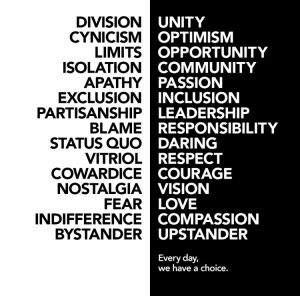
“Viewing the American Dream as a “reservoir” that is replenished with the values, work ethic and integrity of the American people, Schultz said, “Sadly, our reservoir is running dry, depleted by cynicism, despair, division, exclusion, fear and indifference.”

He suggested citizens fill the reservoir of the American Dream back up, “not with cynicism, but with optimism. Not with despair, but with possibility. Not with division, but with unity. Not with exclusion, but with inclusion. Not with fear, but with compassion. Not with indifference, but with love.”

“It’s not about the choice we make every four years,” Schultz said. “This is about the choices we make every day.”

One of the ‘most read’ articles last week, ‘What Happens When Millennials Run the Workplace?’, provided one more illustration that work issues are people issues, and it really doesn’t matter how you generationally identify.

“Joel Pavelski, 27, isn’t the first person who has lied to his boss to scam some time off work.

But inventing a friend’s funeral, when in fact he was building a treehouse — then blogging and tweeting about it to be sure everyone at the office noticed? That feels new.

Such was a recent management challenge at Mic, a five-year-old website in New York that is vying to become a leading news source created by and for millennials.”

The workplace is changing and the 80 million millennials @work will make a significant impact on work/life and the global economy. As a group, the 40 million with college degrees enter the workforce taxed with student loans that are the equivalent of a mortgage. Fidelity Investments announced a new employee benefit last week to address student loan repayment.  Tara Siegel Bernard provided the details.

“Fidelity will apply up to $2,000 annually to the principal of its employees’ student debts.

Fidelity is one of the more prominent employers to announce the student loan repayment benefit in recent months, a policy that seems likely to gain traction. The benefit helps address what some employers describe as a challenge attracting and retaining younger workers, many of whom can’t see beyond the burden of their student debt. Most employers that are offering the new perk also cap their costs at, say, $10,000 total per employee.”

At the end of a difficult week, spring wishes and Happy Easter!

IMG_4148


The week@work: ‘idea debt’, interview questions & women@work: #pledgeforparity & the downside of being a trailblazer

‘Idea debt’, emotional intelligence, International Women’s Day, and lessons from the ‘girl next door who loved sports’, headline our survey of stories this week@work .

Are you a ‘wantrapreneur’? Journalist Oliver Burkeman debunks the belief that thinking about doing something is doing it.

1156.jpg

“I hadn’t seen the problem clearly until the other day, when I encountered the illustrator Kazu Kibuishi’s term for it: “idea debt”. You run up an idea debt, Kibuishi’s fellow artist Jessica Abel explained, when you spend “too much time picturing what a project is going to be like, too much time thinking about how awesome it will be… and too little time actually making the thing”.

Just as the accruing interest on a credit card makes it harder and harder to get back on your feet financially, idea debt impedes action. The more glorious and detailed the pictures in your mind, the more daunting it feels to start making them real.

As Gregg Krech writes in his book The Art Of Taking Action, external reality remains exactly the same after your decision to ask someone out, to write a book, or leave your job. What matters is “creating ripples”, as he puts it – actions, however tiny, that alter things in the world outside your head.”

What are the questions employers ask to determine if a job candidate possesses a solid set of ‘people skills’?  With her article, ‘7 Interview Questions That Determine Emotional Intelligence’, Carolyn Sun not only provides tips for interviewers, but explains the rationale behind the questions for potential hires.

images.jpeg

Here’s one example:

“Can you teach me something, as if I’ve never heard of it before? (It can be anything: A skill, a lesson or a puzzle.)
A job candidate’s answer to this question can reveal several qualities:

Whether the person is willing to take the time to think before speaking.

If the candidate has the technical ability to explain something to a person who is less knowledgeable in the subject.

Whether the candidate asks empathetic questions to the person being taught, such as, “Is this making sense?”

On March 8, International Women’s Day, the Economist “created a glass-ceiling index”, to show where women have the best chances of equal treatment at work. It combines data on higher education, labour-force participation, pay, child-care costs, maternity rights, business-school applications and representation in senior jobs. Each country’s score is a weighted average of its performance on nine indicators.

purple-woman.jpgTo no one’s surprise, Nordic countries come out well on educational attainment and labour-force participation. Women are also relatively well represented in their parliaments; Finland and Sweden were among the first countries to allow women to vote and stand for election. Yet even there women are paid less than men for similar work. In Finland and Sweden the gap is close to the OECD average of 15%, though in Norway it has fallen to 8%.
At the bottom of our index are Japan and South Korea. Too few women there have jobs, few senior managers or board members are women and pay gaps are large—in South Korea, at 37%, the largest in the OECD. If, in the UN’s words, “equality for women is progress for all”, both countries have a long way to go.”

If you are interested additional reporting on #pledgeforparity and IWD,  Washington Post journalist Danielle Paquette wrote two stories this week for Wonkblog:

‘It’s 2016, and women still make less for doing the same work as men’

‘Pay doesn’t look the same for men and women at top newspapers’

The next story falls into the category of ‘you should be safe when you pursue your dream job.’

When sports journalist Erin Andrews graduated from the University of Florida in 2000, she began a career that eventually brought her to sidelines of college football at both ESPN and Fox Sports, and the dance floor; first as a finalist and now as the co-host of ‘Dancing With The Stars’.

Sarah Kaplan, reporting for The Washington Post summarized what happened next.

“In 2008, Michael David Barrett, who served 2 1/2 years in federal prison after pleading guilty to interstate stalking — said he chose to target her because she was popular and trending on Yahoo.”

“Erin Andrews wanted to be “the girl next door who loved sports,” she said.

“And now I’m the girl with a hotel scandal,” the Fox sportscaster tearfully told a Tennessee courtroom Monday.”

The trial and jury verdict in her favor last week is just one story of ‘The Dangers of Being a Female Sportscaster’ described by Richard Sandomir and John Branch for The New York Times.

Unknown.jpeg

“Female sportscasters have unparalleled reach in an age of round-the-clock sports broadcasting and the widespread dissemination of their work across social media. There are more of them now than ever, across multiple channels and websites.

The stories Sandomir and Branch recount serve as a guide for all women@work, not just those with a high profile in social media.

“I’ll try to avoid ever being in the hall of a hotel by myself,” said Kim Jones, a reporter for NFL Network. “And I’ll allow whoever is behind me to pass me before I put my card or key in the door. You have to be so aware because unfortunately that one time out of 10,000, something can happen.”

Alyssa Roenigk, a reporter for ESPN the Magazine who also appears on the air, primarily covering action sports like the X Games, said she had rarely given her security much thought. For years, she usually walked from venues to her hotel, even late at night. But as she began to do more television and was recognized more often, she was told by her bosses to start taking the courtesy car provided by the network.

“At first I thought I was getting special treatment, and I don’t want special treatment,” Ms. Roenigk said. “It’s not special treatment. It’s being safe.”

Stay safe this week@work, create some ripples and start reducing that ‘idea debt’.


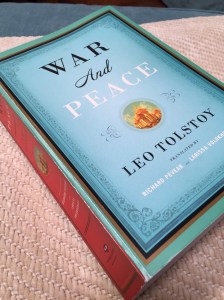
The Saturday Read ‘War and Peace’ by Leo Tolstoy

Are you one of the many who fumbles their way through a conversation of the classics, with vague memories of the Cliff Notes version, having never read the original? You’re not alone, and the ‘Saturday Read’ this week is the first step to fill in the blanks with ‘War and Peace’ by Leo Tolstoy.

“Do you feel pressured to read certain books?” Journalist Alison Flood posed this question after a poll conducted by market research firm, ‘YouGov’, found that “Britons are weighed down with regret over novels they haven’t found ‘time and patience’ for”, garnering a series of Twitter comments concluding, you should try it, you might like it.

“…maybe it’s a classic because it’s good, not because it’s hard. I did precisely that with War and Peace; giving it a crack because I felt I should, and then being startled to discover that it was actually fun. Not a trial at all.”

Only 4% of Britons surveyed had read War and Peace, but that began to change with the broadcast this month of the Harvey Weinstein produced, BBC Television production of the novel as a four part, eight hour mini series.

“Judging by our recent sales … an awful lot of people have finally crossed this classic off their must-read list. Four different editions of the book have hit our bestseller list, shifting an almost equal number of copies each,” said Waterstones buyer Joseph Knobbs.

At publisher Wordsworth Editions, managing director Helen Trayler said that sales of War and Peace had grown steadily after the first episode of the new TV adaptation, with its edition in the top 20 of the Bookseller’s small publisher charts ever since the show launched.”

In December, 1,300 people joined together for a live, four day, marathon reading of the novel on Russian TV.

“Tolstoy’s great-great-granddaughter Fekla Tolstaya coordinated the participants, who are each reading a two to three-minute passage of the novel’s more than half a million words from schools, museums, libraries and other locations around the world.

Readers include Polish film director and Oscar winner Andrzej Wajda, Bolshoi Ballet director Vladimir Urin and Russian politician Valentina Matvienko. Cosmonaut Sergei Volkov contributed a reading from the International Space Station, and French readers were coordinated to read the book’s French sections”


IMG_3888

Yes, the book is written in French and English in the Pevear and Volokhonsky translation.

Clara Bell, reviewing the novel in 1886 for the New York Times criticized both the novel and Count Tolstoy’s domestic environment.

“In fact, War and Peace may be called an illustrated historical essay rather than a novel, there being no semblance of a plot, and the characters serving to develop the public events rather than being developed by them. This inversion of the usual rule, together with the subtle but unmistakeable savor of fatalism which pervades the whole work, disturbs the reader with the same sense of vague discomfort that must have chilled many of Count Tolstoi’s foreign admirers when they found their hero living in a shabby, comfortless, untidy house a little way out of Moscow, where carpets and clean tablecloths appeared to be equally rare.”

So we avoid reading ‘War and Peace’ because it’s described as daunting, boring, long, confusing and required. What if we took the advice of journalist Flood and read it for enjoyment? I did and it is long, but amazing and you will find the seeds of many subsequent classics, and ‘not so classic’ in the story.

It turns out Count Tolstoy had a lot to say about contemporary issues; the individual, happiness and occupation-work. One example, the thoughts of character Pierre Bezukov after he is released from prison at the end of the war.

“The absence of suffering, the satisfaction of one’s needs, and the resulting freedom to choose one’s occupation, that is, one’s way of life, now seemed to Pierre the highest and most unquestionable human happiness.

“…the satisfaction of his needs…now that he was deprived of them all, seemed perfect happiness to Pierre, and the choice of an occupation, that is, of a life, now, when that choice was so limited, seemed to him such an easy matter that he forgot that a superfluidity of life’s comforts destroys all the happiness of the satisfaction of one’s needs, and that a greater freedom to choose one’s occupation, the freedom which in this life was granted him by education, wealth, social position – precisely that freedom made the choice of an occupation insolubly difficult and destroyed the very need and possibility of an occupation.”

This is why we read ‘War and Peace’. It’s why Russian TV devoted four days to a live reading. And why one of Hollywood’s leaders decided to executive produce a screenplay of his favorite novel.

If you are still a bit of a skeptic, Philip Hensher of The Guardian offers ‘War and Peace: the 10 things you need to know (if you haven’t actually read it)’

” 7. Anyone who tells you that you can skip the “War” parts and only read the “Peace” parts is an idiot. The bits that interest you personally and the bits that you find of only abstract curiosity are going to change when you read the book at 20, and again at 50. The book is the product of a very big mind, who lost interest in almost everything War and Peace was about before he died. It is a living organism that is never quite the same as you remembered when you go back to it.”


The week@work – issues that will shape the world in 2016, positive forecast on salary growth, George R.R. Martin misses a deadline and why we should focus on our ‘already done’ list

The past week@work marked the transition from the old year to the new. We have seen the last of the ‘best and worst of the year’ in every imaginable category and it’s time to turn our attention to the future. Here’s the problem; global issues, work issues, customer issues and career issues don’t magically resolve themselves at the stroke of midnight on 12/31.

What the new year does provide is a demarcation point in time, to set aside previous solutions and reimagine innovative answers. We have permission to start anew.

Rose Pastore offers a list of ’10 Issues That Will Shape the World In 2016′. Recognizing the continuum of events from the old year to the new – “The end of 2015 leaves many of the year’s most significant issues still very much in flux, including the reform of U.S. gun control laws, the fates of thousands of Syrian refugees, and the legal status of massive startups like Uber and Airbnb.”

Some of these issues seem so beyond our everyday lives that it may be hard to grasp a connection to our work and workplace. But somewhere, a diplomat, an entrepreneur, an educator or a student may seize the moment, and solve one piece of the puzzle, in one of our multiple global challenges: “the refugee crisis, climate change, data security, gun violence, social justice and regulating the sharing economy.” 

Don Lee reported on the view that salaries will increase in 2016, driven by the decrease in unemployment and the implementation of new minimum wage laws in a number of states.

“American workers are poised in 2016 to finally get what they’ve been missing for years: higher salaries.

…worker wages will get an additional boost from higher minimum wages taking effect in a number of cities and states. California’s new minimum pay goes to $10 an hour in January. The increase will amount to an 11% pay raise for Marco Ruiz, a carwash worker in Anaheim who earns $9 an hour.

That’s an additional $40 a week, more than enough to cover Ruiz’s bus fare to his job from his home in Norwalk, which he rents with his brother-in-law. “It’s marvelous,” said the divorced 35-year-old, who started at the carwash eight years ago making $7.50 an hour, the state’s minimum wage then.

Like Ruiz, most people in the U.S. already feel more secure in their jobs. As layoffs have receded sharply, weekly filings for new jobless benefits have fallen this year to numbers not seen since the early 1970s. And Gallup polls show workers’ “complete satisfaction” with job security rose to a 15-year high in summer 2014. Their overall satisfaction with pay, however, hasn’t returned to prerecession levels. In fact, many workers still feel that the recovery from the Great Recession passed them by.”

Early Saturday morning, author George R.R. Martin posted his admission, “THE WINDS OF WINTER is not finished.”

The year ended and the author of the series, ‘A Song of Ice and Fire’, publicly announced he had missed a deadline and gave us a glimpse of his creative process.

“Believe me, it gave me no pleasure to type those words. You’re disappointed, and you’re not alone. My editors and publishers are disappointed, HBO is disappointed, my agents and foreign publishers and translators are disappointed… but no one could possibly be more disappointed than me. For months now I have wanted nothing so much as to be able to say, “I have completed and delivered THE WINDS OF WINTER” on or before the last day of 2015.

But the book’s not done.

Nor is it likely to be finished tomorrow, or next week. Yes, there’s a lot written. Hundreds of pages. Dozens of chapters. (Those ‘no pages done’ reports were insane, the usual garbage internet journalism that I have learned to despise). But there’s also a lot still left to write. I am months away still… and that’s if the writing goes well. (Sometimes it does. Sometimes it doesn’t.) Chapters still to write, of course… but also rewriting. I always do a lot of rewriting, sometimes just polishing, sometimes pretty major restructures.”

Alison Flood of The Guardian reported on the response from readers and fans.

“This time, though, Martin’s readers were quick to encourage him, with the more than 1,000 comments on his blog ranging from “Love your work, George! Get it done when it’s done. I’ll be there” to “Don’t sweat it, George” and “Take as long as you need to, sir”.

“That couldn’t have been fun to write,” wrote one reader in response to Martin’s blog. “But fact is in 50 years readers will judge on the book’s quality and not if they met some arbitrary deadline and beat the TV adaptation. As much as I’d like to see it released soon, I ultimately approve of the priority on quality.”

For all of you who have started the new year with a missed deadline, consider the lesson here. It’s impossible to live without failure. Even the most successful fail. It’s the next step in the lifelong learning process that matters, and that might be the most important thought to hold in the new year.

Minda Zetlin offers some timely practical advice, that George R. R. Martin might consider ‘Five Reasons You Should Make an Already-Done List Right Now’.

“…if you want to feel motivated, set that to-do list aside, and make a list of what you’ve already accomplished instead.

That advice comes from best-selling author and executive coach Wendy Capland. A while back, I wrote a column from an interview with Capland and as a follow-up we decided she would coach me and that I would write about it. These coaching sessions come with homework, and one recent assignment was to make a list of all the things I had already done​ to advance toward my most ambitious goals. It was something I’d never done before, and it was a revelation.”

Perhaps the best advice is to start the year with an accomplishments audit, focusing on the strengths derived from your success (and failure) and build on that foundation @work in the new year.


The week@work – End of the fossil fuel era, founders, introverts, college athletes and the one business book to read

The generational disruption continues. This week@work world leaders committed to cut greenhouse gases, ensuring the environment for future generations. MTV labeled the next of these generations ‘the founders’. Silicon Valley is quickly becoming the vortex for college consulting, making sure these ‘founders’ gain admission to the best universities. And a group of Clemson alumni have come up with a creative alternative to legally compensate college athletes via crowdfunding.

For introverts, there were hints for employers to maximize success. And if you only read one business book this year, the experts recommend ‘Rise of the Robots’ by Martin Ford.

The global story this week was reported from Paris by The Guardian.

“After 20 years of fraught meetings, including the past two weeks spent in an exhibition hall on the outskirts of Paris, negotiators from nearly 200 countries signed on to a legal agreement on Saturday evening that set ambitious goals to limit temperature rises and to hold governments to account for reaching those targets.

Government and business leaders said the agreement, which set a new goal to reach net zero emissions in the second half of the century, sent a powerful signal to global markets, hastening the transition away from fossil fuels and to a clean energy economy.”

In national news, The Atlantic’s David Sims summarized the MTV survey that resulted in a name for the children of the new millennium.

“The name “The Founders” comes from the kids themselves, according to MTV’s survey of more than 1,000 respondents born after the year 2000. America is still reckoning with Millennials (loosely classified as those born from the mid-1980s to the late-’90s) one thinkpiece at a time, but according to this survey, their fate is already sealed. As the children of indulgent baby boomers, Millennials are classified as “dreamers” who live to disrupt and challenge established norms. The Founders, by contrast, are “pragmatists” who will navigate a tougher world defined by 9/11, the financial crisis, and gender fluidity. Previous generations had to worry about getting into college and finding a job, but the next one is tasked with cleaning up their mess.”

Nathan Heller, writing in The New Yorker imagined how today’s fourteen year olds will impact the economy.

“When the teen-agers call themselves founders, they are not thinking of Roger Sherman or, for that matter, of Henry Ford. They are allying themselves with West Coast startup culture—a milieu that regards inventive business-building as the ultimate creative and constructive act…In embracing “founders,” it affirms the idea that creativity is essential—and performed through business enterprise.

“If the founders hold to their founding, it is not hard to extrapolate the economic model that their interests will support. A founder-friendly society is deregulated, privatized, and philanthropic in its best intent. (See ur-founder Mark Zuckerberg’s recent tax-incentivized pledge.) “Founders,” whose popularity as a Silicon Valley concept followed the 2009 recession, has become a stand-in for more charged, and less heroic-sounding words, such as “small-business owner,” “C.E.O.,” and “boss.” To found is not to manage; it’s to dream and to design. This is the new model for innovative business, scrupulously cleansed of the dank trappings of corporate industry. It’s business all the same, though, and it aims for growth.”

If you are working in the underpaid and undervalued world of college admissions, you have a future in the lucrative business of college consulting. Georgia Perry reported on the growing industry, fueled by parental anxiety, that helps high school students find summer internships, prepare applications and refine essays.

“Private college-admissions consulting is a rapidly growing industry across the U.S. According to the Independent Educational Consultants Association, the number of independent admissions consultants in the U.S. has grown from 2,000 to nearly 5,000 in recent years. In a nationwide study, the marketing firm Lipman Hearne found that of students who scored in the 70th percentile or higher on the SAT, 26 percent had hired a professional consultant to help with their college search. The San Francisco Bay Area has a higher concentration per capita of independent college-admissions consultants than “most cities,” says IECA communications manager Sarah Brachman, though the association doesn’t have specific numbers. The IECA’s most recent report found that nationally, $400 million was spent on college consultants in 2012. Hourly rates in the Bay Area can be as high as $400 an hour, and comprehensive packages with regular meetings throughout high school can add up to several thousand dollars.”

How student-athletes are compensated continues to be a topic in legal proceedings, but this week a group of Clemson folks have come up with an innovative approach that just might work and meet NCAA requirements. Ben Strauss provided the details in his article ‘If Colleges Can’t Pay Athletes, Maybe Fans Can, Group Says’.

“The answer to the riddle of putting money in the hands of amateur student-athletes, who according to the N.C.A.A. cannot be paid, is crowdfunding, said Rob Morgan, a Clemson business school graduate and an anesthesiologist based in Greenville, S.C. His new website, UBooster, started on Friday with the goal of soliciting payments for high school recruits from fans, and delivering the money to the athletes after their college careers end.

“We think this is the direction college sports is headed,” said Morgan, who has been helped in his venture by a former Clemson football player and the interim dean of the university’s business school. “At some point, there is going to be an opportunity for players to make money, and here’s how we can be a part of it.”

“The business model is simple. Fans pledge money to individual recruits, and can leave public notes on the site urging them to attend their favorite college. Morgan said all high school recruits — men and women in every sport from Division I to Division III — would be eligible, though it would seem obvious that most of the interest and money would be directed at top-flight football and basketball prospects. The accounts lock, and no more money can be pledged to players once they formally commit to a college. UBooster will then hold the money in a trust before turning it over to the athletes after their college careers.”

Quiet Revolution founder Susan Cain is an advocate for the introvert in all facets of life. And it’s her website’s section on work that provides insight into fostering career success. This week, Liz Fosslien and Mollie West offered an ‘Illustrated Guide to Introverts in a Start-Up’.

An-Illustrated-Guide-to-Introverts-in-a-Start-Up.jpg

“Famous introvert entrepreneurs include Thomas Edison, Bill Gates, Warren Buffett, Marissa Mayer, and Mark Zuckerberg.

When we imagine our ideal workplace, it looks more like a library full of quiet rooms and isolated carrels than the ball-pit and bullpen situation start-ups are currently obsessed with. As introverts, we may be outnumbered by extroverts at start-ups. According to Laney, “The introvert is pressured daily, almost from the moment of awakening, to respond and conform to the outer world.” This need to conform can be tiring. But we promise, with just a few tweaks in the workplace, you could make us very happy.”

Finally, if there is only one business book you will read this year… and the clock is ticking…the experts recommend ‘Rise of the Robots’ by Martin Ford. Jessica Stillman reported:

“According to the Financial Times and consultancy McKinsey, there’s at least one title even the busiest business owners shouldn’t miss. They recently crowned Rise of the Robots by entrepreneur Martin Ford the very best business book of the year.

Hugely topical, the book discusses the much debated idea that advances in automation will soon radically affect the labor market. “The book reflects growing anxiety in some quarters about the possible negative impact of automation on jobs, from manufacturing to professional services,” explains the FT write-up of the award. This economic reshuffle may require “a fundamental restructuring of our economic rules,” according to Ford, who proposes a guaranteed minimum basic income as one possible remedy.”

Enjoy your week@work… the founders and robots are coming…


The week@work – Why everyone should take a geography class, Angela Merkel’s humanity, and the legacy of Oliver Sachs

The week@work was one of stories that urge us to open our minds and hearts to what we may not at first understand.

If you don’t understand geography you won’t comprehend the on-going global political struggles. If you live in Europe, you are overwhelmed imagining the impact of the vast number of immigrants arriving daily. German Chancellor Angela Merkel has taken on the role of champion for the dignity of common humanity and is guiding the discussion of the consequences if Europe fails on the question of refugees. Closer to home, Dr. Oliver Sachs has left us a legacy of writings and research that helps us understand ourselves, our brains, and appreciate the interconnectedness of life.

Joshua Keating writing for Slate, asks ‘Where In The World?’ While enrollment in university geography classes is increasing, many departments have been eliminated and courses are no longer available. Digital literacy without geographical literacy is not a good thing.

“Geographical literacy remains vital—particularly for those of us who live in (for the time being at least) the world’s preeminent military and economic superpower. Geography is necessary for understanding why the overthrow of a government in Libya contributed to an unprecedented surge of migrants into Europe, why Ukraine has been split between East and West amid its conflict with Russia, and why China’s neighbors are alarmed at the new islands under construction in the South China Sea. And as we learned during last year’s Ebola panic, an understanding of African geography could have helped explain why an outbreak in West Africa should not lead to the quarantining of people from Kenya or Tanzania. In the years to come, as the effects of climate change on everything from sea level rise to deforestation to drought quite literally reshape the world we live in, an understanding of geography will be necessary for mitigating and adapting to the consequences.”

If you have been wondering when the U.S. media would begin leading the news with the story of the immigrant crisis in Europe, this was the week and the focus was on the Keleti train station in Budapest, Hungary. As the route of immigrants shift toward the Balkans anti-immigrant sentiment is growing. Germany expects to receive 800,000 refugees and asylum seekers this year.

In an editorial on Tuesday, ‘The Guardian view on Europe’s refugee crisis: a little leadership, at last’, the staff praised the courage of the German Chancellor.

“There can be no tolerance of those who question the dignity of other people,” she said, standing in front of placards accusing her of being the people’s traitor. “There is no tolerance of those who are not ready to help, where, for legal and humanitarian reasons, help is due.”

Confronted by forces that would overwhelm British leaders, the woman the Greek left (and many on the British left who should know better) mistakenly accuse of being the leading advocate of conservative neoliberalism has stood up to be counted. Being the country to which so many want to migrate should be a source of pride, she says. She wants to keep Germany and Europe open, to welcome legitimate asylum seekers in common humanity, while doing her very best to stop abuse and keep the movement to manageable proportions. Which demands a European-wide response. So far, her electorate and her press back her.”

Dr. Oliver Sachs died this week. There have been countless obituaries and remembrances, but my favorite is from The New York Times’ Michiko Kakutani, the Pulitzer Prize winning book critic.

“It’s no coincidence that so many of the qualities that made Oliver Sacks such a brilliant writer are the same qualities that made him an ideal doctor: keen powers of observation and a devotion to detail, deep reservoirs of sympathy, and an intuitive understanding of the fathomless mysteries of the human brain and the intricate connections between the body and the mind.

Dr. Sacks, who died on Sunday at 82, was a polymath and an ardent humanist, and whether he was writing about his patients, or his love of chemistry or the power of music, he leapfrogged among disciplines, shedding light on the strange and wonderful interconnectedness of life — the connections between science and art, physiology and psychology, the beauty and economy of the natural world and the magic of the human imagination.”

Other articles of interest this week@work offered advice on choice of college major, how to eliminate interruptions in the office and quitting your job before you have another.

‘Major Choice Shouldn’t Define a Career’ Jordan Holman – Sage advice from a senior writing in the student newspaper of the University of Southern California. “In this job economy it matters more about how you can apply the skills you acquired from the classes taken and lessons learned than just the titles on your resumé. It’s about taking that difficult class that you’re frightened of, but which could also serve as the perfect anecdote during an interview.”

‘5 Strategies to Eliminate Constant Interruptions’ Lisa Evans – “Did you know that the average manager gets interrupted approximately once every eight minutes? That’s about seven interruptions each hour. What’s worse, after every interruption, it takes an average of 25 minutes to fully regain cognitive focus. No wonder at the end of an eight-hour day, you still feel like you haven’t accomplished anything.”

Should You Quit Your Job Before You Have Another One? –  Stephanie Vozza – Multiple news outlets covered the release of ‘Leap: Leaving a Job With No Plan B to Find the Career and Life You Really Want’ by former Public Radio Marketplace reporter Tess Vigeland“When I left, one of the biggest questions I got was, ‘What the hell are you doing?’ and there are plenty of times I miss it,” she admits. “I miss being in a newsroom. I miss the microphone and the audience. Those are the times when I beat myself about the head, but they’re becoming rarer and rarer. You have to go through the process. I feel it was absolutely the right thing to do. I used to spend a chunk of day miserable. If it’s Sunday and you never look forward to Monday, you need to make a change. Life is too short to live for Friday afternoon.”

And one more time, The New York Times reported on the continuing trend of wage and salary lag as corporate profits continue to surge.

The week@work – The time we spend @work, unpaid interns@the UN, no union for college football and the value of one good friend

Sarah Boseley reported on Wednesday on the health risks of working long hours for The Guardian newspaper in the UK.

“The largest study conducted on the issue, carried out in three continents and led by scientists at University College London, found that those who work more than 55 hours a week have a 33% increased risk of stroke compared with those who work a 35- to 40-hour week. They also have a 13% increased risk of coronary heart disease.

The findings will confirm the assumptions of many that a long-hours culture, in which people work from early in the morning until well into the evening, with work also intruding into weekends, is potentially harmful to health.”

During a discussion of these findings on CBS This Morning, co-anchor Charlie Rose turned the conversation to a discussion of how we define work.

“For some people reading a lot is play and pleasure. For others it’s work. It’s part of what they do and how they spend their time. It’s one thing to be on an assembly line, I think, and another thing to be reading a novel in preparation to interview someone. 

Where do we draw the line? Is there a line? That is the topic of the next article this week@work.

The New Yorker writer, Tim Wu thinks ‘You Really Don’t Need To Work So Much’. He questions why we have allowed ourselves to become players in “a football game where the whistle is never blown”. His solution, work should fulfill society’s needs with minimal effort. Let the workaholics have their fun, but not at the expense of the rest of us.

“The past fifty years have seen massive gains in productivity, the invention of countless labor-saving devices, and the mass entry of women into the formal workforce. If we assume that there is, to a certain degree, a fixed amount of work necessary for society to function, how can we at once be more productive, have more workers, and yet still be working more hours? Something else must be going on.”

“…in white-collar jobs, the amount of work can expand infinitely through the generation of false necessities—that is, reasons for driving people as hard as possible that have nothing to do with real social or economic needs.”

“The antidote is simple to prescribe but hard to achieve: it is a return to the goal of efficiency in work—fulfilling whatever needs we have, as a society, with the minimal effort required, while leaving the option of more work as a hobby for those who happen to love it.”

Does society need more unpaid interns? Apparently the United Nations thinks so and has grown their ‘volunteer workforce’ from 131 in 1996 to over 4,000 worldwide this year. ‘The Economist Explains why the UN doesn’t pay it’s interns’.

“The story of an unpaid intern living in a tent in Geneva did not make the United Nations look good. David Hyde, a fresh-faced 22-year-old from New Zealand, said he set up camp on the banks of Lake Geneva because he could not afford the Swiss city’s exorbitant rents while working for free. The news stirred up public outrage as well as sympathy from Mr Hyde’s colleagues: scores of UN interns in Geneva walked off the job on August 14th to protest against his plight. That same day a cluster of “interns’ rights” groups penned an open letter to the UN’s secretary-general, Ban Ki-moon, pointing out that the practice of not paying interns sits awkwardly with Article 23 of the organisation’s own Universal Declaration of Human Rights (“Everyone who works has the right to just and favourable remuneration ensuring for himself and his family an existence worthy of human dignity”). So why doesn’t the UN pay its interns?”

“They fear that paid internships may become a back door for recruitment and increase competition for coveted low-level “professional” positions.”

Excuse me, isn’t that why you do an internship? Isn’t this the apprenticeship that may one day lead to a full time job?

And while we are on the subject, let’s turn our attention to another group of unpaid collegians in the news this week, college football players. On Monday the U.S. National Labor Relations Board dismissed a petition from Northwestern University football players to form a union.

Ben Strauss reported on the board’s rationale in The New York Times:

“The board did not rule directly on the central question in the case — whether the players, who spend long hours on football and help generate millions of dollars for Northwestern, are university employees. Instead, it found that the novelty of the petition and its potentially wide-ranging impacts on college sports would not have promoted “stability in labor relations.”

Citing competitive balance and the potential impact on N.C.A.A. rules, the board made it clear that it harbored many reservations about the ramifications of granting college athletes, much less a single team, collective bargaining rights.”

For some college football players, their teammates are their best friends. And it may explain why many are so resilient.

Melissa Dahl described recent research in the UK for New York Magazine, ‘Having Just One Good Friend Strengthens Kids’ Resilience’.

“Let’s take a moment to praise the wonders of the true-blue best friendship, an especially powerful thing during the teenage years. A new study, published earlier this summer in the British Journal of Psychology, looked at this idea specifically among kids from low-income neighborhoods, and found that kids with just one solid, supportive friendship also tended to show signs of greater resilience when facing adversity than the kids with lower-quality friendships.

In their analysis, the researchers found an association between higher-quality friendships and greater resilience, likely, they theorize, because of the emotional support and the sounding board a real best friend provides.”

Here are a few more articles from the week@work that you may have missed.

The Future of Work and Workers – The Pacific Standard began a series this week exploring “What worries you most—and/or excites you most—about the future of work and workers? Put another way: What will be the most consequential changes in the world of work and workers, and what anxieties and possibilities will they produce?”

What the First Female Rangers ProveElizabeth Samet for Bloomberg View “Access to Ranger School, and combat units, is really about access to leadership opportunities. Of the 12 four-star Army generals currently on active duty, all are men. Eleven began their careers in the infantry or armor branch. Ten wear the Ranger tab. In other words, if you want a chance of running the Army, you would do well to go to Ranger School.”

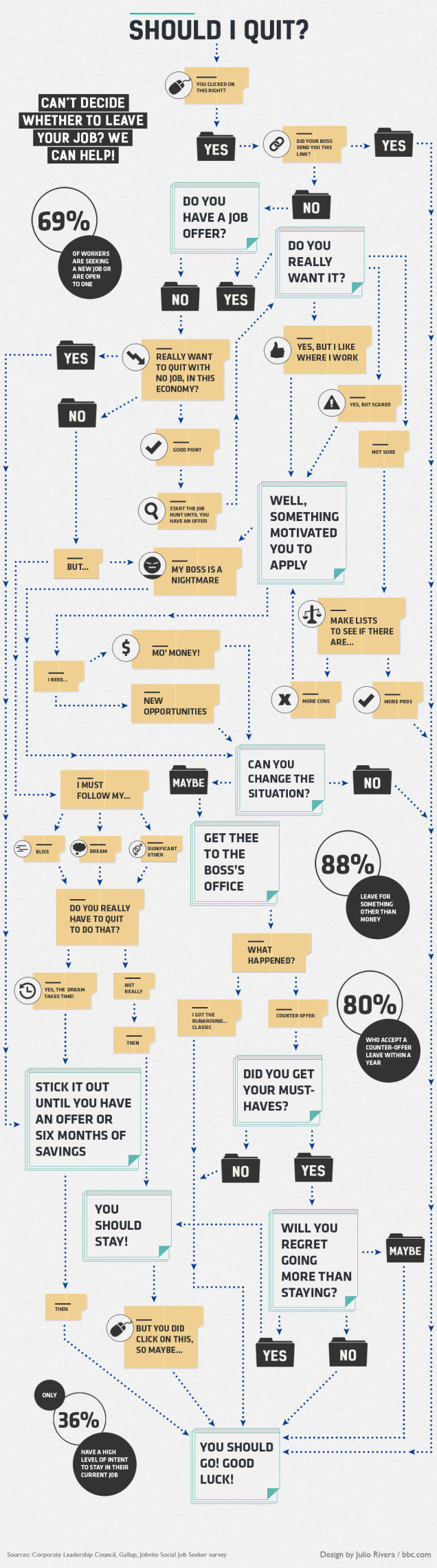
To Quit Or Not To Quit? This Flowchart Tells If It’s Time George Mortimer for Lifehack “Changing jobs or careers is something many people think about, but never seriously consider until it’s too late to change. The use of this flowchart makes it easier for you to determine if your current job satisfies your lifestyle. In basic terms, if your job isn’t making your life better you’re probably better off finding a new one.”

1372360723813364326

The Saturday Read -Mark Vanhoenacker ‘Skyfaring’

This week’s ‘Saturday Read’ is for all of you who keep your window sashes up on transcontinental flights. And for those of you who don’t, author and pilot, Mark Vanhoenacker has a link on his website to share a glimpse of what you have been missing. And it’s not the grainy black and white video from the camera mounted underneath those Swiss Air flights.

The ‘Saturday Read’ is ‘Skyfaring: A Journey With A Pilot’.

What do we know of the work lives of pilots? These are the folks we trust to transport us across oceans, continents, cities and deserts. Our only contact through hours of flight is a welcome message, flight status update or a ‘thank you for choosing our airline’.

Turns out, pilots can be very interesting people. And, like many of us, they arrive at their ‘dream job’ after trying out other options. Mark Vanhoenacker’s career began in academia and management consulting. He started his flight training in 2001 after realizing all those plane flights were constant reminders of what he really wanted to do with his life.

Geoff Dyer reviewed the book for The Guardian newspaper:

“There is always something uplifting about people in love with their work, and on becoming an airline pilot Vanhoenacker (now a senior first officer with British Airways) seems to have attained a state of enviable grace. He loves everything about the job: the machinery, the language, the physics, the maps, the weather (always sunny up there above the lid of cloud), his colleagues, the rituals in which multiple layers of safety are embedded and encoded.”

Dwight Gardner‘s review in The New York Times cited “the intellectual and emotional delights of flying…

Mr. Vanhoenacker speaks often in “Skyfaring” about poetry and art and music. In Paris, he heads for the Musée Rodin. He has a well-stocked mind. Cumulus clouds remind him of the ceilings in the New York Public Library or Versailles; the earth’s rotation summons for him a passage from Marilynne Robinson’s novel “Gilead.” He mentions pilots who go to cooking schools or visit botanical gardens wherever they go.

Thus one of the vivid things about this book is that is makes you imagine the men and women who pilot the machines that fly over our heads as a merry band of scholars and aesthetes, rather than glorified bus drivers. It’s as if they’re racing up there to pluck the world’s best cultural fruit, fruit we are too hidebound to seek except rarely.”

And when Mr. Vanhoenacker is not flying the plane:

“One of my favorite things to do as a passenger is put music on and look out at the world. I think airplanes are one of the few places you can zone out. When you fly as a passenger you definitely have this meditative space. I never use Wi-Fi as a passenger.”  

In the first few pages of ‘Lift’, the first section of the book, the author shares three questions people ask when they learn he is a pilot:

“Is flying something I have always wanted to do? Have I ever seen anything “up there” that I cannot explain? And do I remember my first flight? I like these questions. They seem to have arrived, entirely intact, from a time before flying became ordinary and routine. They suggest that even now, when many of us so regularly leave one place on the earth and cross the high blue to another, we are not nearly as accustomed to flying as we think. These questions remind me that while airplanes have overturned many of our older sensibilities, a deeper part of our imagination lingers and still sparks in  the former realm, among ancient, even atavistic, ideas of distance and place, migrations and the sky.”

If this book doesn’t rekindle the wonder of air flight, check to see if you can still fog up a mirror. For those of you still breathing, invest some time this weekend to take flight with Mark Vanhoenacker as your pilot and rediscover the joy of getting lost in the clouds.

The week @ work – March 2 – 8

Today we celebrate International Women’s Day.  The day is being marked by a variety of events and online activities including a ‘google doodle’ and a popular YouTube campaign encouraging women to write a letter to their younger self, #DearMe, providing advice and encouragement to be who you are – confidence is key.

The first National Women’s Day was celebrated in the US in 1909 to commemorate the 1908 strike in New York by women garment workers protesting against working conditions. From its’ historical roots to today, International Women’s Day is about working women campaigning for change. Harriet Minter writing in today’s Guardian cautions those who believe we no longer need IWD:

“The theme for this year’s International Women’s Day is “make it happen”. Yes, we’ve made things happen since 1909 but we haven’t achieved enough, there is still more to do. So let’s celebrate this IWD but let’s also remember, we’re a long way away from no longer needing it.’

This week the national jobs report showed lower unemployment but average hourly earnings only increasing by .01%. If you are in the workforce, this finding is not breaking news. Is the message here that you need to move to increase your income?

Last week I shared the story of Lynsey Addario, the photojournalist. This week it was announced that Stephen Spielberg will adapt her memoir and Jennifer Lawrence will play Ms. Addario in the film.

And for some workplace humor: ‘The Diary of the Left Shark’ by Kelly Stout in The New Yorker. You may remember the left shark from the Super Bowl halftime show. Here is his journal of events leading up to the performance and it’s aftermath. It’s an imagined story of workplace stress, sabotage and the resulting reevaluation of career direction. “Downloaded application to Columbia Teachers College. Think I could maybe make a difference in the lives of youth…Feeling O.K. about the future. Dance world maybe too toxic for a shark like me. Perhaps whole episode not humiliation but wake-up call! Considering move to Austin.”